
• 214. Caroline to Luise Gotter in Gotha: Jena, late 1798, early 1799
[Jena, late 1798, early 1799]
|488| . . . I still have nothing from the Ifflands. Neither is particularly fond of writing, and at precisely this moment he in particular is quite busy. [1] —
The Schützes left for Berlin today amid this cold spell. [1a] The wife is crazy. They cannot pay for the most necessary things, she allows herself to be deceived by shop servants, and yet curiosity drives her outside . . .
The Life of Diderot is lying in the innermost chamber of Schlegel’s desk. He has not yet gotten round to writing the piece that made him want to read it through in the first place. [2] It will not be passed along to anyone else. If, however, you nonetheless still would prefer to have it back, just send your final instructions in that regard. You do not need to treat it as a secret in any case. It is also in Weimar, and various excerpts from it have appeared in several publications elsewhere as well. —
I am surprised, however, that you do not ask about the Castle of Otranto — Notwithstanding it has only been in the most exquisite of hands, its pink covering has already faded so much that, when Goethe, who has it now, returns it to me, I intend to have it rebound. [3] . . .
So, Minchen, too, has no intention of saving Gotha’s honor. O, ye people “with crooked heads and hard hearts”! [4]
|489| Poor Fleischmann and his family! [5] — A certain Zumsteeg in Swabia has also composed music for Die Geisterinsel. [6]
We are looking forward to Cecile. Auguste received a beautiful new clavier from Dresden for Christmas. [7]
Regards to Minchen and to your good sister. [8]
Your Caroline
Notes
[1] “Neither”: i.e., neither Iffland nor his wife.
At issue is the disposition of two of Friedrich Wilhelm Gotter’s posthumous plays (Der schöne Geist, Die Geisterinsel), which Caroline was trying to place with Iffland in Berlin; see her letters to Luise Gotter immediately after Gotter’s death in March 1797, then on 2 May 1798, late June/early July 1798, and later on 1 April 1799 (letters 200, 202, 233) (see also supplementary appendix 181.1). Back.
[1a] The winter of 1798–99 seems to have been harsh indeed, not least in Berlin, where the Schützes were headed. See Friedrich Schlegel’s letter from Berlin to Caroline from mid-December 1798 (letter 211), where, as he reports, “people are dying here as well. Seven sentries recently froze to death in a single night, and a good woman was just brought into the house who, to save her child, let herself be run over and was killed.” Back.
[2] Presumably “Mémoires pour servir à l’histoire de la vie et des ouvrages de Diderot, par Madame de Vandeul, sa fille”; see Caroline’s letter to Luise Gotter on 15 October 1797 (letter 188), with note 8. Back.
[3] The reference is to Friedrich Ludwig Wilhelm Meyer’s translation of Horace Walpole’s The Castle of Otranto (London 1765) as Die Burg von Otranto. Eine gotische Geschichte (Berlin 1794). Goethe solicited Wilhelm Schlegel in this regard from Weimar on 15 December 1798 (Goethe und die Romantik 1:39):
I come to you yet again today with a request for the Burg von Otranto. I would very much like to initiate into these wondrous things several ladies who have not yet read it.
Wilhelm answered from Jena the next day (Goethe und die Romantik 1:40):
You are receiving herewith the Burg von Otranto, whose rather dirty appearance at the very least lends it an air of legitimacy as an interesting piece, and notwithstanding its pages have become so worn from being turned by nothing but the most elegant of hands.
Goethe sent the translation back on 28 December 1798 (Goethe und die Romantik 1:44):
I am herewith returning to you the Burg von Otranto in a new covering. If this one, too, like its predecessor, should become worn from so much reading, probably not much of the book itself will remain either.
Concerning Walpole’s original novel, Meyer’s translation, and the illustrations that accompanied the translated volume, see esp. Caroline’s letter to him on 30–31 August 1794 (letter 147) with note 17. Back.
[4] “Mit schiefen Köpfen und harten Sinnen,” Ezk. 2:4. Luther reads: “harte Köpfe und verstockte Herzen,” NRSV “impudent and stubborn” (illustration: Christoph Weigel, Biblia Ectypa: Bildnussen auß Heiliger Schrifft dess Alt- und Neuen Testaments, in welchen Alle Geschichte und Erscheinungen deutlich und schrifftmäßig zu Gottes Ehre und Andächtiger Seelen erbaulicher beschauung vorgestellet werden [Augsburg 1695]):

This was the appearance of the likeness of the glory of the Lord. When I saw it, I fell on my face, and I heard the voice of someone speaking.
He said to me: O mortal, stand up on your feet, and I will speak with you. And when he spoke to me, a spirit entered into me and set me on my feet; and I heard him speaking to me. He said to me, Mortal, I am sending you to the people of Israel, to a nation of rebels who have rebelled against me; they and their ancestors have transgressed against me to this very day. The descendants are impudent and stubborn. I am sending you to them, and you shall say to them, “Thus says the Lord God.” Whether they hear or refuse to hear (for they are a rebellious house), they shall know that there has been a prophet among them etc.”
Caroline’s reference to Wilhelmine Bertuch here is otherwise obscure. Back.
[5] Friedrich Fleischmann had died in Meiningen on 30 November 1798, leaving behind a wife, Johanna Christiane Louise, née von Schultes (1771–1856) and four children, including three daughters (Fanni, Carolina and Wilhelmine) and one son (Wilhelm Thurecht) (Göttinger Taschenkalender [1798, 1799]):
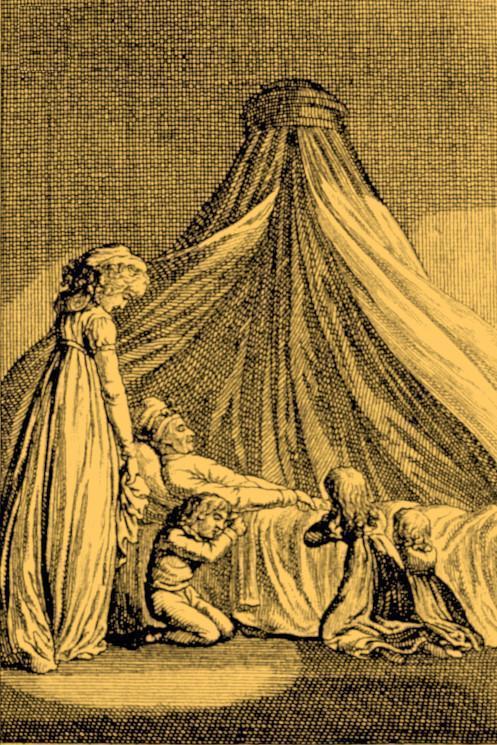
He had earlier composed music for Friedrich Wilhelm Gotter’s singspiel Die Geisterinsel (1796). Back.
[6] Concerning the disposition and fate of Gotter’s pieces, see Caroline’s letter to Luise Gotter in March 1797 (letter 181) with note 2; concerning Die Geisterinsel specifically, see supplementary appendix 107a.1. Back.
[7] Johann Michael Baader and Justus Chevillet, La Jeune Anglaise (late 18th century) (Herzog Anton Ulrich-Museum; Museums./Signatur JChevillet AB 2.4):
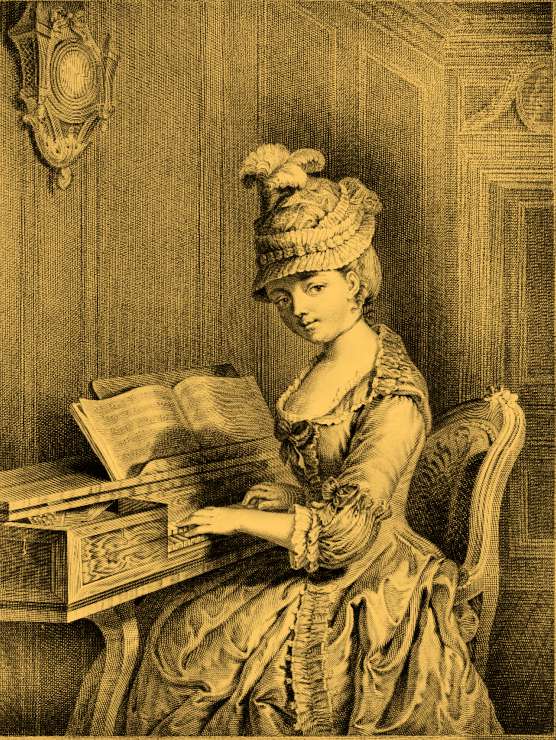
[8] Possibly Luise Gotter’s sister-in-law, Lorchen Gotter. Back.
Translation © 2013 Doug Stott