
202a.1. Wilhelm Schlegel to Gottlieb Hufeland in Jena: Dresden, 15 July 1798. [*]
Many thanks, my esteemed Herr Godparent, for your cordial letter and the good news it contains about your dear wife and the little Christian. I hope you will be able and indeed will want to continue with it until the initial weeks have passed and both mother and child have grown strong and in good spirits. You are absolutely right in maintaining that one must not allow the Adolphs to fall from fashion; they are a hearty stock. [1]
This autumn my wife will have the pleasure of attesting her affection to the godchild in person, though because I hear from Braunschweig that they are anticipating a visit from you there, such will probably not take place until toward the end of the semester break. [2] We are thinking about returning to Jena earlier, around Michaelmas or perhaps a few days after. The current likelihood of the professorship makes this necessary. For otherwise, since we will probably be traveling by way of Berlin, there will likely be no dearth of urgent invitations for us to linger a bit longer there. [3] . . .
That Schelling is coming to Jena is indeed a quite pleasant prospect for me; I made his acquaintance in Leipzig this spring and was pleased to have been able to spend considerable time with him. [4]
I still have a few questions for you regarding my acceptance as professor. I thought I might postpone paying the chancellery fees, for which I have received receipts from Gotha and Coburg, until all four rescripts had arrived. Surely there is no hurry in this matter? The privy messenger administrator in Coburg writes to request that I have 4 rh. in fees sent to him as the accountant in the matter; from Gotha, the privy chancellery messenger sent a printed receipt for 4 rh. 21 gr. and also commended himself for a douceur, or, as he himself called it, “a well-intentioned dusehre.” [5] My question is whether I will be expected to send not only the fees, but also something for the messenger from all four locales, and what might be customary in such cases? I would like to avoid giving too little and yet certainly also too much.
I would also like to know during which hours the auditorium in the Döderlein House will be free this coming winter, which I would then request you make available to me if I do attract students. I am assuming that with respect to your own lectures things will remain as before, namely, that you will be lecturing from 8:00 till 9:00 and then also from 10:00 till 12:00. But is Professor Woltmann in Jena, or is he expected back in the autumn? Would he again be lecturing in this auditorium, and if so, during which hours? I would, of course, prefer to hold my lectures during the day rather than by candlelight.
My sincere thanks for having taking care of the requested materials for Eschen. —
As far as my copy of the Allgemeine Literatur-Zeitung is concerned, during this brief period it certainly suffices if I receive it but occasionally. I will be glad to relinquish the review of Sternbald; I have not yet done any work toward it. [6] You have probably recently received the various reviews I sent; more will follow soon.
Among the short list of new assignments — which I have not yet received — I will immediately take on the two you mention, namely, Voss’s Ovid and Soltau’s Hudibras; and, as I have already pointed out, there is no need to send them, since I already possess both.
My brother sends his regards, and you will soon be receiving contributions from him as well. Among other things, he has largely finished a review of Kant’s Kleine Schriften, though he would yet like to know whether he would need to include part 4, which has since also appeared. [7]
Since, as you relate, Tieck has been assigned parts 2 and 3 of my Shakespeare, I will ask my publisher to send him part 3, which will not be available to the public before Michaelmas, so that the review can appear shortly after the work itself.
You will be receiving the 2nd issue of Athenaeum from Herr Professor Niethammer, to whom the bookseller will be sending the copies intended for Jena. I am puzzled that the latter is still hesitating with the bookseller’s announcement in the Intelligenzblatt der A.L.Z.. I advised him to send it in before the actual appearance of the 2nd issue, since, after all, a couple of weeks always pass before the announcement appears. If you happen to come upon it, please be so kind as to take care of it as quickly as possible.
Acquaintances in Berlin have related so many details to me about the homage that it is almost as if I myself had been there. [8] You realize that I departed a week earlier. I did, however, leave behind a poem about the homage with Unger for the July issue of the Jahrbücher der Preussischen Monarchie; he had a small number of private copies of the poem printed, one of which I am enclosing. [9] Perhaps it is not wholly uninteresting for you to see how I deal with such paying of homage. Please be so kind as to pass along the poem to Hofrath Schütz along with my kind regards.
I also received the preliminary play by Iffland that was performed by Reichardt on the evening of the homage along with Die Geisterinsel. [10] Although the former consists merely of a rural scene, its overall effect demonstrates how well tailored it was for the occasion; Iffland’s own performance as a village mayor who resigns his office may also have contributed to that success. He was called out, and the joy and applause easily doubled when he merely repeated the piece’s final lines, “God bless the king and the fatherland!” [11]
Reichardt’s composition of Die Geisterinsel, to the extent I was able to judge it at rehearsal, pleased me very well indeed. Since the opera has already been rehearsed in Weimar with the music of a different composer, we will likely not hear it there very soon. [12]
Stay very well, my good friend. My wife and Auguste want me to send their warmest regards to you and your family, regards to which I, of course, add my own. Yours,
A. W. Schlegel
Goethe is probably back in Weimar now, is he not?
[Caroline’s postscript] Here in a tiny corner let me dare to add a request to Sophie that she send me as soon as possible (and unfranked) what Mademoiselle Seidler will pass along to her. [13] I am yearning for fresh news from the birthing room.
Notes
[*] Source: “A. W. Schlegel an Gottlieb Hufeland,” ed. Erich Schmidt, Litterarische Mittheilungen: Festschrift zum zehnjährigen Bestehen der Litteraturarchiv-Gesellschaft in Berlin (Berlin 1901), 22–25. — This letter picks up various matters from the exchange between Wilhelm and Hufeland on 1 July and 5 July 1798 (letters 201d, 201e). Back.
[1] See Hufeland’s letter to Wilhelm on 5 July 1798 (letter 201e) with note 1. Caroline and Wilhelm were the godparents to the Hufeland’s new child. Back.
[2] That is, the end of he semester break in Jena between the summer semester 1798 and the winter semester 1798–99, the latter of which began in October 1798.
Madam Hufeland was the sister of Christian Rudolf Wilhelm Wiedemann, husband of Caroline’s sister Luise, née Michaelis in Braunschweig (Rudolf Koch and Fritz Kredel, Deutschland und angrenzende Gebiete [Leipzig 1937])
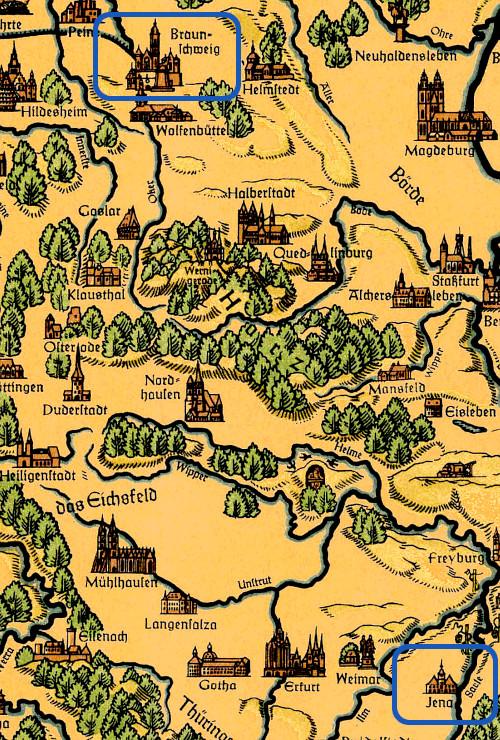
[3] Michaelismas, 29 September.
Wilhelm and Caroline were hoping to attend the premiere of Hamlet in Wilhelm’s translation in Berlin; that premiere would not, however, come about until the autumn of 1799. Concerning the troubled background to this premier, see Ella Horn’s essay on the background to the premiere of Hamlet in Berlin. Back.
[4] Wilhelm had met Schelling in Leipzig while he, Wilhelm, was in transit on his way to Berlin (Post Karte Durch ganz Deutschland, ed. J. Walch [Augsburg 1795]):

Schelling had in the meantime just been appointed unsalaried professor in Jena; see his exchange of letters with Goethe on 5 and 8 July 1798 (letters 201f, 201g). Schelling finally arrived in Jena in October 1798 only after spending time first in Dresden with the Schlegels and the other Romantics; see Rudolf Haym’s brief description cited in Caroline’s letter to Dorothea Marie Campe on 6 May 1798 (letter 200b), note 9. Back.
[5] Fr., douceur, here: “tip, gratuity.” Back.
[6] See Hufeland’s letter to Wilhelm on 5 July 1798 (letter 201e) concerning the review of Ludwig Tieck’s Franz Sternbalds Wanderungen, Voss, Soltau, and the review of Shakespeare. Back.
[7] Kants sämmtliche kleine Schriften: Nach der Zeitfolge geordnet, vols. 1–3 (Königsberg, Leipzig 1797); vol. 4 (1798). Friedrich never published the review. Back.
[8] The official “homage” to Friedrich Wilhelm III in the White Hall of the Berlin Castle took place on 6 July 1798. Back.
[9] “Am Tage der Huldigung. Berlin 6. Juli 1798,” Jahrbücher der preussischen Monarchie unter der Regierung Friedrich Wilhelms des Dritten (1798) 2 (May, June, July, August), unpaginated following p. 95 of the Anzeiger, which follows the normal p. 268 (Sämmtliche Werke 1:160–61).
Friedrich von Hardenberg published a piece for the homage in the same periodical, “Glauben und Liebe oder der König und die Königin,” Jahrbücher der preussischen Monarchie unter der Regierung Friedrich Wilhelms des Dritten (1798) 2 (May, June, July, August) 269–86, i.e., as the piece immediately following Wilhelm’s. See the translation of Wilhelm’s poem of homage to Friedrich Wilhelm III. Back.
[10] August Wilhelm Iffland, Der Veteran: Ein Schauspiel in Einem Aufzuge, in A. W. Ifflands dramatische Werke, vol. 10, (third play in the volume, each play with new pagination), 1–45; Wilhelm recounts having attended this rehearsal of the play by Friedrich Wilhelm Gotter in his letter to Gottlieb Hufeland on 1 July 1798 (letter 201d). Back.
[11] The lines are spoken at the end of the play first by the character Friedrich, then by all the persons onstage together. See the account by Hugo Holstein, ed., in the reprint of Iffland’s Ueber meine theatralische Laufbahn, Deutsche Litteraturdenkmale des 18. und 19. Jahrhunderts 24 (Heilbronn 1886), lv–lvi:
Iffland considered it his most serious and sacred duty to justify the trust the king had placed in him. Iffland himself was filled with genuine, ardent love for the royal family, and viewed the stage as an efficacious means for encouraging patriotism.
For the homage to Friedrich Wilhelm III, he composed the one-act drama Der Veteran, which was performed together with the singspiel Die Geisterinsel by Gotter (adapted from Shakespeare’s The Tempest). Iffland’s piece was received with ardent, sincere emotion.
The theater calendar of 1799 recounts that the public and actors seemed to be a single family. Iffland was called out and received with jubilation after the play’s conclusion as both the playwright and the actor who portrayed the character of the veteran. Instead of addressing the audience, however, he repeated the piece’s concluding words: “God bless the king and the fatherland!” The entire auditorium cheerfully erupted in repeating these lines.
Even though the piece was dedicated and intended solely for the solemn day of homage, it nonetheless had to be repeated at the urging of the public. Several hundred spectators were unable to find a place in the theater because of lack of space. Back.
[12] Concerning the performance and musical composition of Die Geisterinsel in Weimar in May 1798, see Goethe’s letter to Wilhelm on 24 February 1798 (letter 196a), esp. note 3. Back.
[13] Dorette Seidler? Back.
Translation © 2012 Doug Stott