
202b. Wilhelm Schlegel to Goethe in Weimar: Dresden, 18 July 1798 [*]
Dresden, 18 July 1798
Mademoiselle Meyer has doubtless already been so kind as to pass along to you a letter from me she took with her on her journey. It contains a couple of poetic trifles about a role performed by Iffland and one by Madam Unzelmann that the occasion coaxed from my quill and which I now leave to you for the Almanach should you find them not too insignificant. [1] . . .
. . . The poem of tribute to the king has already been distributed in too many copies to appear in the Almanach, [2] nor is it really suitable for the latter in any case. I left it with my friend Unger to be the opening piece in the July issue of the Jahrbücher der Preussischen Monarchie, and he also had several individual copies on high-quality paper printed. I am taking the liberty of sending you two, one for yourself, and one, if you find it appropriate, for His Excellency the Duke on his return.
Enclosed please find the 2nd issue of Athenaeum. We hope that what pleased you in the first issue will be evident in this issue as well, and that you find we have appropriately taken note of your valuable warning. My brother especially asks for forbearance with his attempt to provide a characterization of Wilhelm Meister, forbearance to which the resolution of so lofty and complicated a task might well be allowed to appeal. [3] He would be extremely pleased should you find at least part of your ideas accurately acknowledged and not be completely dissatisfied with the piece. . . .
The news I have from Jena that my petition for a professorship will presumably have the desired success is also quite pleasing to me insofar as it will secure my residence in your immediate proximity. [4] I am now enthusiastically considering how to organize my coming lectures, to which I am genuinely looking forward as a completely new intellectual exercise.
I am trying to use my time here as effectively as possible by refreshing and expanding my antiquarian interests and by viewing the art works here. [5] How fortunate would I consider myself, however, if in these studies I could enjoy the guidance of a man such as Professor Meyer, who amid such profundity and independence of judgment possesses so much convivial communicative skills as well. Please be so kind as to pass along to him my warm regards and to show him a remark concerning Laokoön in Athenaeum pp. 85 and 86; 6 we spoke about this topic when I was in Weimar. . . .
Because of all the social distractions in Berlin, I was not of calm enough disposition to occupy myself with works of art. I was, however, so excellently entertained, with various circumstances delaying my departure, that I ended up spending five full weeks there. Nor would I have counted those weeks as completely lost even had they accomplished nothing more than the performance of Hamlet, for which I arranged everything with Iffland during my final days there. He will be remaining completely faithful to original form except for several expressions for which we had to supply different readings for the sake of tolerable propriety, and several instances of taking license with respect to theater changes, the latter certainly sooner allowable because certain stage directions do not come from Shakespeare in any case and because of the lack or dearth of the necessary equipment. [7]
Iffland asked me to inquire whether Schiller’s Wallenstein might be ready early enough to stage perhaps in November and under what conditions the author might be inclined to have the Berlin theater do the performance. Since I could not tell Iffland that I am not currently carrying on any correspondence with Schiller, I went ahead and accepted the query; might I thus ask you to deliver it and to pass the response along to me or directly to Iffland? [8]
My wife and my brother, the latter of whom accompanied me here that we might work on our enterprise [Athenaeum] in peace and quiet, send their regards. Our friend Hardenberg, who recently took a cure in Töpliz, has augmented our domestic circle here for a couple of days. [9] He, too, asks that I send along his regards. You are quite often present among us here in this pleasant garden house, and we speak of you often with the same kind regards with which you are familiar in us all. Stay well and healthy.
Aug. Wilh. Schlegel
Notes
[*] Source: Körner-Wieneke 72–75.
As Wilhelm points out in this letter, he, Caroline, and Auguste, and Friedrich Schlegel are residing in an otherwise unidentified garden house somewhere in or in the immediate vicinity of Dresden Back.
[1] The letter Marianne Meyer passed along to Goethe was written in Berlin ca. 20 June 1798 and contained the two poems with the accompanying lines (Körner-Wieneke 72):
Mademoiselle Meyer has kindly offered to deliver something to you from me, and I cannot let this opportunity pass to renew your memory of me. I only wish I had something of greater significance to relate to you than the two enclosed poems, which I composed in a quiet moment here and read aloud at a dinner given by Madam Unzelmann.
Chronological note: Caroline, of course, was not in Berlin for the dinner given by Friederike Unzelmann, but rather in Dresden.
Wilhelm was submitting the poems for inclusion in Schiller’s Musen-Almanach für das Jahr 1799 (Schiller was not particularly enthusiastic about either); “An Friederike Unzelmann als Nina” is published there on p. 73 (for the translated text, see section vii of the supplementary appendix Friederike Unzelmann), “Der neue Pygmalion: An Iffland” on p. 105 (Sämmtliche Werke 1:350), though Wilhelm had seen Iffland perform in Pygmalion only in Weimar, not in Berlin.
To wit, on 1 May 1798 Caroline and Wilhelm saw Iffland perform in Jean-Jacques Rousseau, Pygmalion: Ein Monodrama, music by Georg Benda (Leipzig 1780) (concerning Iffland’s Weimar performances, see Caroline’s undated letter to Luise Gotter in April 1798 [letter 199] with note 5; here a portrait of Iffland as Pygmalion in 1800 by Anton Graff; Stiftung Preußische Schlösser und Gärten Berlin-Brandenburg):
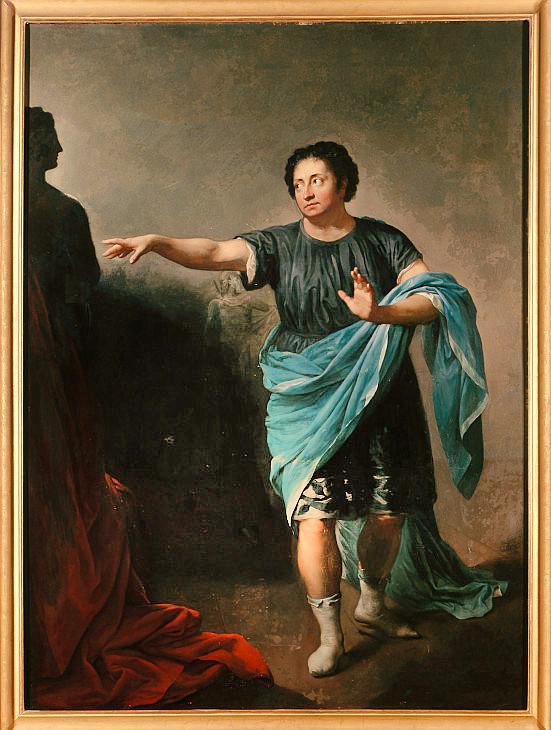
In any event, though Schiller did accept the poems, he was by no means impressed and, moreover, had reservations about the Schlegels in a larger sense as well; he responds to Goethe on 28 June 1798 (Correspondence between Schiller and Goethe 2:108–9):
If Schlegel will arrange to give me something more important for the Almanach, I should have no objection to introduce his little poems. But should he intend them as his only contribution, which, moreover, he does not even expressly send as such, it would look as if we snatched at everything that was to be had of his, and we are in no such dire necessity.
I have experienced so little honest treatment from this family that I must really take care not to give them any opportunity to consider themselves of importance. For were I to accept them, the least risk I should be running would be that Frau Schlegel would assure everyone that her husband never wrote for the Almanach, but that, in order to give it a lift, I had seized upon two of his poems and had them printed. Back.
[2] “Am Tage der Huldigung. Berlin 6. Juli 1798,” Jahrbücher der preussischen Monarchie unter der Regierung Friedrich Wilhelms des Dritten (1798) 2 (May, June, July, August) 266–68 (Sämmtliche Werke 1:160–61); nothing more is known about the special printing of individual copies. Goethe did not find the poem particularly well done. See the translation of this poem of homage to Friedrich Wilhelm III. Back.
[3] The second issue of Athenaeum contained the famous “Fragments” (Athenaeum [1798] 179–322) and Friedrich’s grand essay “Über Goethe’s Meister” (ibid., 323–54). Concerning Goethe’s assessment, see Caroline’s letter to Friedrich on 14/15 October 1798 (letter 204). Back.
[4] Concerning the successful outcome of Wilhelm’s petition for a professorship, see Christian Gottfried Schütz’s letter to him at the end of July 1798 (letter 202d); Wilhelm received his professorship at the same time as did Schelling: Intelligenzblatt of the Allgemeine Literatur-Zeitung (1798) 116 (Saturday, 11 August 1798) 962:
Herr August Wilhelm Schlegel, Schwarzburg-Rudolstädter Rath, previously an independent scholar in Jena, and Herr Dr. Schelling, previously of Leipzig, have been appointed professors extraordinarius in Jena. Back.
[5] This stay in Dresden was one of the most important episodes for the early Romantics (L. Rohbock, [1] Dresden, vom linken Elbufer aus; [2] Dresden, vom Waldschlößchen aus, both from from Original-Ansichten der historisch merkwürdigsten Staedte in Deutschland, vol. 13 [Darmstadt 1861]):
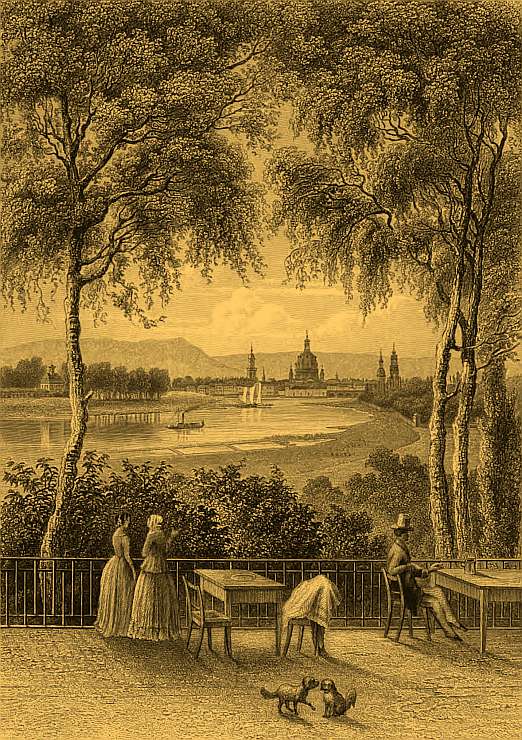

Several of the personalities associated with the group were in Dresden at one time or another during the summer of 1798 (Wilhelm speaks later in this letter about Friedrich von Hardenberg), and the entire group had the opportunity — one whose significance can hardly be overestimated — to visit the Dresden gallery and the Dresden antiquities collection.
One of the direct results of this stay, and one to which Caroline contributed, was the essay “Die Gemählde. Ein Gespräch von W.,” in Athenaeum (1799) 39–151 (Sämmtliche Werke 9:3–101; Kritische Schriften 2:145–252).
See in this context esp. Rudolf Haym’s brief description of this episode cited in Caroline’s letter to Dorothea Marie Campe on 6 May 1798 (letter 200b), note 9. Back.
[6] Athenaeum (1798) 261–63 (85–87 original pagination), fragment 310, which vehemently attacked Alois Hirt’s essay “Laokoon,” Die Horen 12 (1797) no. 10, 1–26. See the supplementary appendix on the Laocoön dispute with Alois Hirt; as well as Caroline’s letter to Friedrich Schlegel on 14/15 October 1798 (letter 204). Back.
[7] Hamlet was not performed in Berlin until 15 October 1799; see Ella Horn concerning the background to the premiere of Hamlet in Berlin. Back.
[8] Concerning Wilhelm’s strained relationship with Schiller, see — besides note 2 above — see supplementary appendix 181g.1 and supplementary appendix 194c.1. In any event, before Goethe could deliver Wilhelm’s query to Schiller, Iffland himself had contacted the latter. Back.
[9] Friedrich von Hardenberg was in Teplitz (Töplitz) (modern Teplice in the Czech Republic), a mineral-springs spa south of Dresden, from 15 July till mid-August 1798. Back.
Translation © 2012 Doug Stott