
• 199. Caroline to Luise Gotter in Gotha: Jena, April 1798 [*]
[Jena] Thursday evening [April 1798]
|449| [Cäcilie’s return home.] [1] Tischbein’s presence went completely unused for her, and the time cost her pain and sleep [2] . . . Gustel wandered around the entire day like a lost soul and did not go to bed again.
. . . The Burg von Otranto will not be lost to you. [3] Please send me Müller again. [4]
|450| . . . Iffland will be performing in Weimar first on the 24th and then 6 days in succession, all of which we will be spending there [5] . . .
Notes
[*] Chronological note: Caroline’s review of August Lafontaine appeared in Athenaeum (1798) 149–67, which in its own turn appeared around Easter 1798 (Easter falling on 8 April 1798). Back.
[1] Concerning Luise and Cäcilie Gotter’s visit in Jena, see Caroline’s letter to Luise Gotter on 11 February 1798 (letter 195) with note 2. Back.
[2] Concerning Caroline’s wish that Cäcilie Gotter’s interest in drawing profit from the presence of Johann Friedrich August Tischbein in Jena, see her letters to Luise Gotter on 11 February 1798 and undated during February/March 1798 (letters 195, 197). Back.
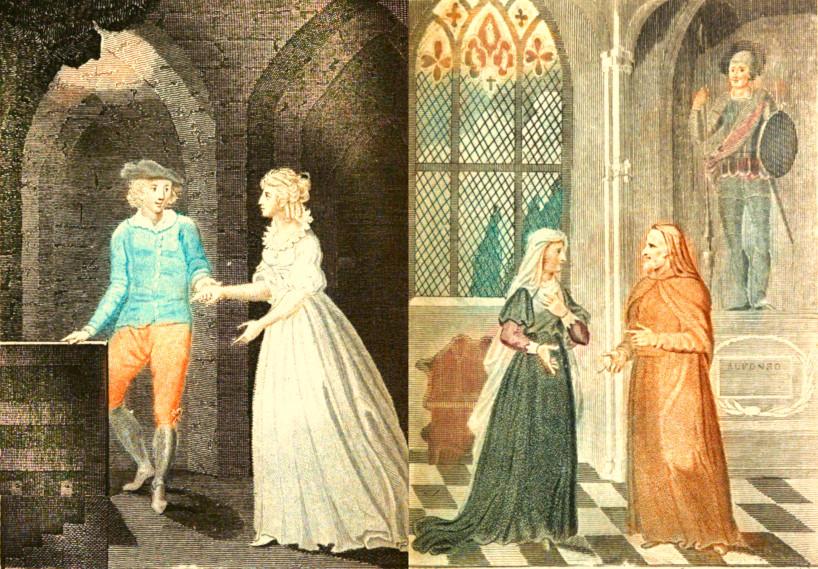
[3] That is, Luise should have no concern about lending it to the Schlegels. Concerning Friedrich Ludwig Wilhelm Meyer’s translation of Horace Walpole’s Gothic ghost novel The Castle of Otranto (London 1765) as Die Burg von Otranto. Eine gotische Geschichte (Berlin 1794), see Caroline’s letter to him on 30–31 August 1794 (letter 147) with note 17 (illustrations here: Jeffery’s Edition of the Castle of Otranto: A Gothic Story, trans. William Marshal, new ed. [London 1800], plates following pp. 90 and 122):
[4] William Guthrie and John Gray, A General History of the World: From the Creation to the Present Time (London 1764–67), vols. 17/1 and 17/2, translated by Johannes Müller as Allgemeine Weltgeschichte: von der Schöpfung an bis auf gegenwärtige Zeit, vol. 17/1, Die Geschichte der schweizerischen Eidgenossenschaft von dem Anbau des Landes an; 17/2, Die Geschichte der schweizerischen Eidgenossenschaft von dem Aufblühen der ewigen Bünde (Leipzig 1786). Back.
[5] Wilhelm and Caroline saw August Wilhelm Iffland perform six guest roles at the Weimar theater, beginning with Der Essigmann mit seinem Schubkarren: Schauspiel in 2 Acten, apparently in its adaptation by Friedrich Ludwig Schröder (publication uncertain) after the French play of Louis-Sébastien Mercier, La brouette du vinaigrier (Neuchatel 1775) on 24 April and ending with Die Aussteuer: Ein Schauspiel in fünf Aufzügen (Leipzig 1796) by Iffland himself on 4 May 1798. See the following repertory listing for the Weimar theater during this period from Das Repertoire des Weimarischen Theaters, 28 (abbrev., followed by number of acts and playwright, translator, composer, librettist: Dr.: Drama; Sch.: Schauspiel; Melodr.: Melodrama; L.: Lustspiel; O.: Opera; n.: nach [adapted from]; v.: von):
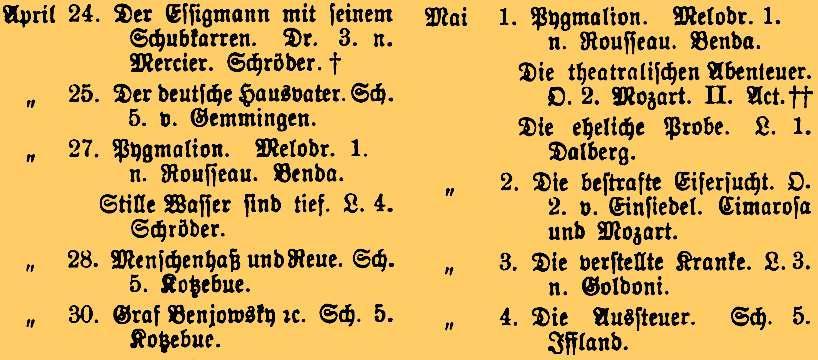
Iffland performed on 24, 25, 27, 30 April and 1, 3, 4 May.
Wilhelm and Caroline also attended several breakfasts that Goethe gave in honor of the artist. Concerning Goethe and Schiller’s correspondence on Iffland’s Weimar performances, see supplementary appendix 199.1. Concerning Caroline’s conversations with Iffland on the subject of placing the plays of Friedrich Wilhelm Gotter, see her letter to Luise Gotter on 2 May 1798 (letter 200). Back.
Translation © 2012 Doug Stott