
201a. Wilhelm Schlegel to Goethe in Jena: Berlin, 10 June 1798 [*]
Berlin, 10 June 1798 [1]
An unexpectedly earlier departure from Jena made it impossible for me, as I might have wished, to visit you once more in Weimar or to await your arrival in Jena. You are presumably there now, and amid all the beautiful things I have been able to enjoy this summer, the prospect of enjoying your company is the only thing making me yearn to be back there. . . .
I encouraged Tieck to send you the novel he has begun; [2] although I have not read it myself, I have been assured it is the best among the things he has hitherto done. You will discern in his letter the shyness with which he countenances making your acquaintance; a kind reception would doubtless please him beyond measure.
At the same time, I am sending you several of his shorter poems. Should they not displease you, please be so kind as to pass them along to Schiller to use as he sees fit for the Musen-Almanach. [3] —
As far as I myself am concerned, I doubt very seriously I will be able to compose any poetry this summer. Moreover, Schiller has renewed his invitation to me to contribute to the Almanach in so perfunctorily a fashion that, considering that my rather peculiar relationship with him since last autumn continues as such, I am hardly convinced he is really serious. [4]
I am, however, quite excited to see what the poetic harvest brings us this coming autumn in the way of new material from you yourself.
My brother has already written you about Zelter’s whimsical composition of the “Zauberlehrling.” [5] . . .
I have already made many and various acquaintances here, including scholars, artists, Jewesses, privy councilors, and actors. One must be mindful not to expect much in the way of cultivation or learning from the scholars, or much of anything else, for that matter. Nicolai, who among other things engaged in a rather comical campaign against my brother and me in the preface to his philosophical dialogues, immediately invited us to a grand evening dinner after we had jokingly made gestures of coming to visit him. His books must indeed cost him a great deal of money in this way. [6]
Your presence was quite tangible in several circles I visited, and I myself was a valued member there because I was the last person to see you and could thus speak about you. On Wednesday, for example, I was at Mademoiselle Mariane Meyer’s at midday, and that same evening at a certain Madam von Berg’s, who also knows you personally, along with Mademoiselle Meyer again; we drank to your health with the most sincere of good wishes. [7]
I will write you in more detail soon about the theater here. I have already seen Iffland several times both in and away from the theater, though in neither case as frequently as I might have wished. He has been quite busy with a new piece that, at least according to the first two acts I heard, will be one of his most excellent. [8]
I read Hamlet aloud to him; he listened with rapt attention and considerable sensibility for the overall piece, for its internal and more profound structure amid seeming incoherencies, and for the essential propriety of all the surroundings. It made such an impression on him that he expressed in the most animated fashion his interest in staging the piece completely in its original form, without any changes: a risky venture in whose successful implementation I take the keenest interest. [9]
Although I will not be able to send you the third volume of Shakespeare until the autumn, the 2nd issue of Athenaeum will, I hope, reach you quite soon. I am still anxious to hear your assessment of the first. [10]
Stay well and healthy and please do not forget us. . . .
Notes
[*] Source: Körner-Wieneke 68–70. Back.
[1] Goethe was in Jena 20–31 May, hence just after Wilhelm’s departure for Berlin on ca. 20 May, and then 4–23 June 1798 (Weimarer Ausgabe 3:2:208–9, 210–13). Back.
[2] Ludwig Tieck sent Goethe the first volume of his novel Franz Sternbalds Wanderungen (Berlin: Unger 1798) on 10 June 1798. For Goethe’s reaction see Caroline’s letter to Friedrich Schlegel on 14 October 1798 (letter 204). Back.
[3] Schiller did indeed incorporate four poems by Tieck in his Musen-Almanach für das Jahr 1799 (Tübingen 1799): “Herbstlied” (26), “Kunst und Liebe” (36–37), “Auf der Reise” (42–44), and “Der neue Frühling” (48–51). Back.
[4] See Schiller to Wilhelm Schlegel on 7 May 1798 (Körner-Wieneke 37): “I will not repeat my invitation with respect to the upcoming Almanach, since the old one applies for always.”
Concerning the relationship with Schiller, see the latter’s letters to Wilhelm on 31 May and 1 June 1797 (letters 181g, 182a), and Wilhelm and Caroline’s response on 1 June 1797 (letter 182); see esp. also supplementary appendix 181g.1 and supplementary appendix 194c.1. Back.
[5] Concerning Goethe’s poem and Zelter’s composition, see Wilhelm’s letter to Auguste on 3 June 1798 (letter 201) with note 2. Back.
[6] Friedrich Nicolai had attacked both Schlegels in his novel Leben und Meinungen Sempronius Gundibert’s eines deutschen Philosophen, Nebst zwey Urkunden der neuesten deutschen Philosophie (Berlin 1798) (here an excerpt from the frontispiece):

He also attacked them in the lengthy (over 70 pages) preface to he Neun Gespräche zwischen Christian Wolff und einem Kantianer über Kants metaphysische Anfangsgründe der Rechtslehre und der Tugendlehre (Berlin, Stettin 1798), esp. Friedrich’s works prior to Athenaeum. Concerning the dinner invitation, see Friedrich’s letter to Auguste on 28 May 1798 (letter 200f). Back.
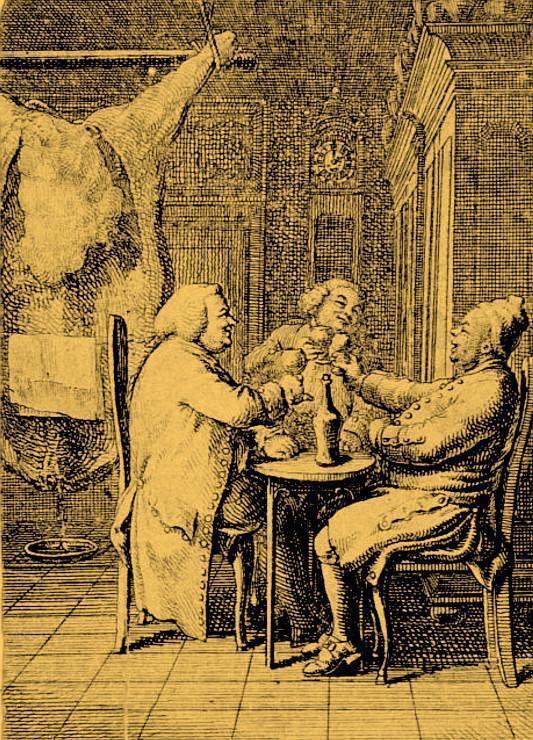
[7] Representative illustrations: (1) A. G. Eberhard, “Zwist und Liebe,” Neues Taschenbuch zum geselligen Vergnügen 1 (1801), 2–65; illustration in the next volume (1802); (2) Daniel Nikolaus Chodowiecki, Da hängt der Ochs (1777); Herzog August Bibliothek; Museums./Signatur Uh 4° 47 (137):

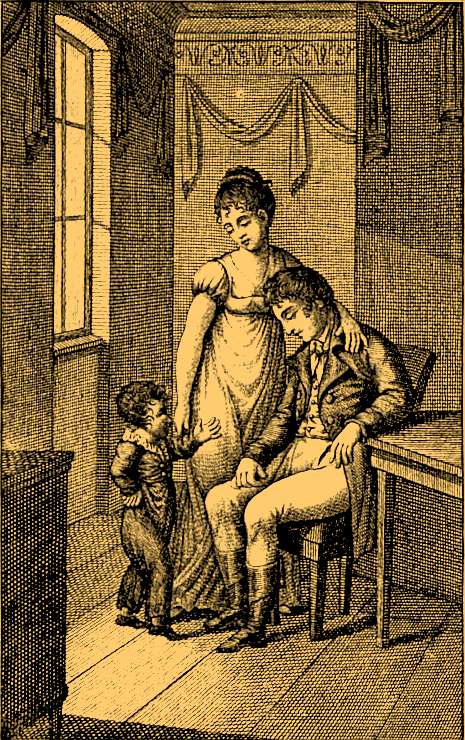
[8] Iffland’s new piece was probably Der Spieler: Ein Schauspiel in fünf Aufzügen (Grätz 1799) (frontispiece from the edition of 1840):
[9] Wilhelm had anticipated reading Hamlet aloud to Iffland in his letter to Georg Joachim Göschen (letter 200e).
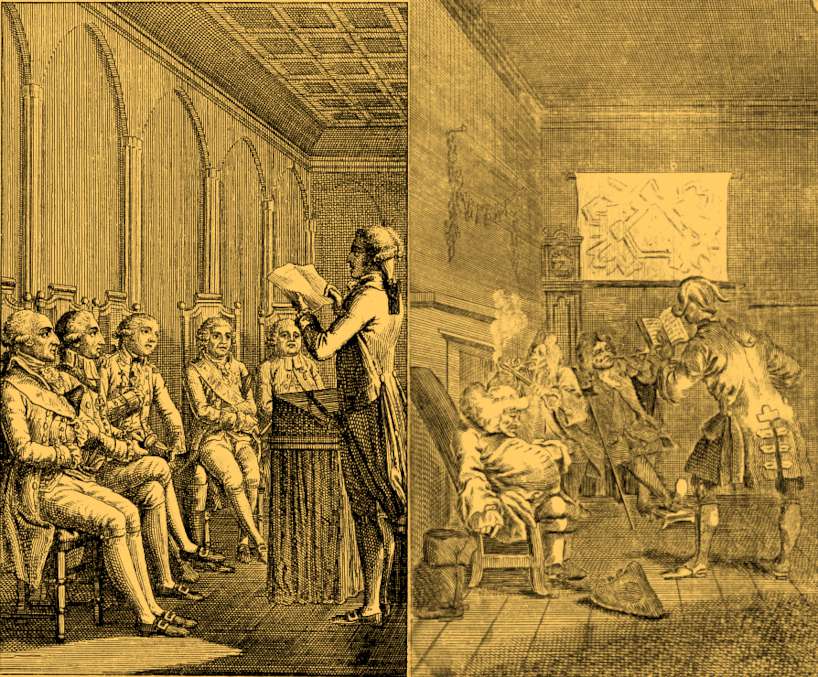
As noted earlier, reading aloud was a common social activity. It was also, however, the means by which playwrights introduced their unpublished works to a publisher, theater director, actors, or friends, as did Schiller with his play Die Räuber. Wilhelm’s informal audience with Iffland presumably fell somewhere between the official reading of a decree on the left below, and the reading among bored friends on the right ([1] anonymous, Die Reichsversammlung zu Regensburg ernennt zehn Friedens-Deputierte [after 1789]; Herzog August Bibliothek; Museums./Signatur Graph. A1: 2201t; [2] Christian Benjamin Gladbach, Runde von vier Männern, einer vorlesend, zwei rauchend, einer schlafend; Herzog August Bibliothek; Museums./Signatur Graph. A1: 815):
That said, premiere of Hamlet in Wilhelm’s translation did not take place until 15 October 1799, though Iffland’s interest in his translation of Shakespeare had already surfaced the previous year; see Friedrich to Wilhelm from Berlin on 2 August 1797 (Walzel, 289; KFSA 24:4): “Unger gave Iffland your Shakespeare [containing Romeo and Juliet and A Midsummer-Night’s Dream] . . . He immediately began to talk quite nicely about your Shakespeare.”
Concerning the complicated history of the premiere of Hamlet and Wilhelm’s (and Caroline’s) eventually troubled relationship with Iffland and his wife, see Ella Horn, “Geschichte der ersten Aufführung von Schlegels Hamlet-Übersetzung auf dem Kgl. Nationaltheater zu Berlin,” Jahrbuch der deutschen Shakespeare-Gesellschaft 51 (1915), 34–52; for the translated text, see the supplementary appendix on the background to the premiere of Hamlet in Berlin. Back.
[10] The second issue of Athenaeum appeared in July 1798. Back.
Translation © 2012 Doug Stott