
200e. Wilhelm Schlegel to Georg Joachim Göschen in Leipzig: Berlin, 26 May 1798 [*]
Berlin, 26 May 1798
Dearest Göschen!
Although a person indeed ought to pay attention to the things that yet lie before us rather than what is behind, it would nonetheless be highly inappropriate to travel with our eyes constantly forward, never looking around to see about our friends. Hence a hearty hello to you! I am well rested and of good cheer [1] — the journey here, despite the bad weather, agreed quite well with me, and it seems things will be going excellently for me here as well.
I have received news from my wife in Dresden — she gives no hint of having been irritated at your ardent enthusiasm. [2] Jean Paul, who, as you know, escaped my net in Leipzig, did, however, successfully fall into my wife’s clutches. [3]
I have found the Ifflands doing well and am hoping to see them often. [4] They have been extraordinarily cordial. I will very soon read my Hamlet to him aloud, which he is not entirely disinclined to stage here in this new form. [5]
Adieu, my good friend; please make do with this brief greeting for now — I simply have neither the time nor peace and quiet to write more. My warmest greetings to your dear wife and Marianne.
Yours,
A W Schlegel
I left my tobacco box in Leipzig — if you might on occasion forward it on to Dresden without too much expense, please do so; I do not need it here. [6]
Notes
[*] Source: Krisenjahre 1:6. Göschen notes receiving the letter on 30 May 1798. Back.
[1] Wilhelm had arrived in Berlin ca. 20 May 1798 by way of Leipzig, where he had seen Göschen. Caroline and Auguste, who had also traveled through Leipzig earlier, had been in Dresden since the evening of 12 May 1798 (Post Karte Durch ganz Deutschland, ed. J. Walch [Augsburg 1795]):

[2] Caroline seems, as anticipated, to have stayed with Göschen on her stopover in Leipzig on her way to Dresden; see her letter to Goeschen on 26 April 1798 (letter 199a). Back.
[3] Jean Paul had left Leipzig on 15 May 1798 for Dresden, where he did indeed meet Caroline. He returned to Leipzig on 30 May. Concerning his encounter with Caroline, see Friedrich Schlegel’s letter to Auguste in May 1798 (letter 200d), note 4. Back.
[4] Wilhelm and Caroline had made the acquaintance of August Wilhelm Iffland and his wife, Louise Iffland, in Weimar during Iffland’s guest performances there between 24 April and 4 May 1798 (though Wilhelm may have known Iffland during their youth in Hannover; see Hermann Müller, Chronik des königlichen Hoftheaters zu Hanover; ein Beitrag zur deutschen Theatergeschichte [Hannover 1876], 4f.). Concerning Iffland’s Weimar performances, see Caroline’s undated letter to Luise Gotter in April 1798 (letter 199) with note 5. Back.
[5] Volume 3 of Wilhelm’s edition of Shakespeare, containing Hamlet and Der Sturm (The Tempest), appeared during the spring of 1798. Here the first two pages of Hamlet, act 1, scene 1 in Wilhelm’s edition and, for comparison, the corresponding English from The Plays of William Shakspeare. In Fifteen Volumes, vol. 15, Hamlet, Othello (London 1793):
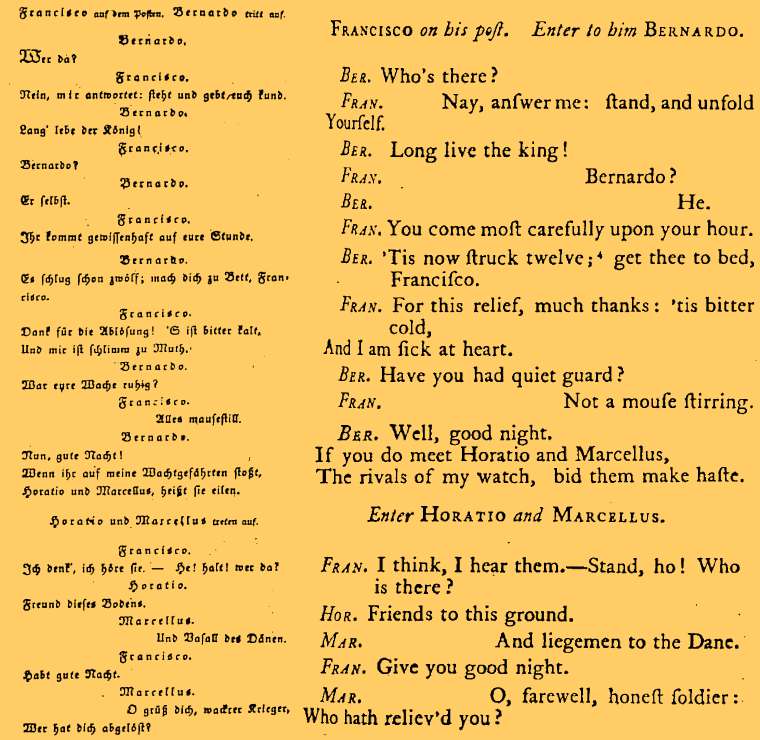
Wilhelm does seem to have had the opportunity to read his piece aloud to Iffland; see Wilhelm’s letter to Goethe from Berlin on 10 June 1798 (letter 201a). See in this context esp. Ella Horn’s essay on the complicated background to the premiere of Hamlet in Berlin. Back.
[6] That Wilhelm was for his entire life a passionate snuff user is variously attested. Here a typical embossed tobacco and snuff box of brass and copper made by Johann Heinrich Giese in Iserlohn in ca. 1760, to whom in 1755 Friedrich II of Prussia (the Great) had granted sole manufacturing rights for such boxes (auction photograph):

See Emanuel Geibel, who writes to his mother as a new student in Bonn on 31 May 1835 (Emanuel Geibels Jugendbriefe: Bonn — Berlin — Griechenland, ed. E. F. Fehling [Berlin 1909], 18):
Apart from Ernst Moritz Arndt, I have found two other people of literary renown here, namely, Herr August Wilhelm von Schlegel and — Johanna Schopenhauer. The former [i.e., Schlegel] looks like a frog that has put on an olive-green coat and opened up a brown silken umbrella, and who also carries around a snuff box and a mirror, before which he can rearrange his peruke when, as is oft the case, it becomes disarranged in the heat of discourse.
See esp. Wilhelm himself, e.g., in a letter to Auguste de Staël (son of Madame de Staël) on 14 November 1815 (Krisenjahre 2:295): “If it is not to much trouble, please provide me with a kilogram of Parisian tabac“; similarly from Heidelberg on 24 October 1818 (Krisenjahre 2:320), where he implores Staël not to let his shipping company forget to ship “my beautiful ebony writing case and especially three pounds [livres] of excellent tabac.” Back.
Translation © 2012 Doug Stott