
• 201. Wilhelm Schlegel to Auguste Böhmer in Dresden: Berlin, 3 June [17]98
Berlin, 3 June [17]98 [1]
|451| Sweetheart Gustel!
Let me thank you for your crazy little letter; it pleased me very much. It will please me even more if I hear from your mother that you are being disciplined and diligent and are trying to make yourself as useful to Charlotte as possible.
I am hoping you already have a singing teacher and are making every possible effort to do well at it. Zelter sang the most charming and merry composition of Goethe’s broom-song for me — at the next opportunity, I intend to ask him whether a little chirpy voice like yours might be able to sing it as well; if so, I will try to find the music for you. [2]
In return, I again have a request to make of you. You presumably have the song of the shepherdess from the Theatralische Abenteuer with you, do you not? Copy it out along with the text as neatly as you can and then give it to your mother to enclose in her next letter. Madam Fritz and Mademoiselle Mendelssohn would like to have it to sing. In return they will doubtless someday do you a similar favor. [3]
You have probably received the Greek books and are already busy with them. [4] Adieu, dear child, I give you a big hug and am already looking forward to seeing you jumping up to greet me when I return to all of you.
Your venerable father, A. W. Schlegel
Notes
[1] Auguste and Caroline had been in Dresden since 9 May 1798, Wilhelm in Berlin since ca. 20 May (Post Karte Durch ganz Deutschland, ed. J. Walch [Augsburg 1795]):

Concerning The Schlegels’ stay in Dresden a year earlier, see Dora Stock to Charlotte Schiller on 2 May 1797 (letter 181e).
See also, however, the puzzling remarks of Dora Stock’s sister, Minna Körner, to Charlotte Schiller from Dresden on 2 May 1798 (Charlotte von Schiller und ihre Freunde 3:34), puzzling because Caroline and Auguste would not arrive in Dresden until 9 May 1798, and Wilhelm (with Friedrich Schlegel) not until 30 June; perhaps Minna Körner is referring to Charlotte Ernst, Wilhelm and Friedrich’s sister, or is speaking in an anticipatory fashion about Caroline and Wilhelm’s arrival in Dresden:
I have not found out anything particularly heartening about the Schlegels; I am beginning to get intolerant. We no longer socialize with the Schlegel family because I think life is too short to expend one’s better hours on indifferent people. Back.
[2] Goethe’s “Zauberlehrling” (The magician’s apprentice) originally appeared in Schiller’s Musen-Almanach für das Jahr 1798, 32–36. Karl Friedrich Zelter’s composition is found in Zelter’s Sammlung kleiner Balladen und Lieder in Musik gesetzt fürs Forte Piano von C. F. Zelter, Heft 1 (Hamburg [ca 1802/03]). For the translated text and the musical score, see supplementary appendix 201.1. Back.
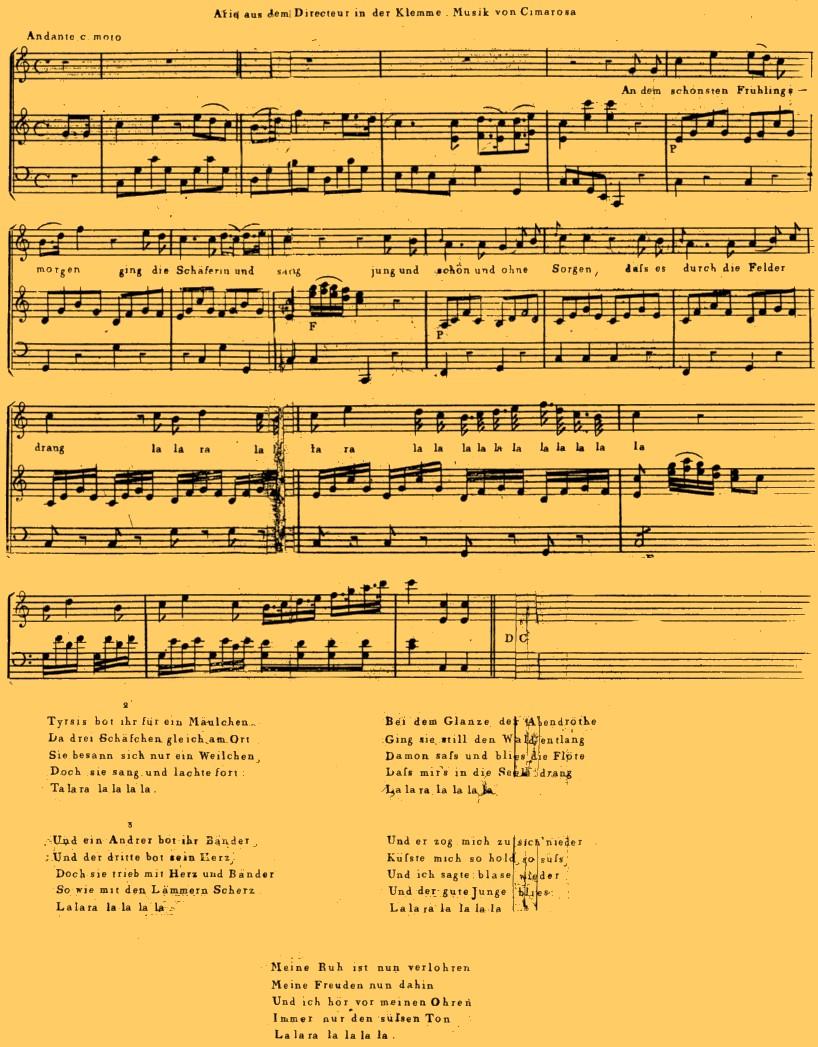
[3] Theatralische Abenteuer. Eine komische Oper in zwei Aufzügen von Vulpius, Musik von Cimarosa and Mozart (Weimar 1791); the play deals with the miserable lot of a certain class of actors at the time. For the musical selections, see Arien und Gesänge aus der komischen Oper, genannt: Theatralische Abentheuer: in zwei Akten, music by Cimarosa and Mozart; libretto Giuseppe Maria Diodati, translation by Johann Wolfgang von Goethe and Christian August Vulpius (Berlin 1817[?]) (listed as “music from Cimarosas opera and Mozart’s Schauspieldirektor [KV 486]”).
Here from Theatralische Abentheuer: Eine komische Oper in zwey Aufzügen, nach dem Italienischen, music by Cimarosa and Mozart (Eisenstadt 1807). This song is sung by the female character Rosalba in act 1, scene 14 and bears the title Romanze; Rosalba transitions to the first person when asked to continue the song (Thyrsis is a shepherd in Virgil’s seventh Eclogue who loses a singing match; approximate rendering):
On the most beautiful of spring days,
The shepherdess went and sang,
Young and beautiful and without cares,
Such that it through the fields rang.
So la-la etc.

Thyrsis offered her for a mouthpiece
Two little sheep right then and there,
She reflected but briefly,
And then sang and laughed on without care.
So la-la etc.

Another offered her ribbons,
And another his very heart,
Yet with heart and ribbons she did but play
As with her lambs in jest.
So la-la etc.

At twilight's gentle colors,
I went quietly along the wood.
Damon sat and played the flute,
Such that it through me soul did flood.
So la-la etc.

He pulled me down to himself,
Kissed me so graciously and sweetly.
And I said: do pipe but forth,
And the good youth did pipe on.
So la-la etc.

My peace has now been lost,
My joy quite flown away,
And my ears can now but hear
That former melody.
Only la-la etc.
Music: “Romanze aus der Oper: Die theatralischen Abentheuer (l’impresario in angustie) von Mozart,” Journal für Theater und andere schöne Künste 4 (1797) no. 5, plates following p. 288, presumably the version with which Wilhelm was familiar and which N.B. he obviously considered Auguste capable of copying out for him:
[4] Possibly including Xenophon, Herodotus, and Euripides. Back.
Translation © 2012 Doug Stott