
200g. Schleiermacher to Charlotte Schleiermacher in Gnadenfrei: Berlin, 23/30 May 1798 [*]
Berlin, 23/30 May 1798
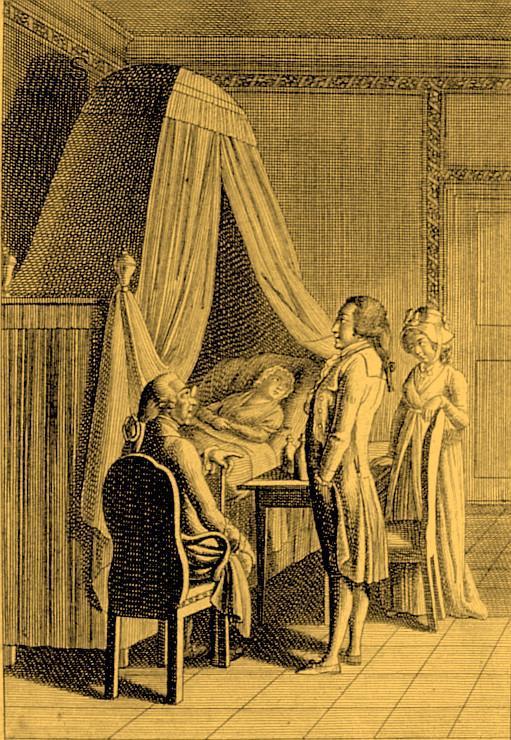
. . . I myself was pained by the fact that beforehand our good Madam Veit became deathly ill from an internal inflammation. We were all extremely distressed, since even after she was completely out of danger — which thanks to Herz’s medicinal arts was the case after just a few days — she still suffered for several weeks from the most violent pains and had to tended to quite attentively, especially at night. We took turns attending and caring for her. [1] . . .
After Karl had departed and Madam Veit was tolerably better, Schlegel came down ill on me as well. Although it was admittedly nothing really serious, since he is always rather anxious in any case I had to devote considerable time and care to him. [2] . . .
30 May. You should not be surprised, my dear, that my correspondence has been so noticeably bad of late. There is no other reason for it than simple well-being and enjoyment of life. The summer is keeping me captive by a thousand fetters, and will not let me go; I am hardly getting around to doing even half of all I plan, and yet I cannot really be dissatisfied with myself. I am alive, I am providing pleasant hours for others, am also useful to them in other ways, what more can one do in this world?
Mostly, however, I am living with Madam Herz now; for the summer she is living in a dainty little house at the Tiergarten, where she sees only a few people and I can thus quite enjoy her. I usually spend an entire day with her at least once a week, something I could otherwise manage with very few people indeed; but thanks to a variety of tasks and entertainment, the day passes for me quite pleasantly with her.
She has taught me Italian, or rather is still doing so, we read Shakespeare together, occupy ourselves with physics, I pass along to her some of my own knowledge of nature, we read sometimes this, sometimes that from some good German book, in between we take walks during the most pleasant part of the day and speak together quite from the innermost heart concerning the most important matters. We have been doing this since the early spring, disturbed by no one. Madam Herz appreciates me and loves me, as different as we are from each other. [3] . . .
Schlegel and Madam Veit have brooded over various concerns about how I am becoming colder toward him and Madam Herz colder toward her, her oldest and most inseparable friend. Madam Veit reproached me for not being all to Schlegel that I could be, for not being open enough toward him concerning his activities and projects, for not sufficiently sparing his temperament and disposition, for not coming to visit her either, about how one had to be near death in order to elicit my attention, that I did things only par charité, and after people were back on their feet and happy again I simply let them go their own way.
Schlegel honestly admitted to me that he is jealous of Madam Herz, and that my friendship with her grew more quickly and intensely than he ever could have managed with me, that he felt restricted almost solely to my understanding and my philosophy, whereas she possessed my innermost heart. [4] What explaining I had to do, and how I stuck out from them with my calm and sense of security!
Viewed in the light of day, however, there was something else besides all that. To wit, both of them, Schlegel as well as Madam Veit, were worried that I was deceiving myself, that my friendship with Madam Herz was in fact based on passion, that sooner or later I would discover that and it would make me unhappy. That really was too wretched, and I laughed about it boisterously for hours. That ordinary people believe that ordinary people, man and woman, cannot be intimate without becoming passionate and in love — that is quite in the order of things; but the sufferings of us both!
It was so strange to me that I simply could not get into a discussion about it, instead assuring Schlegel quite succinctly on my honor that such was not the case and would indeed never be the case. For several days, however, poor Madam Herz was just decimated by this misunderstanding. [5] Thank heaven everything has returned to normal and we are now continuing on undisturbed.
But I have little pleasure from Schlegel. For several days now his brother from Jena has been here, a man well known as a writer and poet and as a new translator of Shakespeare. He is living in town in a house where I can only rarely visit, and [Friedrich] Schlegel is almost always there.
This brother [Wilhelm] possesses neither the depth nor the inwardness of the brother here; he is a refined, elegant man, is very learned and artistically deft, and is bubbling over with wit — but that is all. I predicted to Schlegel that his brother would have no real sense for me, and it appears I was correct. Several days ago I ate with both of them at Iffland’s, whom I already saw once or twice before, and was quite entertained. This man’s comedic talent is truly singular; he is full of funny, entertaining anecdotes, which he acts out so delightfully that one actually enjoys his art far more thus than in the theater itself. [6]
At the same time, he is extremely good-natured, which people with these gifts so rarely are, and one’s awareness that he deserves respect for his basic convictions — about which, however, he does not boast — makes it quite easy to feel comfortable around him.
In any event, Madam Herz is also quite on the way to getting better, and I think she will be completely recovered in a week. At that time the elder Schlegel will also be departing, and I will get my own Schlegel back, at least in part, and hope to return wholly to my customary life. [7] Then my health will probably also improve, which for several days now has not been particularly good. . . .
Your wish to see something by me in print can be fulfilled in a different way now, albeit only in diminutive form. To wit, the two Schlegels are now publishing a new journal together with the title Athenaeum. The second issue contains under the rubric “Fragments” a large collection of individual thoughts and ideas, many of which, namely, those referring merely to abstract philosophy, will admittedly not interest you much; others, however, you will find entertaining to read. [8]
Among those, several are by me, and I will leave it to you, once you have seen this journal, to determine where you sniff something of my manner; I would think you would not have much trouble discovering me. I cannot send it to you because one cannot find individual issues, and the second issue is only just now being printed. Schlegel has managed to get me that far now, but nothing will come of my writing something lengthier. [9] I can use my time better; moreover, it gives me an extremely unpleasant sensation to see something of mine in print. . . .
Notes
[*] Sources: Aus Schleiermacher’s Leben 2:172–76; Schleiermacher als Mensch. Sein Werden. Familien- und Freundesbriefe 1783 bis 1804, ed. Heinrich Meisner (Gotha 1922), 104–8; KGA V/2:318–32. Back.
[1] Here such a sickbed scene from the Taschenkalender auf das Jahr 1798 für Damen; Inhaltsverzeichnis deutscher Almanache, Theodor Springmann Stiftung:
[2] Karl is Schleiermacher’s younger brother, who later became an apothecary.
Schleiermacher and Friedrich, it may be recalled, were sharing living quarters ([N.] Schwerdtgeburt, Moritz Müller, Ein Kranker auf seinem Lager [1814]; Herzog August Bibliothek; Museums./Signatur Graph. A1: 1831):

[3] Schleiermacher and Henriette Herz became close friends ([1] Göttinger Taschen Calendar Für das Iahr 1800; Inhaltsverzeichnis deutscher Almanache, Theodor Springmann Stiftung; [2] Clemens Kohl, Ein Mann und eine Frau bei einem Spaziergang (1795); Herzog August Bibliothek; Museums./Signatur Graph. A1: 1394):


[4] Concerning Friedrich’s view, see his undated letter to Caroline possibly from December 1798 (letter 211).
Concerning, further, the relationship between Schleiermacher and Henriette Herz as viewed from the malicious perspective of anti-Romantic Berlin satirists, see Dorothea Veit’s letter to Schleiermacher on 17 November 1800 (letter 274c), note 4. Back.
[5] Daniel Nikolaus Chodowiecki, Mariane allein auf ihr Kämmerchen macht kummervolle Betrachtungen (ca. 1742–1830); Herzog August Bibliothek; Museums./Signatur Uh 4° 47 (250) (illustration to Pierre Carlet de Marivaux, La Vie de Marianne):

[6] Daniel Nikolaus Chodowiecki, Und ich zur ewigen Glückseeligkeit bestimmt werde herzlich lachen, wenn Ihr verdammt werdet (1781); Herzog August Bibliothek; Museums./Signatur Uh 4° 47 (232):

[7] Such did not happen, since Friedrich traveled to Dresden with Wilhelm, arriving there on 30 June. Back.
[8] “Fragmente,” Athenaeum (1798) 179–322. Back.
[9] Schleiermacher did, however, begin work in August 1798 on his Über die Religion: Reden an die Gebildeten unter ihren Verächtern (Berlin 1799), finishing them in mid-April 1799; translated by John Oman as On Religion. Speeches to its cultured despisers (London 1893); one of the most influential books on religion in the 19th and 20th centuries:

Translation © 2012 Doug Stott