
• 140. Caroline to Friedrich Ludwig Wilhelm Meyer in Berlin: Gotha, 20 February 1794
Gotha, 20 February [17]94
|317| I have long put off writing you because I did not want to do so until I was here, and yet now that I actually pick up my quill and am ready, I wish that everything I have to say were already written down, and that you had already reflected on it — then I in my own turn could |318| already be taking comfort in your sympathy. [1] Sympathy, dear Meyer — for among human beings my cheerful peace of mind has abandoned me.
I have been here for 12 days now. [2] Although the three families whom you know, namely, the Gotters, Schlägers, and Bertuchs, have accepted me with considerable cordiality, the opinion of all the rest is against me, and, as far as I can judge, is so to a degree that you, who know this place better than I, did not anticipate.
I have visited no one among my many acquaintances here — seen no one, for during the entire week I was in Gotter’s house, people avoided it. Political judgment, which is as cutting here as anywhere, is taken as the explicit pretext to turn away from me. [3] Even for my friends themselves, so much still remains obscure that they may well soon lose the courage to argue further on my behalf. The transgressions of my former friends, the mistakes into which I myself was swept up, indeed, even my virtues have now conspired against me — wondrous chance is now oppressing me to the same degree as are the natural consequences of my actions — nor can I really ask that it be any different.
Who knows me the way I really am? — who can know me?! People consider me to be a depraved, rejected creature, and think it commendable that I be completely driven into the ground. The curses pronounced on Therese are meant for me as well. I truly would have to be a sorceress to overcome this situation — nature was charitable toward me — saving my life and my health and refreshing me with sweet joy — oh, could I only have remained in my solitude! Do you know of no small hut for me? For I am an outcast and must at least have a view out into the open — into a mirror that does not reflect my distorted image back to me.
I fear it was the wrong decision to come here among acquaintances. |319| I do indeed want to be careful not to judge too soon — perhaps I can conquer this, too, through gentleness — I am in no danger of doing so through humiliation. You will not think me dispirited because I am so strongly moved — you cannot have expected that I would defy suffering and ills of this sort with affected heroics — as little as that it would divide me with myself.
The hardest thing is to do without the customary respect — I have an element of contentedness that has taught me to make do with any restrictions — I need neither the presence nor the love of the crowd — but how am I to remain indifferent when my very presence causes embarrassment to my friends? Could I but confess quite openly — “Things are in fact thus and thus,” and then present my defense from the bottom of my heart and without dissimulation. Console me if you can.
The Gotters are behaving quite nobly toward me, but you know that his protection cannot really help me. People presumably think our good Mother Schläger is blind to it all — she is attached to me with more than maternal love. People plague me with questions they are compelled to ask because they would so much like to give an answer to others. What led me here was the hope that I might reconcile the family of my daughter’s father from here and through my own presence extinguish the image people have of me. But if people do not even want to see me — then all they do is revel in my banishment.
Although I was long worried about precisely what you wrote concerning Auguste, the child’s fortunate disposition is conquering all difficulties. There is not a trace of secretiveness or obstinacy, and yet I am convinced — she will never betray me. Her habit of not chatting thus in the first place, her attachment to her mother, her fear of hurting me would never allow her to be tempted to say even a single word |320| about that which I have quite simply forbidden her to speak, though forbidden without any accompanying threat or promise and without ever appearing anxious myself. [3a]
When we are alone, we do talk about her brother, who when I left him was doing very, very well and was quite handsome and lively. Auguste is a dear, happy girl — one who pleases others greatly with her resolute and direct answers and with the lightness of her actions and being. I asked her whether she liked you [4] — as you asked me to do — she responded quite wisely: “I do not know him yet.” —
The Göschens in Leipzig were extraordinarily cordial to me, and sincerely so — they know everything — but — I think I may say — they looked past it and forgave me. — Louise Gotter also insists I am the same C[aroline] as 16 years ago and then also two years ago. [5] That makes me glad — I have thus assuredly not been corrupted.
But how did you find me? Then again, what does it help me to know? [6]
Upon hearing of Forster’s death, the news of which I received on the final day of my lonely sojourn, [7] I felt — as if I had rocked an infant to sleep. [8] He wrote me a few weeks before his death — among other things, “I have forgiven the blow that has robbed me of all pleasure so horribly that it now poisons even my memories of the past” — and the final words were, “thus will there likely be no end to suffering till the final dissolution.” [9]
I have received no letters from the H[uber]s since then. [10] Therese flooded me with advice. But you have no need to worry about me on that account — The spell of that particular star’s influence on me has been broken — and as far as my opinion of you is concerned, in that regard, as in regard to others as well, I have always allowed only my own feelings to guide me.
Why are you not here!? I will write more in the future concerning Berlin. [11] Göschen encouraged me in that regard, even offering to provide references.
I knew beforehand I would not see Amalie, at least not initially |321| — though I can tell you that she still thinks well of you and would probably very much like to see you — but then I will be jealous after all insofar as I would then not be seeing you during that time. She and Madam Ettinger have gathered in a great many malicious things about me from Marianne.
Please write to me soon — the voice of my friend will be a melodious sound to me. By the way, this republican thou [12] is all the more wondrous because you presumably have too much reverence to use it in person. [13]
My brother has become 2nd field surgeon with the Hannoverian troops. —
What I might have to say about the “Erlösung” will not fit here [14] — so much — it is beautifully written, truly a delight; but why did you have to write something allegorical?
Notes
[1] Caroline peculiarly switches between the formal (Germ. Sie) and familiar (Germ. Du) forms of address in this letter, beginning with the formal—as was her custom with Meyer—but switching here and later to the familiar. Meyer seems possibly to have used the familiar form (the “republican thou,” as Caroline describes it later) in a previous letter but not earlier in person. Back.
[2] This passage dates Caroline and Auguste’s arrival in Gotha to 8 February 1794 as anticipated in Caroline’s letter to Friedrich Wilhelm Gotter on 4 February 1794 (letter 139) ([1] map: Post Karte Durch ganz Deutschland, ed. J. Walch [Augsburg 1795]; [2] illustration: frontispiece to Strawberry Hill and its Inmates: by a Lady [Swaffham 1830]; [3] illustration: Matthäus Seutter, Die Hochfürstliche Residentz Frieden Stein und Haupt Stadt Gotha. H. A. König delineavit [Augsburg ca. 1738]; Staats- und Universitätsbibliothek Bremen):



Here Caroline switches back to the formal form of address. Back.
[3] Such ostracism naturally also involved Auguste at least indirectly (Leipziger Taschenbuch für Frauenzimmer zum Nutzen und Vergnügen auf das Jahr 1798; Inhaltsverzeichnis deutscher Almanache, Theodor Springmann Stiftung):

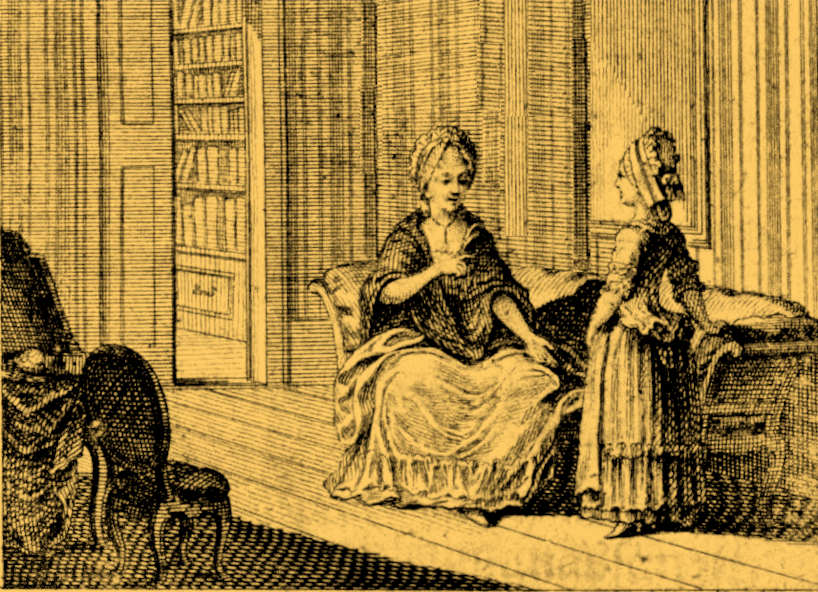
[3a] Title vignette to the Wienerisches Handbuch für Frauenzimmer vom hoh- und niedern Stande (Vienna 1781):
[4] Here Caroline switches back to the familiar form of address for the remainder of the letter. Back.
[5] “16 years ago”: Caroline seems to have attended boarding school in Gotha 1777–78 (leaving for Gotha when she was fourteen according to Luise Michaelis in her Erinnerungen, p. 76), and was back in Göttingen on 4 September 1778 according to letter 1.
“Two years ago”: Caroline and Luise Michaelis had visited Gotha sometime before late October 1791. It was during that visit that Josias Friedrich Löffler unsuccessfully courted Caroline, concerning which see letters 105–10, excepting 107a and 108a. Certain aspects of this courtship charmingly resemble that of Elizabeth Bennett by Mr. Collins in Jane Austen’s novel Pride and Prejudice. Back.
[6] Meyer had visited Caroline in Lucka sometime between 16 and 22 October 1793; it was the last they were ever to see each other (frontispiece to Johann Friedrich Ernst Albrecht, Leben und Thaten des Dokter Pillpullklystropfius der Glückliche genannt, vol. 1 [Leipzig 1783]):

[7] Caroline presumably received the news in late January or early February 1794 in Lucka (Königl. Großbrit. Genealogischer Kalender auf das 1786 Jahr; Inhaltsverzeichnis deutscher Almanache, Theodor Springmann Stiftung):

Georg Forster had died in Paris on 10 January 1794. See Jürgen Goldstein, Georg Forster: Voyager, Naturalist, Revolutionary, trans. Anne Janusch (Chicago 2019), 193:
On December 20 he leaves his garret in the Rue des Moulines, near today’s Opéra (Palais Garnier), one last time. On his way back, he cannot find a carriage and has to walk across half the city to get home. He does not recover from this. For ten days, he does not close his eyes. He cannot hold a quill anymore, writing only a few last lines on January 4, 1794, to his children. A few words are better than nothing. Forster, who wrote constantly all his life, falls silent. “I now have no more strength to write. Farewell! Guard yourself against illness; kiss my sweetheart.” Six days later, early in the evening of January 10, he dies.
His obituary in Le moniteur on 18 January reads (ibid., 194):
A bad fever, sequelae from his voyage at sea, domestic woes, and his work may have blown him off course. But nothing shook his ardent love for the revolution; his final wishes were for the republic and his children.
Concerning Forster’s final days in Paris, see esp. his letter to Caroline from December 1793 (letter 136.5), note 2. Back.
[8] König. Grossbr. u. Churf. Braunschweig. Lünen. Genealogischer Kalender auf das 1779. Jahr; Inhaltsverzeichnis deutscher Almanache, Theodor Springmann Stiftung:

[9] This excerpt from Forster’s letter and the excerpt cited in Caroline’s letter to Amalie Reichard at the end of February 1794 (letter 141) now constitute Forster’s letter to Caroline from Paris in December 1793 (letter 136.5). Back.
[10] Caroline refers to Therese Forster and Ludwig Ferdinand Huber as a married couple now even though they would not be married until 10 April 1794 in Diesse, Switzerland. See Therese’s letter to Caroline on 25 February 1794 (letter 142), note 10. Back.
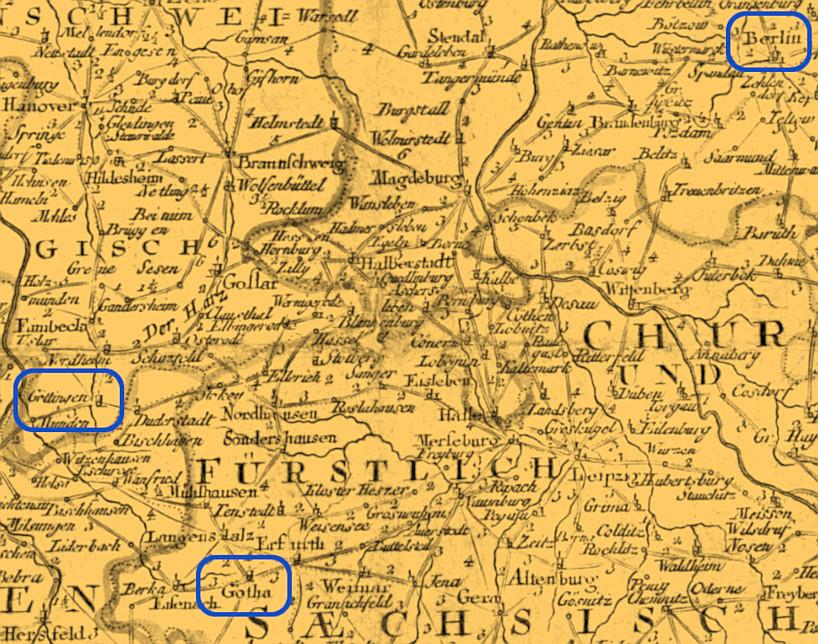
[11] Caroline seems still to have been considering a move to Berlin despite Meyer’s earlier discouragement (see her letter to him on 30 July 1793 [letter 132]), ca. 250 km northeast of Gotha (Post Karte Durch ganz Deutschland, ed. J. Walch [Augsburg 1795]):
[12] That is, the familiar form of address to which Caroline returned in the letter, “republican” insofar as it became customary in revolutionary France to address all citizens equally, i.e., with the familiar form. Back.
[13] That is, Meyer apparently used it in a previous letter to Caroline. Back.
[14] “Die Erlösung: Erzählung,” a story Meyer published in the Annalen des Theaters, ed. Christian August von Bertram (1793) 2 [?] (February), 97–131 (otherwise: nos. 1–20 [Berlin 1788–97]). Caroline mentions it again in her letter to Meyer on 16 March 1794 (letter 143). Back.
Translation © 2011 Doug Stott