
136.5. Georg Forster to Caroline in Lucka: Paris, December 1793 [*]
I can well imagine how unkind people will be toward you; I experienced it differently with regard to my own person, and yet not really differently at all. Among most of those who are so quick to judge and condemn, the impossibility of erring is merely a consequence of their own egoism. The fact that resultant misfortune can make transgressions worthy of considerate treatment, indeed, that it must reconcile us with those who may transgress even if we ourselves might well have been dissatisfied with them — is something of which such people have no concept. . . .
I have forgiven the blow that has robbed me of all pleasure so horribly that it now poisons even my memories [1] . . . thus will there likely be no end to suffering till the final dissolution. . . . [2]
Notes
[*] Sources: Excerpts cited in Caroline’s letters to Friedrich Ludwig Wilhelm Meyer on 20 February 1794 (letter 140) and to Amalie Reichard in late February 1794 (letter 141). Date uncertain. Since Caroline gives the date in both letters only as “a few weeks before his death,” and since letters 140 and 141 do seem to have been written almost sequentially, they are presumably referring to the same (that is, only one) letter.
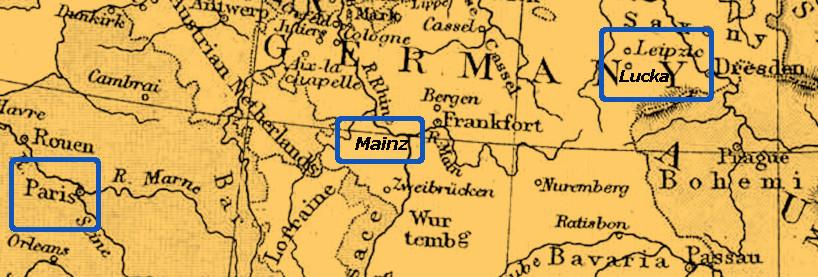
Because Forster almost certainly did not know where Caroline was residing at this time, he presumably had the letter forwarded to Caroline through acquaintances, possibly by way of Leipzig, although — because of the risk (he was imperially proscribed) — not necessarily through Ludwig Ferdinand Huber or Therese Forster. He died on 10 January 1794 in Paris (“Europe 1740,” frontispiece map to F. W. Longman, Frederick the Great and the Seven Years’ War [New York 1899]):
[1] Presumably an allusion to his wife, Therese Forster, who left him on 7 December 1792 for Ludwig Ferdinand Huber and, moreover, took her children, Therese and Claire, with her. See Caroline’s letter to Friedrich Ludwig Wilhelm Meyer on 17 December 1792 (letter 119), note 5. Back.
[2] Concerning Forster’s final days in Paris, see Karl Klein, Georg Forster in Mainz: 1788 bis 1793 (Gotha 1863), 368–72:
[Forster] came down ill on 8 December [1793] after going out one evening without an overcoat and wandering about in the irksome Parisian fog, thereby catching a lung inflammation. Although the illness was quite painful, he did not think it serious, and as early as 11 December he thought he could probably go out again within three days. But his recovery was going slowly. He complained especially about sleeplessness. . . . He could, however, still work. . . . yet in his loneliness his thoughts sooner turned gloomy. “For myself,” he writes on 19 December:
I can easily see there is nothing left but work and toil — and for what? To eek out just enough to support myself from one day to the next in a life void of any and all enjoyment and pleasure? A hundred times I have seen that it is grander to live than to die; every miserable dog can die.
But when the devil or whoever is the malicious, flesh-eating spirit within us that invariably says such things — when with hellish derision it asks: “What, indeed, is grandeur to you? Are you not a vain fool when you think yourself so much better than others merely to deceive yourself about real misery, about the unredeemable injustices of nature?” How can one respond to this Adramelech [Phoenician deity to whom children were sacrificed]? My God! And then I collapse in my own dust, pick up my burden, and continue on and think nothing other than, “You must until you can no longer; then the end will come on its own.
But the sick man did not take care of himself. On this very day, he left his apartment, and since in the distant locale where he then found himself there was no carriage to be had, that evening he had to return to his quarters through half the city on foot. . . . And although he often told himself to have “patience, patience,” his recognition of what he had become made him weep like a child.
On 22 December the knuckles on his left hand suddenly swelled with gout and brought him such shooting pain that he thought he would faint. . . . The gout attacked his entire body, and yet he still did not sense danger; he then wrote on 27 December about “unspeakable pain, sleeplessness, weakness in my entire body” . . .
On 4 January 1794, although the illness had left his bowels, a horrible scorbutic saliva flow began. He wrote in his last letter:
I beg you, my dear Huber, to keep our Therese from imagining things; true, I am quite ill, painfully ill, but let me repeat: there is no danger. — — But now I do not have the energy to write more. Farewell! Keep yourselves safe from illness; kiss my dear children!
These were the last words he ever wrote. . . . A friend wrote to Huber on 12 January:
. . . My tears can attest, my good friend, that I have experienced an extremely sad event. Our poor Forster is dead, he died an hour ago from a stroke . . .
On the day of his death, I remained with him until 4:00 in the afternoon. His illness was still not mortally dangerous; business called me away, but when I returned at 5:00, the struggle between being and cessation had begun, and my poor friend was actively dying. The podagra had entered his breast, he had a stroke, and his last words were for his children. Convulsions finally severed his remaining ties to life; his two manservants and I were with him when he breathed his last breath.
([N.] Schwerdtgeburt, Moritz Müller, Ein Kranker auf seinem Lager [1814]; Herzog August Bibliothek; Museums./Signatur Graph. A1: 1831):
Translation © 2011 Doug Stott
