
• 136c. Friedrich Schlegel to Wilhelm Schlegel in Amsterdam: Leipzig, 11 December 1793 [*]
[Leipzig, 11 December 1793] [1]
Caroline’s health, my dear friend, is very good indeed. She wrote me on [Thursday] 5 December:
I am doing well and have been leaving my room and going over to the other house. [2] Julius’s bright eyes are wide open — and he is handsome and quiet. Tomorrow is the pre-Advent day of penance, and I will probably do a bit extra and find my way to the Lord’s table . . . The doctor believes the only thing left now for which he can treat me is homesickness.
I received no news yesterday, since the messenger did not come in at all [from Lucka]; hence neither can you have any response yet; it was not until Saturday that I sent your package from Tatter and the letter to me on Bürger out there, [3] since a week ago yesterday the messenger never came to get anything from me. . . .
Although Caroline has not taken much of my time, she has taken away my concerns about my own situation. — Her opinion has been of tremendous value to me during this recent time, and has both strengthened and gladdened me more than anything else. Although I really have absolutely no reason to expect her gratitude, she does now have my friendship forever. I have become better through her, though she herself perhaps does not even realize it.
As far as expenses are concerned, let me repeat what I have already so often written. First, that you, of course, owe me nothing. That although I have indeed incurred some expenses, I can only approximate how much. And third, that I cannot possibly accept that you compensate me for visits that, in truth, I actually enjoyed. . . .
[Discussion of Gottfried August Bürger.] The only poetic element I acknowledge in Bürger’s presentation is life; but life is merely one element of beauty, and is not beauty itself. Ask yourself whether you really are impartial. You do yourself injustice by making common cause with Bürger, even should you never seek to acquire his fame. I respect your gratitude, [4] but I have no idea what it is based on. —
You yourself no longer place any value on the poems you wrote during the period when you spent the most time with him, [5] excepting perhaps a few sonnets. In your prose, however, and in your conversation, people noticed in general (I myself was not yet capable of judging at the time) something that was not at all amiable, something that reminded them of Bürger, who is probably also not amiable. —
After you fell in love with Caroline, and after having become acquainted with Dante afterward, your taste attained heights that Bürger is perhaps not even capable of comprehending; and to them you do doubtless owe an element of the purely good — not poisoned by repulsive additives. . . .
There are a great many interesting passages in your most recent letters that I would like to bring up for discussion sometime; among them, however, nothing is more important to me than prosody and metrics, since it is here that I cannot so easily advance my own knowledge and may hope perhaps to learn something from you that I will not find in books.
Even though I do already have an extremely pronounced preference for the Greek verse types, I do promise I will examine the entire matter again from the ground up. And to make you more eager to convert me, let me point out that otherwise the danger exists that Caroline may well come over to my side in this point. Hence let me request a complete doctrine and deduction of rhyme. I did not find much that was particularly instructive in Moritz’s Prosodie. [6] . . .
Notes
[*] Sources: Walzel, 146–53; KFSA 23:162–68. Friedrich’s letter to Wilhelm here is the source of the embedded excerpt constituting letter 136c in Erich Schmidt (1913), Caroline to Friedrich Schlegel in Leipzig: Lucka, 5 December 1793. Back.
[1] The first part of this letter is undated; Friedrich will pick up the letter again on 11 December. Back.
[2] The house in which Caroline was living was part of an ensemble of several houses in Lucka at Hirtengasse 2 similar to the following (“Thüringisch-fränkischer Bauernhof,” Meyers Konversations-Lexikon, 4 ed. [Leipzig, Vienna 1885–92], vol. 2, s.v. Bauernhaus, p. 0470a, fig. 8):

One house from that ensemble was still standing until recently, though now all traces of the half-timber ensemble seem to have been obliterated. See Caroline’s letter to Friedrich Ludwig Wilhelm Meyer on 15 August 1793 (letter 133), note 5, and for additional photographs, see the gallery on Caroline in Lucka. Back.
[3] Nothing more is known about the package from Georg Ernst Tatter. — Wilhelm was preparing a piece on the poet Gottfried August Bürger, whom Caroline had known in Göttingen; the piece, “Bürger,” which here Friedrich was to pass along to Caroline, was not published until later, in Charakteristiken und Kritiken, ed. August Wilhelm Schlegel and Friedrich Schlegel, (Königsberg 1801), 2:3–96 (also in Kritische Schriften 2:1–81; and Sämmtliche Werke 8:64–139). Back.
[4] I.e., to Bürger, who had earlier functioned as a kind of mentor to Wilhelm. Back.
[5] When Wilhelm was a student in Göttingen. Back.
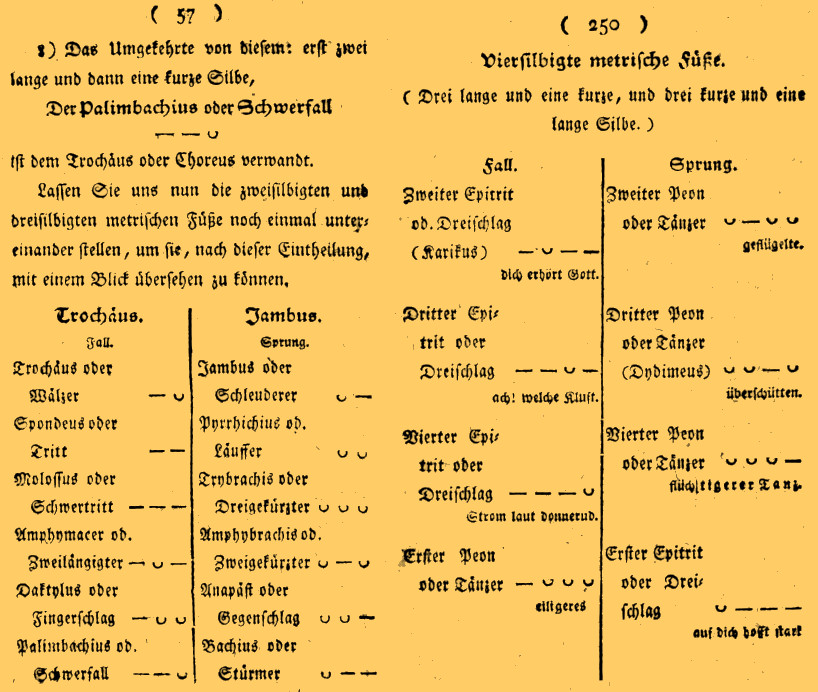
[6] Karl Philipp Moritz, Versuch einer deutschen Prosodie (Berlin 1786), a detailed, organized examination of poetics specifically for the German language that includes thorough analyses of metrics; here the tables on pp. 57 and 250:
Translation © 2011 Doug Stott