
• 123. Caroline to Friedrich Wilhelm Gotter in Gotha: Königstein, 27 April 1793
[Königstein] 27 April [17]93
|283| My dear Gotter — I am not sure whether Humbold[t] is in Erfurt [1] — Amalie probably knows where he is staying now. It is extremely important to me that this letter be forwarded immediately [2] |284| — regardless of where he may currently be. He knows the coadjutant very well, [3] and I was able to initiate him into all the various circumstances. [4]
Notes
[1] Here Gotha, Erfurt, Weimar (see below), and Jena (Post Karte Durch ganz Deutschland, ed. J. Walch [Augsburg 1795]):
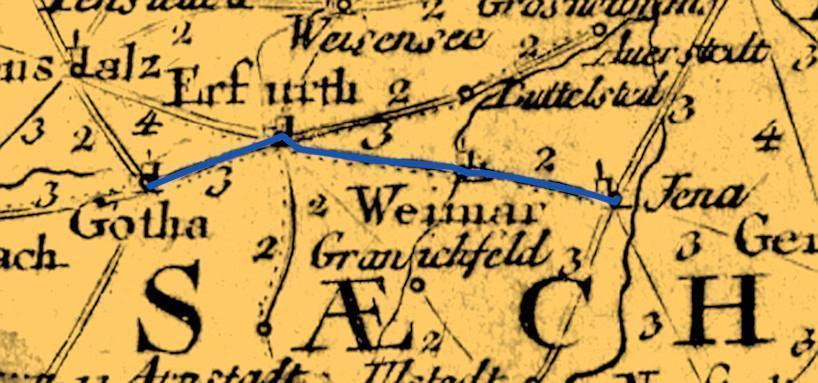
Erfurt at the time was a dominion of the Elector of Mainz. See the chapter on the Lower Rhine in the supplementary appendix on Germany in the late eighteenth century, esp. the section on the dominions of the Elector of Mentz [Mainz].
Wilhelm von Humboldt and his wife had been living in Erfurt — just 25 km east of Gotha, where the Gotters lived — but had left in the summer of 1792, living then on their estate Auleben near Heringen (50 km north of Erfurt); they returned to Erfurt in early 1793, though Wilhelm von Humboldt himself then left Erfurt on 5 May to travel to Berlin for a meeting with his brother, Alexander.
At the end of his letter to Wilhelm Schlegel on 16 November 1793 (letter 136.3) (here Anton Klette, Verzeichniss der von A.W. Schlegel nachgelassenen Briefsammlung, nebst Mittheilung ausgewählter Proben des Briefwechsels mit den Gebrüdern von Humboldt, F. Schleiermacher, B.G. Niebuhr, und J. Grimm [Bonn 1868], V), Humboldt writes that “my address, regardless of where I may be at the time, is always [i.e., mail will be forwarded] in Erfurt in care of Herr President von Dacherroeder [his father-in-law], or in Berlin, Jägerbrücke in the Humboldt house.” Back.
[2] Schmidt (1913), 1:701, remarks that this letter was a note on the reverse side of which, in an unknown hand, the following is written: “but one must not write directly to Madam Böhmer in Königstein, and at the very least make absolutely no mention of the reception of this letter.” Back.
[3] Humboldt had spent the winter of 1789–90 in Erfurt and Weimar; Coadjutant Karl Theodor von Dalberg, heir-designate to the electoral archbishopric of Mainz, was living in Erfurt at the time, Erfurt itself (see above) being part of the territory of the archbishopric.
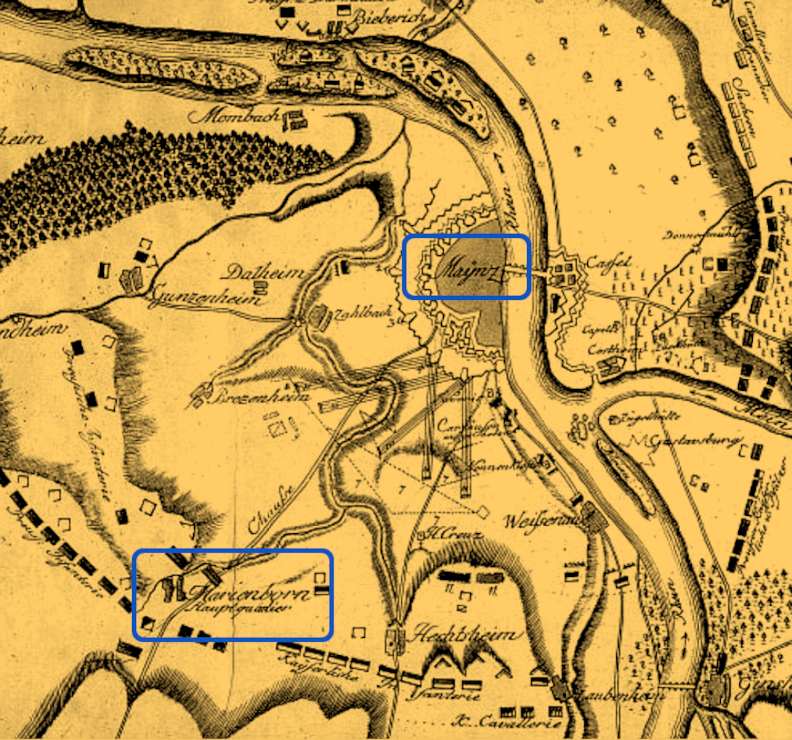
Apparently during June 1793, Friedrich Heinrich Jacobi wrote to Goethe, who had rejoined the retinue of Karl August in camp at Marienborn just to the southwest of Mainz as part of the Prussian forces, and inquired whether Goethe himself might be able to help Caroline and Luise Wedekind out of their present circumstances through an intercession with Dalberg, whom Goethe had recently seen in Erfurt on his way from Weimar to Marienborn. Caroline and Auguste were already in Kronberg at this time (map of Mainz and the Marienborn “headquarters” [Hauptquartier]: Plan der Stadt Maÿnz nebst den Stellungen der vereinigten teutschen Krieksvölker um dieselbe, im Jahr 1793 [n.p. 1793]; Gallia belgica rhenana):
Goethe replied to Jacobi on 7 July 1793 but did not yet know of the rescript that Friedrich Wilhelm II had signed on 4 July 1793 freeing Caroline and Auguste to depart Frankfurt for Leipzig (Weimarer Ausgabe 4:10:90):
It will be extremely difficult to do anything for these prisoners; their fate has been given over and left to the decision of the Prince Elector. There is in any case but a single opinion concerning Madam Wedekind.
That is, ultimately it was not the Prince Elector at all but rather the king of Prussia to whom Caroline owed her release, though Caroline herself did not learn of the rescript until 11 July. Back.
[4] As Humboldt himself points out in his letter to Wilhelm Schlegel on 16 November 1793 (letter 136.3), Caroline sent him at least three letters during this period; none seem to have survived. Back.
Translation © 2011 Doug Stott