
• 122. Caroline to Friedrich Wilhelm and Luise Gotter in Gotha: Königstein, 19 April 1793 [*]
Königstein, 19 April [17]93
|282| Let me thank you, my dear Gotter, for having taken the step of addressing the coadjutant [1] — as I was planning to ask you to do.
The harshest thing that can happen to a woman, after all, is to end up imprisoned in such serious circumstances [2] — before meriting something of that sort, she must at least have committed something more than merely ill-considered opinions, and Herr von Dalberg, [3] who knows people well, doubtless senses that these opinions do not really even come from her, but rather from the influence of her friends — it cannot possibly be his desire that she be thus ruined in the way I cannot but be as the result of extended incarceration.
I am not a criminal — neither directly nor indirectly — though, to be sure, I have had acquaintances who are such and who now cause suspicion to be cast on me as well. I thought I had separated myself from them forever, nor did there ever exist the sort of connection between them and me |283| that might prompt me to view myself now as a martyr.
I have been told of one particular way out that might free me fairly soon, namely, if someone would agree to post bail for me. What do you as a jurist think of this possibility? It is terrible being dependent on how long the siege of Mainz might drag on — and what they tell me is that there will be no formal investigation in my case until that is over. Given the lack of foreign news, can the French be so crazy as to insist on defending themselves for very long? [4]
My dear Louise, were I but sitting in the little room you have so graciously prepared for me! I sense your heartfelt concern — will I also be so fortunate as to thank you in person? Will your friendship not become fatigued? As you can see, I am giving little joy to those who love me, and will perhaps yet give them even more to worry about. God bless you, my dear — rejoice in your freedom and in the fact that you yourself can take your children for walks. I can hardly reconcile it with my conscience that I am making Auguste share my fate. [5] Pass along my warm regards to Wilhelmine.
Your husband should attest to Herr von Dalberg how long I had already been making arrangements with him concerning my departure, [6] and how I requested, when he was in Frankfurt, that he secure a passport for me from the Duke of Braunschweig.
Notes
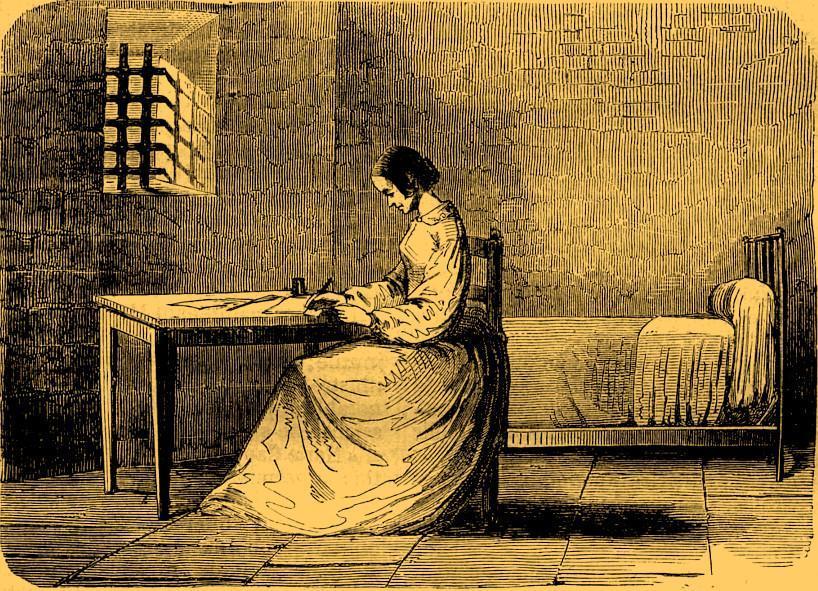
[*] Caroline’s first extant letter from Königstein prison (representative illustration from a slightly later period: “Madame Lafarge dans sa prison,” in A. Fouquier, Causes célèbres de tous les peuples [Paris 1817ff], 25):
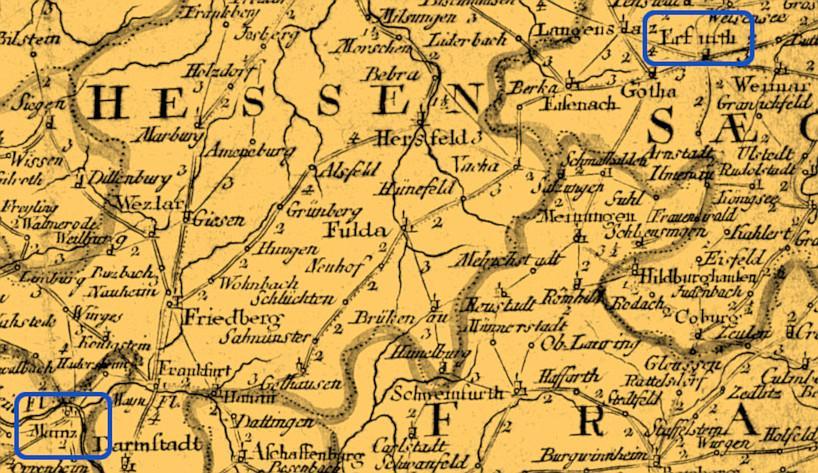
[1] On 5 June 1787, Karl Theodor von Dalberg was elected coadjutant of the Archbishop of Mainz, on 18 June 1787 of the Bishop of Worms, and on 18 June 1788 of the Bishop of Konstanz, whence this title. Erfurt at the time was a dominion of the Elector of Mainz, albeit — oddly perhaps to a later sensibility — an area not at all contiguous with the area around Mainz itself and located ca. 225 km to the northeast; its proximity to Gotha, where the Gotters resided, facilitated contacts between the two towns (Post Karte Durch ganz Deutschland, ed. J. Walch [Augsburg 1795]):
See the chapter on the Lower Rhine in the supplementary appendix on Germany in the late eighteenth century, esp. the section on the dominions of the Elector of Mentz [Mainz]. Back.
[2] François Marie Isidore Quéverdo, Gespräch zwischen Louise und dem Gefängniswärter (ca. 1768–1802); Herzog Anton Ulrich-Museum; Museums./Signatur Queverdo nach AB 3.4:

Caroline and her traveling companions left Mainz on 30 March 1793 trying to get to Mannheim, but Prussian advance troops forced them to turn around at Oppenheim (between Mainz and Worms, ca. 18 km almost due south and on the same [west] side of the Rhine River), and they were then detained in Hattersheim (ca. 17 km almost due east of Mainz on the north side of the Main River), then taken to Frankfurt for interrogation (map: Post Karte Durch ganz Deutschland, ed. J. Walch [Augsburg 1795]):

They were arrested on 2 April and transported to the fortress at Königstein on 8 April. Back.
[3] Karl Theodor von Dalberg, coadjutant in Erfurt for the Elector of Mainz as mentioned above, was also a close acquaintance of Caroline and Wilhelm von Humboldt; see esp. Caroline’s letter to Friedrich Wilhelm Gotter from Königstein on 27 April 1793 (letter 123). Back.
[4] From 14 April 1793 on, Mainz was surrounded by 32,000 soldiers of the First coalition (largely Prussians). Twenty-three thousand French soldiers were defending the town. After various preliminary maneuvers on the part of the Prussians failed to take the fortified positions defending Mainz, they began bombarding the town on the night of 17 June 1793. The French, now under the leadership of General d’Oyré, introduced martial law on 13 July; after promised reinforcements failed to arrive, they began negotiations with the Prussians on 17 July and capitulated on 23 July. Back.
[5] Auguste was not quite eight years old at the time, yet would not be the only child in the prison during this episode (Königl Grosbritanischer Historischer Genealogischer Calender für 1794; Inhaltsverzeichnis deutscher Almanache, Theodor Springmann Stiftung):

[6] Caroline first mentions this matter in her letter to Luise Gotter on 24 January 1793 (letter 120). Back.
Translation © 2011 Doug Stott