
266a. Dorothea Veit to Schleiermacher in Berlin: Jena, 22 August 1800 [*]
Jena, 22 August 1800
This time I will leave financial matters to the end of the letter to avoid having such things smother my imagination right here at the beginning.
First of all, I want to express my heartfelt joy at the prospect that your coming here has been all but decided. [1] It is simply a shame you cannot choose a more agreeable season so that your heart might take refreshment from nature as well; but we will have some wonderful days nonetheless; may God grant that nothing happens to undo this splendid plan. —
We in the meantime spent several days out in the country, a mile from here, in one of the most charming and amiable areas around Jena; [2] I spent twelve days there, Friedrich only six. We were heartily content, and always faithfully thought of you during the magnificent walks we took.
Ritter (with whom I have recently become better acquainted) stayed with us out there as well. He is a splendid fellow, one of those rare phenomena on this earth. Please be so good as to use up your customary, inevitable opposition immediately, that is, before you see him, for afterward you certainly should not lose a single minute on such things, in the end you cannot but grow fond of him as well!
He is one of your greatest admirers and readers; the Monologen [3] made a tremendous impression indeed on his disposition, and a new chronological era has commenced for him with the Reden. He greatly admires the Briefe [4] (without knowing the author), in a word: he is quite full of you, and truly loves you; I told him you would be coming, and he in his own turn wants me to relate to you his joyous anticipation at making your personal acquaintance.
Oh, how beside myself with joy I will be finally to see the entire church assembled in my room; I include Hardenberg, who should be coming along as well; I have acquired more trust in him than initially, when with Caroline’s help I viewed everything askew, which is also why everyone viewed me askew as well. You, Friedrich, Ritter, and Hardenberg! If I am unable to accustom myself to viewing every meal as a banquet of love, I will never have the courage to eat at the same table with all of you and from the same dish. —
The Pauluses have returned from Bocklet; [5] I passed along to him your regards even though you two have not really met, and he sends his thanks and is looking forward to making your acquaintance.
He is an extremely worthy man indeed; to be charming and endearing as well he lacks nothing other than perhaps some sort of sensibility for poesy other than merely the ancient Near Eastern; he is so understanding, composed, cordial, and so quietly diligent that one feels quite fortunate having him as a worldly friend.
I am very fond indeed of his wife. She is the first woman in whose company I am again reminded of my first, youthful friendship with Jette. [6] There is the same sort of complete trust between us; and just as earlier as well, it is more a matter of complementing each other than of being genuinely similar. Her health is very unstable, which often makes her rather sad and anxious, and me along with her, otherwise we would both be just a couple of merry birds.
She brought some quite interesting news back from Bocklet: Caroline and Schelling made a spectacle of themselves there, so ridiculous and detested were they. —
What you said about Auguste’s death is admittedly quite right, but if the mother does not genuinely despair at precisely this consolation, then she has considerable contenance. [7]
I for my part was of the same opinion as that which, as you write, is shared by Madam Fichte, Madam Bernhardi, and Jette. Every shred of female sensibility cannot but be indignant at such heinous depravity.
She no doubt did not really die of dysentery at all; Hufeland says no one dies of that anymore. [8] But this illness emerged precisely during what is an extremely critical stage for young girls, a stage in which Auguste had already been suffering for a year now, [9] and which must be treated with the greatest caution in a creature as delicate as Auguste indeed was, both emotionally and physically. The violent disruptions this child had to endure had already long made her condition a dangerous one. It was from the outset a mistake to treat her as an adult at such an early age; of course, such intriguing precociousness doomed her to an early demise.
The Brunonian arts are not to be reproached in this instance; [10] there was no physician with her at all apart from a totally unknown person from the area near Bocklet itself who was anything but Brunonian. [11] And on top of that, Schelling meddled in the whole thing. They did not summon physicians from Bamberg until she was already cold up to her waist; Röschlaub came and found her already dead, though he did maintain that her illness was fatal from the very outset. [12]
But then the excessive confidence is even more unpardonable that kept them from sending for physicians at the very beginning. [13] In a word — and now this ostentation of grief! —
But let us remain quite silent from now on concerning all these people. I will not write anything more to you about it, so indignant am I. . . .
Notes
[*] Sources: Aus Schleiermacher’s Leben 3: 215–16, 222–23 (frag.); Briefe von Dorothea Schlegel an Friedrich Schleiermacher 84–90; KGA V/4 220–26; KFSA 25:161–64; reprinted in Erich Schmidt, (1913), 1:757–58 (frag.).
On this same day, Friedrich Schlegel sent along a copy of the latest (and overall final) issue of Athenaeum (1800) to Goethe (Goethe und die Romantik 189; KFSA 25:161). Back.
[1] Schleiermacher’s visit did not materialize after all, notwithstanding both Friedrich and Dorothea had issued invitations; see their letter to him on ca. 1 July 1800 (letter 264c). Back.
[2] In Dornburg, northeast of Jena. One German Meile (the term Dorothea uses here) at the time could refer to widely varying increments; since Dornburg is approximately 10km from Jena, Dorothea is likely referring to the Hannover Meile (9323m), or perhaps the German (approx. 7500m) or Württemberg (7450m) Meile (Therese Huber Briefe 1:462–63). Back.
[3] Monologen (Berlin 1800). Back.
[4] Vertraute Briefe über Friedrich Schlegels Lucinde (Lübeck, Leipzig 1800), Schleiermacher’s assessment of Friedrich’s novel, Lucinde. See also his review of Lucinde in the Berlinisches Archiv der Zeit and the final paragraph of Dorothea’s letter to Schleiermacher on 16 June 1800 (letter 263a). Back.
[5] H. E. G. Paulus, his wife, Karoline, and his daughter, Sophie; see Dorothea’s letter to Schleiermacher on 28 July 1800 (letter 265i), note 2. Back.
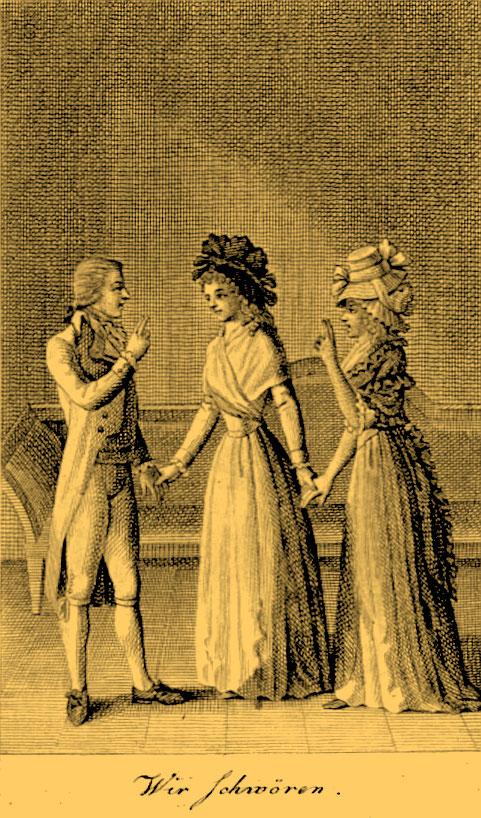
[6] Henriette Herz and Dorothea had been part of a loose organization of friends, the “Alliance of Virtue,” during their youth in Berlin (“Wir schwören” [“We swear”], Taschenbuch für Frauenzimmer zum Nutzen und Vergnügen auf das Jahr 1794 [Leipzig]; Inhaltsverzeichnis deutscher Almanache, Theodor Springmann Stiftung):
[7] Fr., “countenance” in the sense of “composure.” — This passage is unclear, since we seem not to have Schleiermacher’s letter — with what he says “about Auguste’s death” that Dorothea thinks is “quite right — and thus are unable to understand Dorothea’s allusion to “this consolation/comfort.” Back.
[8] Left untreated, dysentery, esp. serious cases, can still be fatal today. Back.
[9] Auguste had turned fifteen on 28 April 1800; Dorothea is presumably referring to menstruation. Back.
[10] Concerning the healing methods and theories of the Scottish physician John Brown, see also “Of the Brunonian Doctrine”. Back.
[11] That physician has been identified only as “Büchler,” the spa physician in nearby Kissingen (Rudolf Koch and Fritz Kredel, Deutschland und angrenzende Gebiete [Leipzig 1937]):
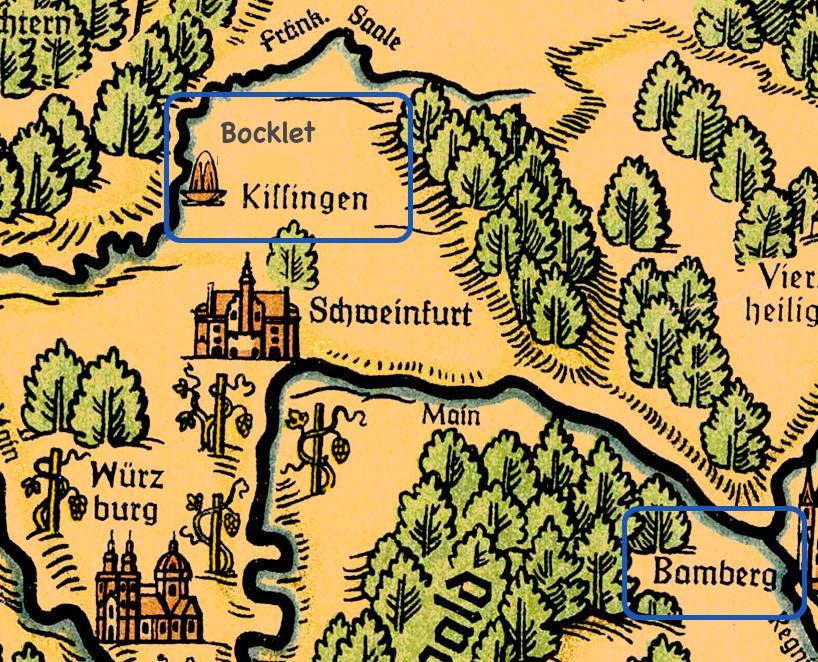
Here Kissingen in an illustration providing a view of the landscape and activities typical of this region and the popular mineral-springs spas at the time along the Franconian Saale River (Gustav von Heringen, Franken, Das malerische und romantische Deutschland: In zehn Sektionen 2 [Leipzig 1847], plate following p. 112):

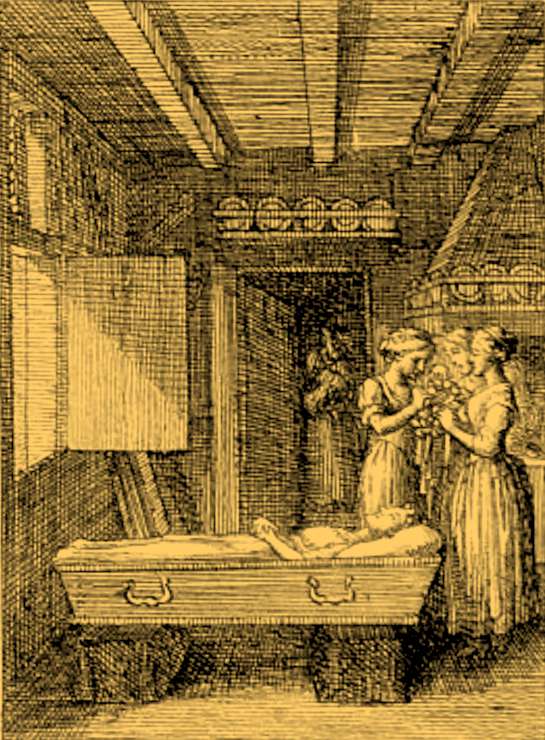
[12] Daniel Nikolaus Chodowiecki, Höltys Elegie auf ein Landmädchen (1794); Herzog Anton Ulrich-Museum; Museums./Signatur DChodowiecki AB 3.985:
Dorothea’s logic here is in any case self-contradictory, since, as attested later, Schelling’s alleged “meddling” strictly followed Brunonian principles and procedure. Back.
[13] The specifics of Auguste’s illness and death, as far as such are ascertainable, are discussed in volume 2; see, e.g., Wilhelm Schlegel’s To the Public. Rebuke of a Defamation of Honor Perpetrated in the Allgemeine Literatur-Zeitung (1802) (letter/document 371b), and in general the correspondence between Schelling and Wilhelm during the late summer and autumn of 1802, and esp. Urban Wiesing’s examination and chronicle of the scandal surrounding Auguste’s death. Back.
Translation © 2014 Doug Stott