
265b. Wilhelm Schlegel to Goethe in Weimar: Jena, 11 July 1800 [*]
Jena, 11 July 1800
. . . My last missive to the Academic Senate did not have any immediate effect; the gentlemen simply filed it away. [1] Hence I would now like to solicit your advice on further action, since now that I have set this thing in motion, it has become a point of honor for me not simply to let it die, as indifferent as I may well be toward it in and of itself.
Hence I cannot see how it can end except that I either obtain satisfaction or take such for myself, and I have been under the impression that the steps taken in the belief that I will not be successful in the former demonstrate more deference toward the directives of the administration than the latter.
Could you perhaps secure me copies of Kotzebue’s Gustav Wasa and Bayard? I missed the performances of both. [2] I can assure you that this request is based on a good, i.e., good-humored purpose, about which I cannot say anything just yet but about which you will soon be hearing something. [3]
My brother, who sends his kind regards, would very much like to come over to Weimar for a day sometime soon and merely wishes to know beforehand whether you might be too busy to chat with him for a couple of hours. [4]
Since Tieck’s departure, we have been leading a rather quiet and solitary existence here among ourselves. [5] My brother is studying Plato, [6] I Shakespeare, albeit interrupted by all sorts of smaller projects. [7] I would like to speak with you before I begin with “Tristan” again. [8] —
Tieck suddenly decided to make a side trip to Berlin from Giebichenstein; his journal is being printed just now, you will doubtless be pleased with it. [9] . . . I will be sending you the new issue of Athenaeum very soon. [10]
Stay well and pass along my regards to your artists. [11]
AWSchlegel
Notes
[*] Source: Körner-Wieneke 109–110. Back.
[1] Concerning this “missive,” see Wilhelm’s letters to Goethe on 30 May 1800 and 6 June 1800 (letters 260c, 261a), Goethe’s letter to Wilhelm on 10 June 1800 (letter 262a; text of missive in note 1), and Wilhelm’s letter to Goethe on 13 June 1800 (letter 262b), esp. with note 2. Back.
[2] August von Kotzebue, Gustav Wasa: Ein Schauspiel in fünf Aufzügen (Leipzig 1801) had been performed in Weimar on 4 and 6 January and 15 March 1800, and Bayard: Ein Schauspiel in fünf Aufzügen (Leipzig 1801) on 5 and 15 April, 3 May, and 3 June 1800 (Das Repertoire des Weimarischen Theaters, 35–36). Here the frontispieces from three editions of Gustav Wasa (Prague 1818; Vienna 1802, 1833), and two editions of Bayard (Leipzig 1802; Vienna 1833):
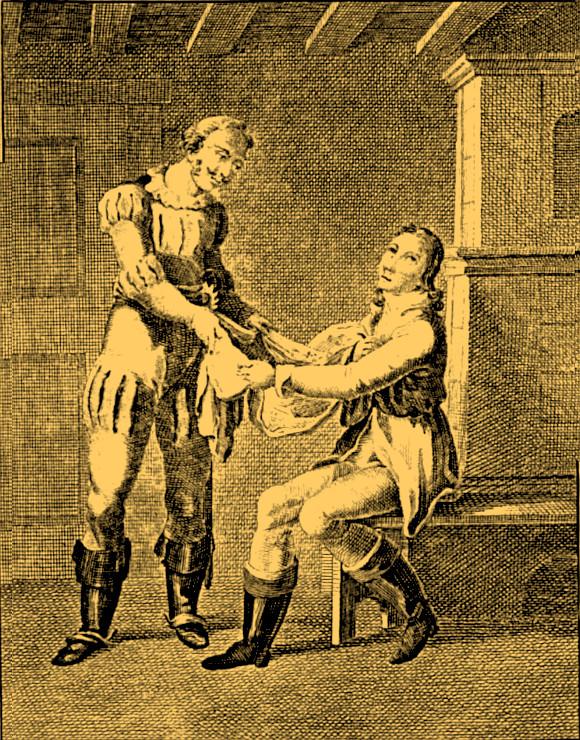


[3] Wilhelm was requesting them in connection with preparations for his satire Ehrenpforte und Triumphbogen für den Theater-Präsidenten von Kotzebue bei seiner gehofften Rückkehr in’s Vaterland. Mit Musik. Gedruckt zu Anfange des neuen Jahrhunderts (Braunschweig 1801); Sämmtliche Werke 2:257–342 + 4 pages of musical score.
References to this piece, which became known as Wilhelm’s Kotzebuade, recur frequently in coming letters, even to the musical pieces, one of which became popular among the children of Jena. Back.
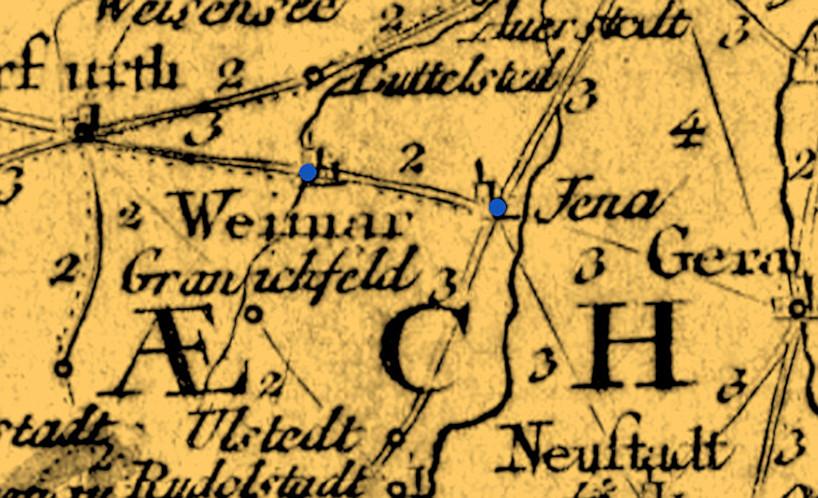
[4] As it turned out, both Friedrich and Wilhelm visited Goethe in Weimar on 16 July 1800 (see Goethe to Wilhelm on 12 July 1800 [letter 265c, which also contains Wilhelm’s response]), though, oddly, such is not noted in Goethe’s diaries (Weimarer Ausgabe 3:2:301–2; Post Karte Durch ganz Deutschland, ed. J. Walch [Augsburg 1795]; illustration of Goethe’s house in Weimar from an early postcard: “Vor dem Goethehaus zu Weimars klassischer Zeit”):

Goethe seems to have persuaded Wilhelm not to pursue further action in his suit against Gottlieb Hufeland and Christian Gottfried Schütz. Back.
[5] Concerning Tieck’s departure from Jena with his family and their itinerary, see Wilhelm’s letters to Johann Diederich Gries on 22 June 1800 (letter 264a), note 6, and 7 July 1800 (letter 265a), note 7.
Friedrich and Dorothea Veit, moreover, were preparing to move out of the apartment at Leutragasse 5. See their letter to Schleiermacher on ca. 1 July 1800 (letter 264c), note 2. Once Wilhelm departed Jena for Bamberg and Bocklet and they moved into their new apartment, the apartment at Leutragasse 5 would be empty until Caroline’s return on 23 April 1801. Back.
[6] Friedrich was preparing for the translation of Plato he and Schleiermacher were planning and had written to the latter a few days earlier, on 5 July 1800 (KFSA 25:136):
Since I have no hope of seeing you soon, I would like to propose that we communicate regularly concerning Plato, since the most important thing is that we communicate and articulate as completely as possible our respective views and disposition concerning this collective undertaking. I would do it in brief sentences — with wide margins for as many annotations as you like — that which constitutes merely critical ideas about individual passages should be excluded and reserved for the delivery of a translated dialogue; but much might be said about the natural order, the genres, the authenticity of individual conversations. . . .
Unfortunately, Friedrich’s failure to keep up his end of the project led to considerable ill feelings on Schleiermacher’s part, as documented at least peripherally in later letters. Back.
[7] Wilhelm was presumably working on volume 7 of his edition of Shakespeare, which would appear in 1801 and include translations of The Life of King Henry V and The First Part of King Henry VI. Back.
[8] Concerning the poem “Tristan” (and for an excerpt), see Wilhelm’s letter to Goethe on 30 May 1800 (letter 260c), note 2. Back.
[9] Ludwig Tieck, Poetisches Journal (Jena 1800), which lasted but two issues. Back.
[10] The second issue of Athenaeum (1800), and the final overall issue, appeared at the beginning of August 1800. Back.
[11] The artists Heinrich Meyer and Friedrich Bury; Meyer lived in Weimar, and Goethe notes having dined with Schiller and Bury on 6 July 1800 after having showed Anna Amalia Bury’s portrait of him that morning (Weimarer Ausgabe 3:2:301), of which Bury did two in chalk in 1800 (Gustav Könnecke, Bilderatlas zur Geschichte der deutschen Nationallitteratur, 2nd ed. [Marburg 1895], 291):

Translation © 2014 Doug Stott