
260c. Wilhelm Schlegel to Goethe in Weimar: Jena, 30 May 1800 [*]
Jena, 30 May 1800
Enclosed you will find extremely heterogeneous materials: the new volume of Shakespeare (along with the two copies for His Excellency, and Herr Geheimrath Vogt), [1] the first canto of the poem I recently began, [2] and documentation of my libel suit against Hofrath Schütz.
Merely for your entertainment, to the two pages of the Intelligenzblatt directed against Schelling and me I have added the preceding one with the allegedly anonymous letter concerning the improvement of the A.L.Z.; and also the earlier one, containing my farewell from it, so that you can compare this one with what I said in this regard in the complaint. [3]
Although I would like to receive copies of the responses of Justizrath Hufeland and Hofrath Schütz, the prorector did not believe himself authorized to grant them, and I have thus directed a petition to the Academic Senate.
Its content was that Hufeland said that Schütz was merely to be viewed as a negotiorum gestor [4] and had no specific mandatum [5] from him concerning the subject of my complaint, he speaking in that context moreover wholly for his own person.
Schütz alleges that as editors of the A.L.Z. they were in fact not subject to the Academic Senate, but rather directly to the duke; further that the senate had no forum competens here, [6] and finally that I myself provoked his attacks on me through the insults contained in my farewell declaration.
My written complaint sufficiently refutes this latter contention. I declared merely that my literary maxims were incompatible with theirs. The editors themselves confirmed as much in surfeit in their own response to it, since the maxims they acknowledge as their own, and whose meaning Schelling has so accurately explicated, are precisely the same as those of which I disapproved. The disgust and rage that Hofrath Schütz has since vented against my literary maxims and opinions confirm this even more, proving that I was quite justified in separating myself from the A.L.Z. at the time, and that, as a matter of fact, I expressed myself far too mildly.
Please note also that the statements Hofrath Schütz attributes to me as such grand transgressions, namely, concerning Garve and Wieland, appeared in the articles signed collectively by me and my brother, and actually derive from the latter. [7]
That he had mocked me in a theater presentation even before I provoked him (except perhaps by not believing him to be the source of sacred authority) he himself essentially admits in his letters to me as well as in issue 57, page 478. [8] Various persons have assured me that I was mentioned quite by name in that presentation, though obtaining formal witnesses to such would be very difficult insofar as all the people present were also invited guests numbering probably around 70 persons.
Enough, that he publicly, and with considerable smugness, derides me in a performance by a (moreover, prohibited) private theater group while commencing a personal injury trial because of his alleged derision of Fichte demonstrates his firm conviction that I myself am completely proscribed. [9] As a writer, I indeed need no higher protection; hence I would be no sorrier for myself were he to be strengthened in this belief.
In the opinion of Paulus, the decree from the Academic Senate, which I am enclosing here in the original, is not at all composed in the correct wording commensurate with the votis [10] insofar as it should have separated and distinguished between the matter with Hufeland and that with Hofrath Schütz. —
It is doubtless not in the correct order of things for the judge to stipulate to the plaintiff what further steps he must take (especially since the Academic Senate also gave me incorrect advice with respect to Hufeland), and even less that he express doubt that the plaintiff will even succeed, as is the case in the decree itself.
The wording of the rescript (the received copy of which I am enclosing to make it easier for you to acquire an overview of the entire matter) to which the decision of the senate refers: “if ever in the future it be charged or otherwise made known etc.” necessarily presupposes that the insulted party would have to draft a memorial [11] to His Excellency the Duke if the matter is presented at the appropriate place, and I would like to hear your kind advice on this.
But enough of this unpleasant business. The pieces by Hofrath Schütz will speak for themselves. I will leave it to you to determine whether the attacks on me in the second Intelligenzblatt, that is, after I had already presented my complaint concerning the first, are not to be viewed as a second denigration. . . .
I am certainly longing now to hear your assessment of “Tristan”; could we but discuss it in person! I told Schiller he would be receiving it from you. I was quite pleased to have a cordial conversation with him again after so long an intermezzo. [12] . . .
Kind regards from everyone here. The beginning of a poetic journal by Tieck will probably be appearing in a few weeks. [13]
Stay very well.
AWSchlegel
Notes
[*] Source: Körner-Wieneke 104–6.
The course and certainly the documentation on the break between the Schlegels and the Allgemeine Literatur-Zeitung can be confusing, since both sides spent considerable energy (and ink) on accusations and defenses (virtually all the documentation is accessible in the original German in Fambach); for an overview, see Wilhelm Dilthey’s essay on the break between the Romantics and the Allgemeine Literatur-Zeitung. Back.
[1] The sixth volume of the edition of Shakespeare contained translations of The First Part of King Henry IV and The Second Part of King Henry IV as König Heinrich der vierte: Erster Theil, König Heinrich der vierte: Zweyter Theil. Back.
[2] The first canto (ninety-one stanzas) of Wilhelm’s new poem “Tristan” — the rest was never finished — was published in 1811 in his Poetische Werke, 2 vols. (Heidelberg 1811), 1:98–134, and Sämmtliche Werke 1:100–26; see Friedrich Schlegel’s letter to Auguste, Caroline, and Wilhelm in early November 1797 (letter 190), note 2. Concerning its anticipated disposition, see Wilhelm’s introductory remarks in 1811 (Sämmtliche Werke 1:100):
In the case of this chivalric poem, whose broad outline remained unfinished, I was focusing primarily on the treatment of this story by our Minnesänger Gottfried von Strassburg and his successor Heinrich von Briberg, who in their own turn drew from the book by Thomas von Bretagne.
Here the illustration of Gottfried von Strassburg from the 14th-century Codex Manesse:

Since according to their narrative Tristan does come to Arthur’s court, and in the later French novel Lancelot is portrayed as Tristan’s bosom friend, I thought it in order to weave part of the adventures of the latter episodically into the story. In the meantime, since a renewed recasting of various old poems has been recently undertaken, perhaps the publication of this fragment of an earlier attempt will not be unwelcome.
Concerning the tradition of chivalric poetry in Germany as represented, e.g., by Gottfried von Strassburg, see John George Robertson, A History of German Literature (New York, London 1902), 155–16:
The German Minnesang is based essentially upon a social convention; it gives literary expression to what the German poets called “Frauendienst,” a more or less formal worship of womanhood. The theme of the Minnesingers’ poetry is “minne,” a word which expresses a much more comprehensive idea than the modern“ Liebe”; to the knight of the twelfth and thirteenth centuries “minne” stood for an entire code of social conventions which regulated the relations of the courtly lover to his lady.
There is thus, at the outset, a marked difference in the interpretation of the word “love” on the part of the Provençal Troubadours and the German Minnesingers. To the Romance poets, love was a purely personal affair, and illicit attachments were usually given the preference.
The German mind, on the other hand, spiritualised the sentiment; the Minnesinger’s love for his mistress widened into an all-embracing reverence for womanhood; “minne” was an ideal attachment, a chivalric devotion to a woman, closely akin to “triuwe” [“fealty, loyalty”] which, as we have seen, was the highest virtue which the German knight could lay at the feet of his liege lord.
In other words, the Germanic poet took love more seriously than the light-hearted southern singer; it became a guiding force in his higher moral life.
Wilhelm’s first two stanzas begin (approximate prose translation):
Of Arthur's knights and round table,
Of magical wonders and visions,
Will I recount truly, in a new way,
Just as I found it in old books;
Of the Holy Grail, as in the alliance of the brave
The purest alone can endure this adventure,
And the way two knights, otherwise disposed of lofty ideals,
Lost their fame through sweet guilt.

Tristan and Lancelot, noble warriors
Destined for friendship through like courage.
Especially Tristan will my song besing,
The gracious one, born or love,
And, enraptured in love through the stars' loving course,
Through love also lost.
Those familiar with such joy and pain
His fate will move, but not dishearten.
The materials Wilhelm collected for his work on the poem are still extant (Msc. Dresden e90 LXXIV). Back.
[3] A fairly extensive and perhaps confusing parcel of materials from the Intelligenzblatt of the Allgemeine Literatur-Zeitung:
(1) Wilhelm’s farewell missive to the A.L.Z., Allgemeine Literatur-Zeitung (1799) 145 (Wednesday, 13 November 1799) 1179 (letter/document 255a).
(2) “Anonymous Missive to the Editors of the A.L.Z.,” Intelligenzblatt of the Allgemeine Literatur-Zeitung(1800) 56 (Saturday, 26 April 1800) 457–59.
(3) Editors of the A.L.Z., “Response to the preceding missive,” same issue as above, 459–63.
(4) Editors of the A.L.Z., “Vertheidigung gegen Hn. Prof Schellings sehr unlautere Erläuterungen über die A.L.Z.,” Intelligenzblatt of the Allgemeine Literatur-Zeitung (1800) 57 (Wednesday, 30 April 1800) 465–80, the A.L.Z.’s lengthy defense against Schelling.
See Schelling’s “declaration” in the Intelligenzblatt of the Allgemeine Literatur-Zeitung on Saturday, 2 November 1799, and the editorial response (letter/document 252d), esp. with note 4. The defense here is esp. against Schelling’s Ueber die Jenaische Allgemeine Literaturzeitung. Erläuterungen, vom Professor Schelling zu Jena. (Aus dem ersten Heft der Zeitschrift für spekulative Physik besonders abgedruckt) (Jena, Leipzig 1800), a special printing of the article “Anhang zu dem voranstehendem Aufsatz, betreffend zwei naturphilosophische Recensionen und die Jenaische Allgemeine Literaturzeitung,” in Schelling’s own Zeitschrift für spekulative Physik (1800) I, 1, 49–99.
(5) “Continuation” of no. 4 above, Allgemeine Literatur-Zeitung (1800) 62 (Saturday, 10 May 1800), 513–20.
This “continuation” includes communication of Schütz’s pertinent private correspondence with Schelling and Wilhelm Schlegel (viz., Wilhelm to Schütz on 20 October 1799 [letter 249b]; Schütz to Wilhelm on 20 October 1799 [letter 249c]; Wilhelm to Schütz on 21 October 1799 [letter 249d]).
(6) The decree of the Academic Senate of the University of Jena.
After his break with the Allgemeine Literatur-Zeitung in the autumn of 1799, Wilhelm filed a complaint with the Academic Senate in Jena against the professors Hufeland and Schütz but was denied any action, since as editors of the Allgemeine Literatur-Zeitung the latter were subject not to the Academic Senate, but directly to the duke, Karl August.
Wilhelm wrote to Schelling on 31 May 1800 (letter 260d): “I have now sent all the documentation of my own libel suit on to Goethe at his request.” Back.
[4] Latin, one who unsolicited and without authority undertakes to act for an absent second party in the latter’s affairs. Back.
[5] Latin, “mandate.” Back.
[6] Latin, “jurisdiction.” Back.
[7] Friedrich Schlegel’s fragment 317 in Athenaeum (1798) 265 (numbering from Jugendschriften 2:356; trans. from Friedrich Schlegel’s Lucinde and the Fragments, trans. Peter Firchow [Minneapolis 1971], 208): “If nothing too much means a little of everything, then Garve is the greatest German philosopher.”
Concerning Wilhelm’s pieces against Wieland, see his anticipated annihilation of Wieland in the supplementary appendix on the break with Wieland.
One can see from Friedrich’s letter to Wilhelm and Caroline from Berlin in May 1799 (letter 237) that Friedrich himself was inclined to be less severe with Wieland. Back.
[8] Concerning this theatrical derision of the Schlegel brothers, see the exchange of letters between Wilhelm and Schütz beginning with Wilhelm’s letter to Schütz on 20 October 1799 (letter 249b); also Caroline’s letter to Ludwig Ferdinand Huber on 22 November 1799 (letter 256), note 5.
In the passage Wilhelm is here referencing, Schütz adduces three incidents that “vexed” Wilhelm (Intelligenzblatt of the Allgemeine Literatur-Zeitung [1800] 57 [Wednesday, 30 April 1800] 477–78):
First vexation: Our review of Athenaeum appeared much later (through no fault of our own) than Herr Schlegel thought appropriate. —
Second vexation: A modest dramatic performance was given before a private audience invited to my home, a performance which, among other things, included derision of the assertion that Wieland had garnered the best things in his own work from other writers, and that Garve was but a mediocre philosopher. Herr Schlegel heard about this performance and understood it as applying to himself, since unfortunately these statements had already been published in Athenaeum.
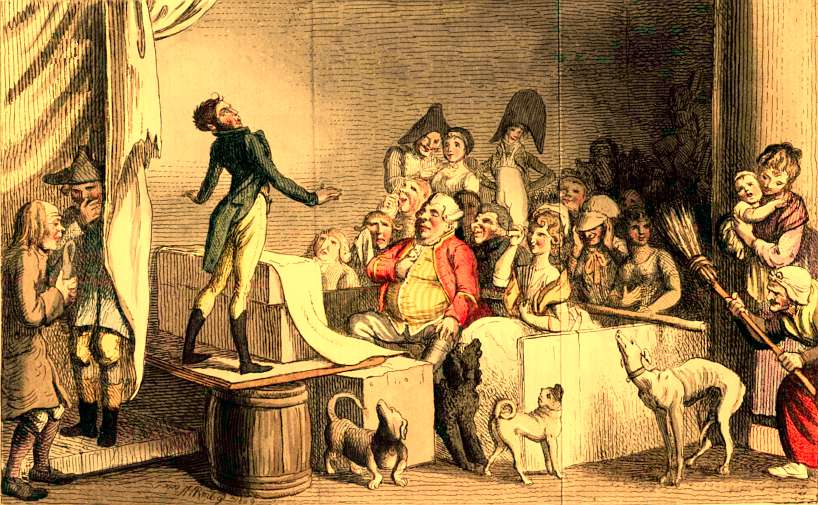
Wilhelm has maintained from the outset that Schütz “publicly, and with considerable smugness,” derided “me in a performance by a (moreover, prohibited) private theater group”; the implication is that this home theater performance was of the sort satirized in the following illustration, though in the latter performance a singer is not quite making the impression he thinks (S. Schütze, Abenteuerliche Wanderung von Weimar nach Carlsbad, 2nd ed. [Leipzig 1810]; Inhaltsverzeichnis deutscher Almanache, Theodor Springmann Stiftung):
Third vexation: Soon thereafter, while Herr Justizrath Hufeland was away, a review of Adelheit B . . . vertraute Briefe was received, a book I had not yet read and indeed have still not read even unto this very day, which is why I did not know that the book contains much contra the Messieurs Schlegel. Hence I had the review published quite without giving it a second thought, and Herr Prof. Schlegel believed, quite despite the asseverations to the contrary supplied to him by Herr Hufeland, that our publishing this review attested my animosity.
This threefold vexation is the true reason for his departure from the A.L.Z., which I will document in one of the next issues of the A.L.Z..
Schütz did so in issue 62 (see note 3 above). Back.
[9] This alleged “derision of Fichte” probably involved Fichte’s dismissal; see the supplementary appendix on Fichte’s atheism dispute. Back.
[10] Latin, “votes.” Back.
[11] Latin, here: “memorandum.” Back.
[12] A remarkable statement considering the Schlegels’ earlier break with Schiller. See in this regard Josef Körner, Romantiker und Klassiker. Die Brüder Schlegel in ihren Beziehungen zu Schiller und Goethe (Berlin 1914), 82–83:
It was precisely A. W. Schlegel’s external relationship with Schiller that over time eventually righted itself again.
Although Schlegel long avoided initiating any personal contact, he did send Schiller dedicatory copies of his recent publications through Goethe’s mediation; but shortly before what one can essentially call Schlegel’s final departure from Jena, on 30 May 1800, Schlegel could finally mention to Goethe having had a conversation with Schiller, adding that he “was quite pleased to have a cordial conversation with him again after so long an intermezzo.”
Their relationship now quickly and visibly improved. On 14 July [1800] Schlegel attended the premiere of Maria Stuart in Weimar [Maria Stuart. Ein Trauerspiel (Tübingen 1801)], on which occasion he also entered into an animated discussion with Schiller and afterwards was in his own turn not at all stingy with . . . cordial comments concerning the poet (e.g., in his letter to Goethe of 17 June 1800: “All of us were quite interested in Maria Stuart, talking a great deal about the subject matter and its treatment. Schiller had promised to send me some authentic French sonnets of his heroine. Please do remind him”).
No doubt the two would have moved on to a complete reconciliation had the death of Auguste Böhmer on 12 July not prompted a decisive turn in Schlegel’s own life, hastening the dissolution of a marriage that had already begun to crumble, and displacing Schlegel himself to Bamberg, Braunschweig, and Berlin, whence he returned only once to Jena for a brief stay (August to October [correct: November] 1801).
Indeed, he had been considering soliciting Schiller as a contributor to the broadly planned Kritische Jahrbücher, which Cotta was to publish, and even offered to allow him to review his own play, Wallenstein.
And yet at the same time, behind Schiller’s back, he was delivering jabs at the writer. In the same letter to Tieck on 14 September 1800 concerning offering Schiller a self-review, we read further (Briefe an Ludwig Tieck 3:236): “If he accepts it [the offer to review his own play], I will pass him into your hands. . . . The collection of Schiller’s poems” “again contains some horrendous choices — but we do not have to offer him everything at once.” Back.
[13] Poetisches Journal, ed. Ludwig Tieck (Jena 1800). Back.
Translation © 2014 Doug Stott