
258o. Wilhelm Schlegel to Goethe in Weimar: Jena, 28 February 1800 [*]
Jena, 28 February 1800
I was quite pleasantly surprised by your parcel, since I thought the printing of your poems had already begun and you had no need for a second communication in this regard. [1]
It was with the greatest pleasure that I immediately compared the two copies of the elegies, though I cannot guarantee that you will find anything useful among my attached, newer suggestions. I wholly concur that one ought not force certain things, and in many cases I thus have no objection to simply maintaining the older readings, my fondness for which continually reawakens when one is not in a “corrective” disposition or is being incorrigibly “correct,” something which, thank heaven, one can assume will not be the case with most of your readers. [2] . . .
We are all quite sorry to hear that the prospect of seeing you again here has now been deferred for so long. [3] I do, however, yet hope to speak with you in Weimar in a more undisturbed fashion. [4]
We are trying to brighten up the long and dreary winter for ourselves as much as possible through diligence and conviviality. Unfortunately, our friend Tieck is still in the same condition, suffering a great deal for goutish pain, which is also greatly hindering his work. He has become so emaciated and weak from it that we have on occasion been quite worried about his overall health. Although he comes to us at midday, one of us must always help him along. [5] His best opportunity for distracting himself is in the evening, when he is able to read aloud to us some comical play or other and in the process recovers all his former didactic liveliness. [6]
My brother is diligently working on the second part of Lucinde, [7] and will also be making what is in part a new sort of appearance in the next issue of Athenaeum. [8]
I am now finished with both parts of Henry IV, with the second part of which I had considerable trouble. [9] The publication of my poems, among which you will find some new material especially in the sonnets, is already quite far along. [10] Hence I hope I will be able to call on you soon with this or that newly printed piece.
Kind regards from everyone here. Please be so kind as to pass along my regards especially to Herr Professor Meyer. Stay very well and remember us kindly.
AW Schlegel
Notes
[*] Source: Körner-Wieneke 93–94. Back.
[1] The initial communication between Goethe and Wilhelm concerning his poems was during the early autumn 1799. See supplementary appendix 245.1. Back.
[2] Volume 7 of Goethe’s neue Schriften was published by Johann Friedrich Unger and appeared in 1800. Back.
[3] Goethe had written Wilhelm from Weimar on 26 February 1800 (Körner-Wieneke 93):
I have hoped in vain since the New Year that I might see you in Jena, if only briefly. Next month as well, I will have a difficult time getting away from here. Hence let me take the liberty of sending along my elegies, which I would very much have liked to have discussed with you in person. Back.
[4] According to Goethe’s diaries,Wilhelm would next visit Weimar on 26 March 1799 (Weimarer Ausgabe 3:2:286) (Post Karte Durch ganz Deutschland, ed. J. Walch [Augsburg 1795]; Rudolf Koch and Fritz Kredel, Deutschland und angrenzende Gebiete [Leipzig 1937]; illustration of Goethe’s Weimar house on an early postcard: “Vor dem Goethehaus zu Weimars klassischer Zeit”):
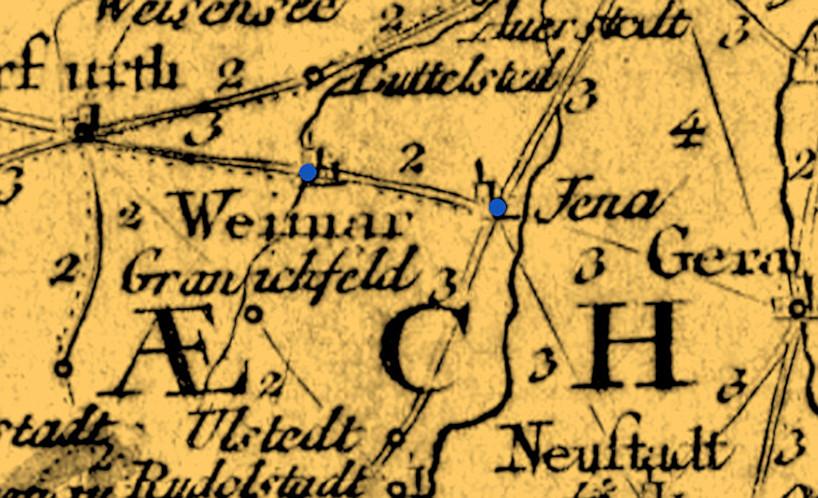

[5] Wilhelm had already written Goethe from Jena on 7 January 1800 (Körner-Wieneke 91):
Our friend Tieck has unfortunately been suffering from severe rheumatism of the knees for more than a month now and has become quite weakened in the process; he has often been quite depressed because he has noticed no improvement and has been wholly unable to work despite all the work he has planned. Although the malady has gotten a bit better, he still is hardly able to walk and on a couple of occasions has had someone carry him over to visit us on a stretcher [from his residence at the intersection of Grietgasse and Fischergasse; see Peer Kösling, Die Frühromantiker in Jena, 44–45].
Goethe replied to the present letter on 5 March 1800 (Körner-Wieneke 95), remarking:
I really feel quite sorry for our good Tieck. I have thought a bit about him lately, and lament that so excellent a talent should encounter, in its prime, such hindrances to the freer, more cheerful exercise of its powers. Back.
[6] At the time, Tieck was fond of reading aloud comedies by, e.g., Ludvig von Holberg; see Caroline’s letters to Auguste on 21 October and 4 November 1799 (letters 250, 253). See esp. the supplementary appendix on Ludwig Tieck reading aloud. Back.
[7] Friedrich completed only poems and sparse prose fragments for the second part of Lucinde, which was never published. For a translation of some of that material, see Friedrich Schlegel’s Lucinde and the Fragments, trans. Peter Firchow (Minneapolis 1971), 131–40. Back.
[8] Friedrich’s important essay “Gespräch über die Poesie” appeared in Athenaeum (1800) 58–128; Eng., Dialogue on Poetry and Literary Aphorisms, trans. Ernst Behler and Roman Struc (University Park, Pennsylvania 1968). Back.
[9] The translation of of the two parts of King Henry IV appeared in volume 6 of Wilhelm’s edition of Shakespeare, König Heinrich der vierte: Erster Theil, König Heinrich der vierte: Zweyter Theil (Berlin 1800). Back.
[10] Gedichte (Tübingen 1800). Back.
Translation © 2013 Doug Stott