
• 248. Caroline to Auguste in Dessau: Jena, Monday, 14 October 1799
[Jena] Monday, 14 October [1799]
|565| Yesterday, my dear little chick, your dear aunt was finally here; I had expected her a week too early. [1] She genuinely was wildly glad to see me and wildly disappointed not to find you here.
They did not arrive until toward midday. Superintendent Hoppenstedt along with his wife, née Glockenbringk, and not much older or taller than you, [2] a pretty little woman, and Doctor Hoppenstedt from Göttingen with Philippine, who is so frightfully ugly that even Sophie looked good next to her. [3] . . .
Her husband pleased me better than did the superintendent. I am hoping they enjoyed themselves here with us. Because I invited Loder and the Pauluses, along with Sophie, we had a fairly large and lively table. Madam Veit had made herself quite beautiful, and I must say that all of us, even the most indifferent personages, are increasingly |566| pleased with her. And I in my new dress was also audaciously pretty.
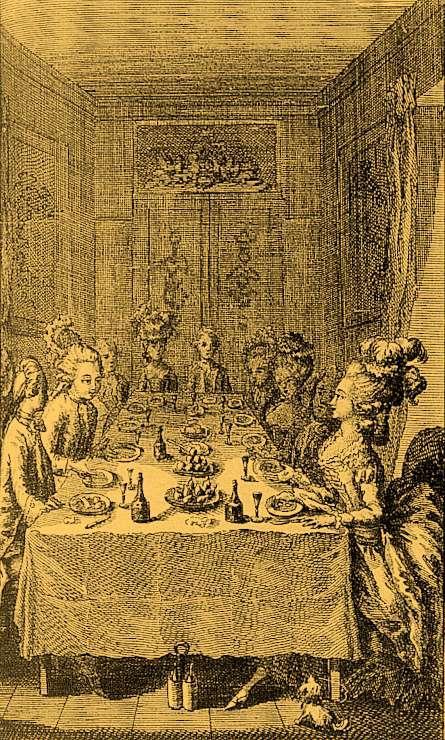
After the meal we all went for a walk, then had tea, then again souper and punch, where Friedrich and I got drunk. [3a] Tonight they departed for Leipzig. They really did have a good time, and I am to give you regards from them all. The little lady would also have liked to see you, no doubt that she might also play a bit with you. —
The day before yesterday I set about entertaining some new company. I invited Madam Fichte over for midday, and my God! we had to go for a walk with her, and then she stayed until 8:00 that evening. [3b] The Frommans came for the afternoon. Although for most of the time the weather has been tolerably good, today it is raining horribly. Schlegel is riding to Leipzig with Loder tomorrow night and will be taking this letter along with him so it will arrive sooner. He wants to speak with Unger in Leipzig. [4]
I continue to have no more news about the Hufelands. They must be in Berlin now [5] and are attending the performance of Hamlet, for which I have simply lost all desire. [6] Nor anything yet from the Tieks either. [7]
We are intensively doing Italian now; [8] every evening at 7:00 our devout, sainted-in-heaven Father Fritz gives us an hour-long lesson. Schelling and me. Madam Veit is also taking part. Fritz or Wilhelm will have to give you extra lessons for a while. We are already too far along. [9]
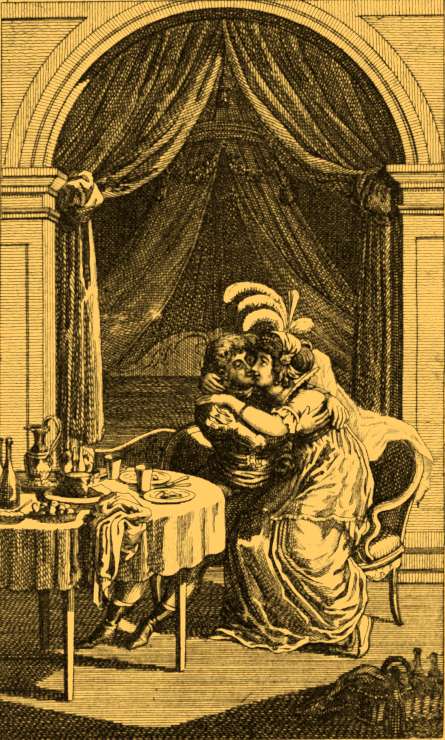
What you recently said to Schelling was not at all nice. If you continue to balk so toward him, I might start believing you are jealous of your mama. It was, of course, not he who made the remark to you about the coy mamsell, it was I, and what is so incomprehensible about it anyway? [10] Do you not occasionally have manners that are as tart as a sour apple? I must relate to you one example of Schelling’s amiability: He secretly had black feathers sent to me for my hat, which now looks quite good on me. Only imagine! I was completely astonished. [10a]
|567| Although Tischbein wrote us a cordial letter from Dresden, we cannot tell from it what his plans are. Do write and tell me what you know about it all; surely I will get letters from you the day after tomorrow.
Philipp is attending the Kirsten Institute and does not inconvenience us in the slightest. [11]
I am sending you a letter from Frau Gotter from which you can see how things stand with the confirmation plans. If Löffler himself is not interested in giving the instruction, I basically do not see why you should go there. [12] Do take the time to write to Cecilie.
The Dieterich son won 20,000 rh. in the lottery just as he was about to be arrested for not being able to pay some money exchanges. [13] If only we had that money!
Stay well, my dearest dear. Everyone sends regards to you and everyone there. Is Madam Tischbein considering my proposal even a little? [14] We would be quite pleased. What a Christmas celebration we would have!
Lady Augusta Murray really is in Berlin. Madam Veit saw her often and is also personally acquainted with Madam de Nuys. [15] Did we already send our thanks for Caroline’s likeness of Madam de Nuys? It really does look just like her. And Wilhelm immediately appropriated it for himself. [16] Will Madam Tischbein be finished soon?
Notes
[1] On 6 October 1799 (letter 247), Caroline had written to Auguste that Philippine Hoppenstedt, née Böhmer, would be arriving the following day. Back.
[2] Louise Sophie Hoppenstedt was five years older than Auguste. Back.
[3] Sophie Wiedemann was the sister of Konradine Luise Hufeland. — Philippine Böhmer was known for being “more ugly than pretty”; see her biogram. Back.
[3a] Doubtless a bit livelier than in this illustration from French society earlier in the 18th century, Retif (or Restif) de la Bretonne, Les contemporaines; ou, Avantures des plus jolies femmes de l’âge présent, 42 vols. in 12 (Leipsick 1780–85), vol. 7 [1780], 170:
[3b] “We” presumably refers at least to Caroline and Wilhelm if not also to Dorothea and Friedrich and apparently also Schelling (Frauenzimmer Almanach zum Nutzen u Vergnügen für das Jahr 1793; Inhaltsverzeichnis deutscher Almanache, Theodor Springmann Stiftung):

Concerning Schelling, see Johanne Fichte’s revealing account of the visit in her letter to her husband on 16 October 1799 (letter 248a). Back.
[4] The autumn Leipzig book fair regularly began on the Sunday after Michaelmas, 29 September; in 1799 that would have been 6 October, Michaelmas itself having fallen on a Sunday. Back.
[5] See Caroline’s letter to Auguste on 6 October 1799 (letter 247), note 7. Back.
[6] Concerning the troubled history of the premiere of Hamlet in Berlin in Wilhelm’s and Caroline’s translation, see Ella Horn’s essay on the background to the premiere of Hamlet in Berlin. Back.
[7] Ludwig Tieck would be arriving in Jena with his wife, Amalie, and daughter, Dorothea, on 17 October 1799. Back.
[8] Dorothea also mentions this instruction in her letter to Schleiermacher on 11 October 1799 (letter 247c). Back.
[9] Concerning Schelling’s participation, see Friedrich Schlegel to Schleiermacher on 6 January 1800 (Aus Schleiermacher’s Leben 3:146; KGA V/3, 339; KFSA 25:42) (Dorothea, who was working on her novel Florentin. Ein Roman herausgegeben von Friedrich Schlegel, vol. 1 [Lübeck 1801] [vol. 2 never appeared]), writes on the same day [Aus Schleiermacher’s Leben 3:147; KFSA 25: 39] about the new “rage and passion” for stanza-making, which had seized even Schelling):
Schelling, to be sure, is completely immersed in his poem [on “nature,” which, however, was never finished], which I do believe will turn into something grand. Until now he has only engaged in various studies for it and is trying to learn how to compose stanzas and terza rima, the latter of which he will probably choose for the whole.
I am reading Dante with him [Schelling] and Caroline, we are already almost halfway through, and once he has an inclination for something, it is great indeed. I have as yet seen only 13 stanzas he did as an announcement of his work at Christmas for Caroline, with whom he gets along very well. Those stanzas were quite beautiful and full of enthusiasm [concerning these stanzas, see Caroline’s letter to Johann Diederich Gries on 27 December 1799 (letter 258)].
See in this regard Rudolf Haym, Die romantische Schule, 636fn, who draws attention to a bit of confusion in the Romantics’ work on Dante that may be of interest to those interested in Schelling’s pursuits apart from philosophy proper during this period:
All this [various poetical attempts by Schelling during this period, including “translation attempts from Dante along with a sonnet to Dante”] along with later, shorter poetic pieces has already been published in Sämmtliche Werke 10:431ff., and several things superfluously reprinted in Plitt. The piece on Dante published in A. W. Schlegel’s Sämmtliche Werke 3:369ff. is actually to be attributed to Schelling, since, apart a few variants, it coincides with Schelling’s Sämmtliche Werke 10:442ff; the sonnet by Petrarch is similarly to be attributed to Schelling (A. W. Schlegel, Sämmtliche Werke, 4:72; Schelling, Sämmtliche Werke, 10:446).
Here Haym refers to Briefe an Ludwig Tieck 3:235, where Wilhelm Schlegel writes to Tieck from Bamberg on 14 September 1800 in reference to their anticipated Musen-Almanach für das Jahr 1802, to which Schelling, using the pseudonym Bonaventura, contributed “Die Letzten Worte des Pfarrers zu Drottning auf Seeland” (118–28) (“The Last Words of the Pastor of Drottning”l Henrik Steffens had supplied the background material), “Thier und Pflanze” (158–59), “Lied” (241–43), and “Loos der Erde” (273):
Schelling will doubtless contribute several pieces, including first of all “Last Word of the Pastor etc.” [in terza rima] and then presumably several Lieder. He would probably compose more poetry were he not losing so much time now because of sickliness [Auguste had just died]. He most recently translated a complete canto from Dante’s Paradise in terza rima, which he is currently polishing and which he then intended to offer you for publication in the journal. I could then at least add an annotation on Dante and on how one must translate him.
The reference is to Schelling’s translation of canto 2 of Dante Alighieri’s Paradise (“All ye, who in small bark have following sail’d, / Eager to listen, on the advent’rous track etc.”). The translation of this canto, with slight variations, is, as mentioned, included in Wilhelm Schlegel’s Sämmtliche Werke 3:369–73 with the following introductory editorial remark (3:373): “The following paraphrased rendering of the second canto of [Dante’s] Paradise was doubtless composed, with A. W. Schlegel’s participation, by his first spouse [Caroline].” Back.
[10] Caroline used a variation this epithet (“stubborn little half-mamsell”) in her letter to Auguste on 30 September 1799 (letter 245). Back.
[10a] Circumstances and Caroline’s tone of voice suggest she might well be teasing Auguste in an unkind way with respect to her — Caroline’s — true relationship with Schelling (Brigitte Rossbeck, Zum Trotz glücklich: Caroline Schlegel-Schelling und die romantische Lebenskunst [Munich 2008], 168–69; illustration: frontispiece to Christian August Vulpius, Rinaldo Rinaldini der Räuber Hauptmann: Eine romantische Geschichte unsers Jahrhunderts, parts 7–12 [Leipzig 1800]):
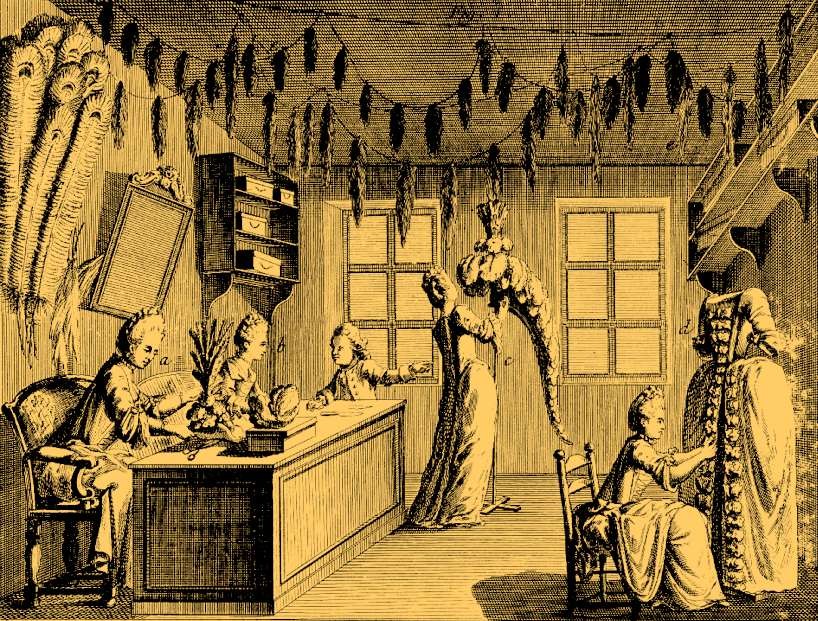
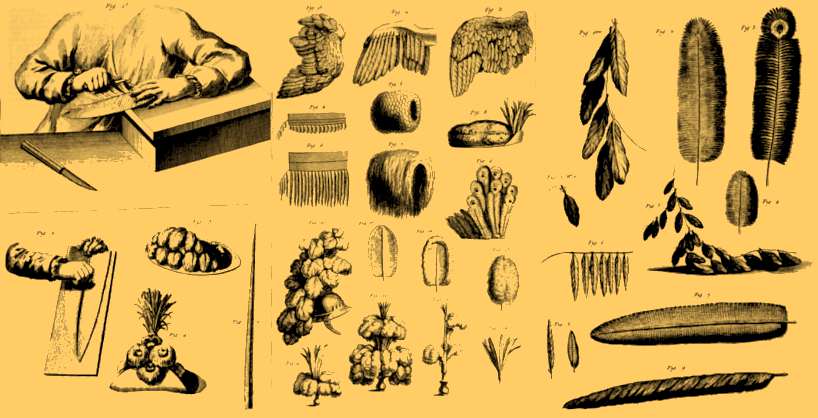
Here in any case 18th-century feathercrafters at work along with stages of production and products (Recueil de planches, sur les sciences , les arts libéraux, et les arts méchaniques, vol. 4 [Paris 1762], 773):
The following illustrations from 1799 portray what were understood to be the latest “London fashions” (Göttinger Taschen Calendar Für das Iahr 1799; Inhaltsverzeichnis deutscher Almanache, Theodor Springmann Stiftung):
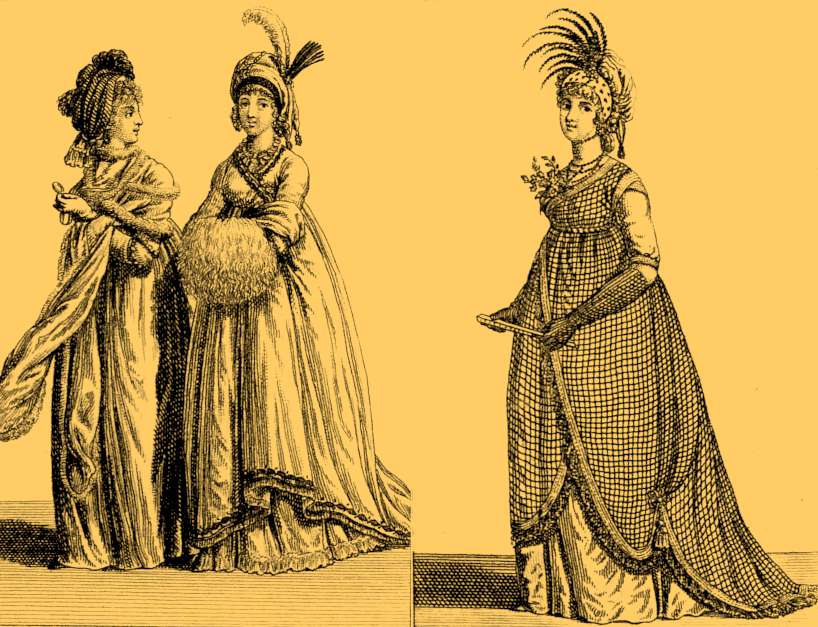
[11] The Kirsten Institute was a private educational institution in Jena founded in 1793–94 by Johann Friedrich Ernst Kirsten; unlike other such institutions, it did not operate under the auspices of the consistory though it was sanctioned by the territorial administration. In June 1797, the institute had twenty-three pupils (Kirsten did not allow the number to exceed thirty) and for non-resident pupils the cost was 120 Rthlr. annually (including supervision, instruction, board, domestic services, light, heat) (Allgemeiner Litterarischer Anzeiger [1797] 68 [Thursday, 8 June 1797], 705). Back.
[12] At issue is Auguste’s confirmation instruction; see Caroline’s letter to her on 30 September 1799 (letter 245), in which she discusses the possibility of Auguste going to Gotha to receive it (Thomas Stothard, Confirmation [1792]; Herzog August Bibliothek; Museums./Signatur FBartolozzi V 3.223):

Erich Schmidt, (1913), 1:746, notes that Luise Gotter responded that Josias Friedrich Löffler would not be able to take over that instruction and instead recommended a certain Pastor Schmidt. Erich Schmidt does not provide information on the rest of the letter, which may or may not be extant.
For Auguste’s reaction, see esp. her letter to Cäcilie Gotter on 6 November 1799 (letter 254). Back.
[13] Unclear allusion; Friedrich Wilhelm Ludwig Dieterich? Back.
[14] Namely, that Sophie Tischbein and her daughters remain in (return to) Jena for the entire winter. They had left Jena in mid-September, having been there since ca. mid-August 1799. See Caroline’s letter to Auguste on 6 October 1799 (letter 247). Back.
[15] Caroline mentions this mix-up in her letter to Auguste on 30 September 1799 (letter 245), with note 19. Back.
[16] Unfortunately, this likeness seems to have been lost, as have all portraits of Minna van Nuys, a woman known for her exceptional beauty (a “famous beauty,” Allmanach auf das Jahr nach der gnadenreichen Geburt Jesu Christi 1786; Inhaltsverzeichnis deutscher Almanache, Theodor Springmann Stiftung):
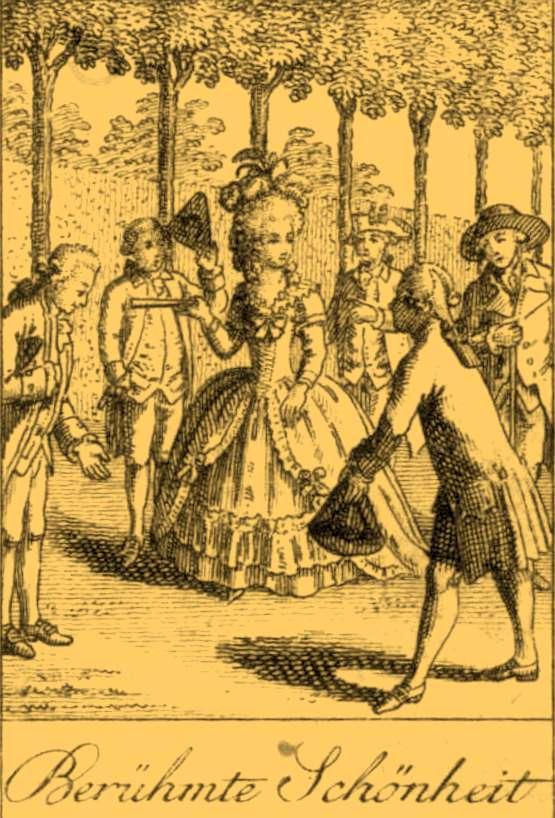
Concerning her relationship with Wilhelm Schlegel, who would later allegedly ask her to marry him, see the supplementary appendix Caroline’s Rival: Minna van Nuys. Back.
Translation © 2013 Doug Stott