
243a. Ludwig Tieck to Wilhelm Schlegel in Jena: Giebichenstein, before 16 August 1799 [*]
[Giebichenstein, before 16 August 1799] [1]
I really must finally let you hear from me, even if only a few words. Please forgive my silence.
I have continued to be quite distracted here, and even today am very much in a hurry, but I will write more extensively on the next postal day, and will enclose the final, shameful, useful, unrecognizable, sportful, rural, versatile, and incredible review. [2]
For now I can only thank both you and your charming wife yet again briefly for everything, including the kindness in securing the coat sack. Friedrich has not yet sent me any Athenaeum, but we do have it here. [3] Voss was still here when we arrived; I spoke a great deal with him, as it were, he was merry, as it were, and we were quite cordial with each other, as it were. [4]
Stay well, my kind regards to your wife. Let me thank you once again, much and often, for her and your hospitality. My wife also sends her regards. Regards also to Schelling, especially from me, and in general to all our other tablemates, especially Auguste, and most specially especially you yourself. In haste,
Yours,
L. Tieck
Notes
[*] Sources: Lohner 40. Dating from Wilhelm Schlegel’s response on 16 August 1799 (letter 243b). Back.
[1] Tieck had spent time in Jena, where he had stayed with the Schlegels, and then returned to Giebichenstein, accompanied by Friedrich von Hardenberg, by way of Weissenfels, where he met Hardenberg’s family. Tieck himself and his family would be moving to Jena in October 1799. Back.
[2] All the German adjectives in Tieck’s tongue-in-cheek sequence in this sentence are rhymed with the sound -endlich[e]. Wilhelm refers to these verbal gymnastics as “Fischartianisms” in his response (letter 243b).
At issue is Tieck’s anticipated review of the latest volume in Wilhelm’s edition of Shakespeare for the Allgemeine Literatur-Zeitung. Tieck never delivered it. See Tieck’s letter to Wilhelm in March/April 1799 (letter 230a); Gottlieb Hufeland’s letter to Wilhelm on 2 May 1799 (letter 236a); and Wilhelm’s letter to Gottlieb Hufeland in July 1799 (letter 242b). Back.
[3] The second issue of Athenaeum (1799) appeared in August 1799. Back.
[4] Here, too, Tieck is writing tongue-in-cheek. Johann Heinrich Voss, a friend of Johann Friedrich Reichardt, was for various reasons decidedly indisposed toward the Romantics. Rudolf Köpke, Tieck: Erinnerungen, 1:243–45, recounts precisely this awkward meeting in Giebichenstein (representative illustrations: Daniel Nikolaus Chodowiecki [illustrations 1, 3, 4], [1] Les Cures des trois Docteurs Doucet, Moellon et Sensé [ca. 1784–88]; Herzog Anton Ulrich-Museum; Museums./Signatur DChodowiecki-Kopie St AB 3.44; [2] Goettinger Taschen Calendar für das Jahr 1791; Inhaltsverzeichnis deutscher Almanache, Theodor Springmann Stiftung; [3] Die Freundschaft [1793]; Herzog Anton Ulrich-Museum; Museums./Signatur DChodowiecki AB 3.968; [4] Belausche sie, die dorten gehn [1778]; Herzog Anton Ulrich Museum, Museumsnr./Signatur Uh 4° 47 [140]):
It was an odd dispensation of fate that, just as he [Tieck] was living amid the wonders of Romantic poesy, he met Voss in Halle, who by nature could not but be the most resolute adversary of that poesy.
Tieck had made a side trip to Weissenfels to visit Novalis, with whom he was already acquainted, when Reichardt’s old friend Voss, at the time still rector in Eutin, arrived on vacation in Giebichenstein.
This coincidence was anything but pleasant for Reichardt. The hostility between Voss and [Wilhelm] Schlegel was already well known. The latter had in the Jenaische Literaturzeitung [i.e., the Allgemeine Literatur-Zeitung] of 1796 [issues 262–267] and 1797 [issues 96, 97] subjected Voss’s translation of Homer and his Musenalmanach to criticism that severely wounded Voss.
Tieck was Schlegel’s friend and had similarly avoided any unqualified praise of the Almanach in his review in the [Berlinisches] Archiv der Zeit [und ihres Geschmacks] [January 1797]. Voss had been educated by way of the culture of classical antiquity, and was one of the premier masters in that field, living in the simple fundamental ideas and forms of antiquity.
In German literature, his models were Klopstock and Gleim. His translations and idylls had enjoyed considerable resonance, and there, too, he had taken a strict treatment of form as his guide, whereas the actual content of his poems was rather sober. He was a solid, rationalistic Low German personality. Like Nicolai, he everywhere feared Catholicism and obscurantism. He acknowledged neither that particular type of mysticism found in the poesy of believers nor the arrogant humor regnant in Romantic writings.
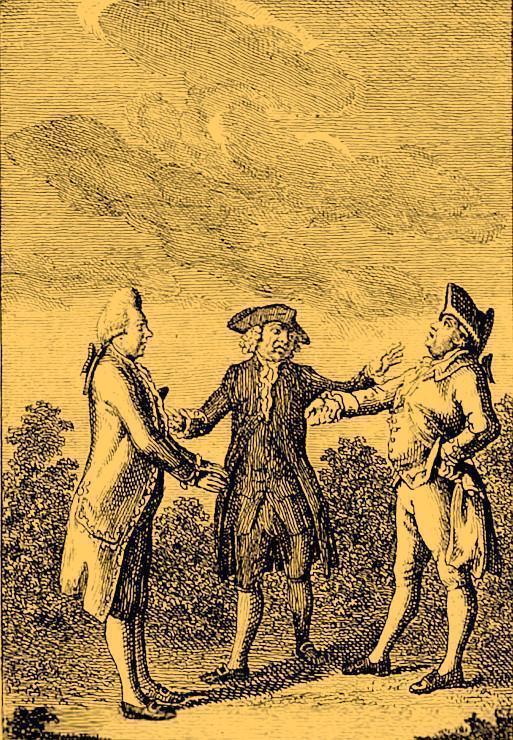
Because Reichardt wanted to avoid any unpleasant personal encounters, he hastily sent a courier to Tieck requesting he not return to Giebichenstein before Voss had left. But the courier met Tieck on the latter’s return journey, and Tieck was not at all inclined to avoid the meeting. Indeed, he encountered both Voss himself and Reichardt near Giebichenstein, the latter of whom was quite surprised to see his well-intentioned caution thwarted. They exchanged a few words, then each went his own way.
In the next conversation with Reichardt, Tieck told him to relax, and that he, Tieck, would not only gain Voss’s friendship, but even prompt the latter to seek him out and accompany him through the entire garden.
When the two adversaries met later, Voss was initially cold and reserved. Tieck could not help but see that this gaunt, dry, stiff man, who spoke in the sharply condescending tone of the scholar, did not make a very favorable impression at all. Nonetheless he was not to be deterred. He approached him with politeness and accommodation, albeit not without irony.
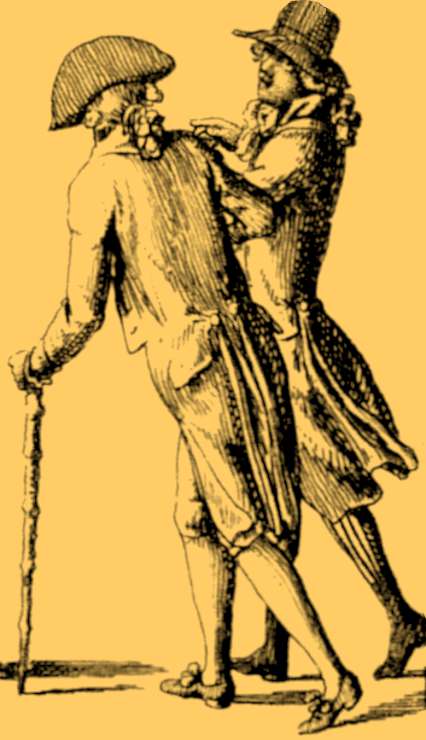
And he finally overcame Voss’s brittle airs. They were soon talking about Goethe. Voss could not refrain from criticizing the hexameters in Herrmann und Dorothea [appeared October 1797; then Berlin 1798]. Tieck quietly listened to these remarks, then dryly responded that there was even a septameter hiding among them. “What?” Voss started, “Well, that would be something indeed! Let us have a look immediately.”
That was the moment for which Tieck had been waiting. They were in the garden; while they returned to the house to fetch the book, Voss followed him with hasty, impatient steps. Tieck’s promise had been kept, and Voss’s good mood wholly reestablished. “You are an excellent young man,” he cried. “You cannot imagine how grateful I am to you for showing me this!”
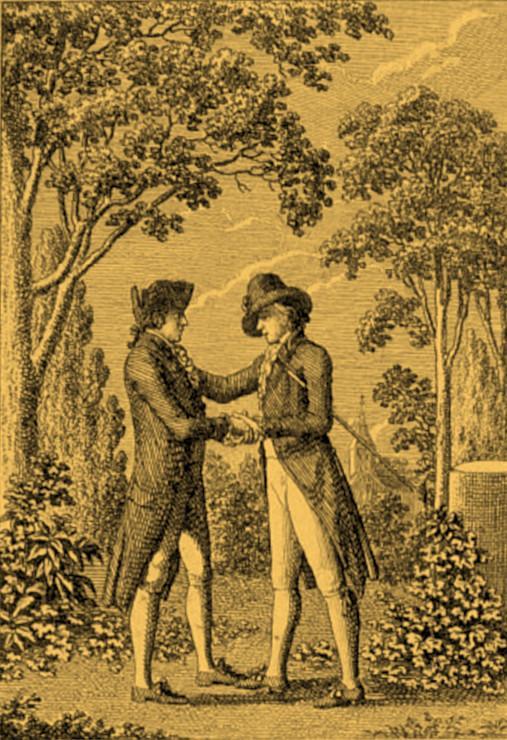
They spent the following days of their shared stay in Giebichenstein quite cordially together.
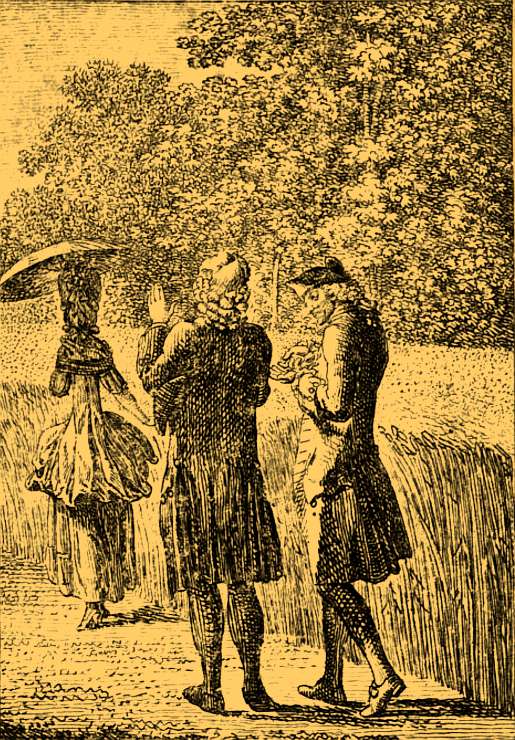
Translation © 2013 Doug Stott