
• 236. Friedrich Schlegel to Caroline in Jena: Berlin, late April 1799 [*]
[Berlin, late April 1799]
|538| I am extremely grateful to you for having given me such an extensive account. [1] I know how irksome it can be to have to write down at the end of the day what one has already had to listen to the entire day. But it was extremely valuable to me. [2] —
What do you think about my intention to write something about it? [3] —
I have, moreover, slipped into a wholly revolutionary state here. All my plans have failed. It is extremely kind of you to invite us so often and so warmly. We were indeed thinking seriously about coming, but not so soon. We would be losing about 30 rh. for the winter because of the logis here; [4] freight alone could cost that much, quite apart from the journey itself. Hence if you two are seriously thinking about changing your place of residence at Easter, [5] it would probably be best for us to come to a definite agreement but then simply leave to chance everything else that might happen beforehand. I for my part need to wait for |539| the reaction to my piece in Weimar before I pick up like that and come with everything I own.
The letter to Voigt is a mistake. But if Voigt was being honest with Fichte, he could easily have sent the letter back to him. — What does it matter that now, after the course the formalities have taken, that he seems to have been in the wrong against such vermin? It is nothing more than that he was too honest. — Did the careless remarks from Madam Schütz — come to you from a completely authentic source? [6] —
I am incredibly curious to know where Fichte will now be going and what he will be doing. The wretched war is currently raging in Switzerland, and that will probably keep him from going there. [7] — Schelling will probably be taking his leave, will he not? [8] —
From what I hear, Goethe is neither warm nor cold, though sooner the latter. I am particularly interested in knowing that. [9]
You certainly have allowed this revolution to evoke all sorts of fears for you insofar as you believe Fichte employed undignified reprisals. — He has been extremely gentle. It is not just atheists who are the opponents, but positive servants of Satan, against whom every writer in Germany is a natural-born soldier.
Which inconsistency in Fichte’s conduct compares to the pathetic nature of the Weimar “And yet“? [10] — “Philosophical opinions are allegedly not an issue etc.” — “And yet his imprudence needed to be reprimanded.” [11] It is abundantly clear that they simply gleefully seized the first excuse that presented itself to them.
Woltmann came here with the idea of becoming Prussia’s Johannes Müller or Spittler. He spent the entire winter wrapped up in intrigues trying to curry favor as a historiographer or who knows what else. Hence such a title is not much more |540| than just a form of refusal. [12] — He finally turned to the king himself, saying he wished to travel to France and Spain under his protection. He was granted such without, of course, any material assistance. Unger really has become quite crazy for and through him. But that is the work of the Ancient Fury.
I paid out the money to Levi three weeks ago today. [13] I am hoping the matter has been cleared up. Fröhlich had already given it to me. If he then also sent you some as well, that can be provisionally credited for the next time.
Are you satisfied with my assessment of the quarrels involving Hirt etc.? Although the passage contra Jenisch is quite nice, the one on Hirt is no less. [14]
Actually, now would be the time for a decisive break with the Literatur Zeitung [15] and to use Hardenberg’s fragment. [16]
One more reason for us to get going with this matter right away is that Goethe is not coming out with an almanach. [17]
Notes
[*] Also in KFSA 24:278–79. Back.
[1] Namely, of Fichte’s dismissal; see Dorothea Veit’s letter to Caroline on 20 April 1799 (letter 234) and Caroline’s to Luise Gotter on 24 April 1799 (letter 235); concerning the course of Fichte’s atheism dispute, see supplementary appendix 215a.1. Judging from Friedrich’s allusions in this letter, Caroline seems to have written Friedrich a letter, regrettably since lost, similar to that to Luise Gotter on 24 April 1799. Back.
[2] The developments had made Friedrich question his own plans for moving to Jena. Back.
[3] See Dorothea’s letter to Caroline on 20 April 1799 (letter 234), note 2. Back.
[4] I.e., because of the leasing agreement; Caroline’s invitation, of course, was for Friedrich and Dorothea to move to Jena (Rudolf Koch and Fritz Kredel, Deutschland und angrenzende Gebiete [Leipzig 1937]):

[5] Nothing more is known about this anticipated move; Wilhelm, Caroline, and Auguste had been living at Leutragasse 5 since early October 1796 and would not give up that lease until late May 1802, when Wilhelm was living in Berlin rather than Jena in any case and Caroline would then move to the “Asverus house” (the house of “tanner Eckardt”) at Fürstengraben/Lutherplatz. See Peer Kösling, Die Frühromantiker in Jena, 34–35. Back.
[6] Unknown allusion from Caroline’s lost letter to Friedrich. Back.
[7] Fichte’s wife, Johanne Maria, née Rahn, was from Zürich, a focus of two important battles during the War of the Second Coalition. In early June 1799, Archduke Charles defeated André Masséna at the battle of Zürich, though in late September 1799 Masséna in his own turn defeated the Russian coalition forces there under Alexander Korsakov (W. R. Shepherd, Historical Map of Central Europe about 1786 [1926]; street battle in Zürich on 26 September 1799 [Stadtarchiv Zürich]):
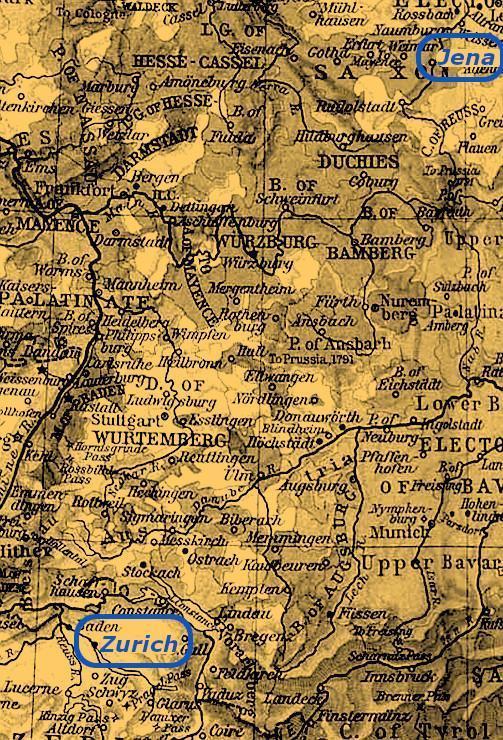
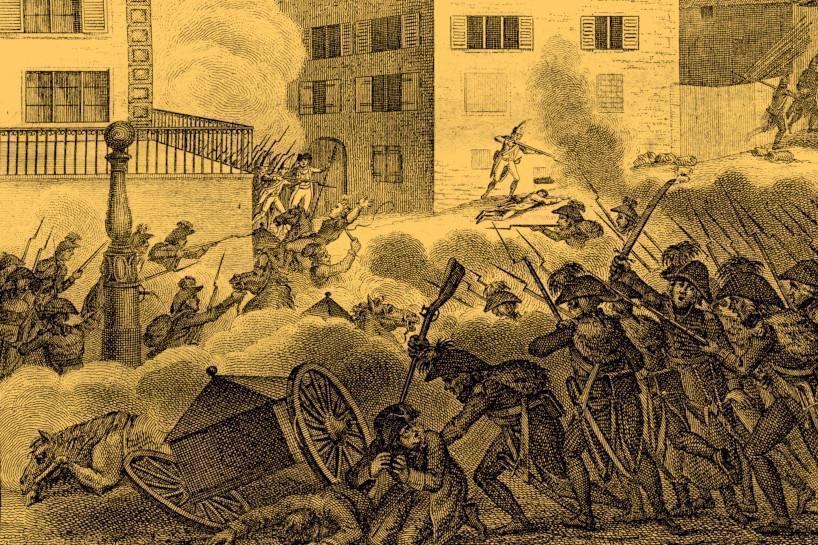
Amid such circumstances, Fichte wisely did not go the Switzerland; he arrived instead in Berlin on 3 July 1799 for a lengthy stay, initially alone and as a boarder with Dorothea Veit, then returned to Jena. In early 1800, he returned to Berlin with Johanne and his son, Immanuel Hartmann. Back.
[8] Schelling did not leave Jena immediately in the wake of Fichte’s dismissal, but rather not until July 1803 with Caroline. Back.
[9] Goethe, who doubtless had a voice behind the scenes in this affair, blithely dismisses the quarrel in his Tag- und Jahreshefte (Weimarer Ausgabe 35:31–32); here Goethe writes concerning 1794, the year Fichte came to Jena:
After Reinhold’s departure, which quite justifiably seemed to constitute a great loss for the academy [the university in Jena], Fichte, in a bold, even daring move, was appointed to replace him, someone whose own writings had addressed the most important questions of morals and the state with grandness but perhaps with less appropriateness than one might have wished. He was one of the most capable personalities ever seen, irreproachable with respect to his disposition from a more lofty perspective; how, however, was he to keep pace with the world, which he viewed as a possession he himself had created?
Because the hours he wanted to use for his own lectures had been restricted on normal workdays, he chose Sundays to commence his lecturing, whose preliminaries then encountered obstacles. Both lesser and greater problems emerging from this situation had hardly been addressed and solved — not without considerable trouble to the authorities — than his utterances concerning God and sacred things, concerning which one admittedly ought to observe profound silence, began to provoke complaints from outside for us.
In the Electorate of Saxony, certain passages in Fichte’s journal did not enjoy a very affable reception, and it did indeed require considerable effort to lend an acceptable interpretation through other words to that which was as a matter of fact expressed a bit strongly to begin with, to mitigate it, and, if not entirely lend it credence, at least to render it somehow pardonable.
Concerning the background to other courts having a voice in Fichte’s situation, see section on the Ernestine trustees in the supplementary appendix on Germany in the late-eighteenth century. Back.
[10] Friedrich seems to be referring to the expression “that notwithstanding” (demungeachtet) in the missive from Karl August to the academic senate in Jena (here from Die Schriften zu J. G. Fichtes Atheismus-Streit, ed. Frank Böckelmann [Munich 1969], 195) after the acknowledgement that
even though philosophical speculation cannot constitute an object of legal decisions, we must, that notwithstanding, judge the dissemination of, at least given their present wording, strange and offensive statements by the editors of the Philosophisches Journal to be extremely incautious, insofar as we ourselves are, after all, justified in expecting that academic teachers sooner protect the reputation of the academy by withholding such ambiguous statements and essays. Back.
[11] The next paragraph in Karl August’s missive reads:
We thus graciously desire thereby that following the registered conforming rescripts of the royal courts you might reproach Professors Fichte and Niethammer for their imprudence and recommend they pay better attention to whatever essays they present to the public. Back.
[12] Karl Ludwig von Woltmann had managed to secure the title of Hofrath. Back.
[13] Presumably Markus Levin. — Concerning payments from Heinrich Frölich, Friedrich’s letter to Caroline in late March 1799 (224b), note 12, and in late March 1799 (letter 225), note 15. Back.
[14] The reference is to two entries in the “Litterarischer Reichsanzeiger” in Athenaeum (1799); the first, 331—32, was directed against Alois Hirt (for the text, see the supplementary appendix on the Laocoön dispute with Alois Hirt).
The other piece in Athenaeum, on 332–33, lampoons the announcement of a Jenischia by the author of the Borussia, namely, the Berlin preacher Daniel Jenisch. As Erich Schmidt, (1913), 738, remarks, the “thrashing” meted out to Jenisch in Goethe’s “Litterarischer Sansculottismus,” Die Horen, no. 2, issue 5 (1795), 50–56, was apparently not enough for him; see the commentary to Goethe’s article in Goethes Werke, Hamburger Ausgabe, vol. XII, Schriften zur Kunst, Schriften zur Literatur, Maximen und Reflexionen (Munich 1981), 697:
[Goethe’s] essay, written in May 1795, was directed against the “uncultured presumption” . . . with which unestablished authors and periodicals were trying to push aside better writers, as did the sansculottes during the French Revolution in the political sphere. Such includes the resistance to Schiller’s periodical Die Horen, resistance which also later provided targets for the sharp criticism of the Xenien. The author of the essay [“Über Prosa und Beredsamkeit der Deutschen”] in the Berlinisches Archiv der Zeit und ihres Geschmacks of March 1795 cited by Goethe here was . . . the much-derided writer Daniel Jenisch (1762–1804), who also became involved in the Xenien controversy.
To wit, writing as Gottschalk Necker, Jenisch had in January just mockingly attacked the Athenaeum fragments in the Berlinisches Archiv der Zeit und ihres Geschmacks (1799) 1:44–47, commencing with an imitation of the famous Athenaeum fragment 216, namely, that the “French Revolution, Fichte’s philosophy, and Goethe’s Meister are the greatest tendencies of the age” (trans. Friedrich Schlegel’s Lucinde and the Fragments, trans. Peter Firchow [Minneapolis 1971], 190).
Jenisch asserts that, as a famous thinker allegedly recently wrote, the “signs of the time include Athenaeum of the Schlegel brothers, who possess the gift of thinking the otherwise unthinkable, feeling what can otherwise only be thought, viewing what can otherwise only be felt, touching with their hands what can otherwise only be viewed, etc.” Wilhelm now responds in Athenaeum:
The author of the Borussia [Borussia in 12 Gesängen (1794), an epic on Friedrich II of Prussia] is just now working on the 152nd canto of his Jenischia, a heroic poem in hexacontameters, to be continued. In this canto, he describes how, for preliminary studies for the Borussia, he read through every heroic poem written since the creation of the world in fourteen days. He hopes to dispense with his famous feud with the Magister Reinhard on account of a falsified letter in ten cantos [a dispute that began in 1795 and extended into November 1796]; similarly also the comparison of fourteen languages in connection with a competition conducted by the Berlin Academy.
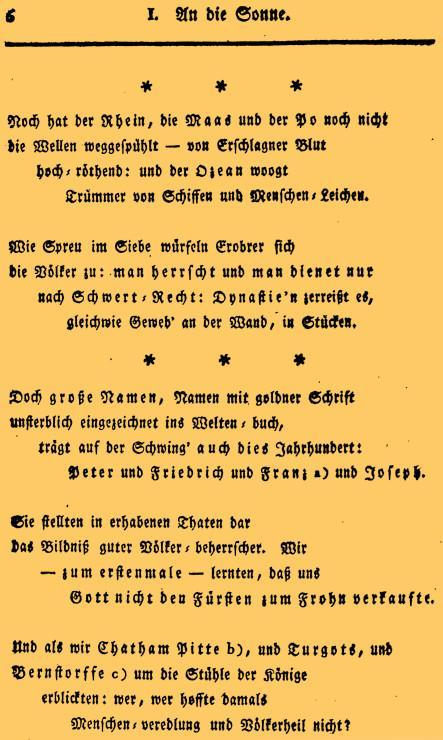
The invention of asterisked odes will eventually constitute the conclusion, namely, such as are frequently divided by three asterisks because otherwise they would be too boring to read in a single stroke [an allusion to Jenisch’s poem “An die Sonne: Am ersten Morgen des letzten Jahres in dem scheidenden Jahrhundert,” Berlinisches Archiv der Zeit und ihres Geschmacks (1799) 1:1–13 — i.e., the same issue in which Jenisch lampoons the Athenaeum fragments — in which Jenisch separates each of fourteen cantos by three asterisks: * * * ; “stroke,” same word in this context as “hyphen”: Germ. Strich.]
[15] As early as 1797, Wilhelm, one of the most talented contributors to the Allgemeine Literatur-Zeitung, had engaged in a touchy correspondence with the editor Christian Gottfried Schütz because of what he considered arbitrary editing of his review of Johann Gottfried Herder’s Terpsichore, 3 parts (Lübeck 1795, 1796); see their exchange early December 1797 (letters 192a, b). An awkward peace lasted only into the autumn of 1799. Back.
[16] Fragment 114 of Hardenberg’s “Miscellaneous Observations,” though not published as part of the “Blüthenstaub” in Athenaeum (1798) 70–106 (Novalis: Philosophical Writings, trans. and ed. Margaret Mahony Stoljar [Albany 1997], 43):
The Allgemeine Literatur-Zeitung is like those people who, out of attachment to the good things of this life, seek only to maintain life as long as possible. Hufeland’s macrobiotics [Die Kunst das menschliche Leben zu verlängern (Jena 1797), 3rd ed. with the addition “Makrobiotik” in the title; Hufeland’s theory concerning the prolongation of human life] was put into practice even earlier by the dispatchers of the Allgemeine Literatur-Zeitung. In the beginning the paper was debauched by new ideas. It had a weak constitution all along. Long use of Kantian concepts did it much damage. Now it has become more vigilant and is trying to prolong the golden dream of earthly existence for itself as long as possible by a diet of fasting, only occasional use of spirituous liquors, and accommodation to the influence of the weather, according to Hufeland’s highly praised principle of moderation. Back.
[17] Friedrich and Wilhelm were looking for alternative publication sources; the quarrel with the Allgemeine Literatur-Zeitung predictably intensified and ended with a break toward the end of 1799, though Wilhelm had already fired the first volley in a letter to Gottlieb Hufeland in late April 1799 (letter 235a); see Hufeland’s response on 2 May 1799 (letter 236a). Back.
Translation © 2013 Doug Stott