
• 230f. Friedrich Schlegel to Auguste Böhmer in Jena: Berlin, after mid-April 1799 [*]
[Berlin, after mid-April 1799]
How does my little Henriette please you? [1] — Would you have liked to keep her there with you? Were you sad when she departed?
I am anticipating hearing quite a bit from you, more than I can really relate to you today even though I am in a sensible enough condition.
All of you have done quite ill in making something of Iffland whether he is even there or not. [2] Your friend Tieck is particularly angry about this. I will be coming with him to visit you this summer so I can scold the lot of you face-to-face. Give my regards to Fichte if you see him, or even if you do not see him. And above all to Madam Dressmaker, [3] and tell her that if she knows anything about Tieck’s Fantasus, she needs to sew it all together for the Notizen. [4] And tell her I am not yet quite finished with Lucinde.
How greatly I pity you for being able to shine now only in borrowed trousers! [5] Poor girl!
Tieck sends his regards to the venerable adviser [6] and to you, our foolish little fool.
Your eternal Friedrich
Notes
[*] Source: Schmidt (1913), 1:641 (letter 27); Waitz (1871), 1:371; reprinted in KFSA 24:274. — Concerning the textual history of Friedrich Schlegel’s letters to Auguste Böhmer, see supplementary appendix 181d.1.
Dating: Erich Schmidt dates the letter to “March/April 1799”; KFSA 24:455 to “after mid-April 1799,” albeit presupposing Henriette Mendelssohn’s departure from Jena on 16 April, a departure mentioned here but not specifically dated. Although 16 April is the date traditionally given for that visit, the date and length of Henriette’s stay in Jena is wholly uncertain; see the editorial note to Henriette’s letter to Dorothea Veit on 16 April 1799 (letter 230c) and her letter to Dorothea on 19 April 1799 (letter 230e), note 1.
Assuming Karl von Holtei’s dating of Henriette’s three letters in Dreihundert Briefe, 1:2:172–77 (here letters 230c, d, e), is correct, Henriette was in Leipzig on 16 April but still expected in Jena at midday (a 75 km trip and not on the way to Dresden), then in Dresden on 18 and 19 April, departing from there for Vienna on 19 April. The possibility exists that Henriette was in Jena on 17 April, then journeyed on to Dresden the same day. Back.
[1] Pieter Yver, Familienbesuch (1736):
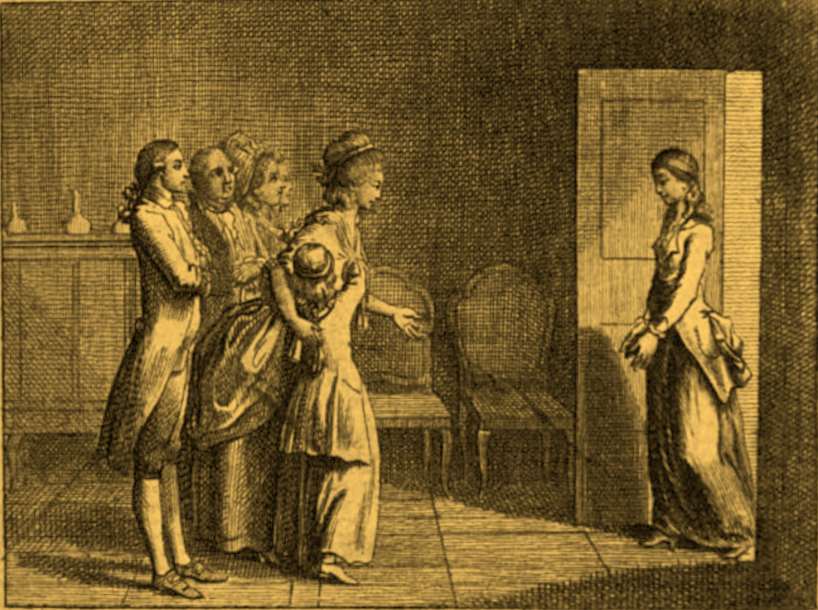
[2] Henriette Mendelssohn had written to Dorothea Veit on 16 April 1799 (letter 230c): “I wrote Caroline about how their later coming [to Berlin] was making all of you so impatient, and may God forgive them for what they are doing for Iffland” (see ibid., note 3). Back.
[3] Viz., Caroline; see Auguste’s letter to Cäcilie Gotter (letter 220) concerning Caroline’s role as a “tailor’s wife who pretends to be a real Ladyship” in the amateur theater production in which she and Auguste would be performing. For the text of the scene in which Caroline and Auguste appear in this play, see supplementary appendix 220.1. Back.
[4] I.e., for the section “Notizen” in Athenaeum (1799) 285–327, which would appear in August 1799. Friedrich is soliciting Caroline to review the lengthy poem “Die Phantasie” in vol. 2, chap. 2 of Tieck’s Franz Sternbalds Wanderungen, 2 vols. (Berlin 1798), 306–13, which begins (approx. rendering):
Who could be that old man there,
Who firmly in the corner bound,
Neither moves nor stirs nor goes around?
Reason guards him without grace,
Noting every change of face.
The old man vexed and sullen sits,
Enfolded by a cloak so broad,
In a thousand folds it 'round him fits.

Phantasus he, wondrous old man,
His wit does never, ever cease,
But follows whimsical caprice, —
But now have they bound him ever close,
He can but cease to be jocose,
Nor disturb fair reason deep in thought,
Nor poor human beings, who every day,
To complete their labors seek a way
In peace and quiet, as they surely ought,
And with their neighbors reasonably speak,
Nor appear as fools who do but shriek.
Of good sense he has none in store,
Dallying about with his toys and more,
Rummaging about and making noise
When everyone ignores his beloved joys etc.
Although Caroline did not contribute anything to the Notizen on Tieck, see Wilhelm Schlegel to Tieck on 30 November 1798 (Lohner 35): “My wife wants me to thank you most ardently for the old Phantasus, who enormously entertained her.” Tieck responded (ibid., 37): “The Phantasus is my favorite poem in Sternbald; I am extremely gratified that she took particular note of it.” After moving to Jena, Tieck divulged to Dorothea Veit that the poem’s author was in fact his sister, Sophie Bernhardi (see Dorothea’s letter to Sophie Bernhardi on 4 November 1799 [letter 253a]). Back.
[5] See note 3 above; Caroline made Auguste “a proper boy’s costume” for her role in the play. Back.
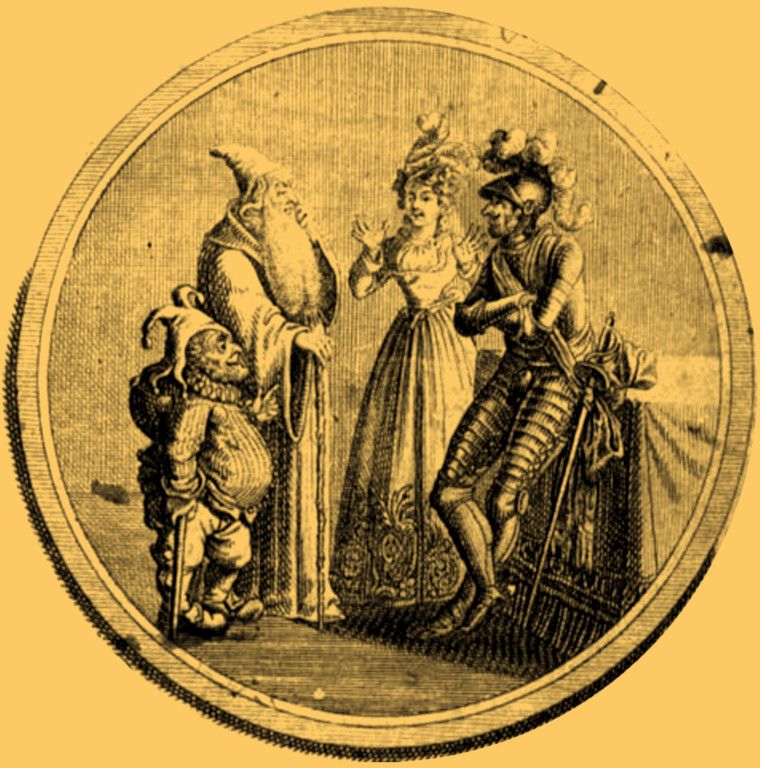
[6] The “venerable adviser” is Wilhelm, so named after a character — der Rathgeber — in Ludwig Tieck’s play Ritter Blaubart. Ein Ammenmärchen in vier Akten von Peter Leberecht (Berlin, Leipzig 1797), a play Wilhelm himself had reviewed in the Allgemeine Literatur-Zeitung (1797) 333 (Thursday, 19 October 1797) 161–65. Here the frontispiece of the original edition:
Translation © 2013 Doug Stott