
• 213. Friedrich Schlegel to Caroline and Wilhelm Schlegel in Jena: Berlin, 22 December 1798 [*]
Berlin, 22 December 1798
|486| There is not really much to write today, my dear friends. — I am doing so primarily so that the two enclosures, particularly the one from Henriette, do not lie around here any longer. [1]
Actually I do have one bit of news to report, one that will be quite pleasing to Wilhelm, as it was to me as well. Fröhlich has resolved to buy Athenaeum from Vieweg, whom our own resolute stance forced into granting somewhat better conditions. [2] He was intending to come to me yesterday morning with the points of the contract that I might send them to you today. But he did not come, and since the weather was very good, it must be, as one might suspect in any case, that he did not completely come to an agreement with Vieweg. —
Everything else that does not involve the change or continuation of the title and everything associated with it will remain just as I already reported to you. But since he seems extremely in favor of an honorarium of 2 louis d’ors, I suggested that in addition to the paper an operation also be performed on the format similar to the one performed for the second year of issues of Die Horen. [3] The older font, but only 24 instead of 30 lines, and a bit more widely spaced. — The old format really is too large for 2 louis d’or.
And one other strange, almost comical point. He may have heard something from Vieweg about your taking up arms against Wieland. He is so attracted to this idea, however, believing it will have such a grand effect, that he is requesting and indeed wishes to receive this piece for one of the four (initial) issues he has agreed to undertake. [4] —
I would think you could probably do him this favor, since Wieland cannot become any more angry than he already is in any case and because Fröhlich is certainly correct as far as the anticipated effect is concerned, something already evident |487| from your review of Voss [5] and from the statements [?] [6] concerning Lafontaine and Richter. [7] How lovely if Wieland’s literary death could be one of the points of the contract. —
But all kidding aside, let me entreat you to find the opportunity in this regard to write a few polite and accommodating lines to Fröhlich yourself, who does, after all, really deserve the gesture, and to tell him yourself whether, the extent to which, and when you can and intend to fulfill his request.
Our story is creating a general stir here; [8] in the meantime, however, all that is almost over now, as is the irksome business itself. It is indeed, by the way, quite salutary that I and my lady friend can now see and sense anew what a pack of scoundrels and rogues it was among whom we had lowered ourselves to live. —
I am very happy with my new freedom. My Lucinde has gotten off to a good start with which I myself am satisfied and which Dorothea and Schleiermacher cannot praise enough. — You will see, I will yet become properly practical and useful; I can already sense [?] it. [9]
As far as Henriette is concerned, she has — since all things are, after all, transient — already completely recovered from here initial silliness. In the meantime, however, she is nonetheless softer than one might deem appropriate, and even the ordinariness of the unspeakably ordinary sister — the superfluous one — has not passed without an element of infectious influence. Henriette’s beautiful soul would doubtless be even more beautiful were it not so excessively and exclusively beautiful.
This is how things currently stand regarding her coming or not coming. [10] —
The people from, among, and with whom she is living simply cannot comprehend why she really wants to go visit you in the first place, since doing so will sooner cost than earn money for her. But because the scoundrels are intent on comprehending absolutely everything, they are also audacious enough to try to figure it out, and so, quite according to the law of |488| of the association of ideas, the true principle of their morality, they come up with nothing but Schlegel and Schlegels, and when they are intent on being really perspicacious, they begin intimating a move toward Christianity, from which they shrink more even than from death itself. [11] —
To be sure, they do not mention these reasons explicitly; instead, they merely adduce the “winter” and the “lack of the right opportunity,” neither of which, however, is the real hindrance. [12] —
Notes
[*] Reprinted (with reference to original manuscript) in KFSA 24:217–18. Back.
[1] The enclosures seem to have been lost. Back.
[2] At issue is the transfer of Athenaeum to a new publisher and the conditions of that transfer; see Friedrich’s letters to Caroline (undated) in November, on 27 November, and 15 December 1798 (letters 209, 210, 212). Back.
[3] Schiller’s periodical Die Horen, the second year of publication being 1796, after which the volumes do indeed exhibit a different format. Back.
[4] Concerning Wilhelm’s proposed “annihilation” of Christoph Martin Wieland, see Friedrich’s letter to Caroline of 20 October 1798 (letter 205) and esp. the supplementary appendix on the the break with Wieland, specifically its section on Wieland’s annihilation. Back.
[5] Wilhelm’s review of the Johann Heinrich Voss’s Musen-Almanach für das Jahr 1796 and Musen-Almanach für das Jahr 1797 (Hamburg 1796, 1797) appeared in the Allgemeine Literatur-Zeitung (1797) 1 (Monday, 2 January 1797) 1–8; 2 (Tuesday, 3 January 1797) 9–16 (repr. Sämmtliche Werke 10:331–51). Back.
[6] Germ. Worte, uncertain reading both in Schmidt (1913) and KFSA 24. Back.
[7] See Caroline’s review of August Lafontaine, with mention of Jean Paul (Friedrich Richter). Additionally, for the text of the Athenaeum fragment on Jean Paul, to which Caroline seems also to have contributed, see Friedrich’s letter to Wilhelm Schlegel and Auguste on 18 December 1797 (letter 194), note 4.
Concerning Wilhelm’s treatment of these two writers in his Berlin Vorlesungen über schöne Literatur und Kunst, see Rudolf Haym, Die romantische Schule, 790–91:
The Berlin reading public had indeed by no means yet realized the enormous distance separating Goethe from previous German poesy. . . . There were still a great many who believed the golden age of German literature had in fact concluded with Klopstock, Lessing, and Wieland. Schlegel was quick to trump precisely these traditional believers by insisting that as far as he could see, it was as if we — the word taken in its full meaning — “still had no literature at all, being at most right at the point where we might finally acquire one.” Indeed, thus Schlegel, only the people, the common citizen really had a literature at all, namely, as Peter Leberecht [pseudonym of Ludwig Tieck] had maintained, the so-called Volksbuch [Tieck, Volksmärchen (Berlin 1797)].
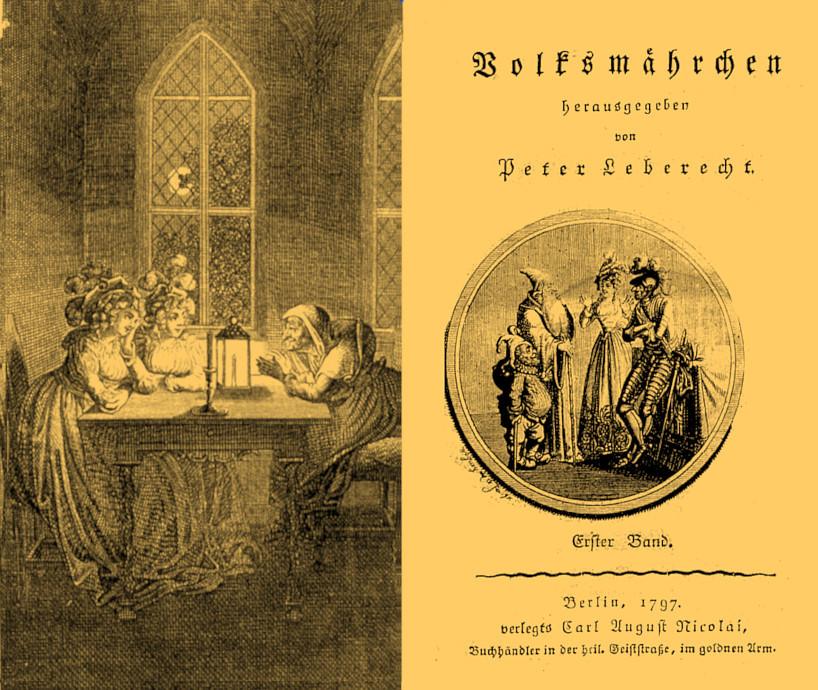
Those extremely old writings, with their genuinely poetic foundation, “need only be freshened up by a true poet in order to emerge in all their magnificence.”
To further underscore his condemnation, he passes review on the primary amusements of the day, characterizing first the delight that the emptiness and curiosity of the contemporary reading public finds in the mass-produced novels that spin an empty love intrigue through multiple volumes, and then demonstrating such by referring to several of the most popular novelists of the day. Although he mentions no one by name, the more astute among his listeners were probably whispering to one another, “But wait, that is Jean Paul! and that Lafontaine! . . . “
See Wilhelm’s remarks in his Vorlesungen über schöne Literatur und Kunst, 2:20–21:
Novels sprout forth like mushrooms under the hands of our most popular writers.
The one [Lafontaine] does possess a certain talent in portraying the vehemence of characterless emotions, which raised higher expectations when he first appeared. But afterward he completely went overboard, a good-natured interest in the fate of his fictional characters now constituting the sum total of his enthusiasm; utterly without understanding, and actually without imagination as well, he knows of no other refuge than to trot out traditional, charitable magnanimity, and love dalliances that allegedly emerged through early habituation during childhood, then suffered separation and all sorts of suffering, in order finally — lest things end too sadly — to be guided to the goal of reunion.
Yet another writer [Jean Paul] exhibits a sickly sentimentality, an almost gouty irritability of the imagination, a capricious sense of humor; unacquainted with the world itself, and restricted to the horizon of a small town, he writes novels that are sooner conversations with himself, and as an unconscious eccentric gives them a certain reclusive charm.
People love him and think they can find all sorts of deeper connections in his compositions between seriousness and jest, deeper than anything even he himself conceived. He is praised, popular, visits larger towns, comes into better or at least broader society, is flattered by women, becomes acquainted with men whose literary endeavors begin with genuine artistic intentions and wants to be just like them, since although well-read in the trashier genres he is unacquainted with masterpieces and is in any event incapable of comprehending them in their purity. And all this destroys his original naïvité without, however, offering any compensation. And now he writes pretentious works that are mere echoes of his initial ones. Back.
[8] That is, the scandal of Friedrich’s relationship with Dorothea Veit (Daniel Nikolaus Chodowiecki, Gnädige Herren, schöne Frauen [1777]; Herzog Anton Ulrich-Museum; Museums./Signatur DChodowiecki AB 3.212):

See supplementary appendix 210.1. Back.
[9] See Erich Schmidt, (1913), 1:733: “The word seems to be ‘sense’ [spüre] instead of ‘save’ [spare].” Schmidt is referencing Georg Waitz’s reading of “save” (spare) in (1871), 1:235; see also Waitz’s introduction, final example in note 12 (ix, note 1 in the original), where Waitz is discussing variant readings:
Haym 495fn*, line 5 [where Haym cites this passage] does in any case incorrectly read “I am sparkling, shimmering” [schillre] rather than “saving” [spare].
Schmidt, letter 213, (1913)), 1:487, reads “I sense, feel” (spüre), but does add a bracketed question mark as reproduced above. Raymond Immerwahr, KFSA 24: 218, 429n11 to letter 129, follows Haym (schillre) and cites Schmidt’s variant reading but not Waitz’s (spare). Back.
[10] Henriette had for some time been planning to stay with the Schlegels in Jena on her way to Vienna; concerning her decision to try out her independence, see Friedrich’s letter to Caroline and Wilhelm Schlegel on 15 December 1798 (letter 212). Also earlier Caroline’s letter to Friedrich 14–15 October 1798 (letter 204) with note 30. As it was, she seems to have spent only 16 April 1799 in Jena with the Schlegels. See also her letter to Wilhelm on 18 December 1798 (letter 212c). Back.
[11] Ironically, Dorothea Veit, after converting to Protestantism and marrying Friedrich in 1804 in a Protestant ceremony in Paris, would convert with Friedrich to Catholicism in 1808. Back.
[12] Henriette was obviously — and curiously — getting considerable advice against making the side excursion to Jena (Göttinger Taschen Calender für das Jahr 1794; Inhaltsverzeichnis deutscher Almanache, Theodor Springmann Stiftung):

One wonder why, then, she was so intent on making it in the first place; girlish admiration for Wilhelm? See her letter to him on 16 August 1798 and 18 December 1798 (letters 202g and 212c). Back.
Translation © 2013 Doug Stott