
• 198. Friedrich Schlegel to Wilhelm Schlegel in Jena: Berlin, 6 March 1798 [*]
[Berlin, 6 March 1798]
|448| . . . Your wife wrote me an extremely vehement and insulting letter about Athenäum that you probably did not see before she sent it. The entire two days this pointless annoyance ruined for me I can make up by staying up late and through considerable exertion, and my health can probably withstand a few knocks. But my good spirits, my good mood are gone, and will probably not be returning any time soon . . .
It is bad enough that I do not really know whether you authorized Caroline to add the reminder concerning the organization [of the fragments], [1] and now, amid such uncertainty, I cannot really make those changes, nor wait again for the printing, nor certainly have everything reprinted differently. You do not seem to have related to Caroline anything regarding the trust you initially put in my organization of the fragments, since she thinks I will be distributing them such that those in the 2nd issue would merely appear to be a continuation of the final numbers of the 1st issue. [2] . . .
Lest you be caught unawares, let me warn you beforehand that my fragments will still include some that are not short. Caroline thinks my fragments are often too long. That, of course, is one of those comments — the response to which invariably gets stuck in one’s throat [3] . . .
I for my part have no objections to the passage in the “Sprachen” concerning language usage etc. that Caroline explicitly brought to my attention. I found it quite witty, as did Schleiermacher. [4] . . .
Notes
[*] Source for supplementary material not included in Schmidt (1913), 1:449: Walzel, 362–64; reprinted in KFSA 24:99–100. — Dating according to KFSA 24:376.55n1, which deduces the date from a letter Schleiermacher writes to Wilhelm Schlegel the same day.
This letter documents the ongoing and subtly increasing tension between Friedrich and Caroline. Back.
[1] What eventually became the “Fragmente,” Athenaeum (1798) 179–322. Back.
[2] The fragments in issue 1 were Friedrich von Hardenberg’s “Blüthenstaub,” Athenaeum (1798) 70–106. Back.
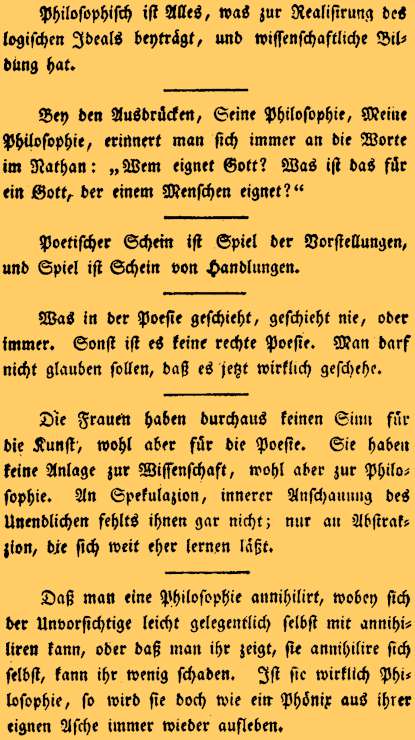
[3] One of Friedrich’s shorter fragments is no. 62 (trans. Friedrich Schlegel’s Lucinde and the Fragments, trans. Peter Firchow [Minneapolis 1971], 169): “Publishing is to thinking as the maternity ward is to the first kiss.” Here a sample page of such shorter or slightly longer fragments (p. 201 in repr. pagination, p. 25 in original pagination):
One of his moderately lengthy ones — but certainly not the longest — is fragment no. 379 (ibid., 291–92; orig., 115–16), beginning with “Der Satan” and extending to the next page:
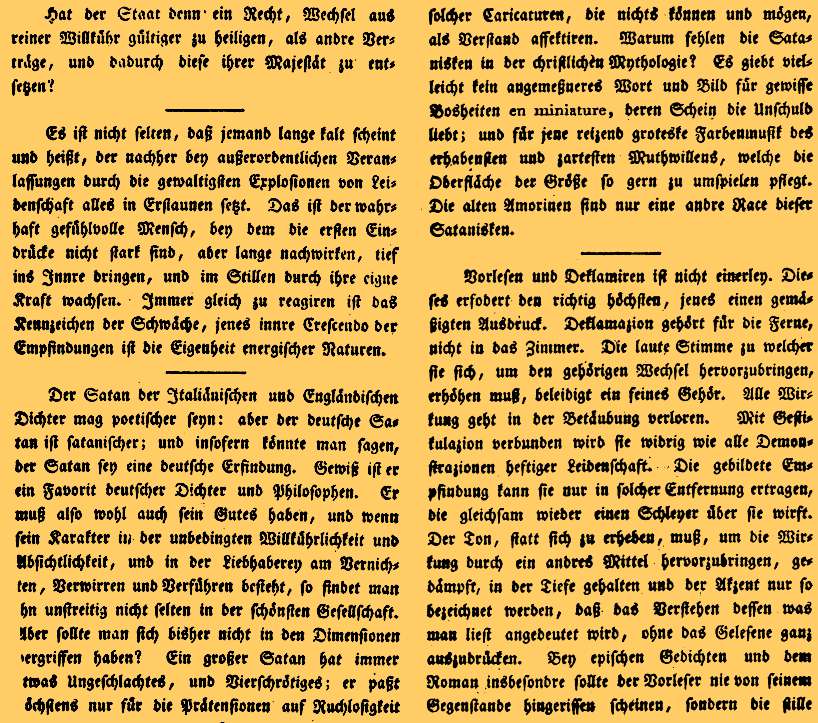
The Satan of Italian and English poets may be more poetical, but the German Satan is more satanic; and to that extent one might say that Satan is a German invention. Unquestionably he is a favorite of German poets and philosophers. So he probably must have his good side, and even if his character consists of unlimited willfulness and scheming, and a fondness for destroying, confusing, and leading astray, one still finds him not infrequently in the very best society. But isn’t it possible that up to now people have been mistaken about his real proportions? A great Satan always has something rough and robust about him; at best he only suits the pretensions to impeity of those caricatures who can’t get beyond a mere affectation of intelligence. Why are the “Satanisks,” the lesser Satans, not present in Christian mythology? There exists perhaps no fitter word and image for those vices en miniature which innocence is fond of feigning, and for the charmingly grotesque music of colors, consisting of the most sublime and most delicate mischief which so delights in playing about the surface of greatness. The classical Cupids are only a different species of these Satanisks.
Friedrich’s collection frankly included a great many considerably lengthier “fragments” that Caroline may have considered too long. For additional Athenaeum fragments by Friedrich, see also his letter to Wilhelm on 25 March 1798 (letter 198b), notes 2 and 3. Back.
[4] The reference is to Wilhelm’s essay “Die Sprachen: Ein Gespräch über Klopstocks grammatische Gespräche,” Athenaeum (1798) 3–69. Walzel, 364n2 (followed by KFSA 24:377n54) adduces Sämmtliche Werke 7:222, which corresponds approximately to Athenaeum (1798) 30–31; the fictional discussion between Italian, German, and French speakers focuses on the Italian’s assertion that the Italian language better delivers the “strong” element or element of the “strength” of objects (to an extent after the fashion of the onomatopoeia) far better than does German, to which such is traditionally attributed.
After adducing various examples in rapid fire (rauco, sorte, fracasso, rimbombo, orrore, squarciar, mugghiando, spaventosos countered by heiser, stark, Getöse, Widerhall, Schauer, zerreissen, brüllen, furchtbar; the exchange continues over several repartees), the Italian continues:
Italian. The Germans’ satisfaction with their generally noisy but dull-sounding words should prompt one to see that perhaps the speaker’s imagination and tone of voice is what accomplishes most in such imitative renderings. All of you believe miracles are at work with how forcefully it thunders in your Donner. But leave off the -r, and the exact same sound makes our hearts jump with the sweetest emotions. Le donne! [i.e., donna, “woman, womankind, lady”]
Frenchman (to the German). How do you say that?
German. Earlier die Frauenzimmer or das Frauenzimmer, now die Frauen, and if one wants to philosophize on them in the French manner: die Weiber.
[Ed. note: The word Frauenzimmer originally meant lit. “women’s chamber/room,” a meaning still found in Luther’s Bible and until the mid-eighteenth century. It then began to designate the “totality of women in the chamber,” and eventually an individual woman, though Luther never uses it as such. After 1600 such usage increased, including as a form of address, though Gottsched rejected it as ridiculous, preferring Weibsperson.
That notwithstanding, after 1750 the term referred initially to genteel or refined women and even came to be used in the diminutive form Frauenzimmerchen. Caroline herself uses Frauenzimmer in a slightly elevated or refined sense in letters 18, 27, and 111.
A late-18th-century journal bore the title Zeitung für Damen und andere Frauenzimmer 1 (1792) no. 1 (January, February, March), “journal for ladies and other Frauenzimmer,” indicating but nowhere specifying in its pages an apparently slight but self-understood distinction between the two terms Damen and Frauenzimmer.
In the nineteenth century, the expression had lost social standing and was replaced by Dame, Frau (pl. Frauen, the latter of which Wilhelm mentions next), Fräulein, and Mädchen. Weib (pl., Weiber), which Wilhelm uses essentially in jest, though often used in expressions denoting a wife or spouse, also acquired meanings rather to the extreme in both the positive and negative sense, e.g., contemptuously as “so ein blödes Weib” (approx. “what a silly goose”), “ein klatschsüchtiges Weib” (“a gossipy woman”), “ein böses/zänkisches Weib” (“a bitch, virago, shrew”), but then also “ein tolles Weib” (“quite a woman”), though even the latter expression can acquire a condescending tone, e.g., as also in the simple sense “Women!”]
Concerning this etymology, see Friedrich Kluge, Etymologisches Wörterbuch der deutschen Spache, 20th edition ed. Walther Mitzka (Berlin 1967) s.v. Frauenzimmer.]
Frenchman. Well, you certainly took a grand step toward cultivation by being able to distinguish the chamber from the person.
Italian. Women [Frauen]? And you are not fearful when you hear that?
Frenchman. I am worried, my fine German friend, that you have words in ambush with which you ultimately intend to knock us over the head.
German. How so?
Frenchman. The most expressive words are those that elicit the designated thing itself, and you certainly have such in your language: Kopfschmerz [“headache”] causes a headache when one but pronounces it, and Pfropf [“cork, plug”] veritably corks one’s mouth shut. etc.
Caroline may have been referring to Wilhelm’s jest about the various designations for “women.” In any event, see Friedrich’s letter to Schleiermacher on 3 July 1798 (Aus Schleiermacher’s Leben 3:75; KGA V/2, 336; Friedrich is now also in Dresden):
Yesterday I spoke at length with Caroline concerning both private and public matters, and in both instances we have come considerably closer to clearing the air. In the former by means of frequent acknowledgment of eternal elements of difference, separation, and lack of understanding. In the latter by means of simple discussion and mutual persuasion. Back.
Translation © 2012 Doug Stott