
• 194. Friedrich Schlegel to Wilhelm Schlegel and Auguste Böhmer in Jena: Berlin, 18 December 1797 [*]
Berlin, 18 December 1797
. . . If only we can get things going, I am hoping that Caroline, too, will get the urge and genuinely do something. [1] It is quite entertaining to watch how the two of you each is exasperated with the other. She has complained most bitterly toward me about how you are even assaulting her at night with demands to write something. —
. . . Caroline recently utterly misunderstood what I said about Tieck. It should come as no surprise that he has a great many enemies here, since he has indeed attacked not a few people who do have a considerable following, and since he is in every respect the antithesis of old “Berlinism.” In society, however, and certainly in those with which I myself am acquainted, he is a welcome guest indeed. He compensates for the fact that he is often perceived as being a bit peculiar and occasionally boring by always behaving quite modestly and even not infrequently also quite jocularly. —
But he has severely withdrawn and is living almost entirely in the small circle he has formed around himself. Wackenroder was very sick but now seems to be out of danger. [2] I know not whether I wrote you that an artist’s novel he wrote is being printed by Unger just now. [3]
This week I will be moving in with Schleiermacher, thereby doubtless gaining considerable time. I can now eat at home. For the past three months, I think, I have not eaten in a hotel more than two or three times (but rather always with so-called good friends). That ultimately cost me a great deal of time and money and, moreover, boredom. . . .
My lady friend is fortunately living quite withdrawn and is being extremely considerate of my time. Only rarely, indeed increasingly so, do I sacrifice a few hours there for propriety’s sake. It is a pleasure for me that Schleiermacher is our common friend; and most importantly, amid such company I never leave my own world and my own element. . . .
|445| . . . I must also ask Caroline to make do today with my cordial greetings — but even more |446| to excerpt fragments from her, your, my, and Hardenberg’s letters, or from wherever she wants, from heaven and earth as far as I am concerned. For even if she cannot, i.e., does not want to compose fragments herself, I certainly know of no one better at sleuthing out fragments. —
Moreover I would also like to ask her for a contribution to a fragment on Friedrich Richter ( — the most humane material is the Frucht- Blumen- und Dornenstücke, especially the second part) [4] and William Lovell. [5] . . .
The letter to me from Hardenberg must have gotten lost. I have received nothing. As similarly not one from me to all of you, Auguste complaining that I was writing nothing but “heart” and otherwise nothing really new? [6] —
I had written to her mother the day the king died . . . Did that letter get lost? — That would greatly chagrin me. —
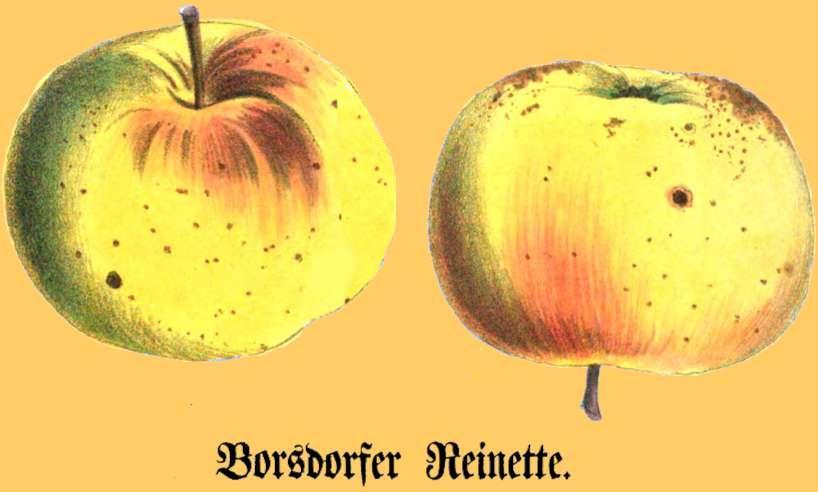
Auguste, whom I warmly thank for her letter, must also make do today with the enclosure as a Christmas present. I would love to pack in a few Borsdorfers as well, since mere heart or inner disposition without apples does not seem to satisfy her. [7] It would greatly vex me, dear Auguste, if you were already to have these Lieder or if they otherwise were of little use to you. I will think of you on Christmas Eve and rejoice with you in thought. —
That would be wonderful if I could rent the beautiful room of Madam Döderlein downstairs; it will likely be rather expensive, though, and could I have it for the summer only? [8] . . .
Notes
[*] Entire letter originally published in Walzel, 332–37; also in KFSA 24:64–68. Extra passages here from Walzel, 333–35; KFSA 24:66–67. Back.
[1] The reference is to getting their anticipated periodical, Athenaeum, off the ground; Friedrich’s letters especially to Wilhelm during the period are full of publication logistics and plans, anticipated articles and other content, format, and negotiations with the first publisher, Johann Friedrich Vieweg. Back.
[2] Wilhelm Heinrich Wackenroder would die on 13 February 1798. Back.
[3] See Walzel, 335n1: “Franz Sternbalds Wanderungen, 2 vols. (Berlin 1798) was originally to be a shared work between Wackenroder and Ludwig Tieck; Tieck continued it as a fragmentary piece after Wackenroder’s death.” Back.
[4] Caroline did apparently contribute to the long and witty fragment about and contra Jean Paul in Athenaeum (1798) 307–9 (Jugendschriften 2:279–81; fragment 421 in Minor’s numbering; translation here Peter Firchow, Friedrich Schlegel’s Lucinde and the Fragments [Minneapolis 1972], 231–33):
Perhaps the great mass likes Friedrich Richter’s novels only because of their apparent adventurousness. All in all he is probably interesting in the greatest variety of ways and for the most contradictory reasons. Although the educated businessman sheds quantities of noble tears while reading him, and the exacting artist hates him as the bloody symbol of the triumphant unpoetry of his nation and his age, the man of universal tendency can idolize his arbitrariness or else find great pleasure in those grotesque porcelain figures that his pictorial wit drums together like imperial soldiers.
Richter is a unique phenomenon: an author who hasn’t mastered the first principles of his art, who can’t express a bon mot properly and can’t tell a story in a better than average way, and yet someone who — if only because of a humorous dithyramb like the mulish, pithy, tense, and magnificent Leibgeber’s letter to Adam — cannot justly be denied the name of a great poet. Even if his works don’t have a great deal of cultivation, they are nonetheless cultivated. The whole is like the part, and vice versa; in short, he is accomplished.
It is a great advantage of Siebenkäs that its execution and descriptions are even better than those of his other works; and it has the far greater advantage of having so few Englishmen in it. To be sure, his Englishmen are ultimately Germans too, but in idyllic surroundings and with sentimental names; still, they always have a strong resemblance to Louvet’s Poles and so belong with those false tendencies he is so given to.
In the same category is also where his women, philosophy, the Virgin Mary, delicacy, ideal visions, and self-criticism belong. His women have red eyes and are paragons, puppets who serve as occasions for psycho-moralistic reflections on womanhood or infatuation.
In fact, he almost never comes down to the level of portraying his characters; it is enough for him to have thought of them, and now and then to say something striking about them. And so he sides with the passive humorists, the people who are actually nothing more than humorous objects; the active ones seem more self-sufficient, but they share too much of a family likeness amongst themselves and with the author to make us think of their self-sufficiency as a merit.
His decor consists of leaden arabesques in the Nuremberg style. It is here that the monotony of his imagination and intelligence — bordering almost on destitution — becomes most noticeable; but here too do we find that charming dullness of his, and that piquant tastelessness which we can censure only on the grounds that he doesn’t seem to be aware of it. His Madonna is a sentimental sexton’s wife, and his Christ is cast in the role of an enlightened student of divinity.
The more moral his poetical Rembrandts are, the more common and ordinary they become; the funnier, the closer to the good; the more dithyrambical and provincial, the more divine: for he conceives of the village primarily as the City of God. His humorous poetry is separating itself more and more from his sentimental prose; often it appears, like interpolated songs, as an episode, or else it destroys the book in the shape of an appendix. But at times large masses of it still escape from him into the universal chaos.
The allusion to Leibgeber’s “Adam-epistle” derives from the novel Siebenkäs, by which title Jean Paul’s novel Blumen-, Frucht- und Dornenstücke, oder Ehestand, Tod und Hochzeit des Armenadvokaten Fr. St. Sibenkäs im Reichsmarktflecken Kuhschappel (Berlin 1796–97) is known, in which Leibgeber is Siebenkäs’s friend.
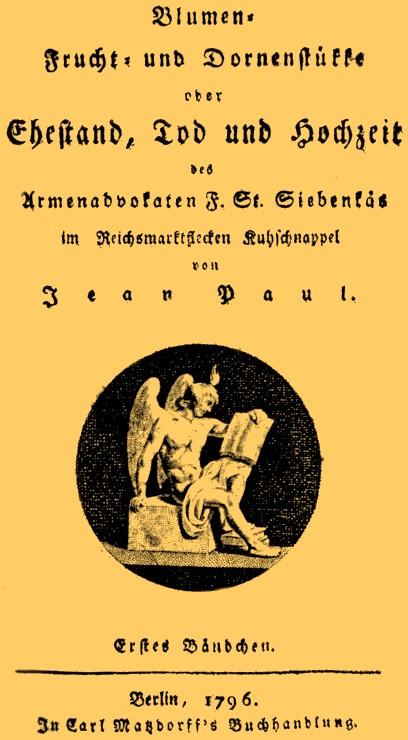
The Athenaeum authors were not the only critics to extol this letter thus. In a review of a translation of the novel, “Flower, Fruit and Thorn Pieces; or the Married Life, Death and Wedding of the Advocate of the Poor, Firmian Stanislaus Siebenkäs. By Jean Paul Frederick Richter. Translated from the German, by Edward Henry Noel. Boston: James Monroe Co. 1 vol.” Graham’s American Monthly Magazine of Literature and Art, ed. George R. Graham, vol. XXVII (Philadelphia 1845), 282, the reviewer remarks:
Perhaps the most striking thing in the volume, is the letter in which Leibgeber wishes that he had been the “first Adam,” in order that on his marriage evening he might have “walked up and down with Eve outside the espalier of Paradise, in our green honeymoon aprons and skins, and have held a Hebrew oration to the mother of mankind.” The oration which follows is one of the oddest, most curious, most original productions that ever flowed from the brain of man. No two men among a thousand millions could possibly have lighted on the same idea.
For the complete text of Leibgeber’s “Adam-epistle,” see supplementary appendix 194.1. Back.
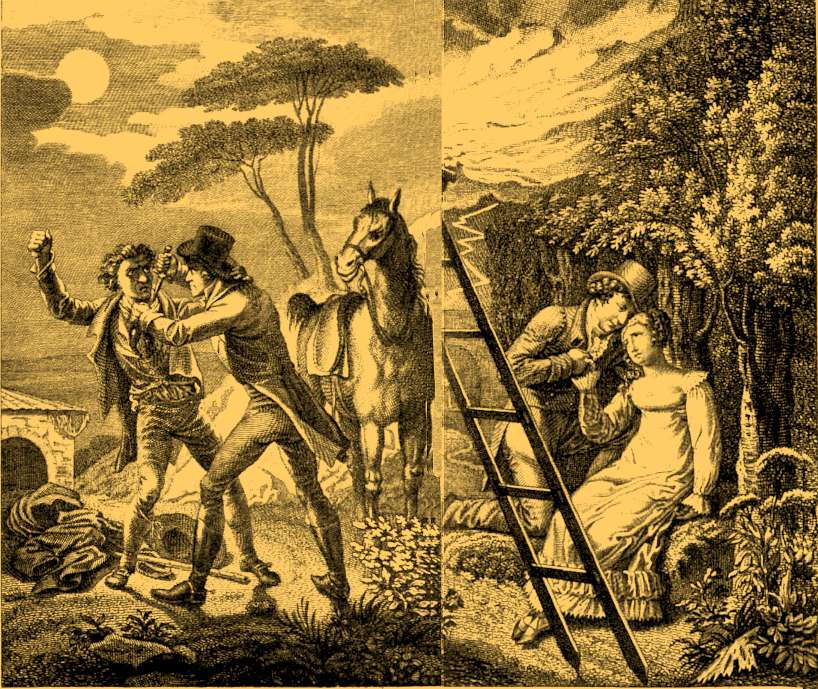
[5] In the same place (Athenaeum [1798] 304–5), Friedrich also criticizes Tieck’s allegedly forced early novel, William Lovell, 3 vols. (Berlin, Leipzig 1795–96) (also frontispieces to William Lovell vols. 1 and 2, in Sämmtliche Werke, vols. 16 and 17 [Vienna 1819]):

[6] Concerning the notion of “heart” and “inner disposition” in Friedrich’s correspondence with Auguste, see his letter to her, Caroline, and Wilhelm in early November 1797 (letter 190) with note 1; also his letters to Auguste in November 1797 (letters 191a, 191b) and late December 1797 (letter 194a). Back.
[7] The Borsdorfer Renetten apples are the oldest documented apple in Germany and likely in Europe as such, being first mentioned by Cistercian monks in the twelfth century; it is a derivative of the French reinette grise variety mentioned in Caroline’s letter to Georg Joachim Göschen on 16 December 1797 (letter 193) (assuming these are indeed the apple varieties to which Caroline and Friedrich are referring), which was imported into Germany by way of daughter Cistercian monasteries (L. E. Langethal, Deutsches Obstcabinet in naturgetreuen fein colorirten Abbildungen und Fruchtdurchschnitten zu Dittrich’s Systematischen Handbuche der Obstkunde: und jedem pomologischen Werke, nebst einer kurzen Beschreibung und Diagnose der Obstarten, 7 vols. [Jena 1858], here vol. 4 [unpaginated]):
[8] Caroline, Wilhelm, and Auguste were living in the house at Leutragasse 5, which had just come into the possession of Friedrich Immanuel Niethammer through his marriage to the house’s previous owner, Rosine Niethammer, née Döderlein; Friedrich is here still referring to her by her earlier name. Back.
Translation © 2012 Doug Stott