
• 188b. Friedrich Schlegel to Auguste Böhmer in Jena: Berlin, ca. 24 October 1797 [*]
[ca. 24 October 1797]
Dear Auguste,
|621| Let me thank you for your news from Jena. I have organized all your letters now into a package with the title Jenaer Zeitung. [1] As dear as that is to me, your mother does write more from her heart than you do, and you yourself have probably written more from the heart in your diary than in your letters to me. Perhaps this is a result of the great distance between us, for I also notice you are expressing yourself much more moderately now concerning your progress in Greek. One of the things that will indeed be necessary before I can entirely overcome my lack of faith and can convince myself in this regard is for you to be able to want to do something and then genuinely do it emphatically and with perseverance.
I am pleased that you like my letters. Were that not the case, I could not justify writing you so often even when I have so infinitely much work to do.
|622| I am unsure whether it is wise of your mother to have you read Nathan der Weise; [2] I do know, however, that even if you might unexpectedly and accidentally become wise yourself, you will certainly not become bright from doing so. — Only read what I wrote about Nathan in the Lyceum and tell me whether it agrees with your own assessment. [3]
I think of you every day and wish you a speedy recovery, you poor little sick girl!
Your Fritz
Notes
[*] Source: Schmidt (1913), 1:621–22 (letter no. 8); Waitz (1871), 1:360; KFSA 24:24–25. — Concerning the textual history of Friedrich Schlegel’s letters to Auguste Böhmer, see supplementary appendix 181d.1. — Dating: Friedrich’s reference to Auguste being sick (suggesting she alerted him to such in one of her own earlier letters) indicates he now (terminus a quo) knows about an illness (a “cough”) of the sort he will yet mention in his letter to Wilhelm Schlegel on (terminus ad quem) 31 October 1797 (letter 188c; Walzel, 298; KFSA 24:29): “Because Auguste had recently written about a cough that would not subside, I was almost convinced she was sick, and so I spent an entire week amid the most terrible anxiety and grief.”
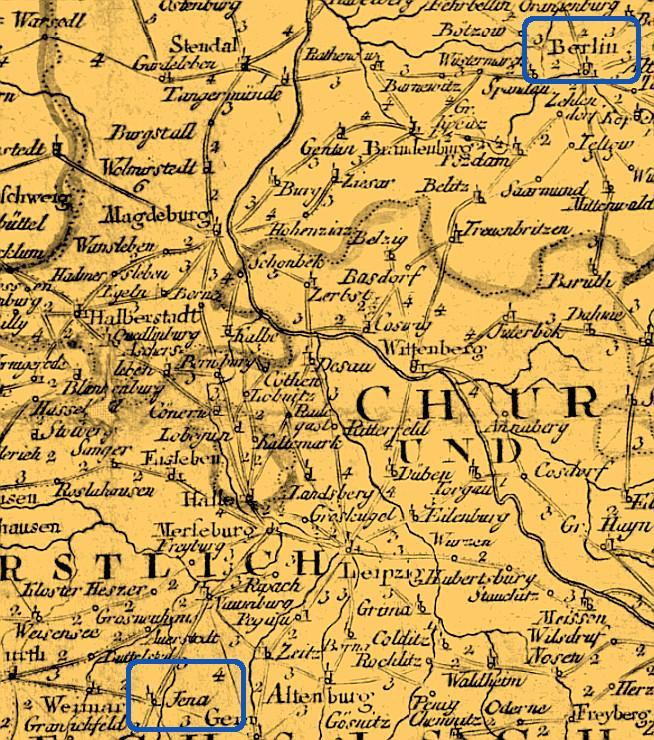
In this letter, Friedrich mentions the considerable distance between Auguste and himself, which was well over 200 km (Post Karte Durch ganz Deutschland, ed. J. Walch [Augsburg 1795]):
[1] “Jena Newspaper.” Back.
[2] Gotthold Ephraim Lessing, Nathan der Weise: Ein dramatisches Gedicht in fünf Aufzügen (n. p. 1779) (premiered in Berlin on 14 April 1783), a play dealing with religious tolerance set in Jerusalem during the Crusades. Here an 1806 engraving of Nathan and the Templar Knight in discussion, act 2, scene 5 (Johann Christoph Frisch, Nathan und der Tempelritter [Nathan and the Templar] [1806]; Herzog August Bibliothek, Museums./Signatur Top 3b:11; translation: Nathan the Wise: A Dramatic Poem, trans. anonymously [Norwich 1805], 100):

Nathan (taking hold of the mantle)
'Tis singular that such an ugly spot
bears better testimony to the man,
then his own mouth. This brand — o I could kiss it!
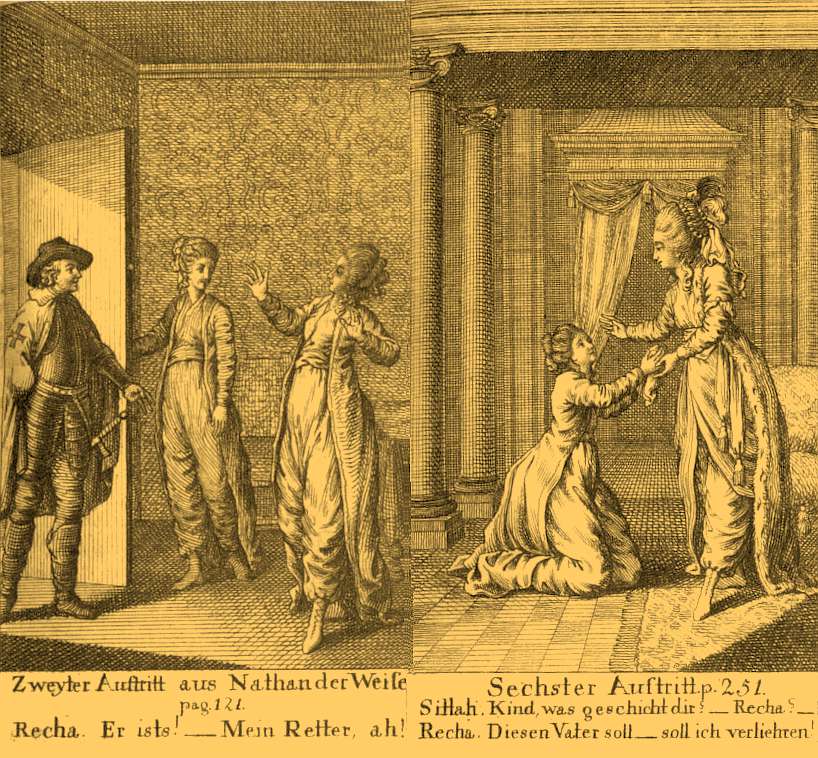
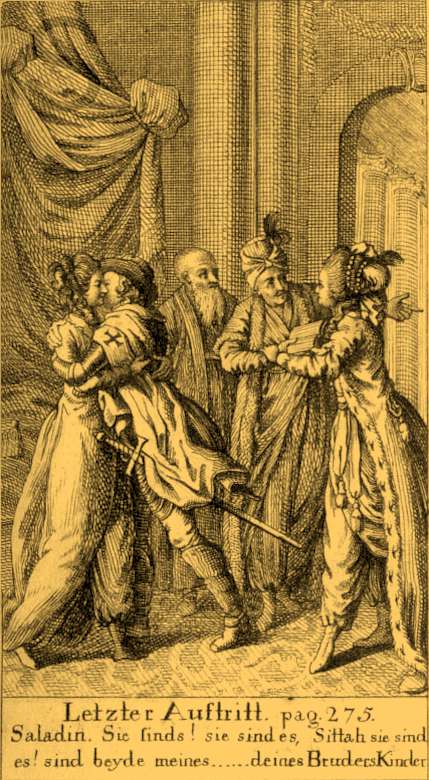
Here three early engravings for the play from the Theater-Kalender, auf das Jahr 1780 (Gotha) (translations same as above):
(1) Recha. ‘Tis he — my savior! ah —
(2) Sittah. Child, child, what hast thou, Recha?
Recha. And this father I am to lose.
Saladin. Yes, Sittah, it is they, [Aloud]
they are my brother’s and thy brother’s children.
[Rushes to embrace them.]
[3] Friedrich’s essay “Ueber Lessing,” published (with an announcement of its continuation) in Lyceum der schönen Künste 1, no. 2 (Berlin 1797), 76–128 (reprinted in Jugendschriften 2:140–64; KFSA 2:1–125), in which he treats the play Nathan der Weise at considerable length (Jugendschriften 2:157–64).
In the Intelligenzblatt of the Allgemeine Literatur-Zeitung (1797) 163 (Saturday, 16 December 1797) 1352, Friedrich announces from Berlin to readers of Lyceum that he must break off the essay (the conclusion was instead published in Charakteristiken und Kritiken [Königsberg 1801], 221–81; reprinted in Jugendschriften 2:415–29; KFSA 2:397–419).
Intelligenzblatt of the Allgemeine Literatur-Zeitung (1797) 163 (Saturday, 16 December 1797) 1352:
I herewith announce to readers of the Lyceum der schönen Künste published by Unger in Berlin that the conclusion to the essay on Lessing I began publishing in the second issue cannot be published in this journal because I no longer have any connection with the editor.
Berlin, 28 November 1797Friedrich Schlegel
Friedrich had already articulated this announcement in a letter to Wilhelm and Caroline from Berlin on 28 November 1797, in which he asks them to enter the above announcement in the Intelligenzblatt (Walzel, 319; KFSA 24:43):
Reichardt is making himself so useless toward me that I neither can nor intend to give him the conclusion to “Lessing.” But since that conclusion must appear as soon as possible, you two must, even if you otherwise have some opposition, make a virtue out of necessity and allow it to be incorporated into the first two issues [of Athenaeum, their anticipated literary journal]. If you have no objection, then please have the following published in the Intelligenzblatt of the Allgemeine Literatur-Zeitung [announcment as above].
Schiller quipped to Goethe on 2 January 1798 (Correspondence between Schiller and Goethe 2:2):
A few days ago, to my great delight, I read in the Intelligence sheet of the Literary Gazette an announcement from the younger Schlegel that he no longer has anything to do with the editor of the Lyceum. Hence our prophecy that this publication would not last long, has proved true!
Goethe responded on 3 January 1797 (ibid., 3–4):
Friedrich Schlegel has had a mad essay of his inserted in a number of the Lyceum, while it was being printed in Berlin, where he was at the time; there happened to be a dearth of manuscripts, and this essay was put in without Reichardt’s knowledge; there is an attack upon Voss in it, and this has given rise to a dispute between the two noble friends.
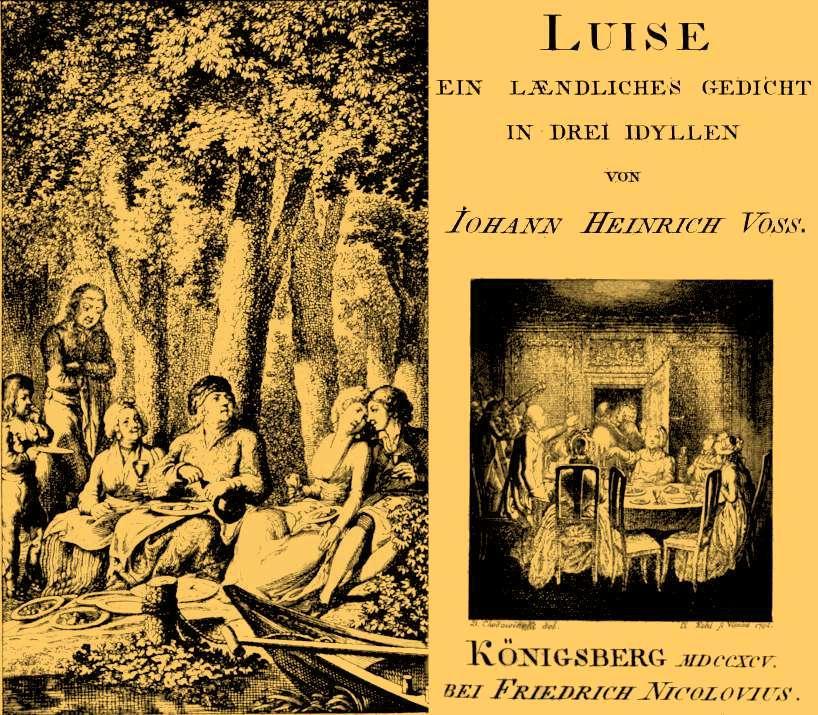
The reference is to one of the “Kritische Fragmente” in Lyceum der schönen Künste (1797) 1, no. 2, 133–69; reprinted in Charakteristiken und Kritiken, 2 vols. (Königsberg 1801), 1:224–55; fragment 113 in Jugendschriften 2:199. Johann Heinrich Voss’s best-known piece was the idyll Luise. Ein ländliches Gedicht in drei Idyllen (1795), though he was also known for his translation of Homer’s Odyssey into hexameters, eventually publishing it along with the Iliad in Homer’s Werke (Altona 1793).
Friedrich quips irreverently (Friedrich Schlegel’s Lucinde and the Fragments, trans. Peter Firchow [Minneapolos 1971], 157): “Voss is Homerian in his Louise; and in his translation, Homer is a Vossian.”
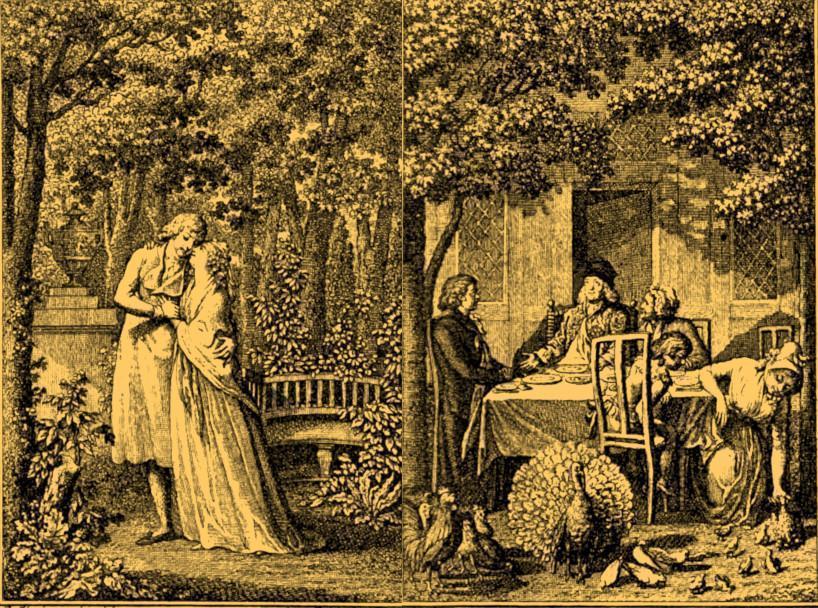
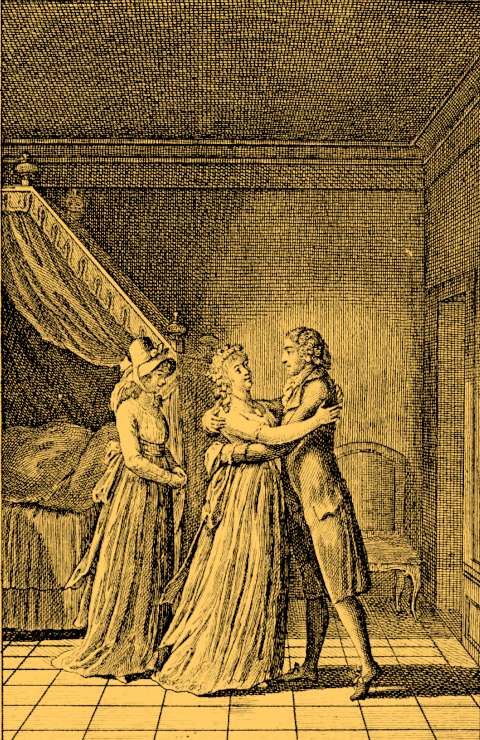
Here the frontispiece and title page to the 1795 edition of Voss’s novel and three accompanying engravings by Daniel Nikolaus Chodowiecki ([1, 2]Wilhelm Gottlieb Becker’s Almanach für 1798; repr. in Otto von Leixner, Geschichte der Deutschen Literatur, 6th ed., vol. 2 [Leipzig 1903], 565; [3] Herzog August Bibliothek; Museums./Signatur Chodowiecki Sammlung [7-511]):
Translation © 2012 Doug Stott