
• 78. Caroline to Lotte Michaelis in Göttingen: Clausthal 1787
[Clausthal 1787]
|161| Lotte! Lotte! Do you suspect nothing? Is no malevolent spirit hounding you around, whispering: “She is victoriously entering the proud city beneath your triumphal arch!” [1] The gods of love have celebrated my return to this, their Elysium in a worthy fashion. Be not angry, my dear — you have so much — be not angry that they saved their precious jewel for me — it is my only one!
Here I am, sitting on the sofa, still worn out from the journey, [2] when an estafette from Braunschweig brings me this package — just as it is. Read. Envy me. I realize you will try to hide behind a scornful smile, perhaps even behind loud laughter. Indeed, do but laugh. But only listen, my dear little manikin, to what a joker Seyfried is. In superlativo. [3] —
You must own that heaven never leaves us entirely without consolation; what better could have happened to compensate me for my separation from all of you? Not a single syllable mentioning you. I confess a malicious suspicion sometimes teases me with the notion that all this is le raffinement de l’amour, or, by contrast, that he sent a similar missive to you in Göttingen. [4]
But do tell me, what on earth am I to do with this person? I cannot possibly enter into any correspondence, since with such poor devils one can never be sure the thing will not end up in print, and in that case I would doubtless be |162| reviled in superlativo! You can tell he became grievously aggravated filling up the first table, even including all the remains of earlier stuff. The silly fool. Only read the thing To Caroline; it was already published in the Flora, where it was addressed to Gretchen or Lieschen or whomever, and now he warms it up again and gives it the title “To Caroline.” [5] Böhmer knows not whether to laugh or cry at having his wife’s name standing over such a poem. But enough.
I am guessing you will give me more details about Dortchen’s examination. [6] . . .
Lotte, the weather here is dreadful. What I am discovering is that I find Clausthal so detestable and cheerless primarily because of its inclement climate and the lack of natural charm — things for which I have otherwise always thought I did not have much sensibility unless they were quite striking. It seems to me I could not but be content here — despite everything! — if only something would extend its hand to help me out in that sense. [7] Stay well, my child.
Notes
[1] Uncertain reference, though presumably a humorous reference to Caroline herself. See below. Back.
[2] Caroline (and presumably her two daughters, Auguste and Therese) visited Göttingen sometime during the autumn of 1787. Back.
[3] Superlativo written as such both here and later in the letter. Apparently an allusion to one of Friedrich Heinrich Wilhelm Seyfried’s literary mannerisms. Back.
[4] Fr., “the refinement (or affectation) of love.” — The poetic homage to Caroline mentioned below seems to have something to do with Lotte’s own, now disappointed expectations (“Not a single syllable mentioning you”). Back.
[5] Although Caroline seems to have received a missive of sorts from Heinrich Wilhelm Seyfried, one possibly inviting a correspondence, this incident otherwise remains obscure, as does particularly Lotte’s involvement or interest.
In 1784 Seyfried published the anthology Flora für das Jahr 1785, oder: Poetisches Taschenbuch für Freunde der Musen. Mit einem allegorischen Titelkupfer und Musik. Erstes Bändchen, ed. Heinrich Wilhelm Seyfried (Hamburg 1784) (Goedeke 4:368, no. 25). The volume was dismissively reviewed in the Allgemeine deutsche Bibliothek 68:1 (1786), 439:
Although this reviewer search laboriously in this Flora for any flower, however modest, whose color and fragrance might delight the reader, he in fact found none worthy of preserving. The prudent consideration of the reading public should determine whether the editor chose wisely in this collection and whether he deserves the status of a commander (it being largely young students who planted this Flora [ed. note: i.e., who contributed pieces to the volume]), and it is similarly on that consideration that any continuation ought also to depend. If such were indeed intended seriously, the reviewer would present the following sample for the public’s assessment:
If from among these flowers here
Charlotte were to pick but one,
Such would be grand reward for me,
and I happy as the sun.
Perhaps an unpublished manuscript included the poem To Caroline that was originally “addressed to Gretchen or Lieschen” from this previous anthology. Caroline could in any case be unflinchingly severe with what she considered to be the immature poetic anthologies of younger writers; see esp. her later review of the Musenalmanach auf das Jahr 1805. Back.
[6] On the fiftieth anniversary of the founding of the Georg August University in Göttingen, 17 September 1787, Dorothea Schlözer was awarded a doctorate by the university after a private (rather than the customary public) examination at the house of the dean of the philosophical faculty (humanities section), namely, Johann David Michaelis. Neither did she have to submit and defend a dissertation. That notwithstanding, she became the first woman to receive a doctorate in a discipline other than medicine (Dorothea Erxleben in 1755 in Halle).
Here an illustration of a doctoral examination in Jena (Jenaer Studentenleben zur Zeit des Renommisten von Zachariae, Supplement 5 to the Jahrbuch der Hamburgischen Wissenschaftlich Anstalten, no. xxv, 1907 [Hamburg 1908], frontispiece and plate 23):
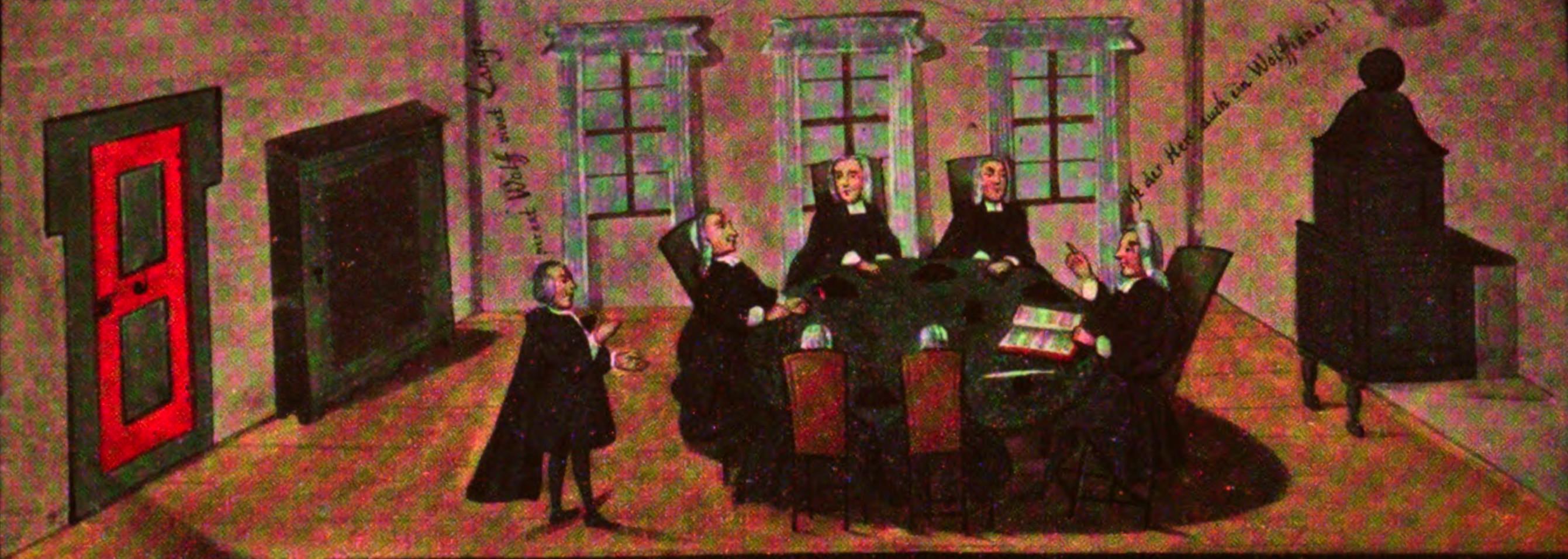
The professor on the right, with his finger in the air, asks the candidate, on the left, whether he is a Wolffian, i.e., a follower of the Enlightenment as represented by the influential philosopher Christian Wolff, who although dismissed from Halle as a subversive, was subsequently reinstated only to arouse the ire of theologians yet again. The savvy student similarly raises his hand in emphasis and declares “May Wolff perish; long live Lange!” namely, Joachim Lange (1670–1744), a Pietist-leaning professor of theology in Halle.
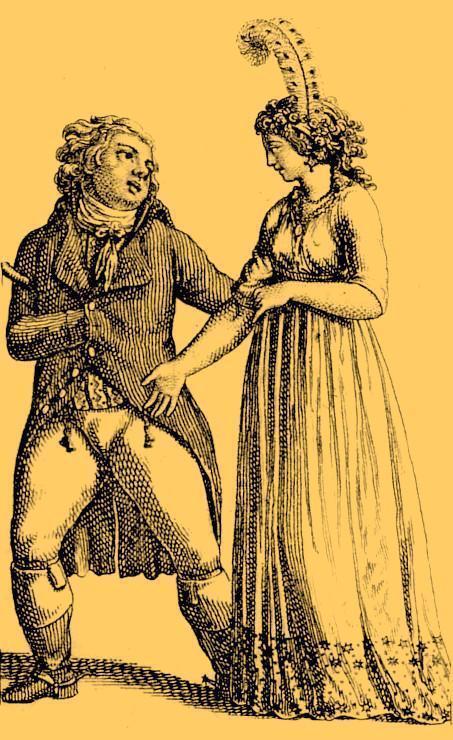
See the following extract from an article published by an American visitor in Göttingen at the time: “An account of Miss D. Schlözer, a celebrated learned Lady in the Electorate of Hanover, who was thought worthy of the highest academical honors in the University of Göttingen at the grand Jubilee, in the year 1787,” Columbian Magazine (1790), no. 5, 156 (illustrations: [1] Almanac de Goettingue pour l’anneé 1786; Inhaltsverzeichnis deutscher Almanache, Theodor Springmann Stiftung; [2] Göttinger Taschen Calendar Für das Iahr 1798; Inhaltsverzeichnis deutscher Almanache, Theodor Springmann Stiftung):
Miss Schlözer is perhaps the first lady who has made any great proficiency in mineralogy. In this she was at first instructed by the ingenious professor Gmelin; and afterwards applied herself to it with unwearied industry during a residence of six weeks in the Hartz Forest [viz. Clausthal, also, of course, visiting Caroline], where she visited the deepest mines, in the common habit of a labourer, and examined the whole process of the work.
Miss Schlözer, though highly celebrated for her erudition, does not neglect what are esteemed the first female accomplishments. She plays upon the harpsichord, and sings with as much taste as she draws and works. Her person is pleasing, and her dress as unaffectedly easy as her deportment. Her knowledge of history, and other literary acquirements, render her very agreeable in company, for she has too much good nature to be reserved, and too much sense to be presuming. She rides remarkably well; and at the balls, where she is seldom absent, the gentlemen of the university are always ambitious of her hand.

Her surprising talents and accomplishments becoming the general topic of conversation, she was proposed by the great Orientalist Michaelis as a proper subject for academical honors. The Philosophical Faculty, of which Professor Michaelis is dean, was judged to be the fittest, and the 25th of August was fixed upon, at her own request, for her examination. Public disputations, and other university exercises unsuited to female diffidence, were agreed to be dispensed with; and the examination was held at the dean’s house, in the presence of professors Kaestner, Heyne, Gatterer, Meister, Feder, and [Ludwig] Kulenkamp. She was introduced by Michaelis himself, and distinguished as a lady with the highest seat.
Several questions were first proposed to her in mathematics, all of which she answered to their satisfaction. After this she gave a free translation of the thirty-seventh ode of the first book of Horace, and explained it. She was then examined in mineralogy, and gave a regular account of the process of the metal, from its discovery in the mine till it is refined and coined. Her calculations were always just, and founded not on a superficial but a thorough knowledge of the subject. One of the professors proposed a difficult question in architecture. She acknowledged that she had not made architecture her study, but answered him with great accuracy, and produced instances of what she asserted from St. Peter’s at Rome, and the buildings she had observed at Florence.
The examination lasted from five o’clock till half past seven, when she was desired to withdraw for a few minutes, and in her absence unanimously pronounced worthy of the degree of Doctor of Philosophy. When she was desired to return, and received the congratulations of her examiners, she thanked them for the honor, and told them, that she feared it was conferred too early; but that she hoped to be deserving of it in five years time. As soon as she was declared successful, Miss Michaelis [presumably Lotte Michaelis], one of the professor’s daughters, presented her with a wreath of laurel, with which, at the request of the professors, she returned crowned to her father. Her degree was publicly conferred in the university church; and her diploma presented to her on the grand day of the jubilee, September 17, 1787. She is now in her twentieth year.
See Dorothea’s undated letter to Caroline following her examination, i.e., after 17 September 1787 (letter 81a). Back.
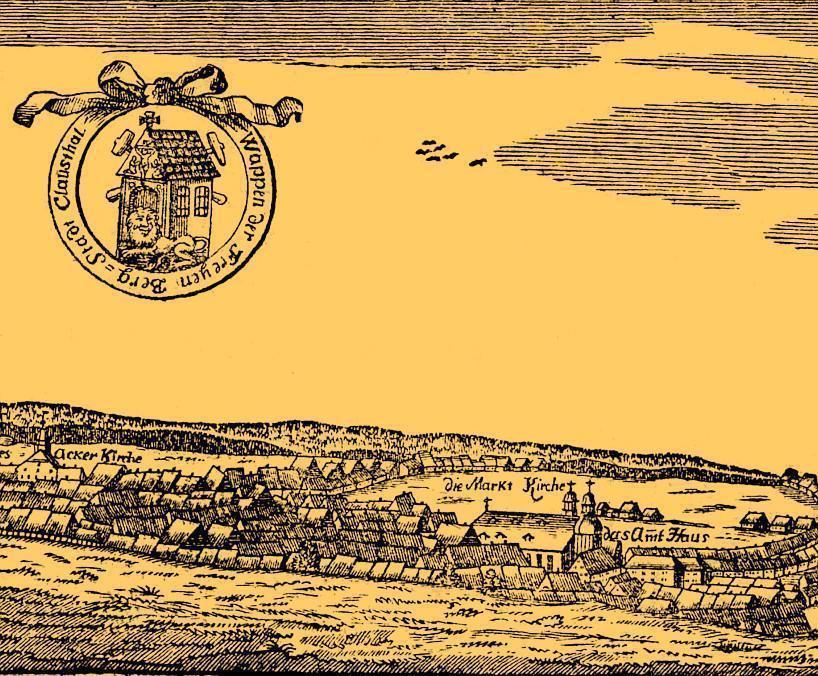
[7] Inclement weather or not, Caroline was clearly still chafing at her existence in the small mining town Clausthal. Here a view of the town during the mid-eighteenth century; Caroline’s house — possibly even visible — was located to the left just behind the Die Markt Kirche and facing the market square (excerpt from Prospect der freyen Berg-Stadt Clausthal, von der Bremer-Höhe nach Süd-Ost [ca. 1651–1750]; Herzog August Bibliothek; Museums./Signatur Top. App. 1:232):
The news of Dorothea Schlözer’s doctoral examination could not but weigh heavily on Caroline. As mentioned earlier, in her chapter on Caroline in her memoirs, Caroline’s sister Luise Wiedemann notes that:
She [Caroline] was also especially proficient and learned in history, so much so, in fact, that the famous Schlözer — who thought extremely highly of her as a young girl, often inviting her to his house in the evening and then never failing to accompany her back home afterward personally with a servant carrying the lantern ahead — suggested that, like his own daughter, Dorothea, who afterward, at the 50th jubilee in Göttingen [1787], received her doctorate, — that Caroline, too, should devote herself wholly to scholarship, and especially history, indeed, even to give talks and presentations.
See also Caroline’s letter to Lotte on 4 April 1786 (letter 69). Back.
Translation © 2011 Doug Stott