
• 257. Caroline to Ludwig Ferdinand Huber in Stuttgart: Jena, 24/27 November 1799 [*]
[Jena] 24 November [17]99
|582| The review of Athenaeum genuinely and truly arrived yesterday, and since it is Sunday and I am still alone, and since it could also be that this is the last time I will be able to speak with you openly, your old acquaintance has chosen not to abstain from doing just that.
I am astonished, tout à fait [1] astonished and gladdened. You wrote that, Huber? At least now I know where you got the idea of acharnement, [2] since, my God, not even against the Revoluzionsalmanach did you ever rail with so much acharnement. [3] Your intention was to attack it in a quite personal fashion. Not enough that you condemn the journal itself, now you even draw into your line of fire the jacket and the poor bookseller, who admittedly may have thought he was perpetrating a kind of impishness. [4]
I can assure you on my honor that the announcement of the continuation comes from the hand of the bookseller, that the Schlegels themselves were not satisfied with it, and that you accordingly ought to be thoroughly ashamed for having mentioned it and ought to view having done so as an extremely immoral and overly hasty act.
In |583| your letter to Schlegel, you assure him that you will regret nothing. Although that sounds quite lofty, I would by no means stand surety that you will not one day become as thoroughly soft-hearted toward the Schlegels as you are toward President von Kotzebue. [5] If a personal acquaintance of the sort on which the latter so unbendingly insisted is also necessary in this context, [6] then it is admittedly true that none exists between Schlegel and you; and yet your imagination has certainly provided you with a vivid enough image of the two young men standing before you.
Schlegel is, moreover, also quite unsuspecting and would truly not have anticipated such. Even though your own writing style gives you away, he would never have guessed that this treacherous review came from your hand. And you really intended to let this remain anonymous? What change could Schlegel’s last letter to you — which as far as I know contained absolutely nothing specific in this sense — have wrought that prompted you only now to view it as a “disgraceful piece of hypocrisy”?
You knew him just as well earlier, before all this, and respected him just as much, as you yourself point out (had you not done so, then the culpability would rest at your own feet); before all this as well, you both corresponded concerning matters in connection with which you surely could have taken the measure of his manner of thinking. Moreover, because of my own inclination toward you he has always been cordial even to the point of partisanship and would gladly have given you every possible assistance, just as he indeed did in connection with, among other things, the review of Klio that you once desired, [7] and several other things as well, indeed, as much so as he would have done for a friend.
When he arrives home and I show him all these marvelous things — he will fall over as if struck by lightning and think himself still reeling from the bad roads he has just traversed. You will in the meantime be quite safe from his melancholy, nor does he have any need to create a measure of boldness in order to look past your “principles,” which so happily separate the writer from the person; that particular quality is already entirely at his disposal, for he possesses tout |584| de bon [8] a considerable store of boldness.
And here he will have excellent play as well, since that which, as I just pointed out, so greatly pleased me will of course also delight him, namely, that the review — is no better than it is. And indeed you should not have taken on this review in the first place, and for reasons other than quite normal considerations of loyalty, namely, that one simply does not ambush a close acquaintance and upright person behind his back, reasons that were, however, quite drowned out by your principles.
You yourself had to realize that you simply did not have the requisite background knowledge for such an undertaking — a situation that does no dishonor to anyone. Hence Schlegel, who was certainly aware of that fact, never thought of you as a reviewer when the A.L.Z. once told him to suggest one himself. [9] That particular journal, which appeared quite accidentally as a journal [10] — and one to which you are nonetheless so particularly inclined to cling — deals with philosophy, art, including the formative arts as well as art in general, and antiquity.
You know better than I could ever tell you myself that you have only an extremely superficial acquaintance with all these things, with philosophy not at all, and with art only in a very confused fashion — even poesy never really appeared to you to be a free art form. You can in no wise boast any acquaintance with antiquity of the sort both Schlegels have to such an extraordinary degree — and I still recall that you had completely neglected Greek, taken purely as a language — and you often write in your own language such that one might well doubt whether you would be in any position to properly judge the “harsh struggles” and “hammer-work.” [11]
So, since you had none of these prerequisites, why did you nonetheless do this review? [12] Your letter sheds some light on this — where you lacked knowledge, you intended for character to step in, with the same strength of character you petition Schlegel to allow to predominate, you yourself intended to coerce the Schlegels, who had incited your displeasure. You felt called to become, not, for example, a lesser, inferior organ, |585| but rather the noble organ of the entire corporate displeasure and indignation of the sacred people of Athens. How ardent will the gratitude be that you will also receive from Böttiger, Kotzebue, the A.L.Z., Nicolai, etc. etc. as well as from all of Fichte’s adversaries and all the hangers-on of all the courts and princes. —
Indeed, Allmanach-Reichardt himself might again feel inclined to join you. [13]
Your error is precisely that you view the Schlegels’ efforts merely as a matter of factions — were you standing closer, you would have a better vantage point from which to recognize the size of the masses. I already told you that it is a universal struggle, though the minority is admittedly as limited as the majority is widespread — but even if the Schlegels were to find themselves utterly alone for a time, which is, however, not the case, I would still not be anxious.
I recently spoke only rather carelessly with you about your shyness of factions — the truth, however, is that what is great ought never to be a faction, and yet one cannot bring it about without such, or at least not without the appearance of such. That is something you yourself were well able to see, and your public reference to factions is nothing other than the same thing; like so much else, it functions exactly like Kotzebue’s hints of Jacobinism, namely, solely to incite the public even more (which, had you remained in character, you instead should have tried to calm down).
Had you gone about all this as a simple reviewer, you would not have adhered merely to your presuppositions here, and would not have done so in so personal a fashion. That on which those presuppositions could indeed be based constitutes only a tiny part of Athenaeum. You would have properly presented the rest of the content as well, content over which you only occasionally skate; one can certainly comprehend why. —
Indeed, I know not how you can call Kotzebue’s comedy, and especially the performance, “most disgraceful” [14] — it was, after all, perpetrated quite openly as an honest act of vengeance, whereas your own moral heroic deed |586| came to light only by chance. To the extent you still have any dignity at all, you have also dealt with the Schlegels in a considerably more undignified manner.
You can believe me when I say that in spite of that I do not for a moment really consider you a treacherous and deceitful person. You have indeed violently shaken my faith in you, but not from the perspective of your pure volition — it is merely that you rather inappropriately and awkwardly stepped in between in the function of an avenging deity and are unable to imagine that others, people who in no way invoke their own character thus, also have a character for which all this is by no means merely a joke.
Reference to the “graying head of the elderly Wieland” is particularly touching and is sure to stir up sympathy. How on earth did you suddenly come upon that? For I have certainly heard you speak quite differently, and if I am not mistaken, you also very quietly wrote something quite different as well. [15] That graying head and well-deserved laurel wreath must venerate themselves beforehand. This same Wieland who as a youth talked like an old woman is now, as an old man, railing like an ill-raised brat against everything around him that is great and that he does not understand — against the revolution, against philosophy, etc. You would probably be aggravated with it yourself. —
And all of you somehow never fail to have Lessing in tow — but did Lessing ever really speak differently about Wieland? Think about the tragedy of Joh. Gray etc. [16]
I am not interested in going into the text any further — I know precious little about literary history — I only see what is happening now — I have never respected Wieland — he always seemed to have a poor understanding of morality and certainly of sensuality as well. [17] I do understand what the Schlegels are doing and I also know that one day they will indeed be able to stand accountable before themselves and, God willing, also before the world, and then your judgment will merely take its appointed path.
That of Lucinde |587| is still ahead of us. [18] May heaven and the public allow it all to be to your benefit! — But one more thing in all seriousness; everything in me that speaks in favor of both you and Therese still cannot forgive you for having so rashly and so precipitately destroyed an understanding that might subsequently have developed into something so beautiful, since by all appearances a personal meeting between us might well have taken place next summer. [19] That was extraordinarily stupid of you, my dear Huber. Farewell. And farewell, Therese.
27 November
Schlegel arrived back yesterday evening and has hardly really had time to have a look at all this business. [20] He sends his regards, and as far as he can see at this point there is nothing further that requires a response. If he finds it necessary to change that opinion later, such a response could of necessity only take a public form and with explicit mention of your name, and in that case he would let you know about it beforehand.
Notes
[*] See the editorial note to Caroline’s preceding letter to Huber on 22 November 1799 (letter 256), which applies to this letter as well. Back.
[1] Fr., “quite, entirely, absolutely.” Back.
[2] Fr., “rancor, animosity; stubbornness, obstinancy.” Back.
[3] Heinrich August Ottokar Reichard’s patriotic, anti-revolutionary Revolutions-Almanach, published 1798–1803. Oddly, no review by Huber is known. Back.
[4] The announcement was that the scandalous “Litterarischer Reichsanzeiger” would be continued in the next issue, but it was not. See Huber’s review, supplementary appendix 256.1, with note 2.

[5] In 1785, Kotzebue was ennobled and became president of the magistrate of the government of Estonia. Back.
[6] See Friedrich Schlegel’s letter to Caroline ca. 20 November 1798 (letter 209), with note 10. Back.
[7] Wilhelm had favorably reviewed several pieces by Huber over the years. No review of Klio by Wilhelm, however, is known: Klio. Eine Monatsschrift für die französische Zeitgeschichte, ed. Peter Paul Usteri (Leipzig 1795–96), a journal whose editorship Huber took over beginning with issue 7 (July 1796), it then becoming Neue Klio. Eine Monatsschrift für die französische Zeitgeschichte (Leipzig 1796–98), as a continuation of his own Friedenspräliminarien, ed. “Der Verfasser des heimlichen Gerichts” [=Huber] (Berlin 1793–96), which concluded with issue 40 (1796). Back.
[8] Fr., “in earnest.” Back.
[9] See Gottlieb Hufeland’s letter to Wilhelm on 2 May 1799 (letter 236a), in which he mentions having solicited Wilhelm to suggest reviewers for future volumes in Wilhelm’s edition of Shakespeare and asks him to suggest several for Friedrich’s works; in the same letter, he does not solicit Wilhelm to suggest anyone for Athenaeum, but does relate to him that he had already contacted someone to do the review (namely, Huber himself). Back.
[10] “That particular journal” being Athenaeum. In his initial remarks in the review of Athenaeum, Huber reproaches Athenaeum for what he finds to be an inappropriate journalist relationship with its readers. Back.
[11] Pejorative terms Huber uses in his review. Back.
[12] In a letter to Heinrich Frölich on 16 December 1799 (Lieselotte E. Kurth-Voigt, William H. McClain, “Three Unpublished August Wilhelm Schlegel Letters in the Kurrelmeyer Collection,” in Modern Language Notes 101 [1986], 592–608, here 602–4), Wilhelm maintains that the partisan editors of the Allgemeine Literatur-Zeitung had assigned the review to a man “who they had to know was up to the task in neither a scholarly nor artistic regard”; “Goethe found the entire review extremely feeble,” and was particularly incensed by the abuse of the “Kunst der Griechen,” a poem “six the likes of which, as he put it, one would have trouble adducing in the entirety of German poesy in this genre.” Concerning the latter poem, see Wilhelm’s letter to Friedrich von Hardenberg on 12 January 1799 (letter 215a) with note 8; Hardenberg’s letter to Caroline on 29 January 1799 (letter 216), note 4; Caroline’s letter to Hardenberg on 4 February 1799 (letter 219), note 15; Friedrich’s letter to Caroline in late March 1799 (letter 225) with note 6. Back.
[13] That is, H. A. O. Reichard as publisher of the aforementioned Revolutions-Almanach. Back.
[14] Huber reviewed Kotzebue’s anti-Romantic play Der hyperboreische Esel oder die heutige Bildung. Ein drastisches Drama, und philosophisches Lustspiel für Jünglinge in einem Akt (Leipzig 1799) in the Allgemeine Literatur-Zeitung (1799) 415 (Saturday, 28 December 1799) 822–24; for the text, see supplementary appendix 250.1. In a bit of irony, Karl Ludwig von Knebel, thinking Wilhelm himself was the reviewer, referred to the review as an example of “German vileness” (letter to Karl August Böttiger on 27 January 1800; Fambach 4:501). Back.
[15] Huber had written indignantly in his review of Athenaeum: “and when in their artificial mischievousness and daring they even try to wrest the well-earned laurel wreath from Wieland’s graying head. . . .” Huber himself, however, had reviewed Wieland’s Geheime Geschichte des Philosophen Peregrinus Proteus (Leipzig 1791) in the Allgemeine Literatur-Zeitung (1792) (6 September 1792) 531–34, here 534, remarking:
The clarity that has always characterized Herr Wieland’s style is discernible in this piece as well, and yet here and there one admittedly also finds passages that are a bit long-winded and watered down, passages in which the striving to say everything at once occasionally borders on garrulousness.
Caroline’s remark here may be referring to this review among others. Back.
[16] Lessing’s Briefe die neueste Litteratur betreffend (Berlin, Stettin 1759–65), a literary weekly edited initially (1759–60) by Lessing himself with the help of Moses Mendelssohn and Friedrich Nicolai, with Nicolai taking over after Lessing withdrew.
Here the reference is to the article “Anzeige des Trauerspiels Johanna Gray von Herrn Wieland. Beweis, dass das Beste diesem Trauerspiele aus Rowes Jane Gray genommen sey. Plan der englischen Jane Gray,” Briefe die neueste Literatur betreffend (1759) 4, letters 63 (18 October 1759)–64 (25 October 1759), 242–68, an examination and comparison of Wieland’s play, Lady Johanna Gray oder der Triumph der Religion: Ein Trauer-Spiel (Zürich 1758) and Nicholas Rowe, The Tragedy of Lady Jane Gray (London 1715) (here frontispieces from editions of 1730 and 1791):
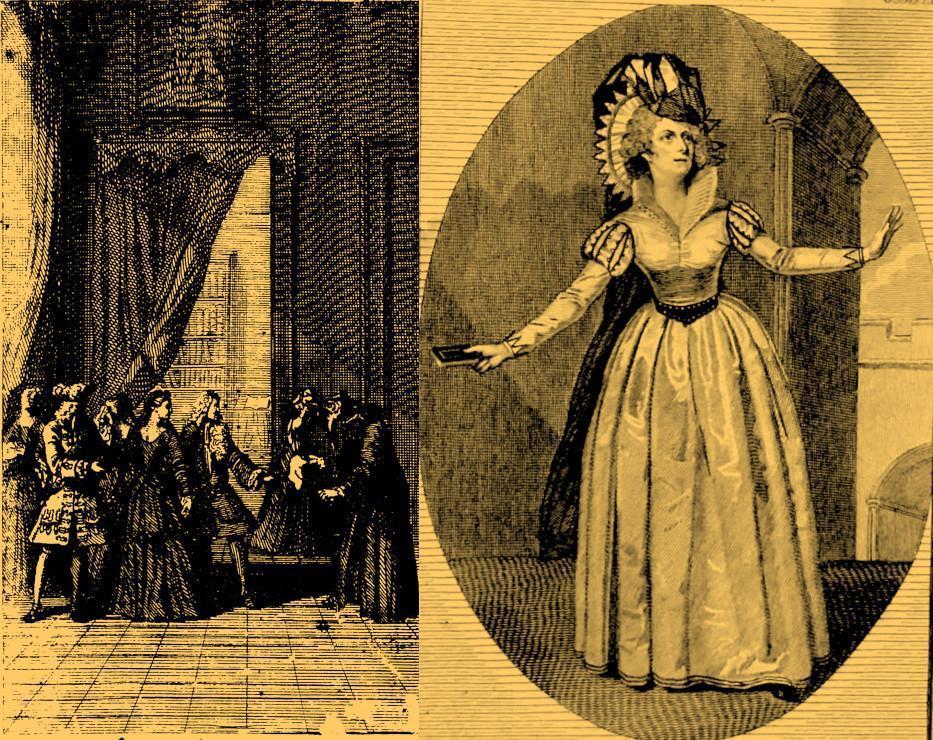
Lessing demonstrates unequivocally that Wieland not only used Rowe’s piece as his model, but also translated entire passages for use in his own play; indeed, the allegation is that not a single element in Wieland’s play is his own. Back.
[17] See on the other hand the very young Caroline’s assessment of Wieland in her letter to Luise Stieler on 15 May 1780 (letter 15). Back.
[18] That is, Huber’s review of Lucinde. Back.
[19] Uncertain reference, though see Dorothea Veit’s letter to Sophie Bernhardi on 16 January 1800 (letter 258f), note 7. As it was, Caroline would not see the Hubers until 1803 in Stuttgart. Back.
[20] This remark also dates Auguste’s return to Jena from Dessau (Rudolf Koch and Fritz Kredel, Deutschland und angrenzende Gebiete [Leipzig 1937]):

Translation © 2013 Doug Stott