
258f. Dorothea Veit to Sophie Bernhardi in Berlin: Jena, 16 January 1800 [*]
Jena, 16 January 1800
I read your second, quite pleasant fairy tale together with Madam Schlegel the same evening it arrived; it greatly amused us both. [1] Do you yourself not think it is executed even more nicely than the “Quell der Liebe”? —
We are now anticipating your sending us yet another one very soon. Schlegel will do his part trying to sell it quickly and for a good price, and as soon as that happens, I will alert you. . . .
Hopefully you are doing better now that the weather is again good. Schleiermacher wrote recently that the cause of your indisposition was actually one “filled with hope.” Is this true? Am I to congratulate you? [2] —
We are admittedly doing quite well here, as well as can probably be expected for people of such weak health and limited finances as we. —
I did indeed promise to write to you honestly and at length about various things here; that I have not done so derives neither from any lack of honesty on my part nor from a lack of thoroughness, since I really have tried on several occasions to relate to you just how things stand, are situated, and are otherwise going. [3]
But I have not been able; you would have to read a great deal without really getting a proper picture. So I reserve the right to tell you about all these things soon in person, there are simply so many details to relate that are simply far easier to describe in person than in writing, especially since I do not have that much time for letter writing. I have to remain diligent, and, you see, our fine conviviality costs a fine bit of time.
What you prophesized has not happened, things have taken a different turn; everyone likes your brother quite well, and respects him, whereas Malchen cuts a poor figure in the family portrait, on that point everyone is quite of one opinion, though she is accorded respect and consideration out of respect for her husband. [4] The other thing you feared has also not occurred; everything is peaceful and civil and quiet. [5]
On the other hand, you can easily enough imagine the sometimes quite ridiculous scenes one witnesses in a house full of originals, in a republic populated by nothing but despots. Everyone generally treats me with true sisterly love, and I have not had a single occasion to complain. Moreover, it is truly a joy for me, and something quite new, that not a single day passes during which I do not hear, see, and experience the most wonderful things. Serlo’s rules for life are followed here in a fashion of the sort one rarely has the opportunity to enjoy. [6]
But amid all that I am nonetheless coming to Berlin again after all this summer, I just cannot yet specify whether it will be at Easter or in the middle of the summer, it depends on what travel plans the Schlegels make, though if they have made no decision by Easter, I will travel to Leipzig at Easter, and from there to Berlin with acquaintances. [7] As contentedly as I am living here, I do nonetheless look forward not a little to seeing you again.
You are right, I should not sell my things cheaply; nor do we want to move too quickly on that, Fichte will perhaps buy some of the things when he comes to Berlin. [8] It is merely that they must indeed be sold by the by, since first of all, I need the money, and second, I find it better that when I come to Berlin I take a furnished room, since, after all, I do not intend to stay in Berlin, and if one takes an entire apartment, one is quite tied down with it and then loses money when one wants to get rid of it again.
But write me more about yourself, you lazy correspondent! how much effort does a letter take? remember that I was there when you were writing letters for your novel, [9] I saw how easy it became for you. Do you already have an apartment? and where? will I be able to live near you when I come to Berlin? . . .
Bernhardi is dead, otherwise I would tell him how pleased I was that he supported Rambach so wonderfully, in the matter contra the Laterne, it is simply delightful. [10]
Notes
[*] Sources: Wieneke (1914) 313–15; KFSA 25:43–45. Back.
[1] Presumably the second fairy tale, “Die Stimme im Walde” (“The voice in the forest”), from the incipient collection Wunderbilder und Träume in eilf Mährchen (Königsberg 1802), 27–55. “Die Quelle der Liebe” (“The source of love”) was the first, though N.B. Dorothea and Caroline are reading manuscript copies rather than the book itself or even proofs.
“Die Stimme im Walde” begins as follows:
Alfonso was but a day’s journey from home. He had sent his manservant on ahead to bring Alfonso’s mother the good news that she would soon be able to press her beloved son to her bosom again.
He had spent the night in a solitary hut at the foot of a mountain, and the inhabitants had related wondrous things to him about spirits that allegedly dwelled in the forest that now lay before the knight. He thought of those tales as he now entered it and the tall trees rustled above him.
A strange sensation constricted his chest; he peered round about him with a feeling of peculiar uneasiness, and then smiled to himself at his own foolishness. “Am I not the same man,” he said, “who feared not death and who fought with valor and honor? And now my heart quakes at the tales of superstitious old people?”
He rode courageously on, and his eyes feasted rapturously on the verdant labyrinth of leaves and foliage that swayed to and fro above him.
Here Sophie Bernhardi, like her brother Ludwig, draws from the popular chivalric motif of the honorable knight facing strange and unexpected dangers from the darker, inexplicable, unpredictable side of reality.
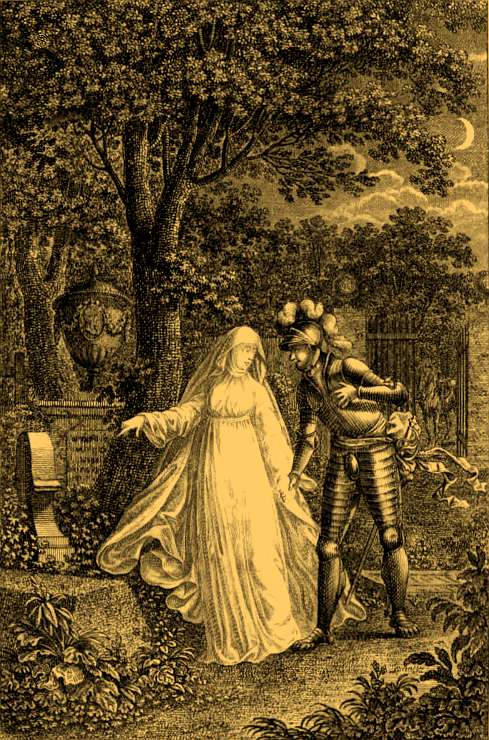
Although her anthology had no illustrations, here are two representative illustrations; the protagonist in “Die Stimme im Walde” was similarly enticed — “Follow me!” — by a mysterious, apparition-like lady in white ([1] Lucas Cranach the Elder, Ritter nach rechts reitend [1506]; Inhaltsverzeichnis deutscher Almanache, Theodor Springmann Stiftung LCranach d.Ä. WB 3.38); [2] Almanach Romantisch-Ländlicher Gemälde für MDCCIIC; Inhaltsverzeichnis deutscher Almanache, Theodor Springmann Stiftung):

[2] The expression “of good hope” and its variations were a euphemism for “pregnant.” Sophie Bernhardi’s son Wilhelm Bernhardi was born on 15 June 1800; she mentions him in her letters to Wilhelm Schlegel during the summer and autumn of 1801. Back.
[3] Here and in what follows, Dorothea seems to be responding to remarks Sophie Bernhardi made in her own letter (not extant) that in its own turn seems to have reflected Ludwig Tieck’s letter to her, Sophie, on 6 December 1799 (letter 257c), in which he mercilessly censures the women in the Jena circle, including Dorothea herself. See note 19 in Tieck’s letter. Back.
[4] The group’s opinion of Amalie Tieck was not especially kind; see Friedrich Schlegel’s remarks in his letter to Caroline in July 1799 (letter 241a): “We are greatly interested in learning whether he has decided to spend the winter in Jena. That would be splendid, if only not for his wife! his wife!” See also the cross reference there in note 6. Back.
[5] Again, what Sophie Bernhardi had apparently implied in her own letter likely reflected her brother’s letter to her on 6 December 1799. Back.
[6] Serlo, theater director in Goethe’s Wilhelm Meisters Lehrjahre; unclear reference, though possibly (KFSA 25:407) an allusion to book 4, chapter 19, which describes Serlo’s procedures for becoming acquainted with actors; translation from Wilhelm Meister’s Apprenticeship. A Novel from the German of Goethe, trans. R. Dillon Boylan (London 1867), 254 (book 4, chapter 19) (representative illustration: Taschenbuch für das Jahr 1819: Der Liebe und Freundschaft gewidmet 1819; Inhaltsverzeichnis deutscher Almanache, Theodor Springmann Stiftung):

It was his [Serlo’s] custom, whenever the actors were assembled around him, to make them read aloud, an amusement in which he himself not unfrequently took part. He selected pieces which were intended for representation, but which had hitherto only been presented to the public in fragments. And after their first performance, he caused them to repeat such passages as afforded any opportunity for criticism, and thus he improved the judgment of his actors, and rendered them certain of hitting the right point. And as a weak but sound understanding may affect others more agreeably than a confused genius can possibly do, he was able frequently to improve men of moderate talents, by the clear views which he imperceptibly opened to them.
His custom of causing poems to be read at their meetings contributed in no slight degree to this effect; by such a course he enabled the actors to appreciate the charm which well measured versification ever awakens in the soul; while in other companies the performance of those prose compositions had already commenced, in which the veriest stipling might excel. Back.
[7] Dorothea mentions these still indefinite plans in her recent letter to Schleiermacher on 6 January 1800 (letter 258c) (Rudolf Koch and Fritz Kredel, Deutschland und angrenzende Gebiete [Leipzig 1937]):
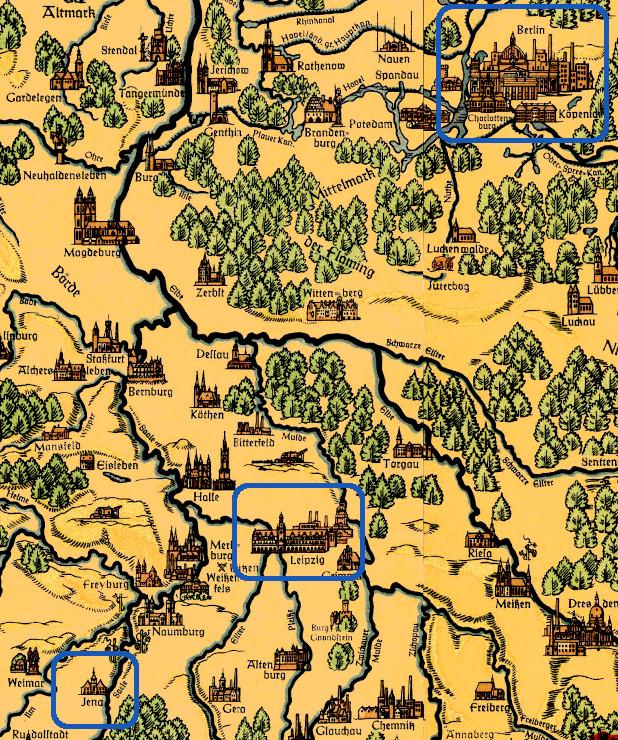
That the Schlegels may also have been making travel plans for the spring or summer may reflect Caroline’s remark to Ludwig Ferdinand Huber in her letter to him on 22 November 1799 (letter 257), in which she mentions the possibility of a meeting with him and Therese during the coming summer. Back.
[8] Dorothea mentions potential sales of furniture items to Fichte in her letter to Schleiermacher on 6 January 1799 (letter 258c); Fichte was currently in Jena, where he would remain until March before returning permanently to Berlin with his family (Rudolf Koch and Fritz Kredel, Deutschland und angrenzende Gebiete [Leipzig 1937]):

[9] Julie Saint Albain (Dresden 1801). Back.
[10] “Bernhardi is dead” is an otherwise unclear allusion, responding perhaps to something in Sophie’s letter (KFSA 25:407).
Concerning Daniel Jenisch, Diogenes Laterne, (Leipzig 1799), see supplementary appendix 252g.1, and Friedrich Schlegel’s letter to Fichte on 3 November 1799 (letter 252g).
Bernhardi had addressed the insulting piece in Rambach’s Berlinisches Archiv der Zeit und ihres Geschmacks (1800), 1 (January) 29, by way of a tongue-in-cheek critique of the question of authorship, arguing essentially that the German reading public certainly hoped that “Gottschalk Nekker” — Jenisch’s pseudonym for previous insulting pieces — would not be exculpated as the author despite the blatant stylistic similarities between Diogenes and “Nekker’s” previous work and despite Jenisch’s own denial of authorship, since in that case Germany would face the prospect of having not one but two such trivial authors. Back.
Translation © 2013 Doug Stott