
257c. Ludwig Tieck to Sophie and August Ferdinand Bernhardi in Berlin: Jena, 6 December 1799 [*]
Jena, 6 December 1799
Dearest children,
You are both no doubt angry because we have not written, and rightly so, and you have thus let me hear absolutely nothing from you. It will not happen again; you will never again go without a letter for so long; alas, that is the way it goes when one keeps putting off writing from one day to the next.
Among the things that have prevented me from writing you is that I have been quite diligent. We think of you all the time, especially of you, dearest sister; we hear that you are not well; what is wrong? If only you could stay healthy. I thought for sure that Fichte would bring some news of you both, but he did not. [1] He says you are probably expecting; do write and let me know whether such is indeed the case, [2] and whether you are taking sufficient care of yourself if it is true, [3] and whether our parents are healthy. [4]
We ourselves have hitherto been quite well, except that I have suffered greatly from fluids that almost always keeps me in a weakened condition. [5] The child is quite healthy and is becoming increasingly more beautiful, nor is it just our imagination, since other people have quite noticed it as well; she is also becoming quite smart and frolics about and plays, this coming winter she will surely be commanding at least a full regiment. [6] She has been weaned since yesterday and is adjusting nicely, though Malchen is suffering, and is quite depressed, which is why she does not also write you something today, though she does send her warmest regards.
O, my dear sister! were I only not so worried about you, it sometimes makes me so melancholy. — What do you have to say about Buonaparte? [7] Bernhardi has doubtless kept up with the political situation, has he not? –
Well, I am sure you also want to hear about how we have been faring.
We arrived here in good shape and were quite content and cheerful; [8] we also saw Hardenberg here, who returned later with his brother, an officer, and both wholly concurred with our own assessment of Madam Veit. [9]
For Christ’s sake — with your permission — it is enough to drive one up a wall the way this beast is behaving here (ah, please do not print this letter and please show it to absolutely no one), the others are as if bewitched, but only because they are all involved in one, big swine of a domestic mess. You were absolutely correct, dearest sister, and you will certainly laugh yet again at my stupidity. Madam Veit need only wear her rose-coloured satin with the black revers and things would be complete. [10] But she dares not do such things now, for they have talked her out of such tasteless inanity.
Otherwise, Schelling is courting Madam Schlegel such that it is causing a scandal in the entire town, Madam Veit is courting Wilhelm Schlegel, and thus everyone and everybody all mixed up, and the women would be delighted if we, too, would participate.
Friedrich has become ridiculous to everyone with Lucinde, as cannot be otherwise. All these people really do need to pay more attention to things insofar as they all claim to scorn morality and because it is according to their own behavior that their doctrine fails and is being judged as false. But do not tell Schleiermacher any of this.
It is regrettable that these fatuous, tasteless women are making absolute monkeys out of these people, people who otherwise really are endowed with the most divine talents, for rest assured that Madam Schlegel (here Caroline) [10a] really is the cause of all the squabbles in which the two have now become entangled, nor do any of them notice it when afterward she inevitably plays the feminine card and tries to calm things down again after something has already happened. They are almost universally hated here, though that is not necessarily saying much at all, since the public here generally consists of mere riffraff; in a word, however, I also find it all quite repugnant, and you, dearest sister, are well enough acquainted with my aversion to such theatrics.
Wilhelm comes across increasingly well the more one becomes acquainted with him; he really is good-naturedness itself, always intent on not clouding the water, though now he has taken on a role they actually learned from me but which Wilhelm is certainly not up to; all the constant talk about Kotzebue, about the Literatur-Zeitung, about Merkel, about all these wretched fellows is so insufferable that I often sit there simply speechless, and now they would like to get me to write something, anything, but I will not do it because I want to live for myself and pursue my own things, whereas they are taking the whole thing seriously. [11]
Friedrich was much more agreeable and pleasant in Berlin; he and I are drifting further and further apart. Madam Veit is indescribably brutal: music connoisseur, confidante of Madam Schlegel, Lucinde to a nauseating degree, a true polychrest pill, useful for all things, and Madam Schlegel is also more wily than clever, and more clever than intelligent, and more intelligent than noble, and more noble than she is a woman; with her it is like being around a — rhinoceros (I was almost tempted to write), or maybe an androgyne, or rather — damn, I just cannot remember the word — a hermaphrodite. [12]
It would absolutely never occur to you that the two of them are actually women. Bernhardi did try to make them look as good as possible, but it just is not convincing. The Diogenes Laterne is extremely vile, [13] as is the piece by Kotzebue, [14] though I am firmly convinced that were I not their friend now, I myself would long ago have written a farce about them, for this ponderousness and the company of these two women, the Luciferinde [15] and the other one, provide the kind of material that virtually throws itself at a comic author. It surpasses even Ovid’s Metamorphoses [16] that this Brendelkin [17] is herself a Lucinde and an artist who now is even working on a novel. [18]
One could become positively Juvenalian over these ill-bred, tasteless whores. Only do not show this letter to anyone; but Bernhardi, whom I often unfairly reproached for being weak, has since come to appear extremely manly and honorable. . . . [19]
Notes
[*] Source: Gotthold Klee, “Ein Brief Ludwig Tiecks aus Jena vom 6. Dezember 1799,” Euphorion, Drittes Ergänzungsheft (1897), 211–15; excerpt (212–13) in KFSA 25:406–7, slightly altered according to the manuscript in Dresden. Back.
[1] Fichte, who had been in Berlin since early July 1799, had returned to Jena to close up his household and move his family to Berlin in March 1800. Back.
[2] Wilhelm Bernhardi would be born on 15 June 1800. Back.
[3] Sophie Bernhardi was and remained prone to bouts of (also manipulative) hypochondria. Back.
[4] Both of Tieck’s parents would die within a week of each other in 1802 (17–23 April), as Caroline mentions in her letter to Julie Gotter on 24 April 1802 (letter 357). Back.
[5] Likely rheumatism (Adelung 2:232–33, s.v. Fluss). Tieck was already suffering in Jena from gout in his left knee (eventually apparently in both knees) and often enough had to be accompanied over to the Schlegels’ from his house at the intersection of Grietgasse and Fischergasse; see Peer Kösling, Die Frühromantiker in Jena, 45. Back.
[6] Viz., of lead toy soldiers, with which Tieck himself was fond of playing as a child (Gotthold Klee in his note to this passage). Back.
[7] See Caroline’s letter to Auguste on 28 October 1799 (letter 252), note 8. Back.
[8] The Tiecks arrived in Jena on 17 October 1799. Back.
[9] Hardenberg was in Jena 11–15 November 1799. Concerning the identify of this brother, see Dorothea’s letter to Schleiermacher on 15 November 1799 (letter 255b), with note 5. Gotthold Klee, 212, similarly identifies him as Karl von Hardenberg. Back.
[10] A puzzling reference to a piece of clothing or ensemble that Dorothea wore in Berlin earlier and with which the Bernhardis were already familiar in a clearly negative way.
In the Journal des Luxus und der Moden during these years, the term aufgeschlagen (from which one has Aufschlag, here: revers) appears in connection with clothing parts such as collars, sleeves, and brims, i.e., that can be folded or carded and then lined on the left side with a material of a different color, often a color contrasting strikingly with the primary color of the clothing piece itself. Pink, for example, might well be used with a black revers of this sort and was certainly fashionable enough at the time, though it tended to be used more with outer garments or upper habits (pelisses, redingotes, casual wraps), less with dresses in the narrower sense, on which, e.g., collars, although previously common enough a few years earlier, had around 1799 rather fallen out of fashion. Colored bordering on dresses was in any case referred to as Besatz rather than Aufschlag.
Since Tieck refers to “rose-colored satin” rather than specifically to a rose-colored dress, his reference may well be to what one may call an upper habit, also because satin was more often used for such pieces rather than for what was more commonly known as dresses.
Although Tieck’s reference to a “swine of a domestic mess” may play a role in his quick allusion to something rose (or pink; in German the word “swine” can be used derogatorily for persons of loose morals), or perhaps, given his later reference to Dorothea as “Luciferinde,” be understood as an allusion to satanic-looking clothing (red and black), such explanations remain speculation. One would have to be familiar with the specific piece of clothing and these friends’ reaction to it in Berlin to understand fully Tieck’s allusion here. The allusion remains intriguing in any case. (The above information derives in part from a personal communication from Sabine Schierhoff.)
That said, the account as a whole seems clearly enough to be severely and rather shrewishly castigating the loose and even chaotic morals of the Jena group and Dorothea’s inclination to engage in “tasteless inanity” unless checked by the group. That Tieck’s accusations of lax morality were not entirely gratuitous in Dorothea’s case can be seen in the accounts of others. Dorothea herself writes to Schleiermacher on 31 October 1800 (letter 273b) with a reference to Johann Wilhelm Ritter, “who began as my spiritual son and has become my spiritual husband, and would welcome the opportunity to be at least one of the two physically”; see esp. note 21 there.
Tieck’s accusations here are at least latently disingenuous insofar as he himself soon allied himself so tightly with another woman that for all practical purposes she was viewed essentially as his permanent companion, or even as the “great love in his life” (Roger Paulin, Ludwig Tieck. A Literary Biography [Oxford 1986], 160), namely, Henriette Amalie Dorothea von Finckenstein. Back.
[10a] Tieck seems to specify Caroline as “Madam Schlegel” lest his recipients mistake Dorothea for such, even though he otherwise correctly calls the latter “Madam Veith”; Friedrich and Dorothea were not married at the time. Back.
[11] Kotzebue had lampooned the Jena Romantics and esp. the Schlegels with his play Der hyperboreische Esel oder die heutige Bildung. Ein drastisches Drama, und philosophisches Lustspiel für Jünglinge in einem Akt (Leipzig 1799) (see supplementary appendix 250.1; the quarrels with the Allgemeine Literatur-Zeitung had been going on with more intensity since April 1799 (see the editorial note to Caroline’s letter to Ludwig Ferdinand Huber on 22 November 1799 [letter 256]); and Garlieb Merkel had spread rumors in Berlin that Karl August had reprimanded the Schlegels for certain items in Athenaeum. See Fichte’s letter to Schelling on 22 October 1799 (letter 250a). Back.
[12] Webster’s Revised Unabridged Dictionary (1913) , s.v.: “Polychrest, useful for many purposes; (Med.) a medicine that serves for many uses, or that cures many diseases. [Obs.]”; see also “Polychrest,” Pierer’s Universal-Lexikon, Band 13 (Altenburg 1861), 314:
a substance or tool that is useful for many things, whence among chemists “polychrestose,” “polychrest remedy,”compounds to which one attributed pan-healing properties, esp. “polychrest pills” (pilulae polychrestae), made of extract of aloe, of wormwood, of centaury, and of hellebore, then also myrrh, mastic, benzoin, and Venetian terpentine; used as a popular remedy in cases of blockage in the lower intestine, amenorrhea, and other maladies.
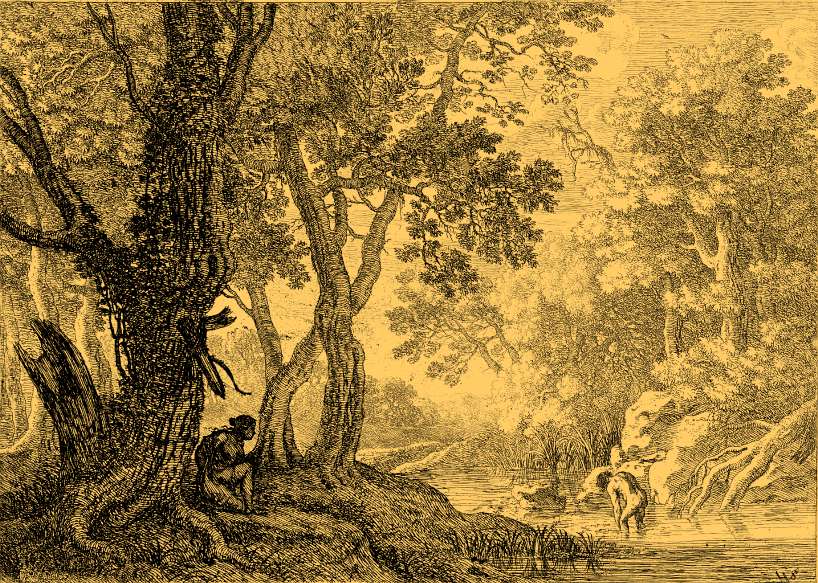
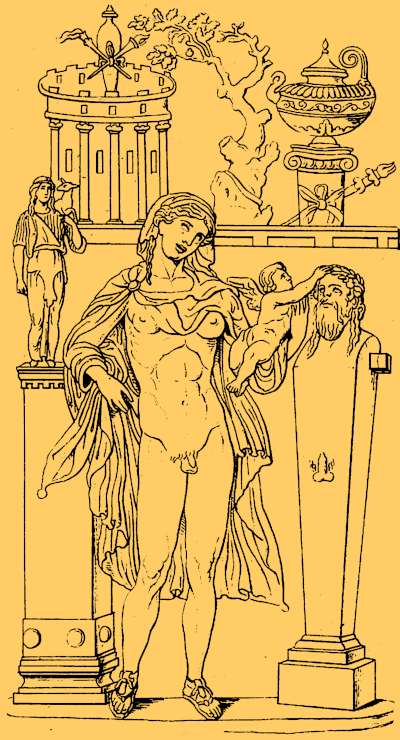
Concerning the mythological background of the hermaphrodite, see William Smith, A Smaller Classical Dictionary of Biography, Mythology, and Geography, 11th ed. (London 1868), 201 (illustrations: [1] Herman van Swanevelt, Salmacis und Hermaphrodit [ca. 1620–55]; Herzog Anton Ulrich-Museum; Museums./Signatur Museumsnr. HvSwanevelt V 3.5727; [2] Hermaphrodite with Eros on his left arm, which is crowning a bearded, phallic Herme, apparently of Dionysus, from Carl Ottfried Müller and Carl Osterley, Denkmäler der alten Kunst, 3rd ed., ed. Friedrich Wieseler [Göttingen 1877], vol. 2, no. 2, plate 717):
Hermaphroditus, son of Hermes and Aphrodite (Venus), and consequently great-grandson of Atlas, whence he is called Atlantiades or Atlantius. He had inherited the beauty of both his parents, and thus excited the love of the nymph of the fountain of Salmacis, near Halicarnassus. She tried in vain to win his affections; and as he was one day bathing in the fountain, she embraced him, and prayed to the gods that she might be united with him for ever. The gods granted the request, and the bodies of the youth and the nymph became united together, but retained the characteristics of each sex.
For the complete text in Ovid’s Metamorphoses, see supplementary appendix 257c.1.
[13] Anonymous (Daniel Jenisch), Diogenes Laterne (Leipzig 1799); see supplementary appendix 252g.1, and Friedrich Schlegel’s letter to Fichte on 3 November 1799 (letter 252g). Back.
[14] Der hyperboreische Esel mentioned above. Back.
[15] An interesting reference to Dorothea (to whom Tieck earlier refers as “Lucinde to a nauseating degree”) with a play on the names “Lucinde” and “Lucifer,” a variation of the latter of which will later adhere tenaciously to Caroline herself, esp. as a result of its use by the circle around Schiller, as Dame Lucifer. Back.
[16] Ovid’s Metamorphoses is the most complete source of information about the story of Hermaphrodite. Back.
[17] Dorothea, née Brendel (= Veronica) Mendelssohn. Back.
[18] Florentin. Ein Roman herausgegeben von Friedrich Schlegel, vol. 1 (Leipzig 1801) (vol. 2 never appeared). Back.
[19] See Dorothea’s cautiously appeasing letter to Sophie on 16 January 1800 (letter 258f), in which she downplays elements in Sophie’s letter to her (not extant) must have reflected remarks in this present letter. Back.
Translation © 2013 Doug Stott