
• 250. Caroline to Auguste in Dessau: Jena, 21 October 1799
[Jena] 21 October [17]99
|568| My dear girl, how is it that I have received absolutely nothing from you for 3 or 4 postal days now? You really are making me anxious. |569| I wrote you on every postal day except the last one. I also gave Schlegel a letter when he went to Leipzig so that it would arrive earlier, though perhaps it arrived later for just that reason? [1]
My dear soul, are you unwell? Are you depressed? Who knows whether the Hufelands might be returning by way of Dessau after all and you are coming with them! They still have not written from Berlin, and now I really do not have any idea what is going on in the world [2] — I do not even know what my child is doing. Do you perhaps believe that because I yet wanted to leave you there, I do not love you? Believe me, you are the most precious thing in the world to your mother, and that is something of which you will certainly continue to be aware.
I must say, though, that your complete silence has also completely upset me.
I received a sad letter from Dresden. Utteline has a foul nervous fever and on the 13th was still not yet out of danger.
The Tieks arrived on Thursday. [3] They came through Dessau, and because they thought you were in Dresden with Madam Tischbein they did not try to find you and were probably even in the theater with you, at the Arkadier. [4] Madam Tiek is not really ugly. If she had a bit of grace and liveliness and something more on her body than a sack, she might even pass for pretty. The little Tiek child has gotten very cute indeed, and quite radiant.
Everyone, by the way, is getting along together quite nicely. [5] On the very first evening, Schlegel read King Richard aloud, [6] and yesterday Tiek read a piece by Holberg aloud. All these things will be read again once you are back. [7]
Did you already hear about the hubbub in Leipzig? Kuhn [8] would be wretchedly delighted by it. Kotzebue wrote a play contra the Schlegels and had it performed during the book fair. One of the roles was |570| copied from the fragments in Athenaeum and is supposed to portray Friedrich, who in the end is sent off to an insane asylum.
But I must say that there was absolutely no wit in it at all except for the Schlegels’ own. It caused a great ruckus in the parterre both pro and contra — naturally the pro kept the upper hand among the residents of Leipzig, though afterward Müller had all further performances prohibited. [9] The play is called the Der hyperboreische Esel oder die heutige Bildung. You can easily imagine what delight Schlegel took in it tout de bon. [10] It will be colossal fun for you. [11] —
Schiller’s Musencalendar is also here; [12] the poem by Madam Imhoff is not much more than a pack of hexameters. [13] But yesterday we almost fell off our chairs laughing at a poem by Schiller himself, the “Lied von der Glocke”; it is quite à la Voss, à la Tiek, à la devil, or at least enough so to end up with the devil. [14]
Sweetheart, is there something wrong with you? . . .
Schelling’s brother has been here since yesterday, but has not yet come to visit because he fell off the postal carriage and is still a bit stunned. He is allegedly bigger than Schelling and only 16 years old. [15] The Niethammers have also returned and are not overly excited about Swabia. [16] She, however provided me with an extremely favorable description of Schelling’s sister. Mammeselle Niethammer came along as well and will doubtless seriously detract from the local beauties, at least all the blond ones. [17]
Madam Veit continues to be an excellent woman, and Friedrich continues to dream. Madam Schiller now has a daughter. Madam Mellish does as well, and only imagine, she only gave birth a couple of days ago. [18] He sent an express letter. [19] You probably did not even know that Madam Schiller was pregnant, or? [20]
God bless you, you still do not know many things. So are you at least learning how to sing?
Your despairing Mommy
Notes
[1] Wilhelm had gone to Leipzig for the autumn book fair and taken along Caroline’s letter to Auguste on 14 October 1799 (letter 248), as Caroline indicates to Auguste in that letter itself. Back.
[2] The possibility that Auguste might return to Jena sooner than planned with the Hufelands has been an ongoing topic in Caroline’s letters; See Caroline’s letter to Auguste on 6 October 1799 (letter 247), note 7. Back.
[3] Thursday, 17 October 1799. Back.
[4] Die neuen Arkadier. Eine heroisch-komische Oper in zwei Aufzügen. Nach dem Spiegel von Arkadien bearbeitet, singspiel with music by Franz Xaver Süssmeyer, libretto by Christian August Vulpius (Weimar 1796), performed in Weimar on 2 February 1796, in Berlin on 3 August 1796.
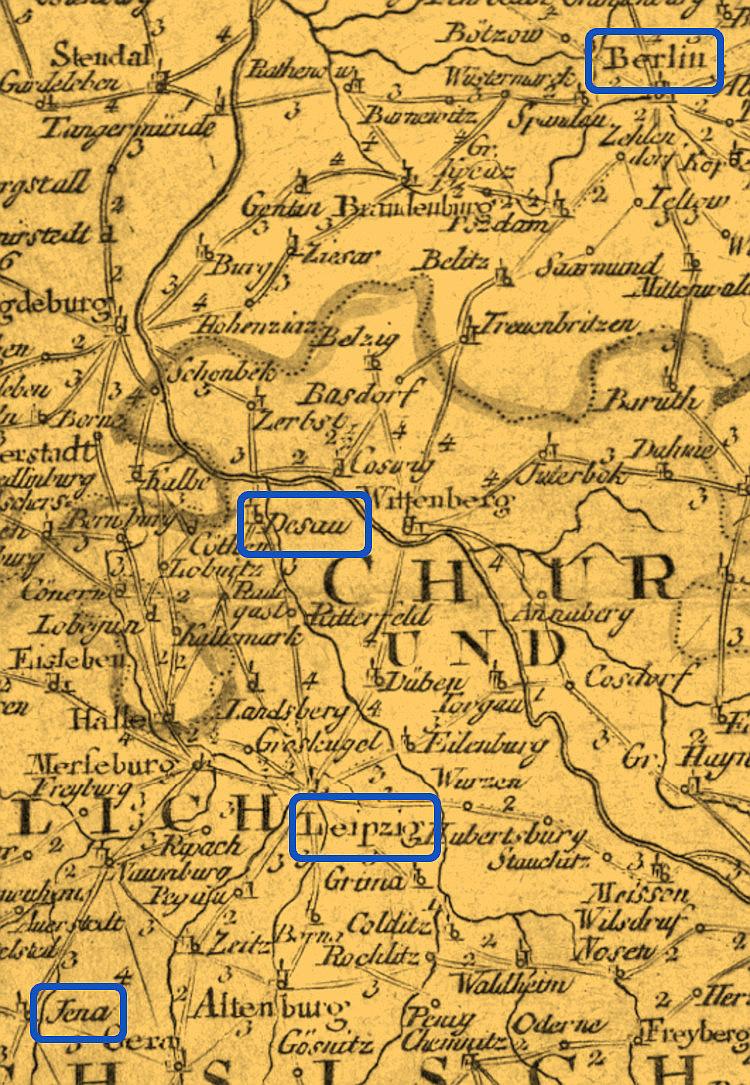
Unlike the Hufelands, the Tiecks did indeed journey to Jena by way of Dessau, which is situated ca. 110 km southwest of Berlin, albeit essentially on the way from Berlin to Jena, which is situated another 110 km southwest (Post Karte Durch ganz Deutschland, ed. J. Walch [Augsburg 1795]):
[5] Concerning Ludwig Tieck’s assessment of how well the group was getting along, see his letter to his sister, Sophie Bernhardi, on 6 December 1799 (letter 257c) in which he speaks about the “beast” Madam Veit, “Lucinde to a nauseating degree,” and also assesses “androgynous Caroline” as being more crafty than smart and more sensible than noble. He continues:
Otherwise it is Schelling who is flirting with Madam Schlegel to the point of creating a scandal for the whole town, while Madam Veit flirts with Wilhelm Schlegel, and so everyone and everything is in a confused mess. Everyone thinks Friedrich is ridiculous with his Lucinde, as is unavoidable . . . but I can assure you that Madam Schlegel [i.e., Caroline] is the real cause of all the squabbling.
Cf., however, the passage from Tieck’s Eine Sommerreise, in his Gesammelte Novellen (Breslau 1838), 5:161–65; also Gesammelte Novellen, rev. ed. (Berlin 1853), 7:102–4, which relates how friends visited the cemetery in Bocklet allegedly three years after Auguste’s death there in 1800:
They spent the night in Schweinfurt, a prosperous, comfortable town. The next morning, they departed from the chaussée in order to proceed, on poor roads, to the mineral-springs spa Kissingen; the place is quite small, and only a few guests were there to drink the waters.
(Album von Kissingen, Bocklet und Brückenau in Stahlstichen, nach Original-Zeichnungen [Frankfurt 1845], unpaginated plate):
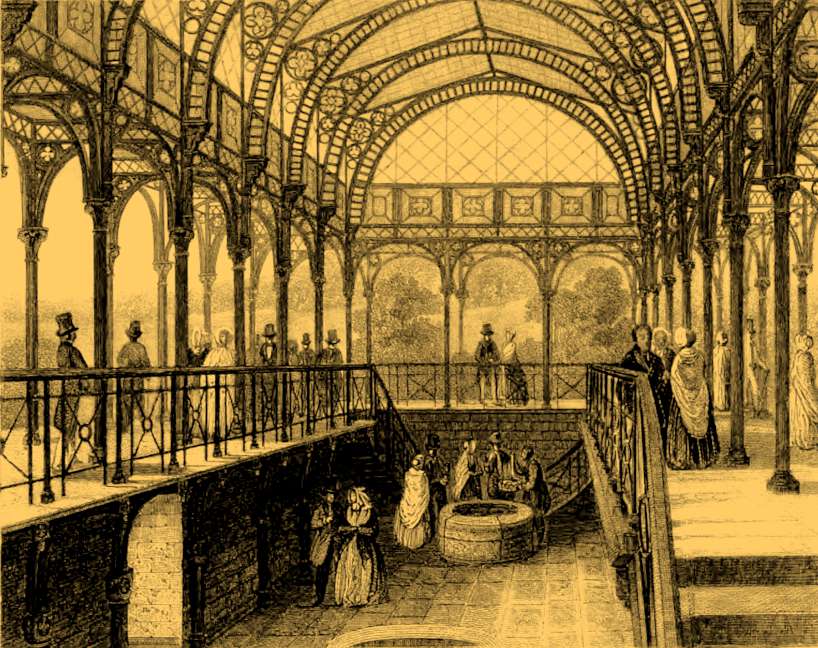
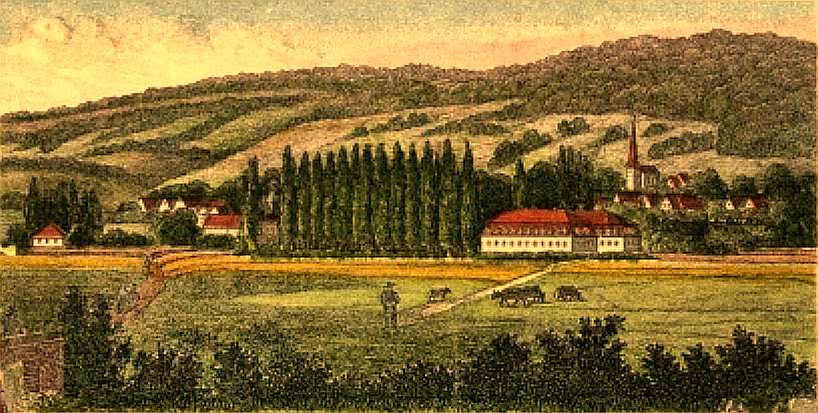
The village Bocklet is a mile [ca. 8 km] away. Here one finds the beautiful greenery of nature, forested hills, fresh meadows in the valley, and a gracious, solemn solitude.
(Map: Rudolf Koch and Fritz Kredel, Deutschland und angrenzende Gebiete [Leipzig 1937]; illustration: unpaginated steel engraving from Album von Kissingen, Bocklet und Brückenau in Stahlstichen, nach Original-Zeichnungen [Frankfurt 1845]):

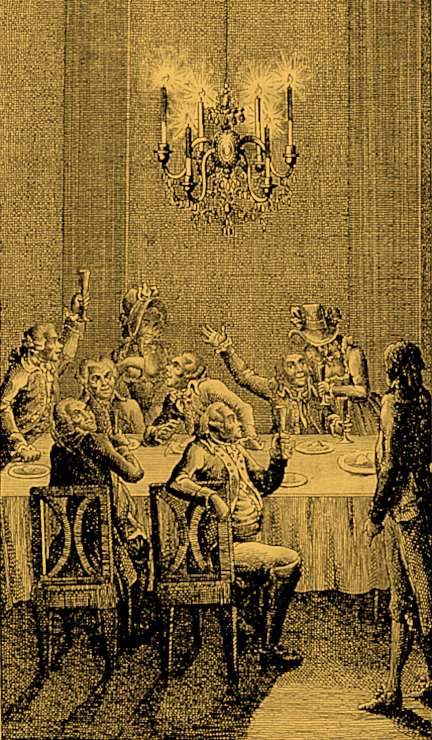
After a rather long walk they arrived at the dining room where the company had gathered. Ferdinand met several ladies and young women he had seen earlier in Berlin. He had peculiar feeling meeting at this small, solitary locale people whom he hitherto could picture only in grand, illuminated salons. . . .
(Johann Gabriel Bernhard Büschel, Die Zöglinge der Natur, vol. 2 [Leipzig, Prague 1794], preceding p. 370):
At dinner everyone was quite cheerful, and only Ferdinand, who sensed that the beauties present there were not satisfied with him, left the room in a slight pique. He went to the local cemetery with Wachtel and Walther to find the grave of Auguste Böhmer, Wilhelm Schlegel’s stepdaughter.
(Calender für das Jahr 1803 [Offenbach]; Inhaltsverzeichnis deutscher Almanache, Theodor Springmann Stiftung):
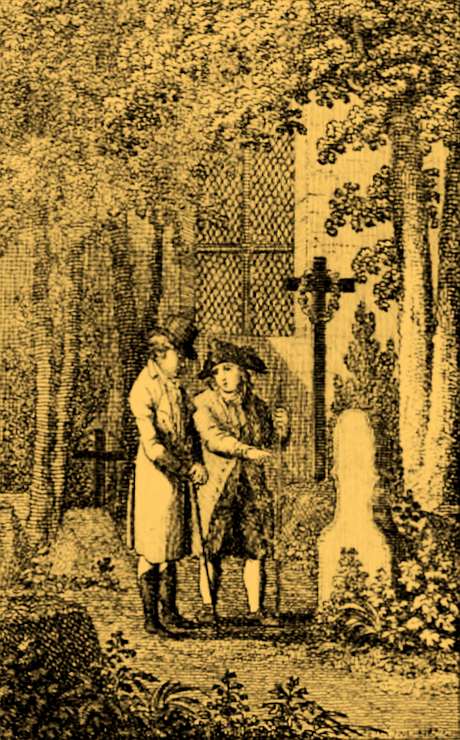
He could not think of her without weeping, finally remarking out loud: “How weak people are! How rarely are they able to listen with noble, genuine empathy to an extremely gifted person being praised, be it for beauty, be it for intellect, for they immediately think something is being withdrawn from themselves, or even that they are being put down, and thus quickly get in line themselves, which is ridiculous, since they are assuming they too must be reckoned among the highly gifted. They are more inclined to endure the praise of the deceased.”
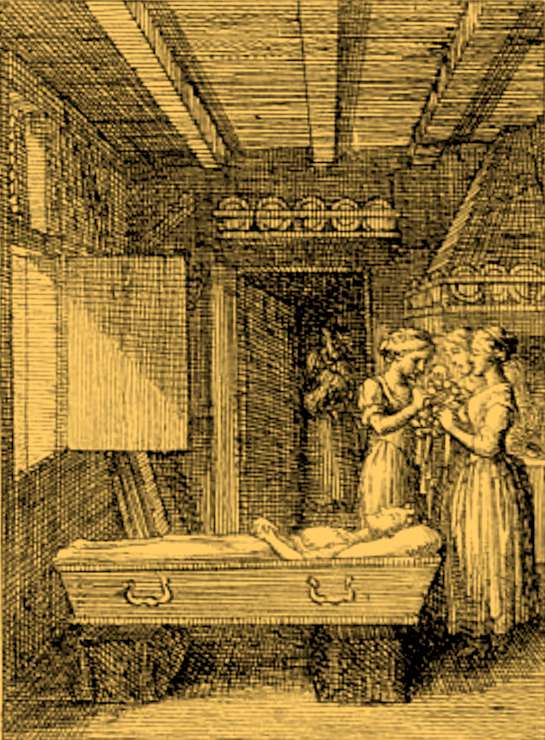
But how sad that the memory of a being as beautiful as this Auguste must so quickly fade. The natural gaiety, the cheerful disposition of this young girl in the flower of her beautiful youth, her innocent wit and gentle mischievousness, coupled with sense and taste, was an enchanting phenomenon.
(Göttinger Taschen Calendar Für das Iahr 1798; Inhaltsverzeichnis deutscher Almanache, Theodor Springmann Stiftung):

Schlegel dedicated several excellent and beautiful poems of eulogy to her memory.
This amiable being was similarly part of the happy, witty company about which I recently spoke in such strong terms, as was the exquisite, intelligent mother of this Auguste, a highly cultured woman who is now Schelling’s wife. This woman had such a sophisticated, practiced ear that Schlegel solicited her advice with regard to his own poems and translations, and whenever he was unsure about three or four possible renderings, she almost always decided which he should choose based on which one sounded the best or sounded most suitable.
This woman, along with Huber’s wife and a very few others, were doubtless among the earliest and most resolute admirers of our Goethe; many future literati will perhaps not want to believe the extent to which such noble and intelligent women set the tone in the history of our German literature. . . . Auguste’s mother came here three years ago to take the waters, and had to see her beautiful, charming daughter buried here.
(Daniel Nikolaus Chodowiecki, Höltys Elegie auf ein Landmädchen [1794]; Herzog Anton Ulrich-Museum; Museums./Signatur DChodowiecki AB 3.985):
See also Rudolf Köpke, Tieck: Erinnerungen, 1:249–50:
In October [1799] Tieck and his wife and newborn daughter, Dorothea, moved to Jena. He lived in A. W. Schlegel’s house [incorrect; the family took an apartment in a house opposite the former intersection of Grietgasse and Fischergasse in Jena (Peer Kösling, Die Frühromantiker in Jena, 44–45); concerning the location, see supplementary appendix 241.1, note 10], which for him and other friends became the center of their life together. He became acquainted with Schlegel’s wife, Karoline, and their [i.e., Wilhelm’s] stepdaughter, Auguste Böhmer. The latter was seventeen [correct: fourteen] years old at the time and undeniably one of the most attractive persons in this circle. She was quick, animated, witty, and thoroughly original.
One could not really call her beautiful, for her eyes and gaze were a bit askew; but far from being disturbing or off-putting, precisely this feature gave her deep eyes a unique expression. There resided a power in them one had difficulty escaping. When Tieck entered the room, she called out to him: “What? You come in through the door? I would sooner expect you to come striding in like your cat, across the rooftops” [allusion to Tieck’s Der gestiefelte Kater, ein Kindermärchen in drey Akten mit Zwischenspielen, einem Prologe und Epiloge von Peter Leberecht, in his Volksmärchen, vol. 2 (Berlin 1797), 1–139; also separately (Berlin 1797)].
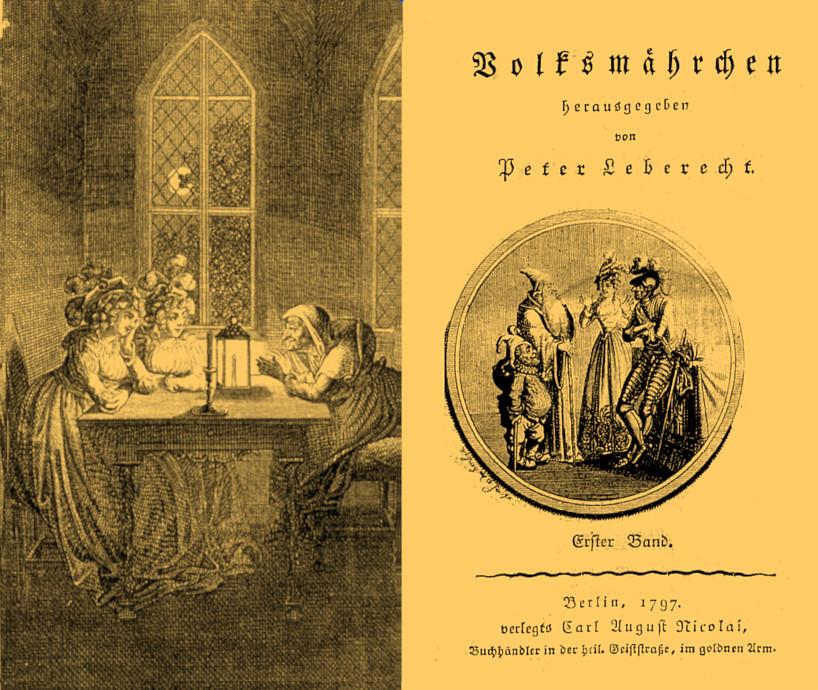

[6] König Johann and König Richard der zweyte (The Life and Death of King John, The Tragedy of King Richard II) appeared in vol. 5 of the edition of Shakespeare (Berlin 1799). Back.
[7] Here an illustration of Tieck reading aloud during his later sojourn in Dresden (A. von Sternberg, “Tieck’s Vorlese-Abende in Dresden,” Die Gartenlaube 8 [1861] 116–17, here 117):

Wilhelm Schlegel, Vorlesungen über schöne Literatur und Kunst, 2:390, jots down notes for further development in his Berlin lectures: “The art of performing Goldoni and Holberg [has been] lost. Tieck’s [art of] reading aloud”. Tieck was widely acknowledged to have been extraordinarily talented in reading plays and other written material aloud (Caroline also remarks as much); see Tieck: Erinnerungen 2:178–80:
Even in my youth, while still attending the Gymnasium, I acquired a not inconsiderable reputation in the art of reading out loud, especially dramatic pieces. I developed this talent ever further later through continued practice, also coming up with certain rules for myself. Much depends on when one takes a breath, and especially on doing so at the appropriate place. It is necessary to draw one’s breath through the nose, which protects the throat from excessive air flow, which during the heat of reading can easily have a slight cooling effect, in which case one’s voice becomes rough and loses both power and endurance.
By contrast, proper exercise can contribute considerably to strengthening and expanding the organ. At my best, I could read two five-act plays one after the other without tiring. During the actual reading, I always tried to stand above the whole. Notwithstanding the fact that to a certain extent I do become one emotionally with each and every character, I nonetheless always tried to maintain enough oversight that I might at any moment catch myself having emphasized this or that word incorrectly.
That is the correct disposition for anyone reading aloud as well as for the actor and artist in the larger sense; and that is the irony here. The tone of the person reading aloud is never permitted to exceed the boundaries of what I have always called the more noble tone of conversation. Not even in the tragic genre is such allowed, since otherwise it turns into false pathos and mannerism, with individual elements being singled out and the impression of the whole thereby lost. And yet everything depends on exactly that whole.
Reading a play with a widely changing voice, or attempts to imitate, even if deceptively, well-known actors, although capable of having an impressive effect at the moment nonetheless remains subordinate, being quite inartistic and inimical to the effect of the whole. That is also why I have always found the now popular activity of readings with so-called role assignments to be repugnant. Through such readings, the whole is utterly sundered.
One person reads tolerably, another horribly, the one reads in a head voice, the other with a jarring bass voice, and none really understand their roles. I was once invited to such a tea reading as a gesture of respect, but I was hardly able to endure it to the finish. [Ignaz Aurelius] Fessler [1756–1839] in Berlin was the first to begin this type of reading. These days, although everyone thinks himself capable of reading, only very few actually understand it, and even otherwise distinguished people often deceive themselves on just this point.
The elder Schlegel could read lyrical pieces and his own poems in an extremely pleasant manner, but dramatic material in an insufferable pulpit voice even though he thought he could read quite well aloud. On the other hand, he criticized my simple style of reading aloud because I allegedly lacked tragic pathos.
See esp. the supplementary appendix on Ludwig Tieck’s talent for reading aloud. Back.
[8] Possibly the Saxon Friedrich Adolf Kuhn. Back.
[9] Wilhelm arrived in Leipzig too late for the performance; Friedrich had traveled through Leipzig on his way from Berlin to Jena a few weeks earlier and was able to attend a performance. See also Wilhelm Schlegel’s letter to Goethe on 22 October 1799 (letter 250b). Back.
[10] Fr. “seriously, in all earnest, indeed.” Back.
[11] August von Kotzebue, Der hyperboreische Esel oder die heutige Bildung. Ein drastisches Drama, und philosophisches Lustspiel für Jünglinge in einem Akt (Leipzig 1799); reprint: Deutsche Litteratur-Pasquille 3 (Leipzig 1907). Concerning the play, its title (“The hyperborean ass, or the education of our age”) and frontispiece, and for reviews and translated scenes, see supplementary appendix 250.1. Back.
[12] Schiller’s Musen-Almanach für das Jahr 1800. Here the front cover:

See next footnote for the internal illustrations. Back.
[13] “Die Schwestern von Lesbos,” in Schiller’s Musen-Almanach für das Jahr 1800, 1–182, a six-canto verse story of two sisters who love the same man (see also Caroline’s letter to Julie Gotter on 11 March 1802 [letter 354], note 12). Here the illustrations accompanying the story. In the final scene, one sister renounces her fiancé at the altar because her sister loves him (plate following p. 150):
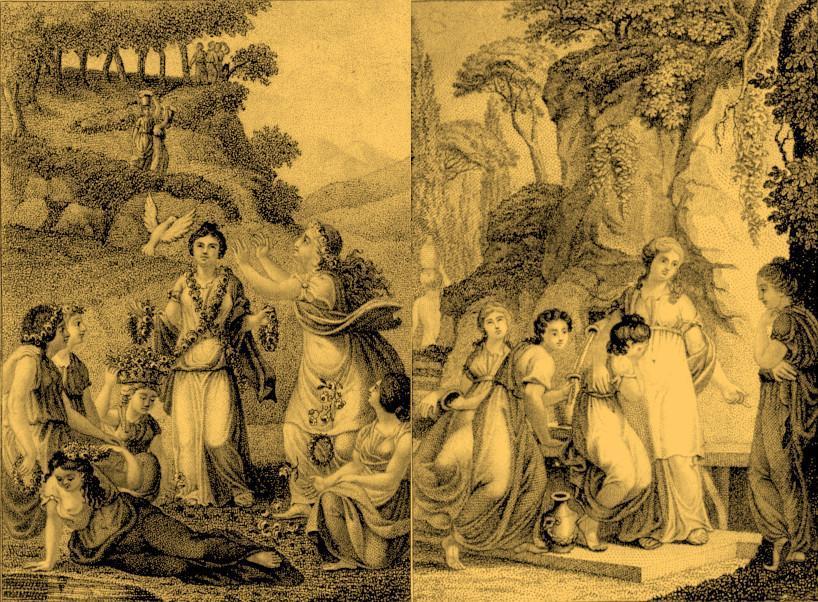
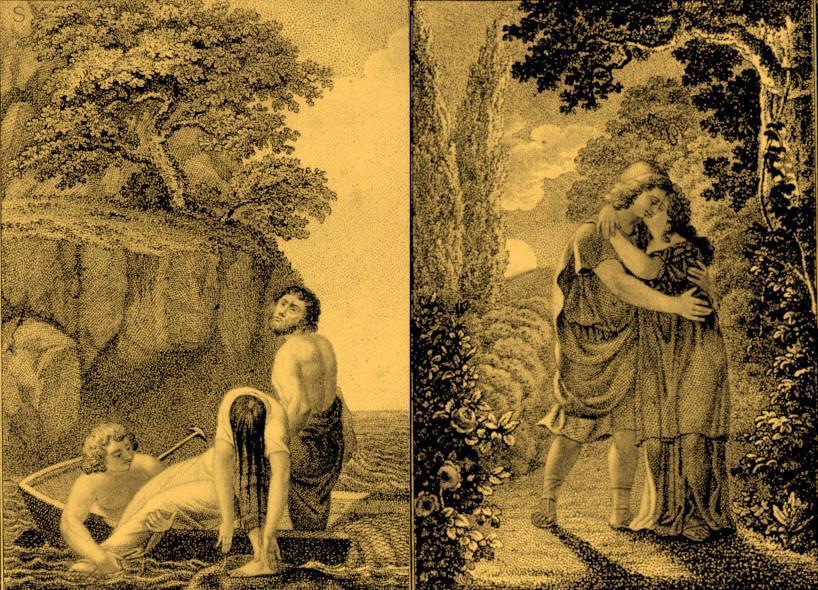
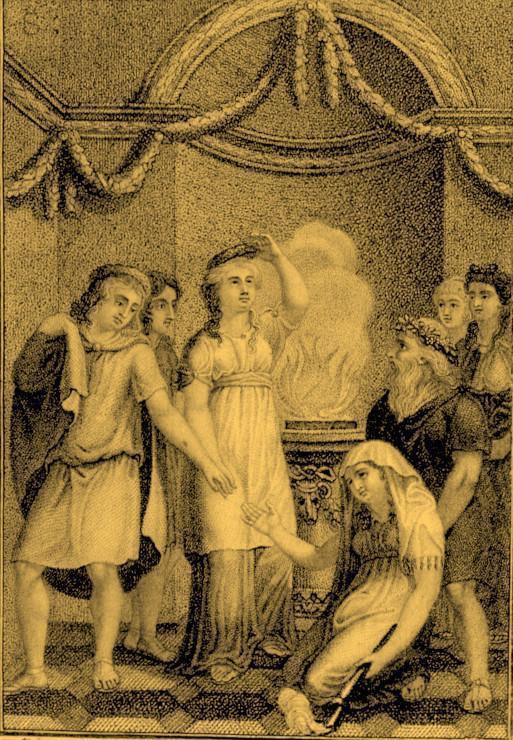
[14] “Das Lied von der Glocke” (The song of the bell) concludes Schiller’s Musen-Almanach für das Jahr 1800, 243–64; full translation in supplementary appendix 250.2. Caroline mentions this incident again in her letter to Johann Diederich Gries on 27 December 1799 (letter 258). Wilhelm later derides the poem in several parodies, including the following (Sämmtliche Werke 2:211–12):
2. Sexton's Criticism
We sextons, esteemed Sir, are delighted
That you have sung thus about bells;
Indeed, your song itself almost sounded like festive ringing.
Excepting that, in venturing so far afield,
The main point you did forget:
To wit: the clapper that hangs inside the bell.
For without a tongue in his mouth — with all due respect —
E'en the pastor himself silent must be.
So, when the bell a clapper lacks,
Howsoever one may pull and jerk the rope,
It will neither ding nor dong.
As Erich Schmidt, (1913), 1:748, remarks, if one imagines certain passages being recited and parodied amid rather high-spirited company, one will perhaps not be quite so inclined to take their impertinent laughter too seriously. Back.
[15] See Schelling’s letter to his father from Jena on 2 March 1800 (Plitt 1:295–96; Fuhrmans 2:218–19):
He [Karl] is still glad to be here and has, I think, profited as much during these first six months as is possible considering he is having to take courses in so many different subjects, virtually all of which are new to him; and if in the following six-month periods, when he will have to take fewer lectures, he also applies himself diligently in private, I would hope that in a year and a half (counting these six months) he will probably have learned what there is to learn here.
Next summer he is to take the remaining preparatory sciences, namely, natural history, mineralogy, botany, etc. It is unfortunate that pathology is so poorly represented here that one can hardly really attend lectures at all. In my opinion, he should not remain here longer than this coming winter, since at that time it will no longer really be worth his while to stay, and then it is up to you to decide whether you would like perhaps to have him in Tübingen for the summer or send him to Bamberg or Würzburg instead.
If things go according to my own plan — since he must, after all, go elsewhere, and the sooner the better, since things stand so poorly both here and in Tübingen with respect to genuine praxis as well as genuine theory — and if it can indeed happen then — either through support from you yourself or that of the church council, the latter of which you certainly have every right to request now, since I myself received nothing — he should go to Vienna in the autumn of 1801, where he can finish in one year and then immediately start his own practice, or, if you reserve the travel money from the church council for him, travel to other countries.
The reason I am so keen on having him go to Vienna soon is that I myself am definitely going there this coming autumn and will remain at least a year, during which time I can arrange things for him and then also pass on my own acquaintances to him. —
As far as I myself am concerned, I will not be staying here very much longer. I am thinking about going to Bamberg immediately after Easter, where I will spend part of my time studying, part of it lecturing privately on the philosophy of nature. Back.
[16] The Niethammers had spent five weeks in his native Swabia. Back.
[17] Uncertain reference; presumably one of Friedrich Immanuel Niethammer’s sisters. Back.
[18] See Goethe’s letter to Wilhelm Schlegel on 1 May 1798 (letter 199c); Goethe seems to have inroduced Schlegel at that time to Joseph Charles Mellish in the Roman House in Weimar; see also Goethe’s diary entry on 29 March 1799: “Midday with Rath Schlegel, Kammerherr Mellish also present from Dornburg. Copper engravings by Flaxman.” Wilhelm eventually published the treatise “Ueber Zeichnungen zu Gedichten und John Flaxman’s Umrisse: Von W.,” Athenaeum (1799) 193–246.
Click on the following image to open a gallery of selections from Flaxman’s illustrations to Dante’s Divine Comedy:

[19] I.e., presumably Joseph Charles Mellish. Back.
[20] Charlotte Schiller had an extremely difficult time during and after the birth of her daughter; the physician — Johann Christian Stark — even feared for her life, so much so that Schiller postponed his anticipated move to Weimar. Caroline mentions these serious complications in her letter to Auguste on 28 October 1799 (Letter 252); see Schiller’s letters to Goethe during this period cited there in note 16. Back.
Translation © 2013 Doug Stott