
199c. Goethe to Wilhelm Schlegel in Weimar: Weimar, 1 May 1798 [*]
Weimar, 1 May 1798
His Excellency the Duke has charged me with accompanying you, esteemed Herr Rath, to what is known as the Roman House [1] tomorrow morning to introduce you to Herr Melish, a great enthusiast for Shakespeare and admirer of your translation. [2]
Might you therefore arrive at my house toward 11:00? [3]
I hope to see you this evening in the theater. [4]
1 May 1798
Goethe
Notes
[*] Source: Körner-Wieneke 67. Back.
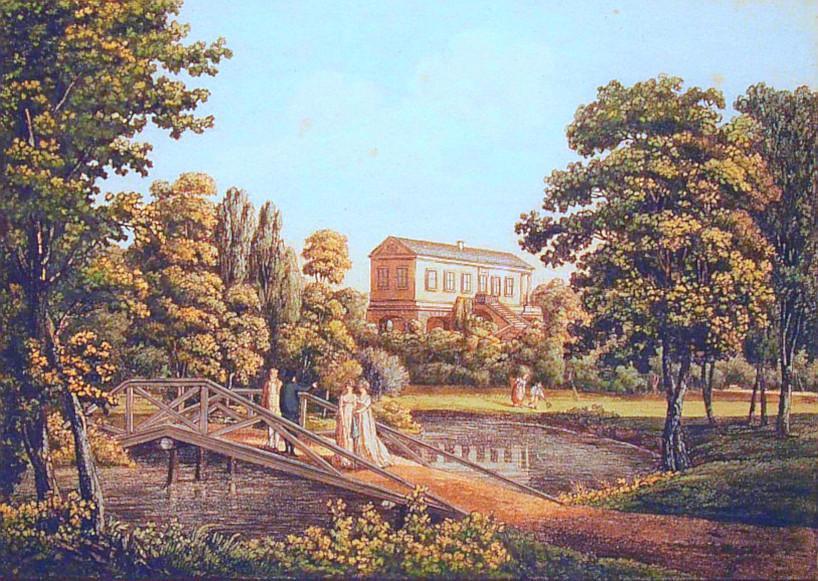
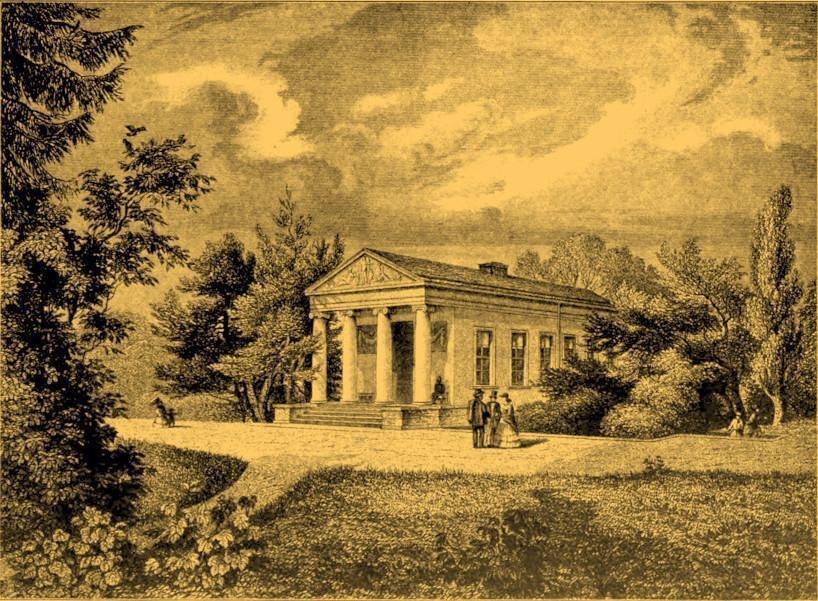
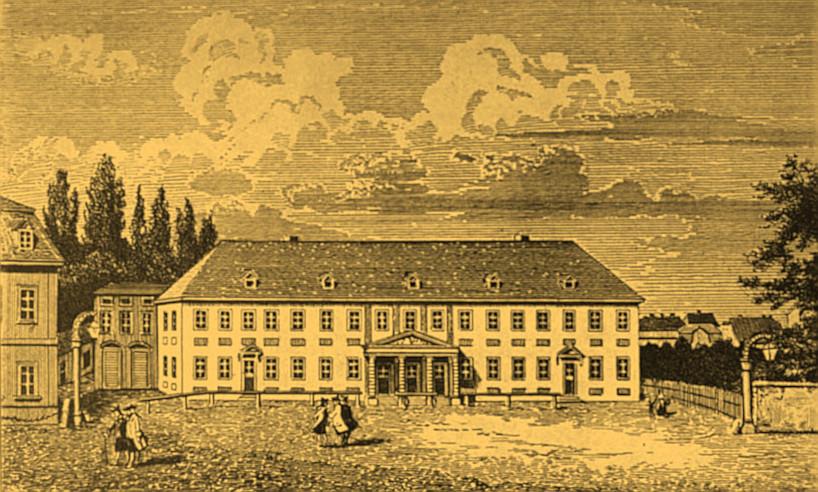
[1] The Roman House is a building on the edge of the park on the Ilm River in Weimar built between 1791 and 1798 as a garden house for Duke Karl August; it was built in an early classical style and modeled after a Roman temple (whence the name), the idea for which Goethe had brought back with him from his trip to Italy between September 1786 and May 1788; here in a 1799 illustration by Georg Melchior Kraus; second illustration by Robert Bauer (Wilhelm Bode, Damals in Weimar [Weimar 1912], 64):
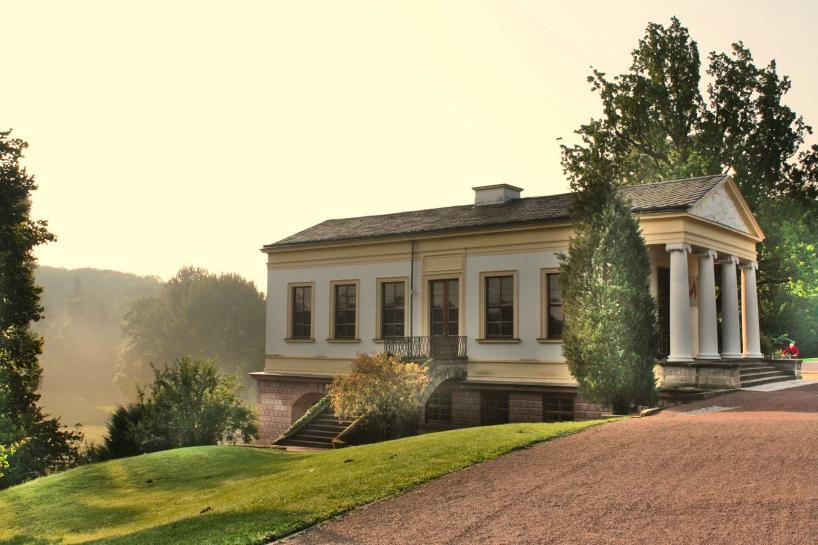
The house today, from the other direction (photo R.Dumke, courtesy Sabine Schierhoff):
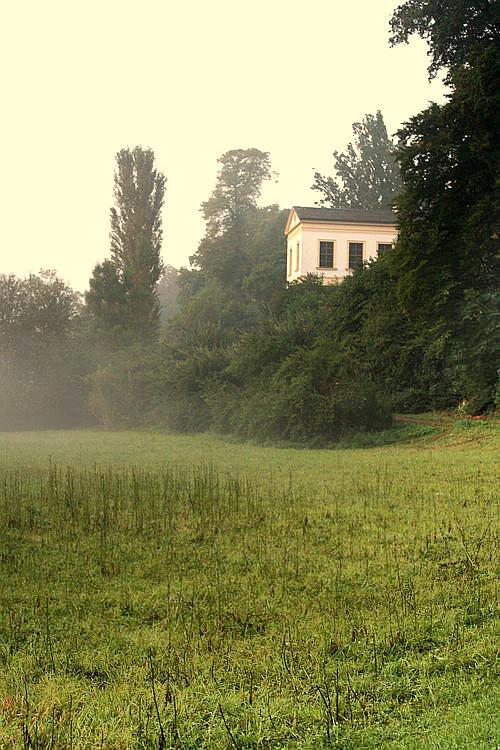
And from the perspective of the Ilm Park situated behind it (photo Sabine Schierhoff):
[2] Goethe writes to Schiller from Weimar on 2 May 1798 (Correspondence between Schiller and Goethe 2:79):
The English translation of my [Herrmann und] Dorothea [Herrmann und Dorothea. Taschenbuch für 1798, appeared in October 1797)], which Mr. Mellish undertook, is now ready, as he told me himself yesterday; he is going to show me the first four cantos, which he brought with him. I am myself no judge of this sort of work, I shall get Schlegel to take a look at them; he has studied the relation between the two languages thoroughly. Back.
[3] Goethe’s notes in his diary for 2 May 1798 (Weimarer Ausgabe 3:2:206): “Breakfast in the Roman House.” Back.
[4] Here an illustration of the Weimar theater ca. 1800 (Adolph Döbler, Lauchstädt und Weimar: Eine theaterbaugeschichtliche Studie [Berlin 1908], illustration following p. 64):
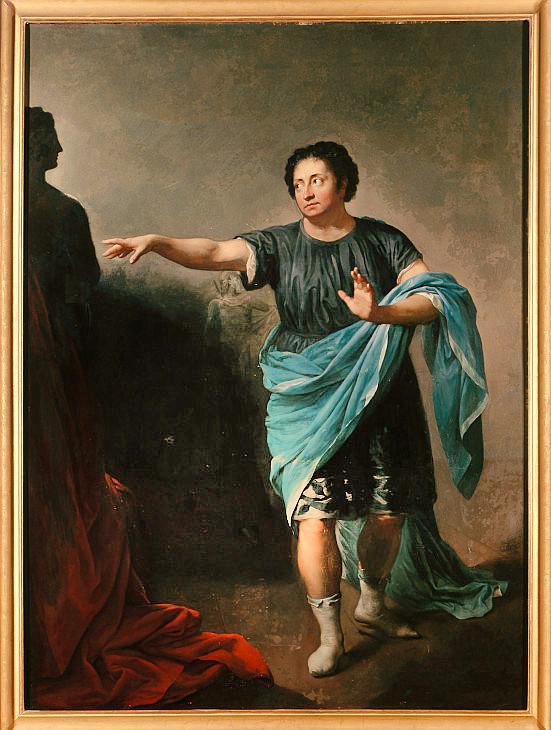
On 1 May 1798, Caroline and Wilhelm were to see August Wilhelm Iffland perform in Jean-Jacques Rousseau, Pygmalion: Ein Monodrama, music by Georg Benda (Leipzig 1780) (concerning Iffland’s Weimar performances, see Caroline’s undated letter to Luise Gotter in April 1798 [letter 199] with note 5; here a portrait of Iffland as Pygmalion in 1800 by Anton Graff; Stiftung Preußische Schlösser und Gärten Berlin-Brandenburg):
The other two dramatic pieces performed that day were Die theatralischen Abenteuer, by Cimarosa and Mozart, and Die eheliche Probe by Wolfgang Heribert Dalberg.
Die theatralischen Abenteuer had a complicated history in Weimar as an adaptation of Cimarosa’s L’impresario in angustie, which had premiered in 1786 in Naples Teatro Nuovo. It premiered in Weimar in one particular adaptation on 14 October 1797 and was simultaneously printed as a text for the audience. The adaptation included both Cimarosa und Mozart as composers, an anonymous Italian and Johann Gottlieb Stephanie as librettists, and Goethe and Christian August Vulpius as redactors; the piece was repeated in this configuration on 13 and 20 January, 1 May, (the date in question here), 4 August, und 8 December 1798, after which it underwent yet another adaptation; see Max Morris, “Goethe as Bearbeiter von italienischen Operntexten: I. Die theatralischen Abenteuer,” Goethe Jahrbuch 26 (1905), 3–28, here 7. Back.
Translation © 2012 Doug Stott