
207a. Wilhelm Schlegel to Georg Joachim Göschen in Leipzig: Jena, 31 October 1798 [*]
Jena, 31 October [17]98
Please forgive me, dear friend, for not answering your letter until today and extending to you my warmest thanks for the things you sent. The reason is that I have been enormously occupied. For as you no doubt know, I have genuinely become a professor here — that is to say, I am giving lecture courses, and not simply to empty seats, the way Anthony preached to the fish — but to genuine participants, who, moreover, seem quite attentive. I am indeed enjoying it, but it also takes a great deal of time to get things going. [1] Just now it is also considerably obstructing my literary projects — though I will do what I can to avoid neglecting anything. [2]
What a pleasant surprise the magnificent edition of Neubeck was for me [3] — that is certainly a matchmaker’s reward and then some! And indeed, I am genuinely proud to have prompted, as it were, this beautiful monument to German typography. You can depend on me getting to a review of it very soon, as well as the yet outstanding one of Doolin. [4]
I am really quite disappointed you are not interested in taking on the sketches to Dante — though given the circumstances you describe I cannot really hold it against you and must thus seek salvation elsewhere. [5] I am pleased that you speak so candidly and freely with respect to my poems — so let me respond with equal candor. —
If I exclude from my collected poems several earlier, immature pieces, and everything I otherwise also consider less than excellent, as well as the poetic translations from Petrarch etc., I think it will comprise about a dozen printer’s sheets if done in an elegant format that is not too narrow. In the meantime, I cannot have the honorarium determined by the number of printer’s sheets, and would ask just as much even were it printed in a narrower format. My price, in a word, is 60 louis d’or. Once we have agreed on terms for the initial edition, we can address contract details for subsequent ones, which I hope would in each case be considerably larger. Only let me know in this case what your conditions are. —
Please do not be disturbed if my price seems too high. Only be so kind as to let me know your decision as soon as possible. [6]
So much for business. I hope things are going well again in your family and that your dear spouse has completely recovered from the blows her health has suffered. [7] My own spouse is doing quite well — it seems that the rural sojourn of this summer, [8] the mineral waters, and the journeys have been quite salutary for her indeed. Auguste is also quite merry and healthy and is growing up much to our delight.
Stay well, good friend — thank you once more for your recent parcel; let us hear from you again soon.
Yours,
A W Schlegel
The luggage and container of books all arrived safely — thank you for taking care of it all. [9] I have not even asked Frommann yet whether he compensated you in my name for the expenses. If such not be the case, then rest assured I will take care of it, just as I also remain obliged to you for Wieland and the works of Elias Schlegel. [10] [Caroline:] (And no doubt for more as well.)
[Caroline continues:] Good evening, my dear Göschen. If your poor, dear wife gives birth again, we will all be quite angry with you. [11]
Notes
[*] Source: Krisenjahre 1:7–8 (Rudolf Koch and Fritz Kredel, Deutschland und angrenzende Gebiete [Leipzig 1937]):

[1] A humorous allusion to St. Anthony of Padua (1195–1231), who according to legend once preached to fish because the heretics would not listen to him. Here presumably also an allusion to the German folk song based on material from Abraham a Santa Clara and later included in Des Knaben Wunderhorn: Alte deutsche Lieder, vol. 2, ed. Ludwig Achim von Arnim and Clemens Brentano (Heidelberg 1808) (trans. from The Library of Wit and Humor, Prose and Poetry, vol. 3 [Philadelphia 1893], 178–79; illustration from Franz Graf von Pocci et al., Festkalender in Bildern und Liedern geistlich und weltlich, rev. ed. [Freiberg im Breisgau 1887], 89):
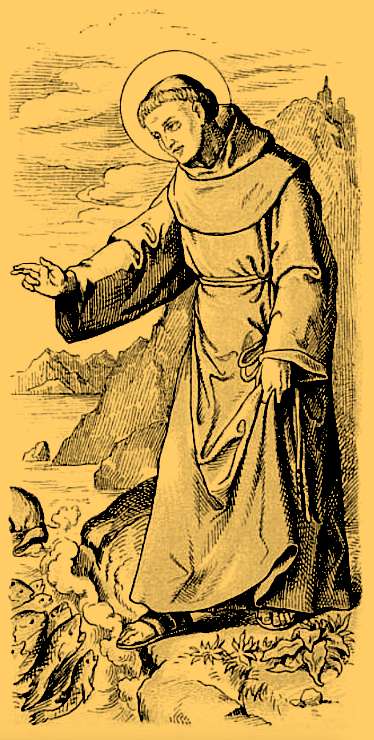
Saint Anthony at church
Was left in the lurch,
So he went to the ditches
And preached to the fishes.
They wriggled their tails,
In the sun glanced their scales.

The carps with their spawn,
Are all thither drawn;
Have opened their jaws,
Eager for each clause.
No sermon beside
Had the carps so edified.

Sharp-snouted pikes,
Who keep fighting like tikes,
Now swam up harmonious
To hear Saint Antonius.
No sermon beside
Had the pikes so edified.

And that very odd fish
Who loves fast-days, the cod-fish,
The stock-fish, I ean,
At the sermon was seen.
No sermon beside Had the cods so edified.

Good eels and sturgeon,
Which aldermen gorge on,
Went out of their way
To hear preaching that day.
No sermon beside
Had the eels so edified.

Crabs and turtles also,
Who always move low,
Make haste from the bottom
As if the devil had got 'em.
No sermon beside
Had the crabs so edified.

Fish great and fish small,
Lords, lackeys, and all,
Each looked at the preacher
Like a reasonable creature.
At God's word,
They Anthony heard.

The sermon now ended,
Each turned and descended;
The pikes went on stealing,
The eels went on eeling.
Much delighted were they,
But preferred the old way.

The crabs are back-sliders,
The stock-fish thick-siders,
The carps are sharp-set,
All the sermon forget.
Much delighted were they,
But preferred the old way. Back.
[2] Josef Körner, Krisenjahre, 3:13–14, points out that Wilhelm, having been appointed extraordinarius professor on 30 July 1798, lectured on aesthetics and the history of German poesy during the winter semester 1798–99. To Goethe, too, Wilhelm boasts of always having “an attentive audience” (14 December 1798, Körner-Wieneke 78).
But since Wilhelm was making his living by writing rather than as a professor, this double vocation quickly became an onerous burden. Friedrich Karl von Savigny, who attended Wilhelm’s lectures in the summer of 1799, remarked (Adolf Stoll, Friedrich von Savigny. Ein Bild seines Lebens mit einer Sammlung seiner Briefe, 2 vols. [Berlin 1927–29], 2:118) that
a destructive power comes to expression in his facial features . . . he has also allegedly considerably changed over the past few years from the time when he was yet a fresh, vigorous, handsome youth, the main cause allegedly being over-exertion, whose cause in its own turn is to be found in severe economic distress
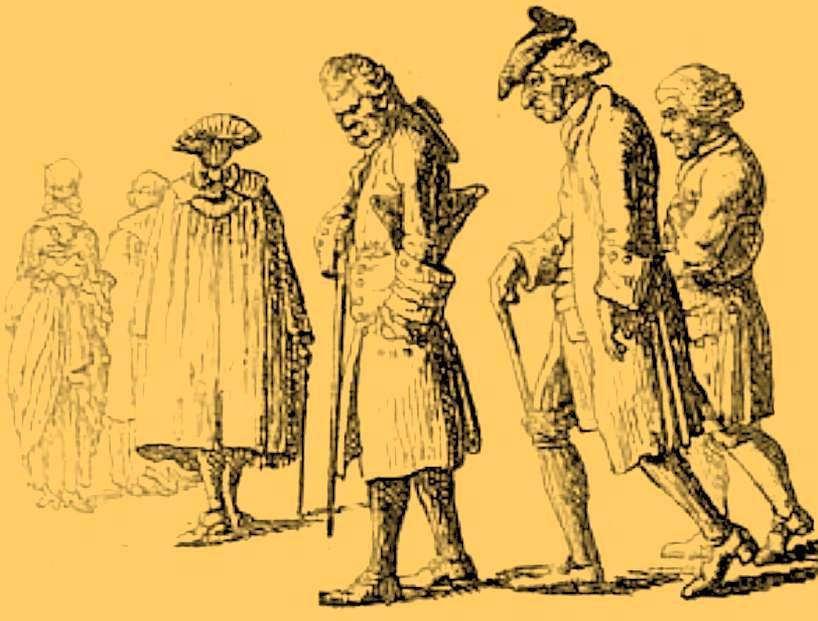
(Illustration: Daniel Nikolaus Chodowiecki “Der Schriftsteller,” Illustrationen zu Erasmus’ Lob der Narrheit in sechs Abteilungen [1780]; Herzog Anton Ulrich-Museum; Museums./Signatur DChodowiecki WB 3.32)

Chodowiecki similarly gently but poignantly satirized the broader implications of such a lifestyle in his illustration of the psychologically depressing “fate of the wise” (Loos der Weisen [1780]; Herzog Anton Ulrich-Museum; Museums./Signatur DChodowiecki WB 3.32):
In annotations to a slightly later letter that Wilhelm wrote to Christian Gottlob Heyne in Göttingen on 12 April 1799 (Körner [1930], 1:87–88, not reproduced here), in which Wilhelm mentions his professorship (“I have, as you perhaps already know, held my first lecture courses this past winter and felt quite comfortable in my new enterprise”), Körner provides a bit more information concerning Wilhelm’s experiences (ibid., 2:35):
In the winter semester of 1798–99, Wilhelm lectured on aesthetics and the history of German poesy, also giving practical stylistic instruction; in the summer semester 1799 on aesthetics and methodological considerations in the study of antiquity; then in the winter semester 1799–1800 on Greek and Roman literary history. These lectures were published on the basis of lecture notes taken by Friedrich Ast from 1798 as Vorlesungen über philosophische Kunstlehre, ed. August Wünsche (Leipzig 1911). Ast’s notes are contained in the literary estate of the philosopher Karl Christian Friedrich Krause (1781–1832), who himself attended the lectures in 1798–99 and was quite pleased with them [ed. note: while not, incidentally, attending Schelling’s lectures]; Krause writes to his father from Jena on 14 December 1798 (Der Briefwechsel Karl Christian Friedrich Krauses zur Würdigung seines Lebens und Wirkens, ed. Paul Hohlfeld and August Wünsche, 2 vols. [Leipzig 1903–7], 1:7): “I am not attending any lectures by Schelling, but rather [Wilhelm] Schlegel’s on aesthetics and, publice, the history of German poets (2 hours weekly) — and I am very pleased indeed with Schlegel, but not with Schelling.”
The young Friedrich Karl von Savigny occasionally attended the repetition of these lectures during a visit to Jena in the summer of 1799; a short sample he relates from them coincides almost word for word with Ast’s notes (Adolf Stoll, Friedrich von Savigny 1:118f.; compare with Ast, Vorlesungen über philosophische Kunstlehre 103f.).
At the time, Schlegel’s audience, with which he had been quite satisfied the previous year (to Goethe on 14 December 1798, Körner-Wieneke 78, as noted above), had shrunk to five attendees, nor did things improve the following semester (see Casimir Ulrich Böhlendorff [not Friedrich Muhrbeck, as in Körner’s note] to Friedrich Hölderlin on 24 October 1799: “No one is attending Schlegel’s lectures”).
“His lecture,” Savigny writes, “is completely worked out beforehand and already ready for publication, but for precisely that reason not entirely free, since he occasionally anxiously searches for an expression”; Friedrich Muhrbeck remarks in September 1799 that “he lectures the way he writes poetry: half with his understanding, half with spirit, without sureness and without feeling and life” (Stuttgarter Hölderlin Ausgabe, vol. 7.1, Dokumente, ed. Adolf Beck, 1. Teil: Briefe an Hölderlin [Stuttgart 1968] 146, 142). Without a doubt, Schlegel’s lack of academic success in Jena prompted his plan to transfer his lecturing activity to Berlin.
These developments are of crucial importance for both Wilhelm’s and Caroline’s later plans and play a part in Caroline’s letters; although Rudolf Haym’s account of these developments in Die romantische Schule begins after the demise of Athenaeum and after Wilhelm had already lectured in Jena, Haym returns to those Jena experiences as well. See the supplementary appendix on Haym’s introduction to Wilhelm’s Berlin lectures 1801–4. Back.
[3] The new edition of Valerius Wilhelm Neubeck, Die Gesundbrunnen. Ein Gedicht in vier Gesängen (Leipzig 1798). Wilhelm had enthusiastically praised the first edition of the book (Breslau 1795) in the Allgemeine Literatur-Zeitung (1797) 243 (Wednesday, 2 August 1797) 289–96 (Sämmtliche Werke 11:71–85), thereby contributing to the unmerited success of this formally smooth but (according to Josef Körner) otherwise stale hexameter hack work.
In a letter to Goethe on 24 September 1797 (Körner-Wieneke 63–64), Wilhelm mentioned Göschen’s plans to publish a new edition. The new edition appeared in 1798 (another in 1809), actually an octavo edition with German typeface and a special folio edition with Latin typeface. Although the new edition was reviewed in the Allgemeine Literatur-Zeitung (1798) 374 (Saturday, 8 December 1798) 633–36 (Sämmtliche Werke 11:85–91) allegedly by Wilhelm, who includes it in his list of A.L.Z. reviews in Athenaeum (1800) following page 164, there is reason to believe this particular review came from Caroline’s hand; for the text, see the review of The Health Springs.
It seems unlikely that Wilhelm, already wholly preoccupied with his lecture courses and, as attested by this letter, behind in his literary work, would have had the desire, having already reviewed the previous edition, of examining this newer edition with such precision as is genuiney exhibited in the review, and to do so, moreover, before the publication deadline — likely in mid-November at latest, since the review itself appeared during the first week of December. See esp. Caroline’s letter to Friedrich von Hardenberg (Novalis) on 15 November 1798 (letter 208), in which she mentions “my own opinion is that they, namely, the brothers, should not have burdened themselves down with a journal, and that Wilhelm not have become a professor. He is so busy with lectures that this business with Athenaeum has hardly made an impression on him.”
Though there can be no certainty, it may well be that he charged Caroline with examining the book and writing the review. See also Wilhelm’s letter to Göschen on 7 February 1799 (letter 219b). Back.
[4] See Wilhelm’s letter to Göschen on 27 April 1798 (letter 199b) with note 4. Back.
[5] Körner, Krisenjahre, 3:14, notes that although as early as 1795 Göschen wanted to publish a piece proposed by Wilhelm on Dante’s life and work, to be ready by Easter 1796, Wilhelm’s Shakespeare project prevented him for carrying it out. Now Wilhelm was thinking about publishing his various translation samples of the Divina Commedia, which had appeared in different publications, as a book illustrated by the sketches of the English sculptor John Flaxman (La divina Commedia di Dante Alighieri . . . , disegnata da Giovanni Flaxman, Scultore Inglese, ed incisa da Tommaso Piroli Romano [1793]).
Flaxman’s rare publication was loaned to Wilhelm for this purpose by the Dresden architect Johann August Heine, who after Göschen’s negative response tried to interest the Leipzig bookseller Georg Voss in the piece, albeit in vain (the publisher, incidentally, of several of Wilhelm Gottlieb Becker’s periodicals in which Wilhelm had earlier published several of his pieces on Dante; see Friedrich Schlegel to Wilhelm on 9 October 1793 [letter 135ab] with note 7).
In a letter to Wilhelm on 20 March 1799 Heine does send him the volumes on loan and then nervously continues in his cover letter (Emil Sulger-Gebing, Die Brüder A. W. und F. Schlegel in ihrem Verhältnis zur bildenden Kunst, Forschungen zur neueren Litteraturgeschichte 3 [Munich 1897], 64):
I beg you, however, to view these volumes as something sacred, and that, commensurate with your promise, you allow no one to copy anything from them. – You can keep them for a full week, after which time I must request them back for myself.
Click on the following image to open a gallery of selections from Flaxman’s illustrations to Dante’s Divine Comedy:

This project eventually prompted Wilhelm’s essay “Über Zeichnungen zu Gedichten und John Flaxmans Umrisse,” Athenaeum (1799) 193–246 (Sämmtliche Werke 9:102–53). Back.
[6] Göschen was indeed scared off by Wilhelm’s price for his poems; greatly annoyed, Wilhelm broke off the negotiations in February 1799 and offered the collection to Johann Friedrich Cotta in Tübingen in a letter from Jena on 2 August 1799 (Briefe an Cotta. Das Zeitalter Goethes und Napoleons 1794–1815, ed. Maria Fehling [Stuttgart, Berlin 1925], 256), who immediately accepted the project and published the volume at the Easter book fair of 1800: August Wilhelm Schlegel, Gedichte (Tübingen: Cotta, 1800)

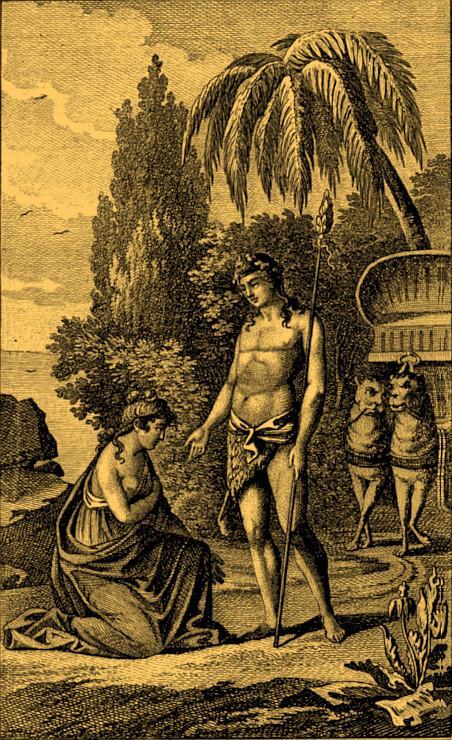
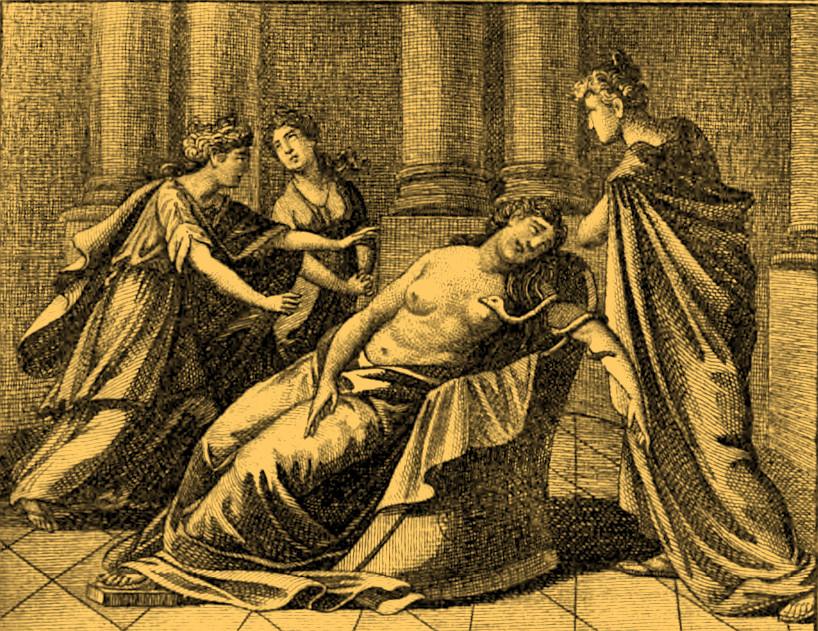
Wilhelm’s collection was, however, reprinted in 1804 with a copper-plate frontispiece (Ariadne) and title vignette (Cleopatra), Gedichte (Vienna, Prague 1804):
[7] Apparently a difficult childbirth, on which Caroline comments at the end of the letter. Back.
[8] Outside Dresden, likely at the summer home of Charlotte Ernst and her husband in Pillnitz. Back.
[9] See Caroline’s letter from Dresden to an unidentified recipient in Leipzig on 20 September 1798 (letter 203a) with the accompanying notes. Back.
[10] Göschen had given Wilhelm complementary copies of the lavish edition of Christoph Martin Wieland’s Sämmtliche Werke (Leipzig 1794–1802), which eventually comprised forty-five volumes, and of Johann Elias Schlegel’s (Wilhelm’s uncle), Werke, ed. J. H. Schlegel, 5 vols. (Kopenhagen, Leipzig 1761–70); here the title vignettes to vols. 1 and 2 of the latter:
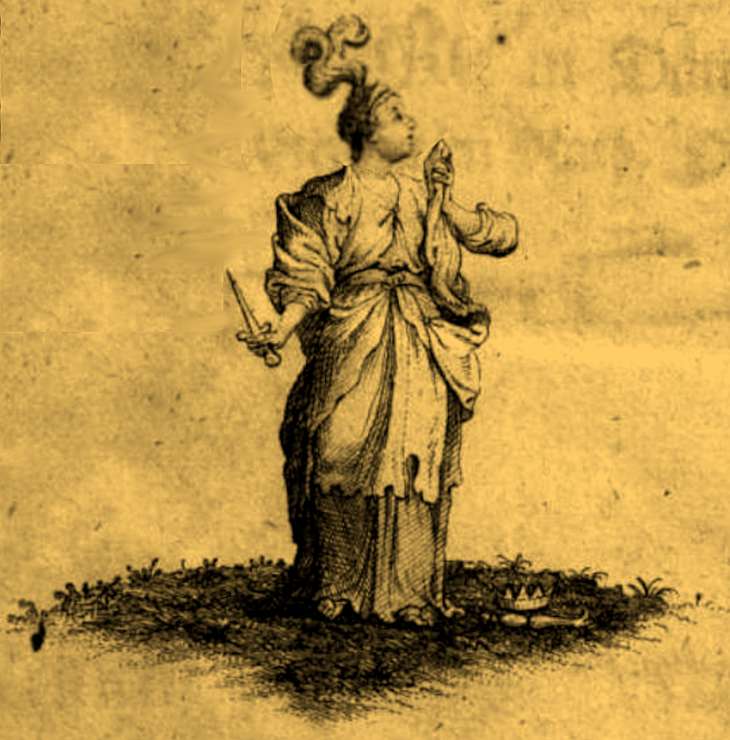

[11] Henriette Göschen bore nine children (eight sons, two daughters), three of whom died early; the one to whom Caroline is here referring seems to have died early (see Caroline’s letter to an unidentified recipient from Dresden on 20 September 1798 [letter 203a] with note 2). Concerning Göschen’s children in general, see The Life and Times of Georg Joachim Goschen, Publisher and Printer of Leipzig 1752–1828, by his grandson Viscount Goschen, 2 vols. (New York, London 1903) 2:434–36. Back.
Translation © 2013 Doug Stott