
• 207b. Friedrich Schlegel to Auguste Böhmer in Jena: Berlin, November 1798 [*]
[Berlin, November 1798]
|637| I am extremely pleased that Henriette is almost certain to be coming to Jena, [1] partly because I am thus hoping she genuinely will do so (at the very least, I intend — this very afternoon and with your charming letter in hand [2] — to deliver an emphatic, enthusiastic, and quite terrifying harangue to her), and partly because you — O you of such powerful resolve! [3] — are beginning to betray such wonderful talents for one day distinguishing yourself as a wartime field commander and peacetime lawgiver.
But if what you want and what you command perhaps do not come to pass, my positive little friend, do not for that reason direct your hatred and even less so your mistrust at yourself or at the omnipotence of the will. For in that case it is merely a misunderstanding between your will and fate. The latter has simply failed to understand the former, since otherwise it surely would have obeyed it.
I would very much like to see how Tischbein painted such a smart child; [4] no doubt differently than Mademoiselle Alberti, who was unable to make you appear sufficiently innocent or demurely blushed. [5] The only consolation I have for neither receiving your picture nor even being permitted to receive it — according to the decision of Your Sage Righteousness — is not, for example, that the picture of your mother will and must be the only one, but rather that I do not really need it in the first place. I am by nature more inclined to give paintings than to receive them, since in my imagination I certainly can paint at least as well as Tischbein does in reality. In my imagination, I am able to think and see my men and lady friends so clearly and vividly that I invariably end up losing something when I have but a picture before me. Hence I already have your picture sufficiently present within my imagination, though it admittedly would be best if you yourself would come here soon that I might compare my copy with the original and retouch it, [6] |638| for I fear you have probably considerably outgrown it again. [7] —
Madam Veit sends many warm greetings; I did not see Henriette yesterday.
Your Friedrich
Notes
[*] Source: Schmidt (1913), 1:637–38 (letter no. 23); Waitz (1871), 1:369; reprinted in KFSA 24:191. — Concerning the textual history of Friedrich Schlegel’s letters to Auguste Böhmer, see supplementary appendix 181d.1. Back.
[1] Concerning Henriette Mendelssohn’s anticipated visit to Jena, see Caroline’s letter to Friedrich on 15 October 1798 (letter 204) and Friedrich’s response to Caroline on 29 October 1798 (letter 207). Back.
[2] Auguste’s letters to Friedrich have been lost except for her letter to Friedrich and Ludwig Tieck during the spring of 1799 (letter 232). Back.
[3] From Goethe’s Iphigenie auf Tauris, in Goethe’s Schriften, vol. 3, 1–136 (Leipzig 1787), line 336 (spoken by Iphigenia). Rendered by G. J. Adler, Iphigenia in Taurus. A Drama in Five Acts by Goethe (New York 1850), 27, as “E’en Pelops, man of powerful resolve.” Back.
[4] See Tischbein’s portrait of Auguste in this gallery. Back.
[5] This sentence is slightly ambiguous. No portrait of Maria Alberti by Tischbein is known to exist, nor does Adolf Stoll, Der Maler Joh. Friedrich August Tischbein und seine Familie (Stuttgart 1923), 181–207, list such a portrait in his catalogue, though he was, of course, familiar with these letters (he includes reproductions of Tischbein’s portraits of Caroline and Auguste).
“Mademoiselle Alberti” can be read as either an accusative (parallel with Auguste, i.e., “such a smart child”), or as a nominative (parallel with Tischbein), though the latter presents a pronoun conflict.
If the former, then Friedrich is referring to a portrait Tischbein did of Maria Alberti in which she was unable to affect quite the innocent attractiveness Auguste did in her own portrait, was unable, try as she may, to make “herself” (sich) look that attractive.
If the latter, then Friedrich is saying that Maria Agatha Alberti’s own attempt (she was studying painting in Dresden at the time) at a portrait of Auguste (no longer extant) was apparently unsuccessful (because Maria Alberti seems to have come to Dresden around 1795, such a portrait was almost certainly done during Auguste’s stay there between May and October 1798). This portrait is indeed attested in Charlotte Ernst’s letter to Wilhelm Schlegel in January 1801 (letter 282a), in which Charlotte Ernst mentions that even Maria Alberti herself thought the portrait unsuitable. It also seems to be attested in Schmidt, (1913), 1:760, in which Schmidt speaks about “an unsuccessful Albertian rendering — a remark, moreover, that seems to concur with Friedrich’s assessment here.
One significant point militating against reading the passage as referring to Maria Alberti’s portrait of Auguste, however, is that it requires the assumption that either Erich Schmidt misread “you” (i.e., Auguste, dich) as “herself” (sich), or that Friedrich himself miswrote “herself” for “you.”
Unfortunately, no manuscript exists of this letter in which to check whether the pronoun sich might be read as dich.
This present translation, however, follows the emended text in Schmidt (“you” rather than “herself”), (1913), a text thus attesting a portrait of Auguste by Maria Alberti. Back.
[6] The Schlegels had not made the anticipated trip to Berlin from Dresden to bring Henriette Mendelssohn back with them to Jena. Back.
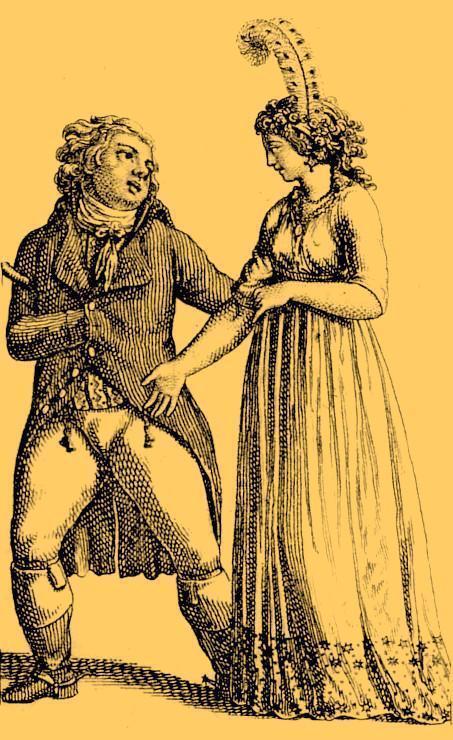
[7] Friedrich is only slightly jesting. Although he had seen Auguste in Dresden the previous summer, she was indeed at the age (she had turned 13 the previous April) when changes in appearance could occur rapidly (Göttinger Taschen Calendar Für das Iahr 1798; Inhaltsverzeichnis deutscher Almanache, Theodor Springmann Stiftung):
That said, doubtless no one among the group of adults around Auguste or among her acquaintances imagined that she would be gone in just a year-and-a-half. Back.
Translation © 2013 Doug Stott