
• 134. Friedrich Schlegel to Wilhelm Schlegel in Amsterdam: Leipzig, 28 August 1793 [*]
Leipzig, [Wednesday] 28 August [1793]
I just spent several extremely sad days in L[uck]a. I went out there on Saturday, [1] found her quite well, even serene, and brought her two letters from Franz Wenner in Frankfurt. The first contained the words, “I know about your entire situation.” The second, which she opened first, “People know about it in Maynz: Gr. is still there.”
She was fairly stunned with fright and pain, and for a long time could utter only single words. She suffered inexpressibly during those few days, indeed according to her own words more, far more than ever before in her life. [2] —
You doubtless have a better overview of the consequences of this unfortunate discovery than I, since you know all the particulars; the loss of her widow’s pension, her mother’s grief (who does not know about it yet, though in his last letter Philipp expressed concern that she might already be suspicious), the persecution of the Böhmer family, which may even result in her losing custody of her child. [3] —
I will spare you any true description of her suffering, which would rend your heart; her initial outburst, she crying out with the voice of the most profound suffering, was “Oh, my mother!” and “My child! my child!” and statements of that sort, though afterward it was her emotional breakdown that showed itself far more intensely, the entire two days, sometimes in one way, sometimes another, all amid the most vehement changes from sudden tears to utterly deranged thoughts to the joking and laughter of utter despair. [3a]
Her health suffered enormously those first two days; except for a few periods of perhaps a quarter hour at a time, she spent the entire day Monday in bed, [4] with back cramps and vehement agitation and dazed nerves, amid the most painfully awkward, confused hallucinations, the latter condition being more disagreeable to her even than the severe pain of the former.
It is for that reason, however, that I do believe you can stop worrying with respect to the future, insofar as, that is, though certainly extremely irritable, she does have considerable physical strength. Tuesday morning [5] I had to go in to take care of some letters and because of my own affairs. — She wanted to hide it from you in order to spare you. I objected quite emphatically, nor have I spared you now either, since I consider it a sign of weakness in a man, not least because it is important that you know the truth about how she is doing.
But that other people do not spare her, and will perhaps not spare her in the future either, is a flagrant disgrace unless it happens out of ingenuousness, as with Franz Wenner. Her circumstances and the coincidence of so much suffering have made her extremely irritable and sensitive, and I firmly believe that were she healthy she would not only view the matter quite differently, but also rise resolutely and facilely above it, be the situation itself ever so bad.
You must be extremely careful with respect to what you now write to her about Sophie; [6] believe me, I would not tell you this did I not have solid evidence that in so doing you can hurt her quite severely. And from this you can perhaps see most clearly the profound influence her current physical condition has on her emotions. And is the way you are currently comforting her, namely, urging her to persevere, really the right way? —
Please do not think me immodest; and — I have seen her, while you yourself do not really know her situation firsthand. She herself said, “I fear that Wilhelm’s next letter will again contain what even now is already causing me pain.” You could give her great joy by sending your portrait. Could you not ask Tischbein to have it sent? [7] It would adorn her small, rural room, more specifically in the place where a missing mirror is supposed to be and where for now we have hung an old oak-leaf garland.
The area around L—a is sad. The family with which she is living consists of a sickly, miserly, cranky physician, [8] and his oppressed and tormented kinfolk. On the whole, however, we can be satisfied enough; the man has a reputation for being a skilled accoucheur, and should he himself become too ill, or perhaps even die, another is nearby whom one can call; she is living there completely concealed, and in other respects, too, it is better for her to be in the Altenburg area.
In Saxony the police are so vigilant that it would be extremely difficult for her to remain unrecognized for long. [8a] Our own precautions lack for nothing. How can you possibly think I would send your letter without an envelope? I am taking care of all the tiny details; we have found that more advisable, since I have only one curious manservant to keep in order, whereas Göschen has six, not to speak of his extended family and his many obligations and visitors. I myself am living so solitary an existence now that I can quite readily be absent for a few days without anyone noticing. So there is absolutely nothing to fear in that regard.
I realize my letter does not contain much that is encouraging. The only thing I can do to ameliorate the inevitable pain and worry for you (I am not gentle, but neither am I without feeling) is to give you news as often as possible, and I do promise to do so on the next postal day. —
I cannot resist including this one passage from her most recent note to me (since you are not receiving anything from her today in any case), something that will not be anything new for you, but rather something you are probably hearing for the hundredth time. [9] —
You can sense what kind of friend Wilhelm was to me. Everything I could ever give him he has now voluntarily, selflessly, unconditionally requited through more than helpful support and assistance. I became reconciled with myself by being able to call him mine without some blind, irresistible emotion tying me to him. — Even should it be going too far to judge a man according to his behavior toward a woman, nonetheless to me Wilhelm, in what he did and was for me, seems to have encompassed everything one can call manly and at the same time also childlike, unprejudiced, noble, and amiable.
It now seems to me that in my last letter [10] I may have described some things inaccurately, or perhaps too bleakly. —
In reality she has still not been completely found out here [Leipzig]; and even should she be, what harm can it do us? Moreover Göschen and I can perhaps also confuse or silence the few who may have picked up the trail. And I would hope such to be the case even with my sister should the worst occur.
From what I wrote in that regard, you might think I would act precipitately. I merely wanted to indicate what seemed to follow from your own instructions in the case of an emergency. It went without saying that I delayed as long as possible that everything might be deferred to you; all the more so insofar as she said she was not satisfied that you had allowed Göschen to suspect something that was in fact not true. [11]
Nor should you think I gave him anything more than hints, though admittedly he did (perhaps together with your letter) take them to be true. Commensurate with your instructions, I am seeing to it that I get along quite well with him. I had avoided any disclosure previously for the reasons cited. —
It is very kind of Caroline to credit me for my mere goodwill toward you both, something I cannot at all really demonstrate through my actions. From you, however, I expect absolutely no thanks for something that simply goes without saying, nor any apologies for different expectations concerning something that does not really occur to me at all. That sort of thing is rather touchy for me. —
That does not, however, free you from the obligation to write to me. “How can my letters mean anything to you,” you have already said twice to me, “compared to conversations with her?” — Well, I myself might ask as much since you have been seeking to deal only with my understanding. . . .
I also wrote to Mastiaux, though only rather briefly; [12] we will probably not receive any answer. Caroline now regrets not going to him; the beautiful area around the Rhine, more conveniences, perhaps more security given the proximity of so many towns, the area here, where she has acquaintances, all that can perhaps explain that regret for you.
But she regrets it so vehemently that I must believe that, here too, her circumstances are influencing her judgment. She did not write you about it out of fear you might reproach her for not having planned things better from the outset. —
I have no expenses for her, or only insignificant ones. I would nonetheless like to repeat the request I made in my last letter (for two, three, or four Ducats), since a complete lack of money might admittedly easily make it impossible for me to get some small item or other for her that she can get only from me or have to do without entirely. You are doubtless scratching your head; for when someone lacks as much as I do, one is generally nonetheless wont to have the little one needs. But I assure you that except for the time before Michaelmas, I really hardly know how to get together the necessary money. —
The entire issue of money management has everywhere been so ridiculous and wondrous that it seems quite contrived to plunge me into ruin through trifles. — I mentioned the expenses only lest you think I wanted to play the generous one at precisely the wrong time, which would become me quite ill insofar as I am so much in your debt in this matter. I cannot calculate them; I repeat my request only because of the possibility that she might indirectly suffer because of it. I will faithfully manage finances. Could I but secure for her various conveniences she now utterly lacks! Things will be fine with respect to furniture, since her own things are coming. —
But it really will be dreadful that until then, in her condition (she has many sleepless nights), she does not even have a bergère, [13] and has an uncomfortable bed on top of that. The table is utterly inappropriate for an ill person, or someone in a weakened condition. But nothing can be done except hope that some of the things to which she became accustomed in Königstein and Kronenberg make it bearable for her and at least not directly harm her health. I could not help but notice both her and her child’s striking moderation. —
We think it most likely that Madam Forkel was the traitor, out of envy over her earlier release. [14] She [Caroline] thinks it absolutely impossible that it was Gr. (who is still in Mainz as a hostage); and there is no third possibility.
I believe the former is correct, since it is so utterly disgraceful and yet quite easily explained. At the same time, however, it does seem to me that she should be more certain concerning the latter. Can you tell me anything about her connection with this Gr.? [15] It is not conscientiousness in my duties that prompts the question this time, nor even curiosity. I think you can guess the sense of my question, and thus you are both permitted and able to answer it. She quite briefly related the main point to me, but I feared irritating her, and most of the time she was utterly incapable of carrying on a conversation in any case, not to speak of one about that. —
It was quite unexpected for me, and everything would seem to point to Forster. I do not really know why it stunned me so in the initial moments. — . . .
I had so much more I wanted to write you about Caroline, but I can never find the words when I want to speak about her. I believe I can guess approximately what she thinks of me (what you say about her understanding of human beings seems quite evident to me); she herself does not harbor the same hopes that I and, for example, one of my friends have, but how could she? — Although I certainly have understanding, I am so inexperienced, limited, and above all — it would be unfair to deny that I have soul, but it is the soul of souls, my dear Wilhelm, that I apparently wholly lack, namely, the sensibility for love. —
Perhaps she appreciates a certain strength of character in me (which in its own turn, however, is so inconsistent), though on the other hand it would not at all surprise me if she found me coarse. For I am indeed thus; and then respect prompts me to treat her like a man. —
You yourself can easily enough imagine how extraordinarily alien and distant I am for her; we are together not because we belong together, but because we meet in the same house (I will let you guess where the house is). If it were not such an ill-sounding word, I would almost say we could live together as siblings. Somme tout [16] although I am quite ordinary, I am still a good enough contact for another person in that regard. —
My first impressions of the child were not favorable because she squints askew and is a bit ugly (though that may yet change considerably). But I am growing fonder of the simple little creature for the sake of her unspoiled character and excellent gifts and aptitude, and loyalty to her mother. It is still wholly impossible for me to write anything about her [Caroline] yet, though I can say that after what I already knew and had read, I did not at all expect simplicity and a virtually divine sense for truth, and yet that is precisely what most flatters my own peculiar nature, and it is her pain that brings her closest to me. — I believe one cannot know her without loving her, or without being loved by her. [17]
I would like to know more about Sophie, or S., as you always refer to her, no doubt out of fear of philosophy, your mortal enemy. [18] I hardly know anything more about this beautiful woman than that she loves you and that she wrote billets to you, some of which I have found delightfully charming. It is everywhere sinful — your confidences invariably come only as overflows after your full heart boils over, and then everything immediately disappears again behind the shores of lethargy and mistrust. Try offering a confidence once in a while as generous alms.
I must yet tell you about one of Auguste’s rather funny traits. She quite prides herself for being indispensable to her mother. “Were I not here, you would have absolutely no idea how to save yourself from the Schlegel affliction.” When they departed for L—a and I took my leave of them the night before, she was already asleep. When she woke up, she said, “Mother, will you get the Schlegel affliction from this Schlegel, too?”
Do not be surprised that I am prattling on to you with so many things you perhaps cannot even attentively read after the opening of this letter. — I know full well what I wrote you, and I feel it as well; it was for that reason that I was looking for some diversion, and perhaps it will be the same for you when you get the news. I could not conceal anything from you. I know how important your letters are to her, but they cannot be so if one is not confident about speaking the truth. —
I would not have brought up the thing about Sophie had I not discerned the most unambiguous signs in that regard. That is why I do not reproach her for anything petty; it is quite natural in her condition. For otherwise I am certain that one can be truthful with her. Nor can anything greater be said about a person. . . .
Notes
[*] Sources: Walzel, 103–9 (original publication); KFSA 23:123–28. The excerpt “You can sense what kind of friend . . . noble, and charming,” published in Erich Schmidt (1913), 1:309, was originally published in Waitz (1871), 132–33, then as part of Friedrich’s overall letter in Walzel, 103–11.
Friedrich is still uncertain concerning the abbreviation “Gr.” (for “Cr.”), namely, Jean-Baptiste Dubois de Crancé. Back.
[1] Saturday, 24 August 1793. Back.
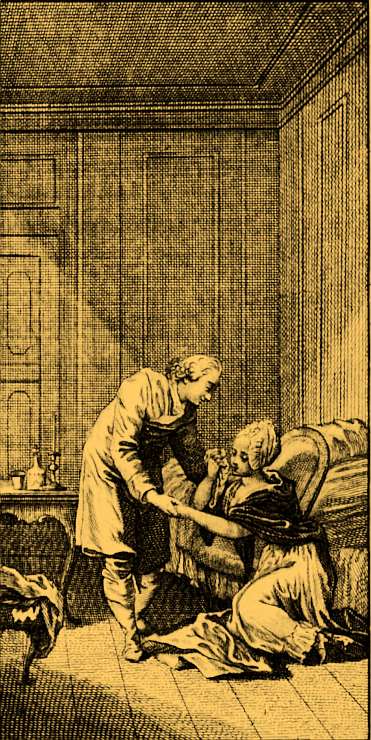
[2] Illustrations: (1) frontispiece to Johann Timotheus Hermes, Sophiens Reise von Memel nach Sachsen, vol. 1 (Worms 1776); (2) Daniel Nikolaus Chodowiecki, Mariane allein auf ihr Kämmerchen macht kummervolle Betrachtungen [ca. 1742–1830]; Herzog August Bibliothek; Museums./Signatur Uh 4° 47 (250); illustration to Pierre Carlet de Marivaux, La Vie de Marianne:

[3] Presumably a reference to the Böhmers’ discomfiture with Caroline and, through her, their grandchild (Auguste) having been drawn into such socially reprehensible circumstances (alleged participation in the Mainz Republic, arrest and incarceration).
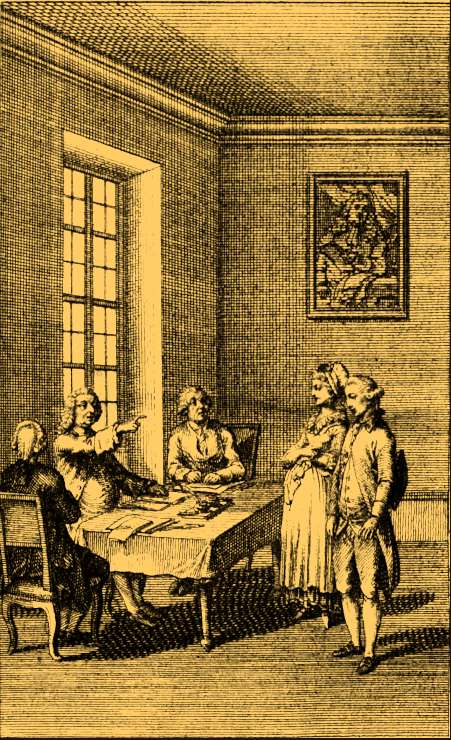
Worse yet was the possibility of the discovery of her out-of-wedlock pregnancy by not only relatives, but also civil authorities, who could withdraw the custody of the child from such a mother (frontispiece to Franz Xaver Huber, Der Richter über den Herrn Schlendrian, vol. 1 [Frankfurt 1787]):
[3a] “Sophie wrung her hands,” Calender für das Jahr 1803 (Offenbach); Inhaltsverzeichnis deutscher Almanache, Theodor Springmann Stiftung:

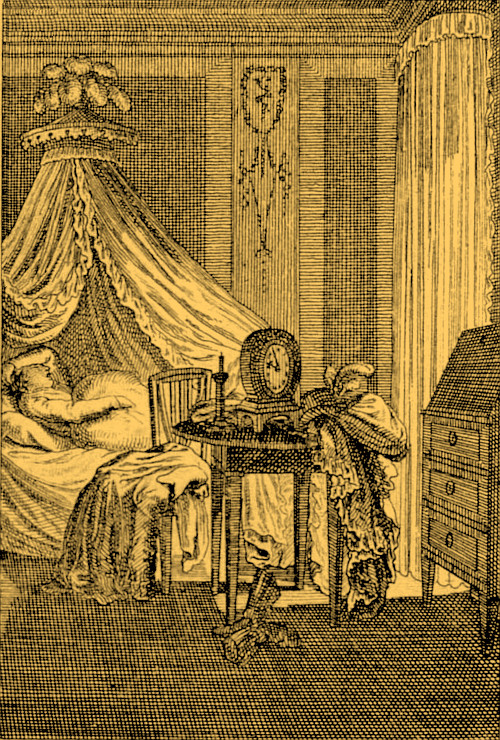
[4] Monday, 26 August 1793 Göttinger Taschen Calendar Für das Iahr 1797; Inhaltsverzeichnis deutscher Almanache, Theodor Springmann Stiftung:
[5] Tuesday, 27 August 1793. Back.
[6] Wilhelm’s love interest in Amsterdam, apparently Sophie Tischbein. See the supplementary appendix on Sophie Tischbein as the Amsterdam Sophie. Back.
[7] The painter Johann Friedrich August Tischbein, who had made Wilhelm’s acquaintance in Amsterdam, seems to have painted his portrait in the early 1790s. Back.
[8] See Caroline’s letter to Friedrich Ludwig Wilhelm Meyer on 15 August 1793 (letter 133) with note 5. Back.
[8a] Lucka is located just at the border between Electoral Saxony to the north and the jurisdiction of Altenburg to the south (shaded area on map; Johann Baptist Homann, Tabula geographica in qua…principatus Gotha, Coburg et Altenburg cum omnibus eorundem praefecturis tam in Thuringia quam Misnia et Franconia sitis ostenduntur [1724]):

In fact, during her walk to Berndorf Mill in October 1793, Caroline, strictly speaking, passes over into Saxon territory; see Friedrich’s letter to Wilhelm on 16 October 1793 (letter 135cd). Back.
[9] This excerpt (to the end of the paragraph) was published in Schmidt (1913), 1:309, and originally in Waitz (1871), 132–33. Back.
[10] On 21 August 1793 (letter 133a). Back.
[11] Wilhelm seems to have written Göschen a letter implying a different relationship with Caroline than was actually the case; he would correct things in a letter to Göschen on 24 January 1794 (letter 137c). Back.
[12] Apparently with respect to Caroline moving to the area around Cologne, where Mastiaux was then living. Back.
[13] Fr., “large and deep arm-chair.” Back.
[14] The implication is that Meta Forkel divulged information about Caroline’s pregnancy to acquaintances out of pique over Caroline’s earlier release. The exact date of Meta Forkel and her mother’s release from Kronberg, however, is not known (see Caroline’s letter to Friedrich Wilhelm and Luise Gotter on 13 July 1793 [letter 131], note 4), though Monika Siegel documents her having remained in custody until at least 18 July 1793 (“Ich hatte einen Hang zur Schwärmerey,” 124fn110). Back.
[15] Friedrich suspects but still does not know that Jean-Baptiste Dubois de Crancé was the father of Caroline’s child; he initially suspected Georg Forster (see below). Back.
[16] Fr., “on the whole, in a word.” Back.
[17] Concerning Friedrich’s first impressions of Caroline, see also “Caroline in Friedrich Schlegel’s Lucinde. Ein Roman (Berlin 1799),” supplementary appendix 132a.1. Back.
[18] An astute allusion to the fact that Wilhelm was less philosophically (Gk. “philo-” and “sophia”) inclined than Friedrich. Back.
Translation © 2011 Doug Stott