
265m. Wilhelm Schlegel to Schleiermacher in Berlin: Bamberg, 21 August 1800 [*]
Bamberg, 21 August 1800
. . . So much for literary matters and plans. Please allow me now to burden you with a request that is extremely important to me personally.
You are, of course, acquainted with Schadow; please be so kind as to call on him sometime and inquire, as if quite by chance, what his price might be for a marble funeral urn with simple decorative elements, and four or five figures in bas-relief round about it, about a foot high (the figures, that is), or for a similar sarcophagus. If the sum is no higher than between 5 and 800 rth, you can pursue the matter further by saying that you are actually inquiring for me, and ask whether he might not be able to take on the project this winter.
To wit, we would like to have a monument erected in Bocklet for our beloved daughter. I have been there to see the gravesite and to arrange the necessary details. I am hoping to receive permission to place the monument amid the shrubbery along the fountain promenade. [1] In that case, only a stone would be placed in the cemetery itself, and for the actual monument a round, grassy place planted round about with roses, in the thick shrubbery, has been selected. [2]
Because I have not yet really spoken about this with any artist, I myself am still not entirely clear about the idea. Either a sarcophagus, I would think, placed on a couple of steps, and then the figures or other adornment on three sides, and on the fourth the inscription. Or an urn as described above, on a high pedestal, which would then be inscribed and could be executed with adornment by subordinate, skilled hands according to the artist’s drawing. —
The figures themselves, I think, could all be derived from old monuments and would perhaps include the following: a seated, grieving woman with loosened hair and belt sash etc., or preferably a group from the family of Niobe, where the youngest daughter is trying to flee into her mother’s lap; [3] then Hermes, who leads away the veiled young girl as a bride of Hades; [4] and finally a male figure in a tunic who pours out a libation over an urn or sarcophagus, perhaps with his other hand leaning on a lyre. [5]
Although I had hoped that Tieck’s brother would return to Germany and spend the winter in Berlin, from a letter I just received I see he is instead thinking about spending it in Italy if possible. Otherwise I would have consulted him on this matter. [6] Schadow is probably the best in Germany. —
If what he says with respect to the price does indeed prompt you to go into details with him immediately, give him many kind regards from me; I myself will be coming to Berlin and would hope to discuss everything with him in person. [7] I would very much like for the monument to be set up next summer, to which purpose I would then travel to Bocklet myself.
These are really the only consolations grief now allows. Let me say nothing of my own grief, which you can, I think, little imagine, since you were not acquainted with its object. You can at the very least see from my letter that I am not simply giving in to it with gloomy idleness.
Stay well.
Notes
[*] Source: KGA V/4 218–20. Part of a lengthier letter between 20 and 21 August 1800; the excerpt here begins on 21 August, after the earlier portion has discussed literary and publication issues. — The background to this letter is the incipient planning for a memorial for Auguste’s grave in Bocklet. Back.
[1] See the Bocklet gallery for various illustrations of this promenade. Back.
[2] The actual location of this spot seems never to have been specified in letters. Back.
[3] The classical motif of the seated mother and approaching daughter was similarly attested in contemporaneous fashion literature at the time; see, e.g., the 1802 vignette “Costume grec; Coiffure Etrusque,” from the Göttingischer Taschen-Calender für das Jahr 1802; Inhaltsverzeichnis deutscher Almanache, Theodor Springmann Stiftung:

The motif was in general not uncommon especially during the Age of Pericles in Athens (“Grave Relief of Hegeso,” Ceramicus, Athens, late 5th Century BCE, from H. H. Powers, The Message of Greek Art [New York 1913], fig. 104):

The motif was in fact ultimately incorporated into Auguste’s memorial triptych (Auguste Böhmer, triptych by Bertel Thorvaldsen: center piece; Thorvaldsen Museum Copenhagen, Inventory number: A701; Auguste on the left, Caroline on the right; note the serpent at Auguste’s heel):

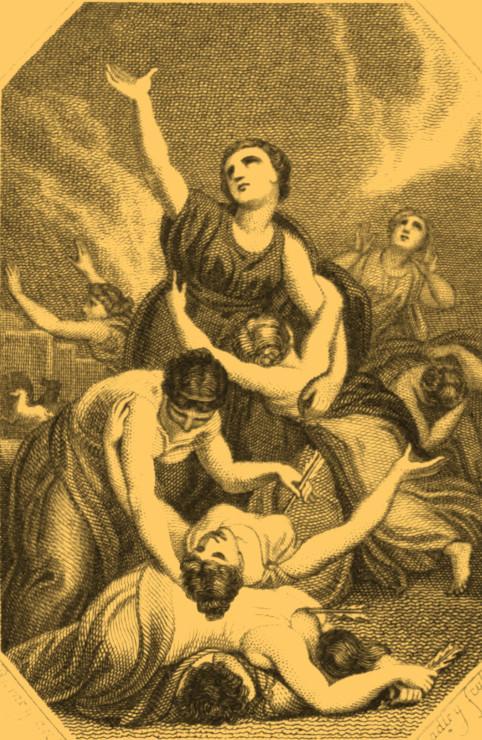
Wilhelm’s next allusion is to Niobe, daughter of King Tantalos, married Amphion, king of Thebes, who boasted of her own many children to Leto, who had but two children, whereupon Apollo and Artemis killed all her children, and Niobe herself was turned into stone (illustrations [in order]: Hermann Hettner, Die Bildwerke der Königlichen Antikensammlung zu Dresden [Dresden 1856], plate 3; A Dictionary of Polite Literature; or, Fabulous History of the Heathen Gods and Illustrious Heroes, 2 vols. [n.p. 1804], s.v. “Niobe”):

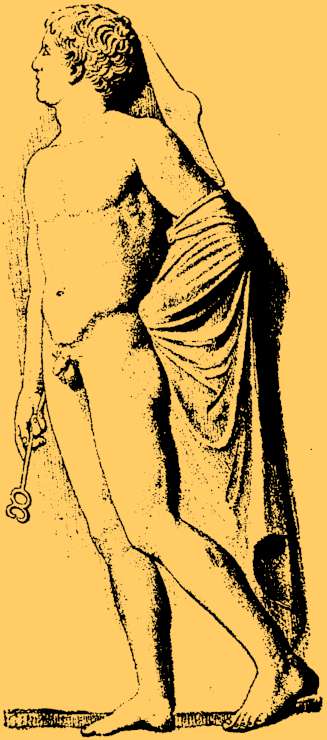
[4] Hermes, son of Zeus and Maia, messenger of the gods, in one iteration the guide of the deceased down to the underworld (“Hermes als Totengeleiter,” Ausführliches Lexikon der Griechischen und Römischen Mythologie, ed. W. H. Roscher, vol. 1:2 [Leipzig 1886–90], 2416):
Wilhelm’s concept of the “bride of Hades,” rather than conceived in the negative sense of a horror story (“bride of Hell”), instead perhaps resembles, if distantly, this veiled apparition in white, a not uncommon motif at the time (Gottlieb Böttger der Ältere, Kennen Sie mich? [1804]; Herzog August Bibliothek; Museums./Signatur Graph. A1: 276):

[5] For later drafts of some of these and other motifs by Bertel Thorvaldsen, see the gallery on Auguste’s memorial. Back.
[6] Wilhelm had inquired about Friedrich Tieck in early August 1800. In a letter from Jena to Schleiermacher in Berlin on ca. 1 August 1800 (Aus Schleiermacher’s Leben 3:211; KGA V/4 182; KFSA 25:150), Dorothea remarks that Wilhelm had already queried her about Friedrich Tieck in this matter: “Will brother [Friedrich] Tieck be returning to Germany soon? Wilhelm wanted us to ask, since he would very much like to speak with him about doing a monument for Auguste.” Back.
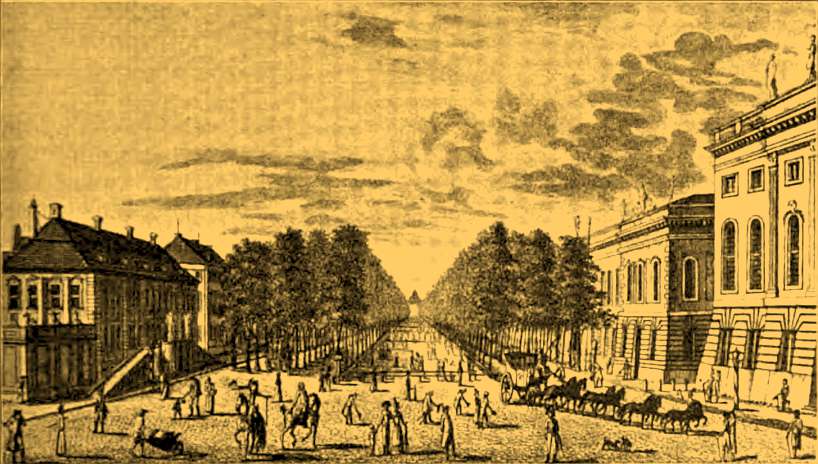
[7] One of several documents attesting Wilhelm’s early plans to move or at least journey to Berlin; although he accompanied Caroline to Braunschweig in early October 1800, he moved permanently to Berlin in February 1801, while Caroline returned to Jena in late April 1801 ([1] Rudolf Koch and Fritz Kredel, Deutschland und angrenzende Gebiete [Leipzig 1937]; [2] the Berlin promenade Unter den Linden ca. 1800, from Adolf Streckfuss and Leo Fernbach, 500 Jahre Berliner Geschichte: Vom Fischerdorf zur Weltstadt, Geschichte und Sage [Berlin 1900], 401):

Wilhelm later specifies in several letters that his original plans were to accompany Caroline to Braunschweig, return to Jena by mid-October, be present in Jena for Schleiermacher’s anticipated visit (which never materialized), and then spend the second half of the winter in Berlin (see his letters to Schleiermacher on 8 September 1800 and Ludwig Tieck on 14 September 1800 [letters 267d, 267e]). Back.
Translation © 2014 Doug Stott