
265l. Henrik Steffens to Schelling in Bamberg: Dresden, 8 or 20 August 1800 [*]
[Dresden, 8 or 20 August 1800]
I cannot leave you yet; I am unable to express — what Auguste’s loss means to me, to me as well. This magnificent girl — I cannot comprehend her death. — So completely alive, so completely in bloom — and now dead. — I simply cannot speak about it — alas!
She was more dear to me than anyone realizes, indeed, more so than I am inclined to own even to myself — and all my later aberrations resulted solely from my occasionally being able to forget her. [1] —
When I was calmly working, when I reflected in a healthy, lively fashion on everything Jena meant to me — the source of my more sublime life — it was that child who, like a serene angel, stood before me — My last stay in Jena brought her even closer to me — and now [2] —
Never — never, for years now, has death come this close to me — the whole time, whenever I saw demise and collapse all around me, I saw only change, never death itself — and now — But I should not renew this grief — Please give my regards to the unhappy mother. [3]
Even as I write, I am becoming more agitated. — It seizes me such that I have to exert all my energy to control this enormous discomfiture. — I must close.
20 August 1800
I am leaving this [grammatically] incorrect, foolish letter just as it is. Go ahead and laugh! I would laugh myself — did I not fear the consequences. I know for certain you will forgive me and will also send along my pardon in written form on the very next postal day. Though you may not have wanted to write anything until receiving this letter. [4]
Stay well!
Notes
[*] Sources: Plitt 1:305–6; Fuhrmans 236–37.
Dating: Gustav Plitt, while not dating the first half of this letter, positions the entire letter between letters dating to 18 August and 1 September 1800. Fuhrmans notes that it was probably written immediately after Steffens’s preceding letter to Schelling from Dresden on 8 August 1800 (Fuhrmans 2:234–35), in a postscript to which Steffens adds “I just this moment heard that Auguste has died. — Horrible!” Fuhrmans accordingly dates the first half of the letter to 8 August as well because of Steffens’s initial lines in this letter. Back.
[1] See Caroline’s remark in her letter to Johann Diederich Gries on 27 December 1799 (letter 258), regarding a poem Schelling gave Auguste for Christmas that referenced “one whom fate’s fickle wings carry far away from you etc.,” who, Caroline remarks, “was supposed to be Steffens.”
See similarly Friedrich August Eschen’s letter to Wilhelm Schlegel on 30 May 1800 (letter 260b).
Those two passages and Steffens’s remarks in this present letter are the only documentation of such romantic interest in Auguste apart from the possibility that Schelling, too, had been interested (see below). Unfortunately, nothing more is known of these relationships. Auguste was fifteen years old at the time of her death (Taschenkalender auf das Jahr 1798 für Damen; Inhaltsverzeichnis deutscher Almanache, Theodor Springmann Stiftung):

[2] Though Steffens nowhere mentions Auguste in his memoirs, they do attest that he was the reflective and sensitive individual whose sincere grief here can hardly be doubted (Heinrich Guttenberg, Niklas (ca. 1776–1800); Herzog August Bibliothek; Museums./Signatur Graph. A1: 873:
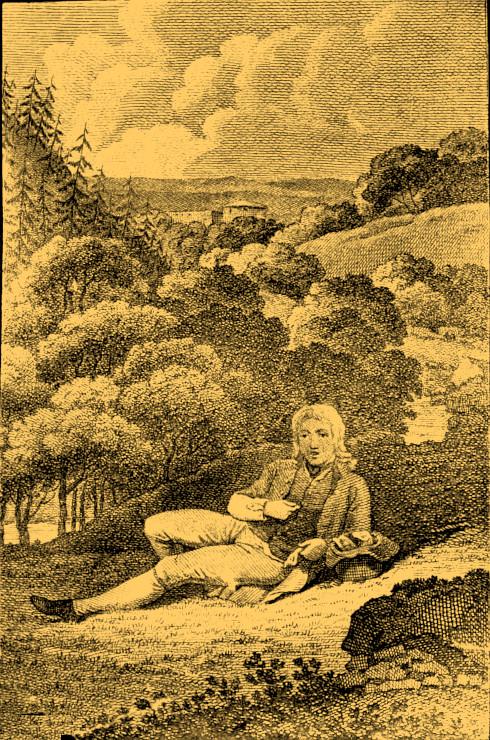
[3] Frontispiece to August Lafontaine, Der Sonderling, Gemälde des menschlichen Herzens, vol. 2 (Berlin 1800):
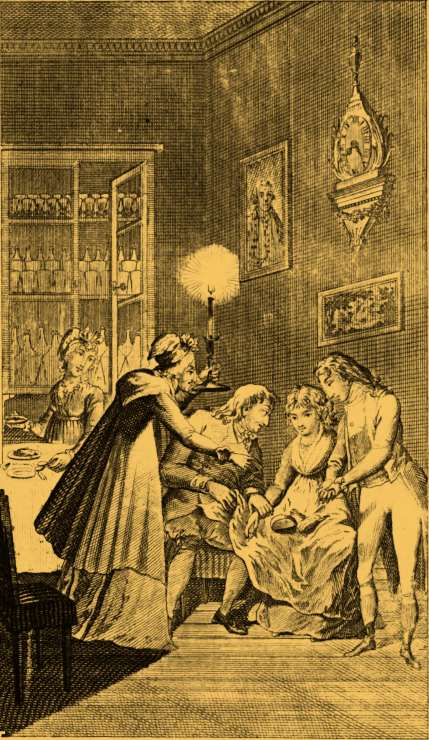
[4] In his preceding letter to Schelling on 8 August mentioned above, the one to which Steffens may be here alluding, Steffens had concluded with remarks suggesting a certain disagreement with Schelling had arisen, Steffens himself then suggesting that,
as much as I would like to work together with you — though always on my own — I must renounce such were it to take place only through a kind of submission that were beneath my dignity.
This remark may or may not reflect a part of Schelling’s personality that becomes increasingly evident in correspondence after he leaves Jena.
On the other hand, Steffens remarks to Schelling in a subsequent letter from Dresden on 1 September 1800 (Plitt 1:310; Fuhrmans 2:243):
The entire tone of your last letter truly shocked me. — You seem — I am almost tempted to say — utterly discouraged, and I must conclude that the deceased meant more to you that I initially suspected — here, too, her memory is too often revived for me by Madam Ernst. Back.
Translation © 2014 Doug Stott