
43a. Therese Heyne to Samuel Thomas von Sömmerring in Kassel: Göttingen, 6 June 1784 [*]
Göttingen, 6 June 1784
. . . I just heard that Dr. Michaelis has become court physician. [1] His sister is exuberant. Please give him my regards, and tell him I am quite pleased to see his sister so delighted. —
This sister whom he so elevates is an extremely smart girl, the smartest I know here; but she is too vain not to be false and too inexperienced and has seen too little of the world to possess any measure of real tolerance.
A few years ago, through her own inexperience and through the company of a rather useless young girl, [2] she acquired an extremely ambiguous reputation, committing some genuinely malicious and incautious things out of vanity and envy (the natural consequence of vanity if it be not overcome by pride and an inner feeling of worth); this now gives her the occasional appearance of prudery, since in truth she is gentle and reserved quite against her own natural temperament. —
She must admittedly present herself to her brother in the most advantageous light, since her vanity is merely nourished when she is around him [3] — and in absolutely no way insulted. Had our respective interests as young girls not so often conflicted, and did I not already know that she formerly turned from my friend into my enemy, I would prefer her company to that of all others. [4] Her brother cannot help but constantly admire her understanding and her talents, and I do admire in her the expression of sisterly love, for she absolutely worships her brother. [5] — — —
Notes
[*] Source: Forster’s Briefwechsel mit Sömmerring, 69–70; Therese Huber Briefe, 1:147–48. Erich Schmidt included this letter excerpt in his notes to letter 41 ([1913], 1:681). Back.
[1] Friedrich Christian Michaelis became professor of practical medicine in Kassel (Cassel) in 1784. Back.
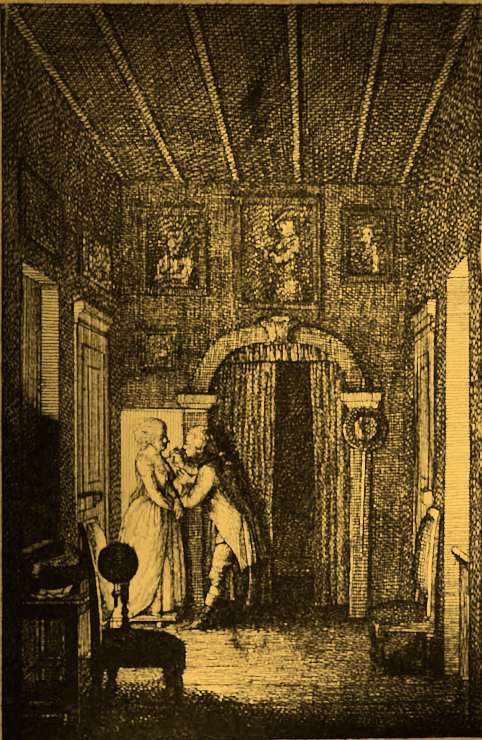
[2] Therese Huber Briefe, 1:553n89, ponders whether the “useless young girl” may have been Luise Stieler; in her later autobiographical piece, “Unsere Geschichte,” intended for her family, Therese herself recalls the student Friedrich Wilhelm Gotter, Luise Stieler’s later husband, as one, though not the last, of her (biological) mother’s lovers when Therese was quite young (frontispiece to Carl Friedrich August Frh. von Lütgendorf, Karl von Dahlfeld der Jüngling, oder: der junge Herr und sein Hofmeister als Nebenbuhler [Munich, Leipzig 1788]:
[3] Although Hermann Hettner, Forster’s Briefwechsel mit Sömmerring, 69, reads “her,” Erich Schmidt (1913), 1:681, wondered whether the pronoun should not be read as “him”; Therese Huber Briefe, 148, does indeed read “him” (Germ. bei ihm). Back.
[4] Therese had taken the part of Lotte Michaelis and Pedro Hockel in their relationship, which both Caroline and her parents opposed (see Caroline’s letter to Luise Gotter on 12 January 1781 [letter 21]; concerning a possible epistolary intrigue on Caroline’s part, see Therese’s letter to her daughter Therese Forster on 17–25 July 1803 [letter 380a]).
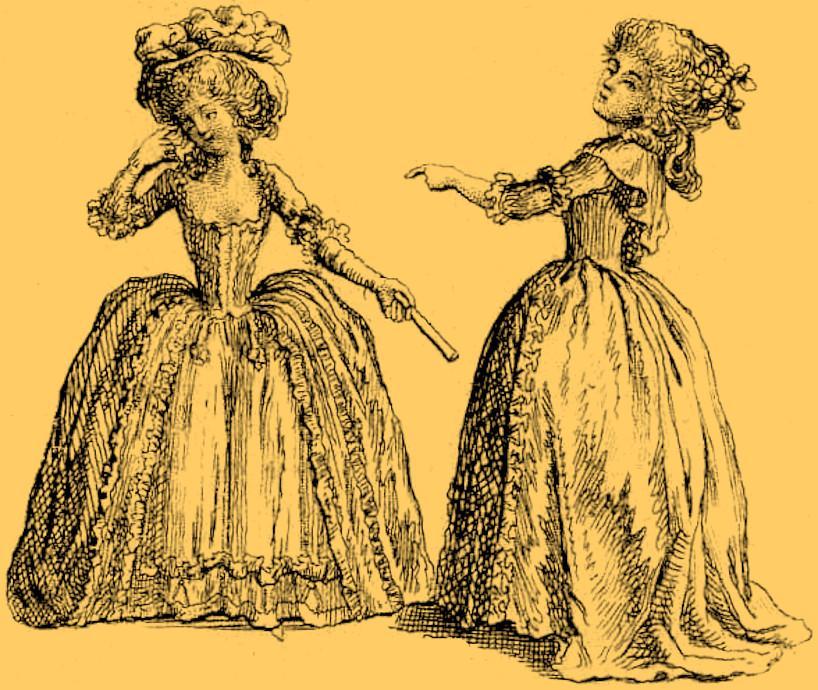
In any event, Therese and Caroline would never get beyond this element of rivalry, mutual admiration, and mutual distrust. Their occasional “rendezvous of the spirit” (thus Caroline in a letter to Luise Gotter on 3 April 1784 [letter 40]) was eventually disrupted, as Rudolf Haym remarks in his biographical essay, by “inevitable (and doubtless quite infantile) tensions, with meanness and sulking and tender, tearful reconciliations,” for Caroline had, “certainly not without some justification . . . discovered in her inconstant friend an unfortunate predisposition for dissimulation.” This inconstant relationship never really reached calmer waters, not even when the two were adults, and, as seen in later correspondence, in Therese’s case eventually issued in petty and willful slander and distortions of the truth ([1] Goettinger Taschen Calender vom Jahr 1784; [2] Almanac de Goettingue pour l’anneé 1786; Inhaltsverzeichnis deutscher Almanache, Theodor Springmann Stiftung):

[5] In her memoirs, Luise Wiedemann recalls (p. 76) that Fritz Michaelis “greatly loved his family, love that even went as far as the romantic sort in the case of his sister Caroline.” Back.
Translation © 2011 Doug Stott