
• 21. Caroline to Luise Gotter in Gotha: Göttingen, 12 January 1781
Göttingen, 12 January 1781
|34| . . . Why on earth do old aunts and uncles always have to cause so much trouble? I wish they would but let young people travel the arduous path of life in peace, quit tormenting them, and generally calm down. [1]
Only imagine, poor Link has this old abhorrence of an uncle who, unfortunately, must act as his guardian and, moreover, also basically controls Link’s temporal happiness, since, frankly, he is rich. He came up with the idea of intercepting all the letters from Link’s friend in Göttingen, and not only has the effrontery to keep them from him, but also is excessively eager to choose a dear wife for him of his own high-handed choice. [2] This is all just truly insufferable! Has such an outrage ever been devised? . . .
What will come of it all? In the near future, I will send all of you an avertissement for a novel titled The Elderly Uncle, which I am considering publishing per subscription and praenumeration [2a] despite Herr Wezel’s Gefahren der Empfindamkeit! [3] Although I can probably laugh about it, I do so like someone who forces herself to smile through tears.
You asked me, dear Louise, whether I had written to Link. No, since doing so would accord neither with my duty nor with my principles. Lotte is corresponding only with his friend, who probably passes along news about me to him but whom neither I have engaged to pass along anything to Link nor whom Link has engaged to pass along anything to me. I will not become involved any further. I am not so romantically [4] inclined to think “Link or no one at all,” and since I am not so inclined, it seems to me I would be acting unwisely were I to go further.
My dear, precious Louise, [5] I do not want to distress my good parents, or my beloved brother, nor justify my sister’s mistakes with my own bad example, nor act in any way unworthy of my |35| friendship with my dear Louise — and though the voice of passion be ever so powerful, I would still conquer myself, for the sincerity of my convictions and my upright heart are more valuable to me than any temporal happiness. That is my conviction today, and may God answer my sincere prayer that it always remain so. —
I hardly mentioned Link in Gotha; [6] I did not intend, did not want to give in excessively to my own thoughts, and I similarly request that you not answer me in this regard, since it merely rekindles a memory I would prefer to — if not repress completely, then at least not allow to flare up too ardently. So, farewell for a long, long time, my dear ! You were good and kind, whence your destiny will doubtless be a happy one!
. . . Every new letter from Lotte makes her even more dear to me. [7] I cannot describe the joy I feel at her improvement; it almost compensates for the countless gloomy hours the poor, errant girl has caused me. If she but wants to, she can become quite good indeed.
Today I read a letter from Therese Heyne that almost has reconciled me with her again. [8] It was to Lotte; these letters have been sent unsealed to our house ever since my mother told Madam Heyne of her concern that Lotte might learn something about Hockel from her daughters, who are wholly on Hockel’s side. Perhaps you will get to read it as well, for I have learned precisely from these letters from Therese that your own husband has seen some of them. He will have your approval just as he had mine completely.
That was precisely the aspect through which Therese blinded me. I have always felt confident maintaining that she really does have these principles; it is simply that she is currently so swept up by the whirl of things that she is unable to put those principles into practice the way she normally might. People are more inclined to excuse her rather “free” disposition because it simply seems to be part of her temperament. |36| She talks incessantly and always with considerable wit, and for precisely that reason some find her intolerable, while others are bedazzled.
Even though on the whole she is not particularly well liked, she does have various open admirers. [9] And even though one cannot really accuse her of being underhanded, she would not have been able to preserve her good reputation were she not protected by the high esteem enjoyed by her mother, a woman who is the daughter of a man on whom the university itself virtually depends, [10] a woman who has many friends in Hannover and who moreover is a respectable woman.
Even though Madam Heyne has as little to do with “fine ladies” as does Madam Blumenbach,” [11] they are present at each and every event of public entertainment, never missing an opportunity to attend; indeed, at such events, the Heynes are the first to be mentioned. Hence they traffic only with gentlemen, who for the most part enjoy free entry into their house. I fear all this misleads Therese into doing things that do not accord with what she has said earlier. Despite all her good principles, however, there is much that is false about her, and — though I hesitate to be so severe as to say she has a malicious heart, she is nonetheless not in the slightest kindhearted.
Even when I myself was still on quite intimate terms with her, many people warned me about her, often urging me not to trust her; but you know how I am: I always defended her as ardently as possible. A person could not hurt me more bitterly than by speaking ill of her in my presence. Had I but heeded those warnings. Although she did teach me henceforth to be on my guard, the experience cost me very, very dearly. She broke with me suddenly under the most insignificant pretense. I was inconsolable, and even though I had every right to be proud of my own innocence in the matter, I nonetheless spoke only the kindest words to her.
But for naught; she answered me with most bitter contempt! But then my feeling of self-worth rose up, and I became infuriated. And then she again enticed me with cordiality, only to rebuff me yet again. All this |37| happened a year ago. We have not gotten together a single time again since then; she chose a new confidante for herself, and I would have forgotten about her had I not suddenly discovered — through Lotte’s letter to Hockel, which we found — what she had been plotting against me.
Therese had gradually become better acquainted with Lotte. [11a] And since Lotte was otherwise not even allowed to visit the Heynes with me, they fearing the possibility of seduction in the case of the younger daughter, Marianne, she — Lotte — now became the object of attention and affection because, since I could not possibly take her side given her behavior, neither could she take mine. Hence Lotte was charged with fetching Therese’s letters from among my papers, and once Therese had them back and no longer need fear similar revenge, she intended to disseminate those I had written her. Hockel was in on the entire plot. I almost fainted when I read the letter —
O, my Louise, how ardently would I thank you at this moment for being my true friend, far from any falsehood; although I cannot, you must believe that my heart feels such gratitude. —
That same day, Therese wrote me a billet demanding her letters back; Lotte had not found any because they had all been burned. My mother answered in my stead, telling Therese that I did not have any more. [12]
Now, however, the whole storm crashed down upon me. Therese and Hockel and all his friends tried in every conceivable way to bring me down and to insult me as hurtfully as possible. And alas, they succeeded only too well! If not immediately in bringing me down, then certainly in hurtfully insulting me. I suffered everything a young heart could suffer. It wrecked my entire body. [13] I soon collapsed from all the pain and torment, but, O, Religion, thou Consoler of the utterly inconsolable! Thanks to you, I did not utterly despair and have once again attained a measure of peace. God improved my heart and took me to his bosom. [14]
|38| To this were added my perpetual worries about Lotte, and the unmentionable ways she managed to hurt me almost daily, all of which, though mere petty things, can nonetheless still profoundly trouble a sensitive soul. Only imagine my horrific situation; ah, my dear Louise, how many nights did I spend weeping, how often did morning dawn without my having closed my eyes even for a moment.
My journey to see you gave me new life and at the same time freed me from at least one part of my sorrow. Nor do I intend to complain anymore; after all, I have many friends in the leading families, [15] and since I am no longer part of the glittering circles in Göttingen and now cannot give anyone even the slightest reason to speak ill of me, my enemies’ vengeance will simply expire on its own.
I have never spoken ill of Therese, nor will I ever; but I do know that she bitterly reviles my name even in conversations with students. At least outwardly, she is always quite cordial whenever we happen to meet. How often have I thought of Leisewitz’s portrayal of a similar situation as told by the character Guido of Tarent. [16]
In addition to Lotte, she now has yet another new friend; the one who came after me has already been forgotten. She used to make fun of Blumenbach and his wife even when there was no cause to, but now she is completely theirs, body and soul. Friederike Böhmer is too good a friend of mine, moreover, the contrast as regards beauty too great for Therese ever to be kindly disposed toward her; for the general consensus is indeed that Therese is ugly. [17]
And who was the initiator of all this trouble? Link was the unknowing initiator, he who would have given his life to serve me. It was just as well that he was no longer here when all these scenes took place, otherwise he would have become furious and would have made us both unhappy in exacting his revenge. Therese thought he was romancing her because he was so taken by her wit; that is what she wrote |39| me, exactly as I am describing it to you here. She later found herself deceived and was kindly disposed toward him — —
I would certainly be aggrieved with him on this account if only I could. Despite all this, I do believe that without this disagreeable inclination toward falseness and without quite so much restless vivacity, Therese would be an excellent young woman. Even though as long as I have known her she has never denied her feeling for religion, still, one wonders what this sort of scorned affection coupled with a lack of kind-heartedness is capable of. Although I will myself never be irreconcilable, I fear she is, since those who have caused insult are less inclined to forgive the other person for personal wrongs than the insulted person is to forgive that person the initial insult. . . .
Notes
[1] (1) Frontispiece to Die Werber: Ein Lustspiel in fünf Aufzügen, in Stephanie des Jüngern sämmtliche Schauspiele, vol. 1, 2nd ed. (Vienna 1777), preceding p. 1; (2) Gothaischer Hofkalender (1778):
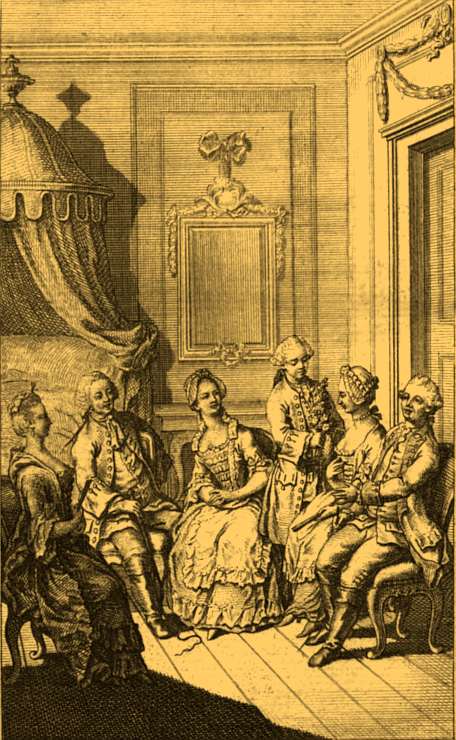
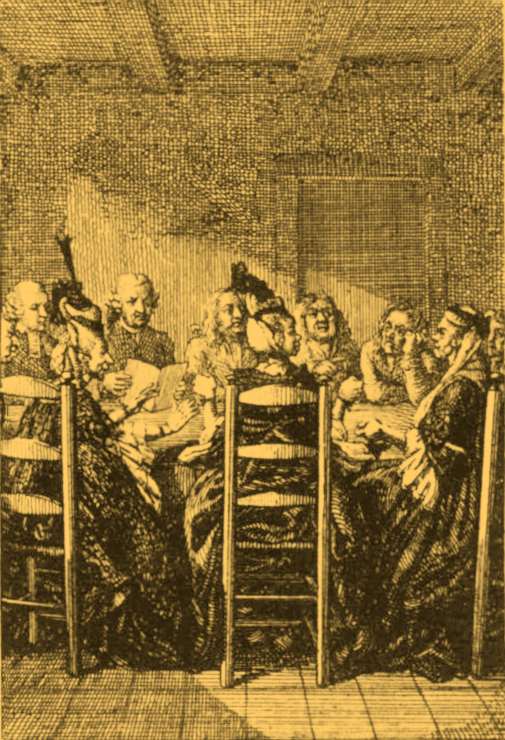
[2] (1) Frontispiece to Carl Ludwig Nikolai, Das Felsenschloß von Sommerau, oder Geschichte eines relegirten Studenten: Eine Arabeske von Karl Ludwig Nikolai, Verfasser der Noradine, oder das Labirinth (Leipzig 1801); (2) Almanac de Goettingue pour l’anneé 1786; Inhaltsverzeichnis deutscher Almanache, Theodor Springmann Stiftung (3) frontispiece to August Heinrich Julius Lafontaine, Barneck und Saldorf, vol. 2 (Berlin 1805):
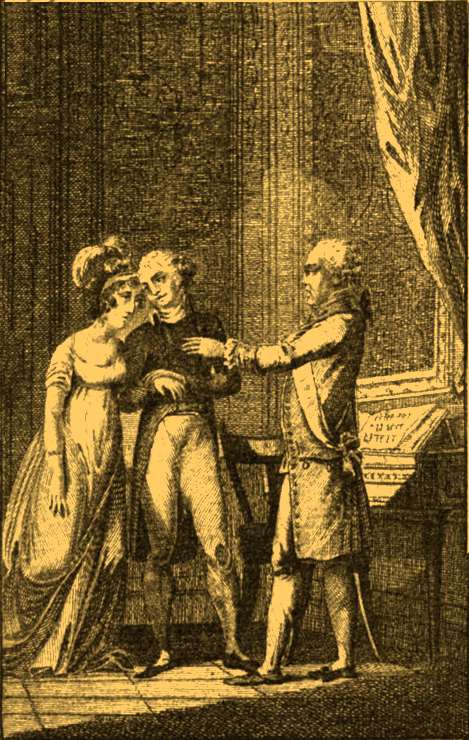

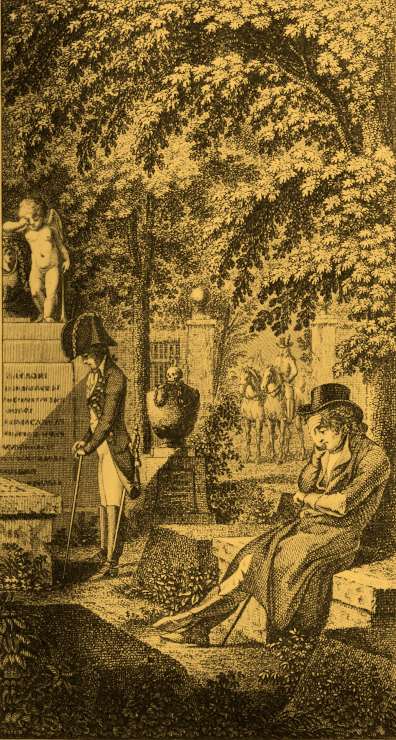
[2a] Fr., “advertisement” in the sense of a “notice” or “announcement,” in this case: of publication; German booksellers at the time often published such pre-publication announcements. — “Per subscription and praenumeration,” Fr., “by advance ordering and prepayment.” Back.
[3] Uncertain allusion (“despite”) to Johann Karl Wezel’s piece on the “dangers of sentimentalism,” Wilhelmine Arend, oder die Gefahren der Empfindsamkeit, 2 vols. (Dessau, Leipzig 1782). Here the title pages and frontispieces by Daniel Nikolaus Chodowiecki:


[4] Germ. romanhaft; see Caroline’s letter to Luise Gotter on 16 June 1780 (letter 16) with note 1. Back.
[5] Caroline variously spells the name “Luise” and “Louise.” Back.
[6] Caroline had been in Gotha for a visit in October 1780 (she mentions the trip later in the letter as well) (Post Karte Durch ganz Deutschland, ed. J. Walch [Augsburg 1795]):

[7] Lotte Michaelis had been in Gotha since the end of 1780 attending the same boarding school Caroline had attended; her parents had sent her there primarily to remove her from the influence of Pedro Hockel in Göttingen, her suitor since 1780, a law student who was in Göttingen from October 1777 to Easter 1782 and who rented a room in the Michaelis house.
The maneuver was not entirely successful, however, since he clandestinely followed her there and arranged meetings in any case (Goettinger Taschen Calender vom Jahr 1783; Inhaltsverzeichnis deutscher Almanache, Theodor Springmann Stiftung):
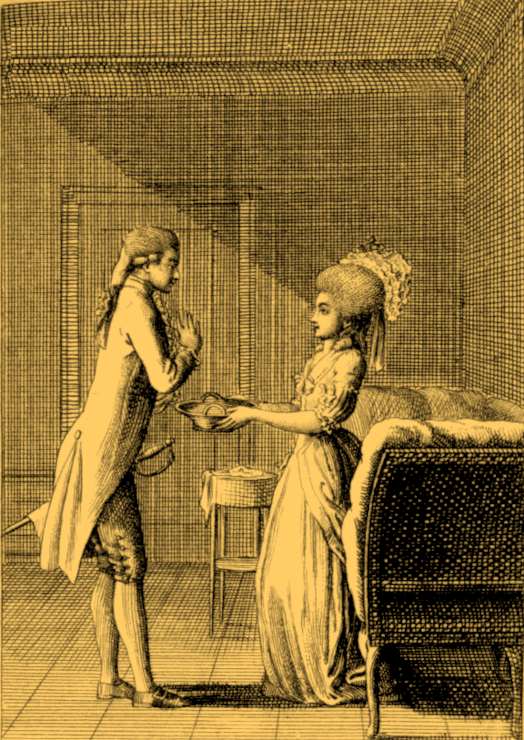
Concerning Pedro Hockel generally and his relationship with Lotte specifically, including in Gotha, see Piter Poel, Bilder aus vergangener Zeit, 312–17 (for text see supplementary appendix 21.1). To complicate matters, August Kotzebue also made Lotte’s acquaintance in Gotha and indeed came between her and Hockel (see Kotzebue’s letter to an unknown Göttingen student on 22 October 1781 [letter 25a]). Back.
[8] Erich Schmidt (1913), 1:676, included the following remarks concerning Therese Heyne in his annotations to this letter:
Therese Heyne was the daughter from the first marriage of Christian Gottlob Heyne, a classical philologist at the university who had risen to a position of well-deserved leadership; alongside Caroline, Therese was the most gifted and interesting among the daughters of Göttingen professors. The two women were both attracted and repulsed by a constant force field of rivalry and antipathy amid mutual respect for each others’ talents, as will be explicated later in greater detail during and after the period in Mainz.
It is impermissible to condemn Caroline on the basis of Therese’s statements and Caroline’s own teenage confessions, and the literary historian should be able to correctly assess Therese’s education, judgment, circumspect persistence, her merely external impeccability in the relationship with Friedrich Ludwig Wilhelm Meyer and in the transition from the brilliant Georg Forster to the sooner insignificant Ludwig Ferdinand Huber, as well as her indefatigable, inartistic and utilitarian literary career as a widowed mother — one should be able to prudently assess all these factors without accusing Caroline, who was certainly no less well educated and intelligent and yet of a completely different temperament, of ‘moral inferiority’ compared with Therese. Her sister Marianne, four years younger, was later unhappy as the wife of Hofrath Jeremias David Reuss in Göttingen.
Concerning Therese in general in German-language sources, see Ludwig Geiger, Therese Huber. 1764 bis 1829. Leben und Briefe einer deutschen Frau (Stuttgart 1901); idem, Dichter und Frauen. Abhandlungen und Mitteilungen. Neue Sammlung (Berlin 1899), 85-87 provides a retrospective on Caroline’s girlhood from a letter Therese wrote to her daughter, now in Therese Huber Briefe, vol 1, 1774–1803, ed. Magdalene Heuser (Tübingen 1999), 420–2 (letter 380b in present volume). In general, Geiger’s Dichter und Frauen, 83–124 provides a largely negative portrayal of Caroline. Back.
[9] Concerning Therese Heyne’s personality in society, see Piter Poel, Bilder aus vergangener Zeit, 266:
Less thorough and straightforward, the eldest of her [Madam Heyne’s] two step-daughters, Therese, developed a more lively spirit, stimulated and governed more by the imagination and sensuous impressions than by any more deeply seated, heartfelt emotions; her thoughts and ideas followed one after the other with such rapidity that her words could hardly keep up, and she often ran out of breath.
On the other hand, it was not at all that difficult to amuse oneself by prompting the most comical outbreaks of impatience in her through intentional misunderstandings. For those of my age, her small, fiery eyes, the uncommonly adroit features of her youthful face, a face not really pretty but nonetheless also not disfigured by any malformation or disproportion, and her daintily shaped figure bestowed a unique charm on whatever she said, even though I myself found the truth and conviction of feeling too lacking in her for her to prompt any more profound interest on my part. Back.
[10] Therese’s father, Christian Gottlob Heyne, had remarried in April 1777; his second wife was Georgine Brandes from Hannover, whose father, Hofrath Georg Friedrich Brandes, headed the university administration in Göttingen.
Caroline’s allusions, however, are rooted deeper in the Göttingen university culture than is immediately apparent here. See Thomas Biskup, “A university for Empire? The university of Göttingen and the Personal Union, 1737–1837,” The Hanoverian Dimension in British History, 1714-1837, ed. Brendan Simms and Torsten Riotte (Cambridge 2007), 128–60, here 157–58, who provides an illuminating discussion of the close, indeed intimate ties between the university in Göttingen, on the one hand, and Hannover and London as central administrative sites, on the other, not least involving Caroline’s father, Johann David Michaelis:
For the upkeep of communication, the German Chancery’s civil servants were more important than the ministerial level as they were often based in London more permanently and had excellent connections within court, government and leading London circles. The London Geheimer Kanzleisekretär Wilhelm Philipp Best and his son Georg August thus acted as London agents of Göttingen University from 1752; Göttingen professors frequently discussed university affairs with Best father or son, who would then act on their behalf either at court or in Hanover . . .
No wonder Göttingen professors were keen to strengthen these channels by marrying into Hanover’s leading families, the Hübsche Familien [hübsch, from höfisch, courtly, associated with the court, here: the leading, upper bourgeois class in Hannover], which also provided the staff of the German Chancery; Blumenbach and Heyne were thus linked to Georg Friedrich Brandes [having married his daughters], who controlled university politics and was well connected to Britain; Johann David Michaelis married his daughter Caroline to the son of the Göttingen colleague Georg Ludwig Böhmer, whose wife was daughter of a London Wirklicher Geheimer Sekretär and in addition closely related to the Bests.
This system of communication was as personalised and family-based as were scholarly networks and university-government relations in general: just as the Anglo-Hanoverian network of scholars could only be as successful as it was due to the longevity of its protagonists Michaelis, Heyne and Blumenbach on the German side, and Pringle, Bryant and Banks on the English, it also helped that the communication channels between London and Göttingen were upheld by Best father and son (between 1746 and 1806) for six decades without interruption. Back.
[11] In 1779, the Göttingen professor Johann Friedrich Blumenbach, who once courted Caroline herself, married Louisa Amalia Brandes, sister of Christian Gottlob Heyne’s second wife (and Therese Heyne’s stepmother), Georgine Brandes. Back.
[11a] Goettinger Taschen Calender für das Jahr 1793; Inhaltsverzeichnis deutscher Almanache, Theodor Springmann Stiftung
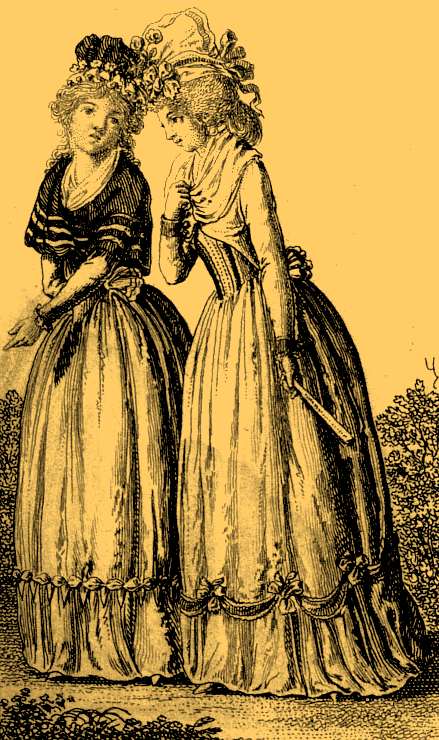
[12] Goettinger Taschen Calender fuer das Jahr 1791; Inhaltsverzeichnis deutscher Almanache, Theodor Springmann Stiftung:

[13] Adam Ludwig d’Argent, Ein Mann tröstet eine weinende Frau, eine weitere Frau steht wütend daneben (ca. 1768–1829); Herzog August Bibliothek; Museums./Signatur Graph. Res. A: 91:
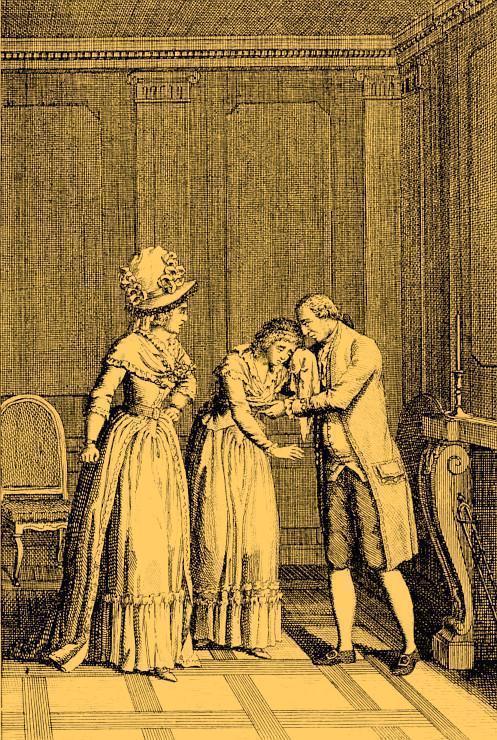
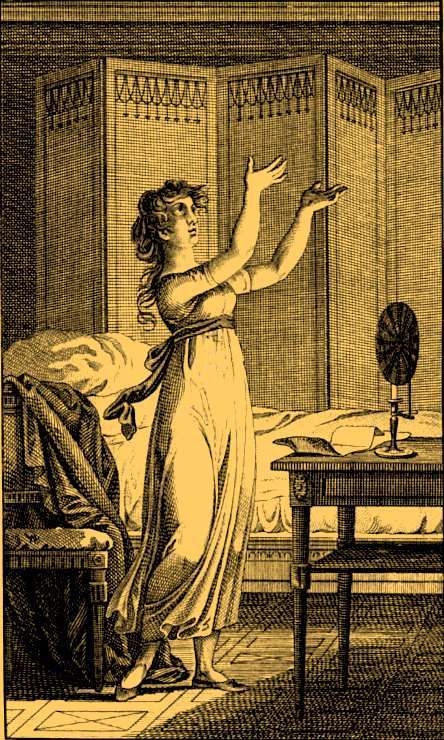
[14] (1) Theater-Kalender auf das Jahr 1787 (Gotha); (2) frontispiece to August Lafontaine, Das Testament: eine Familiengeschichte, vol. 2 (Vienna, Prague 1810):
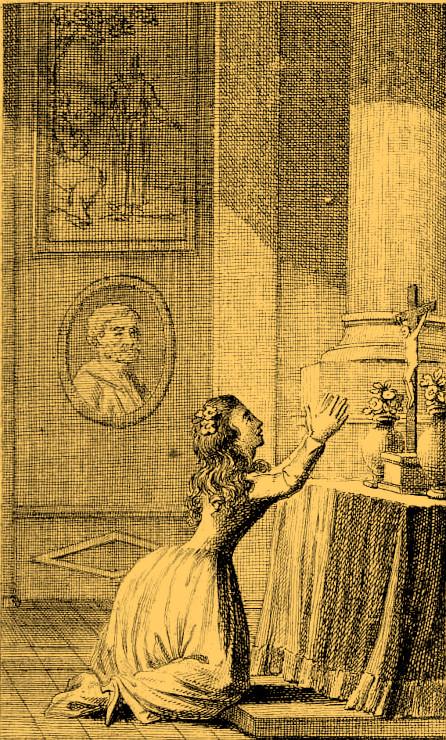
[15] Germ. Familien, with no modifier, nonetheless here rendered as “leading families”; Caroline is presumably alluding to the hübsche Familien, “leading, upper-bourgeois families,” in Hannover and by extension in Göttingen (see note 10 above). Back.
[16] Johann Anton Leisewitz, Julius von Tarent. Ein Trauerspiel, a play about two brothers who fall in love with the same woman (1774; published Leipzig 1776), which Leisewitz wrote in Göttingen, where he studied law from 1770. The play made a powerful impact on the young Schiller (Die Räuber [The Robbers]). See Franz Thiem, The Literature of Germany From Its Earliest Period To The Present Time: Historically Developed, 2nd ed. (London 1866), 154–55:
It is a wild composition. Two brothers, who are rivals for the affections of a girl, murder each other; — a painful plot; — though the different passions of the brothers are depicted with great skill; and the diction of the tragedy is excellent.
Although Erich Schmidt (1913), 1:677, refers the reader to act 3, scene 3, it seems Caroline is sooner referring — esp. considering her preceding sentence — to act 1, scene 1, when Guido of Tarent (the tempestuous, ambitious brother) remarks the following to his brother, Julius (the sensitive brother; here an illustration of a different scene with the prince, played by Conrad Ekhof, and the brothers Julius und Guido, the latter two of whom appear in the scene below, from the Theater-Kalender, auf das Jahr 1778 (Gotha), plate 5:
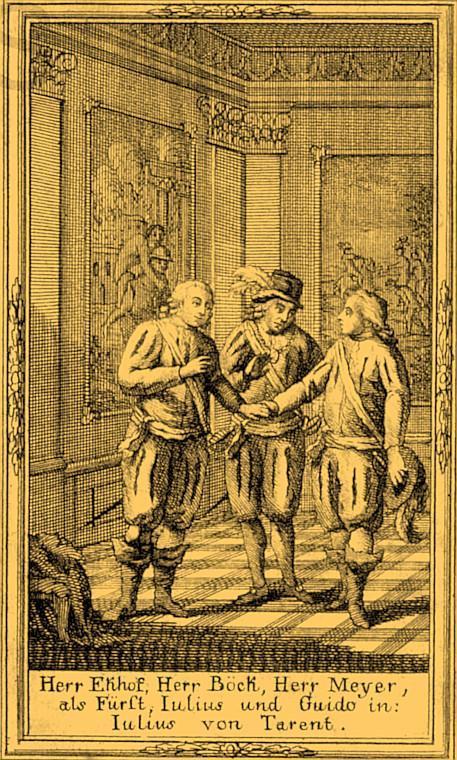
Brother, the tone between us pleases me not at all. I myself am quite capable of hating, indeed, of hating like a man! — but there is a certain kind of dull hatred in which a person will not admit that he no longer loves. — I loathe such hatred, in which people continue with the same old gestures of friendship but without any genuine spirit of trust, and treat the corpse of deceased friendship as if that friendship were still alive, indeed, accompany it both to table and to bed. Forsooth, such friends cut a fine picture, their eyes full of ill will and their mouths distorted into the most natural, cordial smile — like wooden muscles manipulated on a puppet string.
Concerning the play, see esp. also Lotte Michaelis’s letter to Caroline in November 1785 (letter 64), note 5. Back.
[17] See Wilhelm Schlegel to Sophie Bernhardi on 15 May 1804 (letter 383f), where he remarks that Therese Heyne was “never pretty,” something put even more forcefully by Wilhelm von Humboldt, who asserts that Therese “is not pretty . . . Sometimes she is even ugly, in fact very ugly” (text and source in notes to letter 383f). Back.
Translation © 2011 Doug Stott