
264c. Friedrich Schlegel and Dorothea Veit to Schleiermacher in Berlin: Jena, ca. 1 July 1800 [*]
[Friedrich:] It is now high time for me to write quite seriously to you, something I must do more often and more properly now that the hope of seeing each other has disappeared. I am still having considerable trouble coming to terms with this prospect, nor, in fact, do I even want to, [1] which is why I have come up with a different plan, one I think is quite expedient not least because it is so important to me.
As you know, we have rented a logis for the winter; it is also spacious enough for a friend. How splendid if you might visit us this autumn for a few weeks, and how easily might that also be arranged. [2] . . .
Becoming acquainted with Ritter alone would be worth the cost of the trip, and you are curious about Hardenberg in any case; Goethe would doubtless be a more interesting acquaintance for you than Fichte and would doubtless also receive you quite cordially.
The main thing, however, is that we could spend more time together here in a week than in six months in Berlin, where the lengthy streets and broad people tend to separate people so much. I truly long for this to happen, so please do consider it seriously. . . .
[Dorothea:] Your lady friend sends her regards as well and begs your pardon with a reference to the Pyrmont spring water. [3] Let me entreat you to give appropriate consideration to Friedrich’s invitation. My request concurs with his own.
Poor Hülsen! — We must go about this matter quite delicately now. [4]
Notes
[*] Sources: Aus Schleiermacher’s Leben 3:191–92; KFSA 25:130–33. — Dating: KFSA 25:474. Back.
[1] Friedrich is chagrined over his and Dorothea’s decision not to travel to Berlin after all; see Dorothea’s letter to Schleiermacher on 16 June 1800 (letter 263a). Back.
[2] That is, Friedrich and Dorothea had already made arrangements to move out of Leutragasse 5 and into their own apartment, arrangements that seem to have been facilitated by the Paulus family (see Dorothea’s anticipation in her letter to Schleiermacher on 16 June 1800 [letter 263a]).
Although the exact location of this apartment cannot be determined, Friedrich and Dorothea did move into the apartment in September 1800 (see Dorothea to Wilhelm on 23 September 1800 [letter 268a]) with an “open view toward the hills” and amid all “the activity in the Graben [the area of the original moat surrounding the town], always full of people,” “but quiet and peaceful in the house itself.”
The owner of the house was Christina Friederike Wilhelmine Bieglein, née Fürstenau, widow of Johann Wolfgang Bieglein, Saxon administrator and academic fencing master in Jena; she would, however, die on 4 January 1801 (KFSA 25:558, note 23 to letter 132, Friedrich to Heinrich Frölich on 12 January 1801, in which Friedrich passes on his new address to Frölich; the editor of KFSA 25, Hermann Patsch, acknowledges Heinz Härtl for the information about Madam Bieglein’s death).
Peer Kösling, Die Frühromantiker in Jena, 28–30, has determined that the house seems to have been situated in the southeastern corner of Jena, apparently near Fichte’s former residence (house no. 12a [between houses 11 and 12] on Löbdergraben on the map below) and near the Paulus family on the street Unterm Markt.
Johann Wilhelm Ritter maintains in a letter to Friedrich Karl von Savigny on 17 December 1800 that he lived two doors down from Friedrich and Dorothea on this street (Uebersichts-Plan der Residenz- und Universitätsstadt Jena nebst Umgebung [Gera 1909]; Städtische Museen Jena: Stadtmuseum und Kunstsammlung) (Unterm Markt on the right, Leutragasse 5 at left):
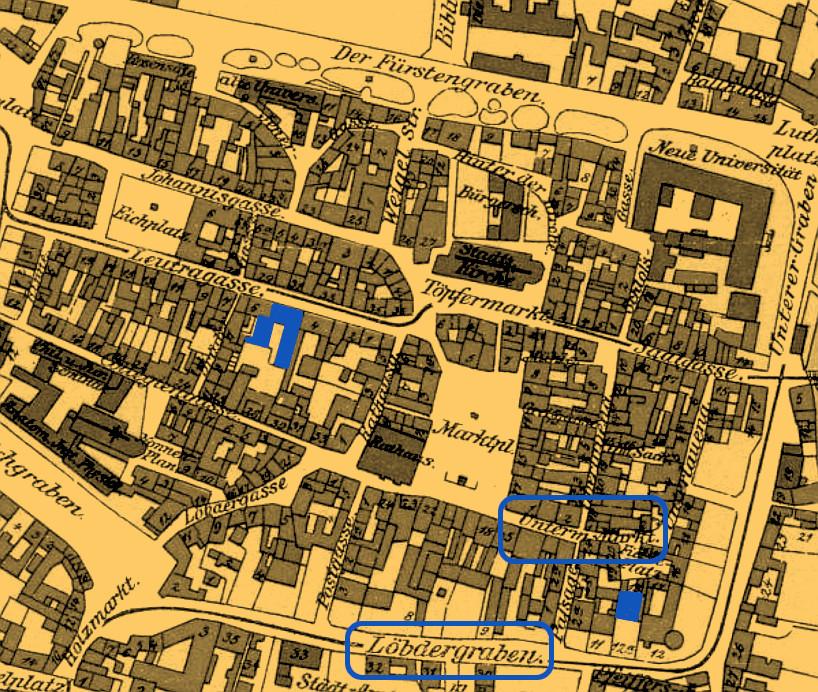
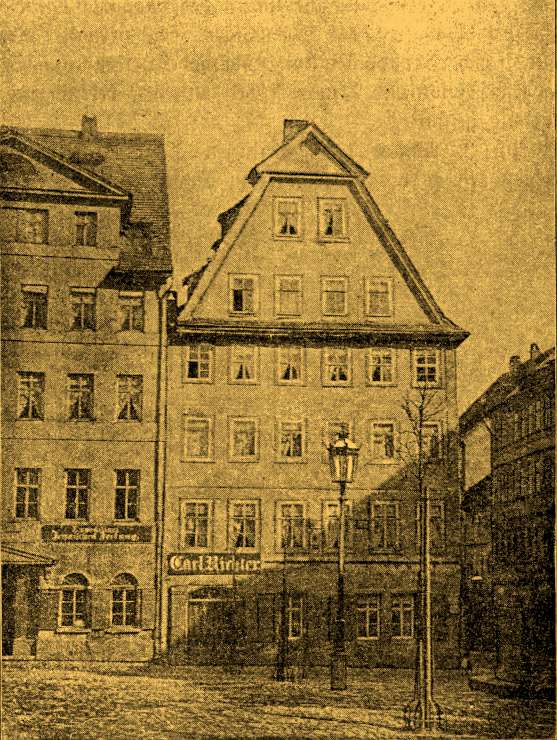
As seen above, the entrance to Unterm Markt was located diagonally across the Market Square from the entrance to Leutragasse. In the illustration below of the house at Unterm Markt 1, one turns the corner at the bottom right into the street where Friedrich and Dorothea’s apartment was located (Berthold Litzmann, Schiller in Jena, 2nd ed. [Jena 1890], 107):
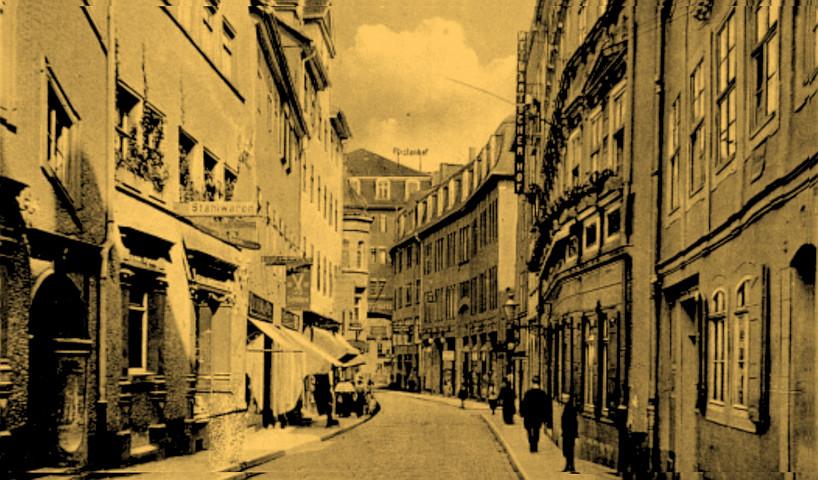
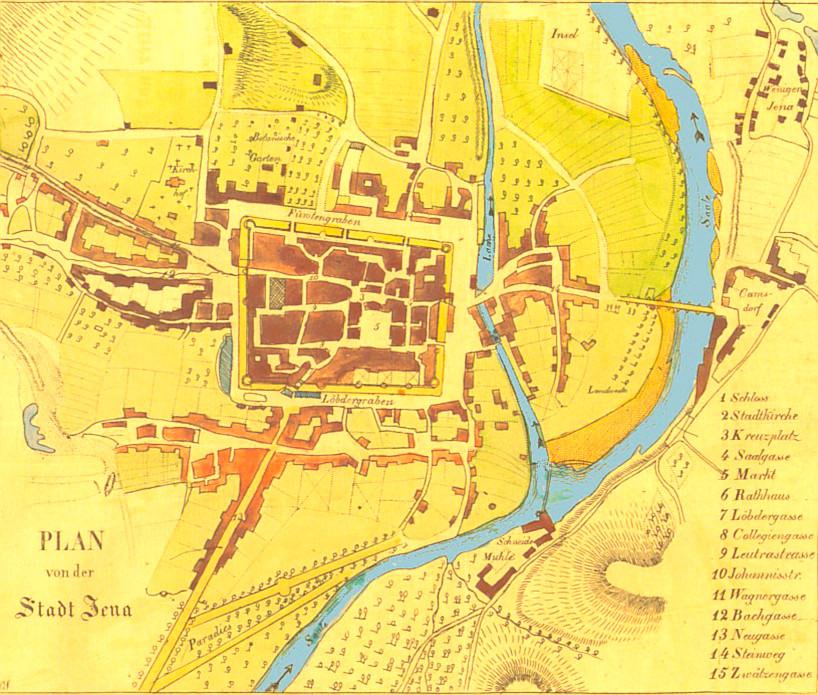
According to Kösling, 29, the apartment likely was located in the rear of one of the buildings on the south side of the street (on the right in the postcard below from ca. 1915), the side that has the open view out onto the surrounding hills as seen on the following map (Carl Schreiber and Alexander Färber, Jena von seinem Ursprunge bis zur neuesten Zeit, nach Adrian Beier, Wiedeburg, Spangenberg, Faselius, Zenker u. A. von Carl Schreiber u. Alexander Färber: Mit Kupfern, Karten, Lithographien u. Holzschnitten [Jena 1850], map following p. 52):
An astonishing development in this connection is that Friedrich later invites Wilhelm Schlegel to move in with them (in the letter on 30 September 1800 [letter 269a]). Back.
[3] Dorothea has earlier spoken about drinking Pyrmont spring water for her health; see her letters to Schleiermacher on 14 February 1800 (letter 258m) and to Rahel Levin on 10 April 1800 (letter 259d).
The problem to which she is alluding is presumably that this water, though quite popular, had to be drunk in large quantities. It was thought among other things to be efficacious in treating headaches, from which Dorothea was suffering (KFSA 25:475). See also Friedrich and Dorothea’s letter to Schleiermacher on 5–7 July 1800 (letter 264e), note 1. Back.
[4] Hülsen’s wife, Leopoldine, was seriously ill. Dorothea had been considering placing her son Philipp Veit in Hülsen’s boarding school. See her letter to Schleiermacher on 16 June 1800 (letter 263a), esp. note 4.
Concerning Wilhelm Schlegel’s activity in Jena at this time, see his letter to Schleiermacher on 27 June 1800 (Körner, (1930), 113–14; KGA V/4 113), included here for its illumination of the activities in Jena after Caroline, Auguste, and Schelling departed and prior to Auguste’s death in Bocklet on 12 July 1800.
To wit, Wilhelm, Friedrich, and Schleiermacher were intently, at times feverishly involved not only with the notion of launching a new journal, as seen in coming letters, but also with completing and sending off to Schleiermacher in Berlin the material filling out the final issue of Athenaeum, about which Wilhelm speaks in this letter (Schleiermacher had been attending to the journal’s business matters since Friedrich’s departure for Jena the previous autumn).
That is, work on this final issue of the circle’s journal, which appeared in August, concluded essentially with Auguste’s death. Even after her death, however, their (ultimately unsuccessful) attempt to establish their new journal continued without interruption.
Wilhelm had written Schleiermacher on 20 June that “on Monday [23 June] I will be sending Soltau” (Körner, [1930], 46). Wilhelm is speaking in his letter about the final three articles in Athenaeum (1800) 297–354: under “Notizen,” first (297–29) a harsh review of Dietrich Wilhelm Soltau’s translation of Don Quixote, and (329–36) his (Wilhelm’s) response to a criticism of his own translation of Shakespeare that had appeared in the Belletristische Zeitung; then (337–54), following the rubric “Notizen,” Friedrich’s important essay — his response to certain Athenaeum critics — “Über die Unverständlichkeit,” trans. by Peter Firchow as “On Incomprehensibility,” in Friedrich Schlegel’s Lucinde and the Fragments (Minneapolis 1971), 257–71.
I could not keep my word on the last postal day, and with respect to this one, as well, I have miscalculated. Because of the exacting thoroughness, as you will see, that was absolutely required for the piece on Soltau, I ended up not having enough time today to work through the excerpts.
Although everything is already there in the inkwell, I simply will not be able to get it out of there this evening, though between now and tomorrow midday I will definitely get it done, and in three days will send off the rest concerning Soltau, which as far as quantity is concerned will be approximately the same as the parcel today.
I am going ahead and sending on today the piece on Shakespeare that will appear after it so that you can now, with Friedrich’s nice essay, finally get a rough estimate. The pieces on Soltau and Shakespeare together I would estimate at about 2 printer’s sheets, or at the very least over 1 1/2. . . .
Adieu for today. More soon, and less rushed.
A. W. Schlegel Back.
Translation © 2014 Doug Stott