
258c. Dorothea Veit to Schleiermacher in Berlin: Jena, 6 January 1800 [*]
Jena, 6 January 1800
So what do you think about the stanzas? I mean Friedrich’s? [1] And what will you say when you now hear that I, I myself, introduced this stanzic rage and passion [2] into our house!
To wit, I recently read in an Italian travelogue that the Italians improvise in stanzas, and that Tasso and the ottave rime of Master Ludwig are in every mouth there. [3] I, no slouch myself, immediately began having my own Florentin improvise in such dainty, flowing stanzas, and I have succeeded so well that even Master Wilhelm has dispensed his unqualified praise. [4]
Of course, everyone began chasing after my fame, and thus did Schelling come up with his own stanzas, [5] and now even Saint Friedrich! whose luster so overwhelms the rest of us that we are ashamed to step onto the same stage with him.
For precisely that reason, however, I have no intention of letting anyone forget that I was the first who dared! I also composed a dainty little Lied that will be finding a place in volume two; it is too sentimental for volume one. [6] Do not believe that marriage and childrearing do not receive their proper and respectful due in Florentin; that Florentin complains so about it merely proves that he was not a little surrounded by it. [7] —
Unger has not yet responded; if only the Evil Demoness has not noticed from whom it came! But it will indeed be sold, there is no worry about that, but what a delightful bit of fun it would be were it sold to Unger. [8]
Friedrich is very diligent, and yet despite all conceivable diligence is moving forward only very slowly. For the rest, we are all doing about as well and are living about as pleasantly as doubtless very few people within such a tight circle might boast. We are as cheerful and merry as if there were neither cold nor lack of firewood nor stupid people! We lack but a single thing, and that is admittedly, unfortunately, money! Just where we are supposed to get it, even as little as we need: well, both my old and my new understanding simply freeze on me when confronted with that question! That we are not yet able to pay you back the 50 rth., while not one of the most oppressive of our worries, is nonetheless certainly one of the most painful! how hard it is! . . .
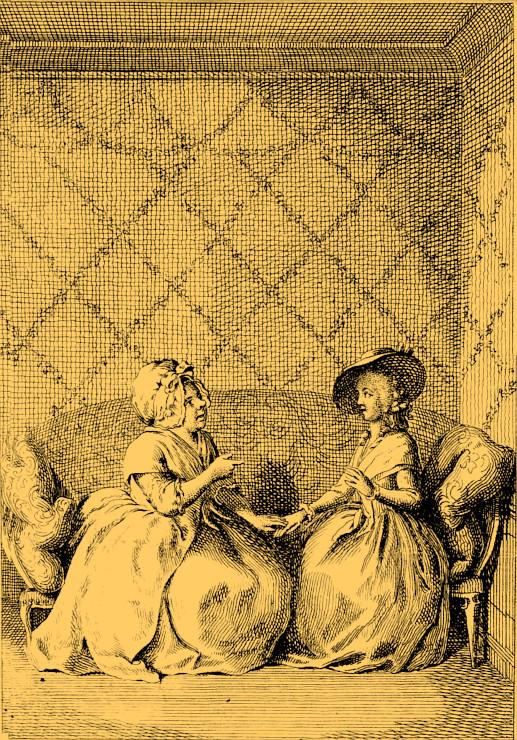
As far as the sale of the furniture is concerned, Jette should not be too hasty. 10 rth. for that enormous, opulent sofa seems a bit too little to me, especially when I consider what one would then be offering for the other things given that precedent. [9] Fichte intends to acquire some furniture in Berlin and wants to see mine, and probably buy some of it; he will no doubt sanction his hatred of Jews at least by paying me a Christian price for the things! [10] I will definitely be coming to Berlin this summer, only I cannot say anything more definite yet except the term summer! . . .
Notes
[*] Sources: Aus Schleiermacher’s Leben 3:147–48 (incomplete); Briefe von Dorothea Schlegel an Friedrich Schleiermacher 25–28; KGA V/3 334–38; KFSA 25:39–41. Back.
[1] “An Heliodora” in Athenaeum (1800) 1–3; the poem accompanied this letter (KFSA 25:401; (not to be confused with “Nikon and Heliodora,” Wilhelm Schlegel’s poem for Minna van Nuys). Back.
[2] Friedrich rhymes Germ. Wuth and Gluth (Eng. rage, fury” and “ardor, embers; passion”) in the first stanza of “An Heliodora.” Back.
[3] Caroline refers to the latter (Ludovico Ariosto) similarly as Messer Ludovico Ariosto in her letter to the family of Luise Gotter from Munich on 4 January 1807 (letter 420). Concerning Italian improvisors, and esp. concerning the visit of Pietro Scotes to Weimar during June 1802, see Caroline’s letter to Julie Gotter on 15 June 1802 (letter 363). Karl Fernow provides a description of the art of improvisation in his Römische Studien, 3 vols. (Zürich 1806–8), here vol. 2. Back.
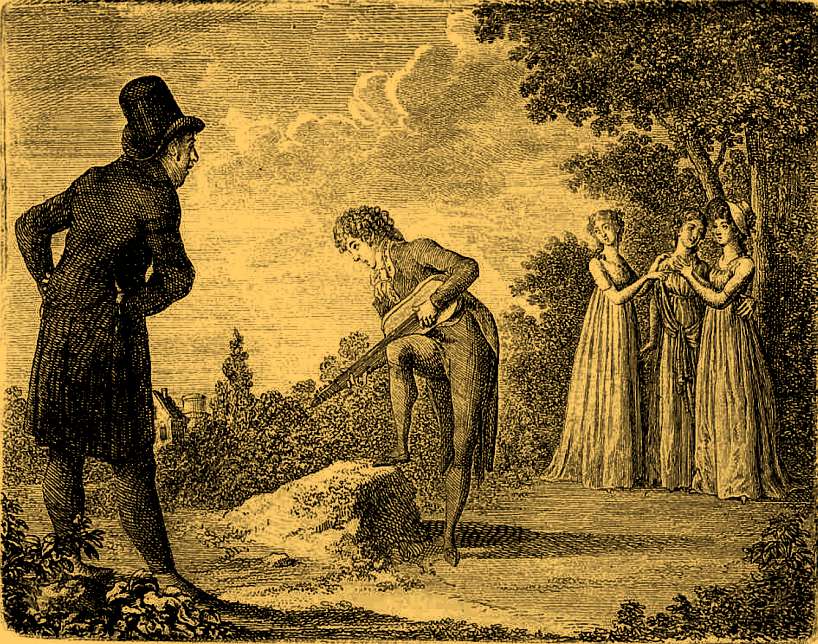
[4] The protagonist in Dorothea’s novel, Florentin. Ein Roman herausgegeben von Friedrich Schlegel, vol. 1 (Leipzig 1801), accompanies his own stanzas on guitar in chapters 6 and 12. Here the first two stanzas of the song in chapter 12 (approximate prose translation; representative illustration: Daniel Nikolaus Chodowiecki, Mr. de Village [1798]; Herzog Anton Ulrich-Museum; Museums./Signatur DChodowiecki AB 3.1015):
My song? what proclaim that is new?
And what wisdom, my friends, seek you?
Never in youth did I such lofty wisdom find.
Neither what is new nor what is old could I fathom;
May fate yet grant me wisdom in my old age!
We, all of us, err, and cannot but err,
May time undo such tangle at its leisure.

Forest stream rushes deep within the cleft,
Over craggy cliff it runs,
Precarious, frightful over dark abyss;
Who stumbles is sure to meet his death!
The traveler weary in body and spirit staggers on,
Gazes into depths, shudders, knows dread:
While without care a child plays on the rocks,
Picks a small flower blooming on that very precipice. Back.
[5] See Schelling’s stanzas to Caroline at Christmas 1799. Concerning this and Schelling’s other verse projects, see Caroline’s letter to Auguste on 14 October 1799 (letter 248), note 9, which cites Friedrich’s letter to Schleiermacher on this same day (6 January 1800). Back.
[6] Volume two was never published. Back.
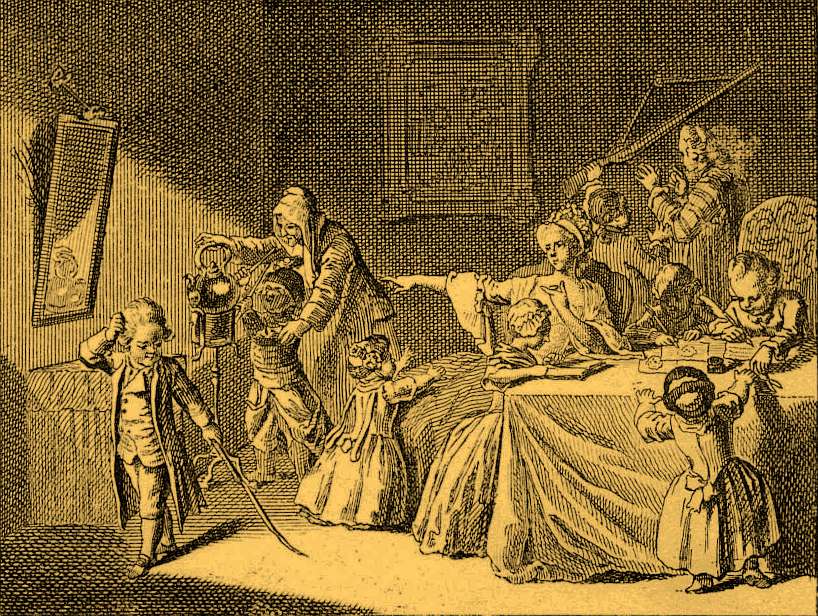
[7] “Marriage and childrearing” are variously discussed in the novel Florentin; here representative illustrations of childrearing tasks and practices at the time (Kupfersammlung zu J[ohann] B[ernhard] Basedows Elementarwerke für die Jugend und ihre Freunde: Erste Lieferung in 53 Tafeln. Zweyte Lieferung in 47 Tafeln von L bis XCVI [Leipzig, Dessau, Berlin 1774], plates XXIX c and XXIX d):

[8] Friedrich Unger did not buy the book; it was published by Friedrich Bohn in Lübeck/Leipzig. The malicious plays on Friederike Unger’s name (here Germ. Unger becomes Unholdinn, which can have various shades of meaning) recur in Friedrich’s earlier letters, and there is conflicting evidence he may have had (or tried to have) an amorous relationship with her; see Friedrich’s letter to Caroline on 20 October 1798 (letter 205), note 19. Back.
[9] Sofa illustration by Daniel Nikolaus Chodowiecki, Aber wie? (1787); Herzog August Bibliothek; Museums./Signatur Chodowiecki Sammlung (5-368); originally published in Berliner Genealogischer Calender auf das Jahr 1788:
[10] Fichte had resided in Berlin since early July 1799; he was presently in Jena closing up his household and would return to Berlin with his family in March 1800 (Rudolf Koch and Fritz Kredel, Deutschland und angrenzende Gebiete [Leipzig 1937]):

Although remarks Fichte made in his early piece Beitrag zur Berichtigung der Urtheile des Publikums über die Französische Revolution (1793) (Gesamtausgabe I/1 193–404, esp. 292f.) were indeed stridently critical of Jews, remarks to Johanne Fichte concerning Dorothea are of some consequence in this regard. Fichte writes to Johanne on 13 September 1799 from Berlin (Fichte Briefwechsel [1930] 2:154–55 ; Gesamtausgabe 4:4:78; also cited in supplementary appendix 210.1):
I really do owe it to both you and Madam Veit urgently to commend this woman to you. Although it may sound odd to hear me praising a Jewess, this woman has altered my earlier belief that nothing good could come of this nation. She possesses both intellect and knowledge to an uncommon degree amid little, or actually no external attractiveness, yet with an utter lack of pretention and considerable good-heartedness. Although it is only little by little that one grows fond of her, one then does so all the more ardently. I hope you two will become good friends. . . . Although she is not married to Fr. Schlegel, nor will she likely ever be, the tenderness with which she is nonetheless taking care of him is truly touching, and I myself consider this choice the very best thing that could have happened to Schlegel — considering he is, after all, this particular Schlegel. Back.
Translation © 2013 Doug Stott