
252b. Wilhelm Schlegel to Schleiermacher in Berlin: Jena, 1 November 1799 [*]
Jena, 1 November 1799
I know not whether Fichte has already passed along to you my letter of the most recent postal day. [1] If not, then my missive today will doubtless be wholly unexpected, though I do hope it will provide a bit of fun for you in any event.
After receiving Fichte’s news that Merkel was talking about us everywhere in Berlin in so unseemly a fashion, [2] we resolved to mete out some exemplary punishment to him, and just as God always uses modest means and instruments for his purposes, so also has our resolution resulted in an expansion of German poesy, namely, the enclosed sonnetto à la burchiellesca, which Tieck and I produced together one evening. [3] To preempt falsification in copying, we arranged for a small edition of 120 copies. Herewith you yourself are receiving 40, which you may share with Fichte and Bernhardi. I thought you might perhaps give Fichte 20 right away, since he sees the most people.
We would like to see it distributed in Berlin as soon as possible, — at the same time, however, you may want to be mindful with the copies so you do not have to order replacement troops immediately. In fact, it probably would not hurt to be a bit stingy with them; I think it would be devilishly good if Merkel had to traverse Berlin from one end to the other before actually seeing a copy himself. [4]
Tell Fichte that after considering it I do not think it worth the trouble also to print the written dementi against Merkel’s rumor I sent to him to show around, [5] since the rumor has doubtless already been distributed through Böttiger’s diligence in any case, since it sooner casts the harshest light on the pathetic nature of the scoundrels who can think of nothing else to do but seek the protection of a prince, and since, finally, time itself will refute it soon enough. I think the sonnet already constitutes a quite nice proof to the contrary.
I cannot really go along with your suggestions concerning the deviltries. [6] If we treat Schiller ill, we will ruin our personal relationship with Goethe, a relationship that is more important to me than all the literary deviltry in the world. Anything contra Iffland would, given my relationship with him, look not only hostile but also deceitful. Moreover, I am not interested in closing myself off from the theater. As far as Herder is concerned, my conviction is that jokes and jesting should be presented with considerable caution.
But now I must tell you that you are not entirely bedeviled yourself if you want to compose deviltries only conditionally. To me that seems a bit like practicing virtue for the sake of a payoff. So compose deviltries about whomever and however you like, and I am sure we will all be heartily entertained by them; and there are no doubt connoisseurs among us in this particular province, only do not insist that everything be published. What can it matter so much? We have convinced the best readers even before publication.
Although it would, I confess, be remarkably welcome were we to receive something from you about Reinhold, I cannot really presume to subject you to such boredom. But let me propose something different, namely, Jacobi’s letter to Fichte, which must have been published by now [7] — though it goes without saying: only if Jacobi is handled delicately, otherwise I would not really want to have it done, for Fichte’s sake. I myself will yet provide several “notices,” so that together with those from Bernhardi a fair number will come together. [8] And then, as I hope, deviltries — Tieck claims he completely forgot the one about Zöllner. [9] —
Frölich is being quite cordial and polite and would very much like to begin printing the next issue very soon. [10] In light of both these considerations, I conclude better sales of Athenaeum — can you not learn anything about all this? The appearance of the next issue awaits Friedrich’s dialogue on poesy, concerning which I admittedly cannot really say how soon it will be finished. [11]
Take care. More anon, moreover, in a more organized fashion.
Yours,
AW Schlegel
Notes
[*] Sources: Aus Schleiermacher’s Leben 3:130–32 (incomplete); KGA V/3:227–29.
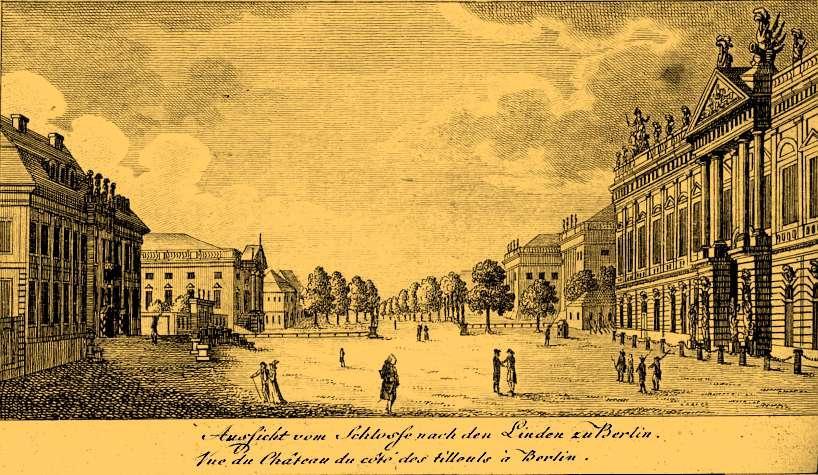
Schleiermacher had become essentially Wilhelm’s Berlin contact not least for matters concerning Athenaeum; here the signature Berlin promenade Unter den Linden in the late 18th century (Almanach zu Kenntniß der Preußischen Staaten für Reisende und Einheimische [1795]; Inhaltsverzeichnis deutscher Almanache, Theodor Springmann Stiftung);
[1] Not extant. Back.
[2] See Fichte’s letter to Schelling on 22 October 1799 (letter 250a). Back.
[3] Concerning the sonnetto à la burchiellesca, see Francesco Flamini, A History of Italian Literature (1265–1907), trans. William Michael Rossetti (n.p. 1906), 84, 111–12:
In this respect Niccolo Soldanieri and Alessio Donati resemble Sacchetti, the second with the greater boldness and more frankly popular style. Their ballads, full of banal jests and animal onomatopeia, as well as certain poems of Franco himself, have an undeniable kinship with the rhymes of a painter Orgagna, probably not the famous artist; but these rhymes — all enigmas, quibbles, and whimsical conceits — are evident precursors of the poetic manner that in the succeeding century was called Alla Burchia (“At Random”). The peculiarity common to these versifiers is the union of the sententious and the burlesque. . . .
In the fifteenth century the old popular Florentine style of poetry was followed by Burchiello, who revived the manner of Orgagna, and by Francesco d’Altobianco degli Alberti, who affected that of Pucci. Alberti has left many sonnets-gnomic, satiric, and jocose, as well as political. Burchiello — that is, Domenico di Giovanni, called Burchiello — a barber of Florence (1404–1449), attained to fame, not so much by the rhymes in which he sang the motifs of burlesque poetry, or by certain fine political sonnets, or the many derisive ones, obscure now, but clear and enjoyable to his contemporaries, as by the speech, alla burchia, used by him in more than one composition — whimsical, extravagant, incomprehensible to students of correct language. [Alla burchia means “at random;” burchio is a bark, and burchiello a little bark.]
See Caroline’s letter to Auguste on 28 October 1799 (letter 252) and supplementary appendix 252.1. Back.
[4] Merkel did, of course, obtain a copy of the sonnet and reprinted it in his Briefe an ein Frauenzimmer über die wichtigsten Produkte der schönen Literatur 2 (January–April 1801) no. 5, 299; see his commentary at the end of supplementary appendix 252.1. Back.
[5] Not extant, though it likely refuted the charge that Duke Karl August had had the Schlegels reprimanded; see Fichte’s letter to Schelling on 22 October 1799 (letter 250a). Back.
[6] In his letter to Wilhelm on 5 October 1799 (KGA V/3:205–7), Schleiermacher had discussed at length potential articles he might contribute to Athenaeum as well as various “deviltries,” i.e., critical pieces intended contra various in part quite well-known and respected literary personalities. Back.
[7] Concerning this letter, see Wilhelm’s letter to Johann Diederich Gries on 10 May 1799 (letter 236c) with note 10 and esp. Caroline to Gries on 9 June 1799 (letter 240) with note 3. The letter was published in the autumn of 1799 in Hamburg. Back.
[8] That is, the same sort of “Notizen” for which Duke Karl August allegedly reprimanded the Schlegels. See Fichte’s letter to Schelling on 22 October 1799 (letter 250a), note 2. Back.
[9] Tieck had related this “deviltry” to Schleiermacher in person but not in written form before leaving Berlin for Jena, but Schleiermacher himself was unable to recall it either. Back.
[10] I.e., of Athenaeum, the penultimate issue of which appeared in April 1800. Back.
[11] Friedrich’s “Gespräch über die Poesie,” Athenaeum (1800) 58–128; 169–187. Back.
Translation © 2013 Doug Stott