
• 247. Caroline to Auguste in Dessau: Jena, Sunday evening, 6 October 1799
[Jena] Sunday evening [6 October 1799]
|563| Tonight let me yet sit down and write to you, sweetheart, to ensure you will receive a letter from me tomorrow, since you are moaning and lamenting so. [1] You must remember that often I really am not able to write, since I now have to take care of all your smaller chores along with my own larger ones.
So only the latest news. Today at midday Madam Veit arrived after Friedrich’s impatience |564| had become almost unbearable for him. And so now she is here — here she is — note it well. She has a national, c’est à dire, [2] Jewish appearance, manner, and so on. She does not seem pretty to me; her eyes are large and glowing, but the lower part of her face is too slack, too pronounced. She is no taller than I, perhaps a bit broader. Her voice is the gentlest, most feminine thing about her. [3]
That I will grow fond of her I do not doubt for a moment. And you have no need to fear the little boy any longer, c’est un joli petit espiègle who will give you loads of fun; [4] indeed, I have already become great friends with him. He is quite small and supple like a page; we will want to put your livery on him. [5]
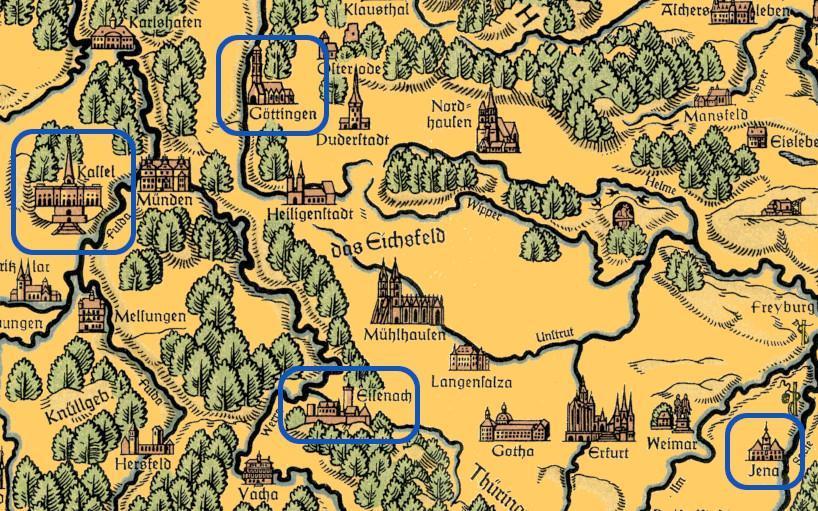
But only guess who is coming tomorrow. The day before yesterday the Hoppenstedts from Göttingen got in touch with me, hence no one less than your Aunt Philippine. They are taking a trip to Cassel, Eisenach, etc. and on here to Jena with the elder Hoppenstedt, whose wife is Mlle. Glockenbringk. She has already learned through the Loders that you are not here just now, and is quite taken aback about it. [6] She would really like to see you because she has heard so many good things about you — but it is just as well that she does not see you after all, since now she can believe all the more good things about you. They will be staying for but a single day, which is certainly fine with me, since the weather is terrible and no one is here. I will then write you more about their visit.
It is enough to make me crazy that Madam Tischbein did not wait longer here. Tischbein would surely have agreed to a stay for the winter. I intend to raise the subject with her again; the winter does, after all, still have a long way to go. You girls need to come out in support of what I write her.
To you, however, my dear, let me speak some words of reason and confidence. You are already there and have already gotten through the initial period of separation. Are you still absolutely insisting on |565| returning within two weeks with the Hufelands? [7] You have already lost the initial period as far as your music is concerned, for you have hardly even started; you will never get this opportunity again and you already want to give it up without further ado? Could you not resolve to stay at least until toward Christmas? At Christmas, of course, you are surely to be here, on that you have my maternal word of honor. Moreover I intend to write you every postal day.
It is just that — if you remain such a short time it will just not be right; it will be as if you merely made a short excursion there so that afterward you might scornfully criticize the residents of Dessau. Sweetheart, please do consider it carefully. You know that we will be leaving Jena at Easter, and perhaps [8] . . .
[Conclusion is missing.]
Notes
[1] Auguste had traveled to Dessau by way of Dieskau with the Tischbein family on approx. 14 September 1799 following the Jena visit of Sophie Tischbein, her son, and her two daughters, Betty and Caroline.
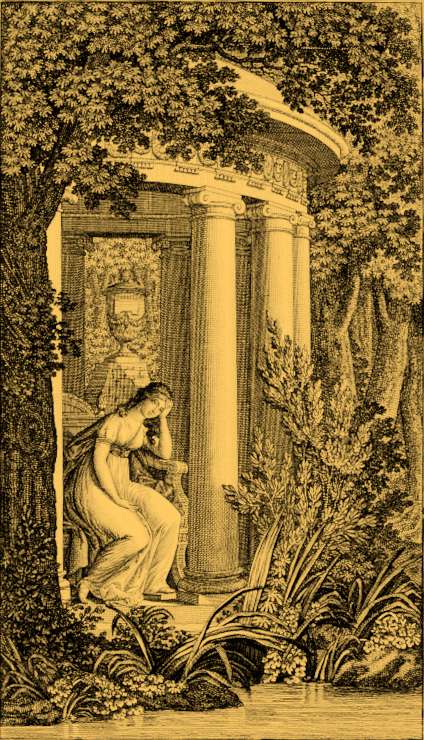
Although Auguste remained in Dessau until 26 November 1799, this letter attests her increasing restiveness and homesickness at being away from home by herself for the first time (Johann Caspar Weinrauch, Nachdenkliche junge Frau in einem Pavillon [ca. 1800]; Herzog August Bibliothek; Museums./Signatur Graph. A1: 2790i):
[2] Fr., “that is to say.” Back.
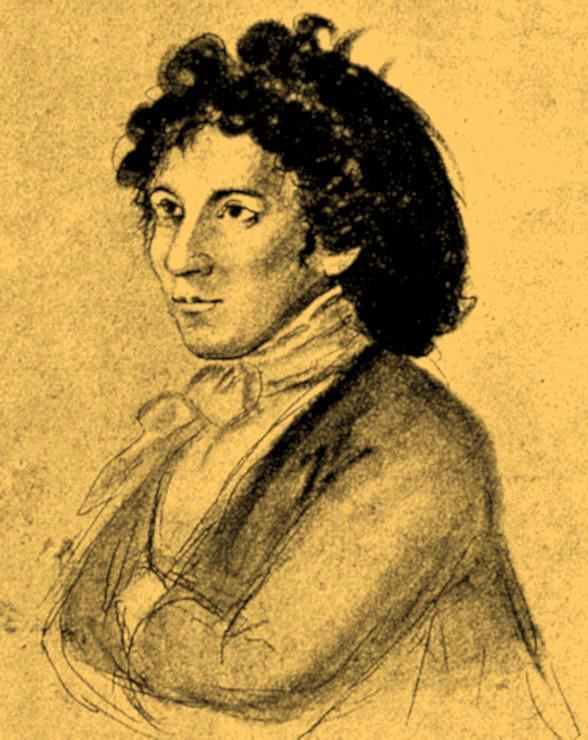
[3] Here Dorothea Veit in 1798 (pencil drawing from the Varnhagen Collection; in Briefe von und an Friedrich und Dorothea Schlegel, ed. Josef Körner [Berlin 1926], plate following p. 24):
Erich Schmidt, (1913), 1:743–46, remarks the following concerning the history of part of Dorothea Veit’s correspondence during this period:
The letters Dorothea wrote to Schleiermacher and that Wilhelm Dilthey published in volume 3 of Aus Schleiermacher’s Leben suffered considerable abridgement, not least in passages concerning her relationship with Caroline (Fritz Jonas supplies additions in “Aus Briefen von Dorothea Veit an Schleiermacher,” Euphorion 1 [1894], 608–12). These letters will be published in an unabridged edition in 1913 as a publication in the series of the Berlin Literaturarchiv-Gesellschaft as Briefe von Dorothea Schlegel an Friedrich Schleiermacher, ed. Heinrich Meisner and Erich Schmidt, Mitteilungen aus dem Literaturarchiv in Berlin N.S. 7 (Berlin 1913). Let me summarize some of the material from the manuscripts of these letters.
Translations of all the letters Schmidt cites in excerpts are included in this present edition; the letters have also since been published in the original in KFSA 24 and 25. Back.
[4] Fr., “he is a cute little scamp, rogue.” Readers may note that Caroline assumes Auguste understands the French without a translation.
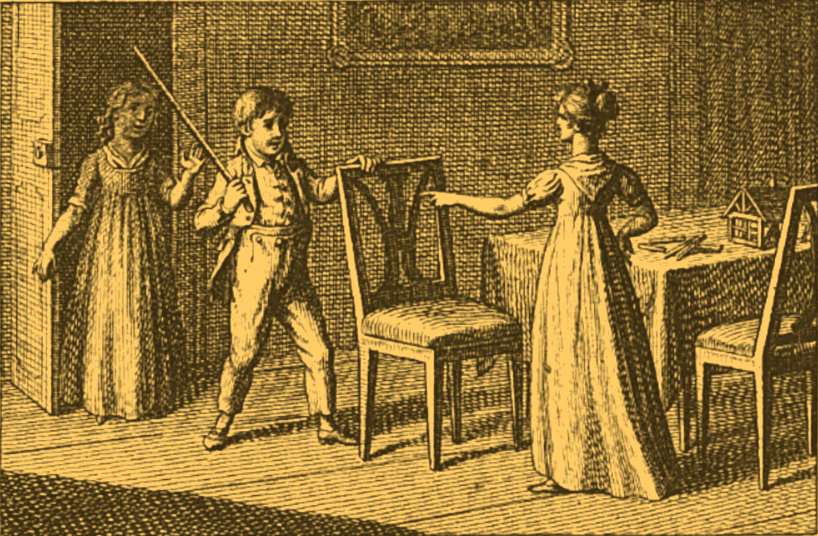
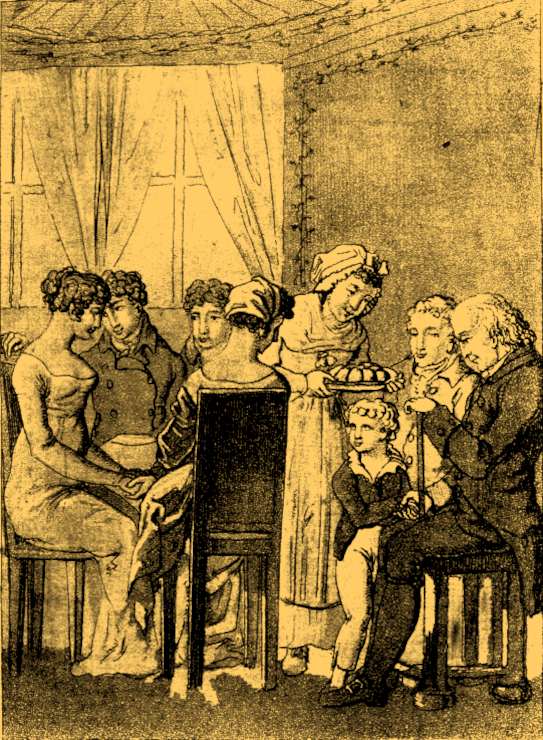
Auguste may have expressed apprehension at the thought of an unknown little boy joining the household ([1] title vignette to Jacob Glatz, Sittenlehre für Jüngere Mädchen in Beÿspielen und Erzählungen, vol. 1 [Frankfurt 1807]; [2] Wilhelm und Luise: Ein Taschenbuch für das Jahr 1811; Inhaltsverzeichnis deutscher Almanache, Theodor Springmann Stiftung):
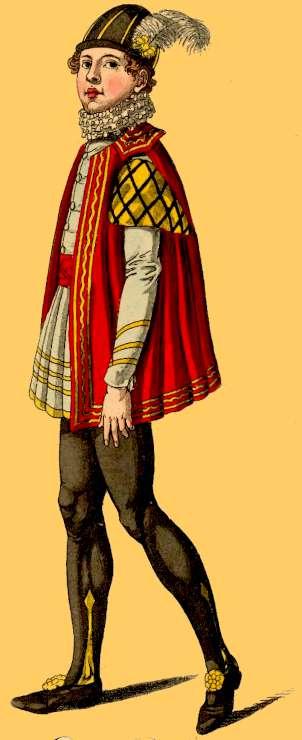
[5] I.e., the livery (“proper boy’s costume”) Caroline had made for Auguste to wear for her role as a page in the performance of Friedrich Ludwig Schröder, Die Heurath durch ein Wochenblatt. Eine Posse, in einem Aufzuge (Vienna 1786) on the birthday of Justus Christian Loder back in February 1799 (similar to the lad in this illustration by Daniel Nikolaus Chodowiecki, Das Goldstück [1793]; Herzog Anton Ulrich-Museum; Museums./Signatur DChodowiecki AB 3.955; second illustration: Göttinger Taschen Calendar Für das Iahr 1800; Inhaltsverzeichnis deutscher Almanache, Theodor Springmann Stiftung):

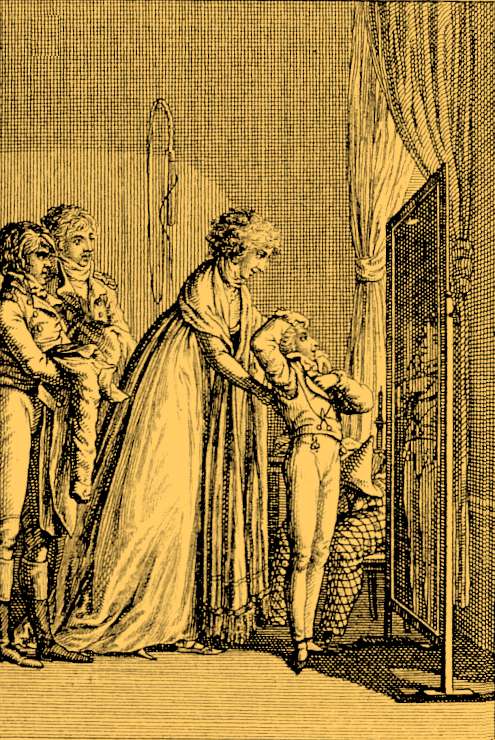
For comparison a costume illustration for a page, albeit it at a formal occasion, for the later Berlin theater for (Kostueme Auf Dem Koen. National-Theater in Berlin [Berlin ca. 1808]; Herzogin Anna Amalia Bibliothek Weimar):
See the initial paragraph of Auguste’s letter to Cäcilie Gotter on 18 February 1799 (letter 220); for the scene itself, see supplementary appendix 220.1. Back.
[6] Caroline mentions this visit in her letter to Luise Gotter on 5 October 1799 (letter 246). Here the Göttingen visitors’ general route (Rudolf Koch and Fritz Kredel, Deutschland und angrenzende Gebiete [Leipzig 1937]):
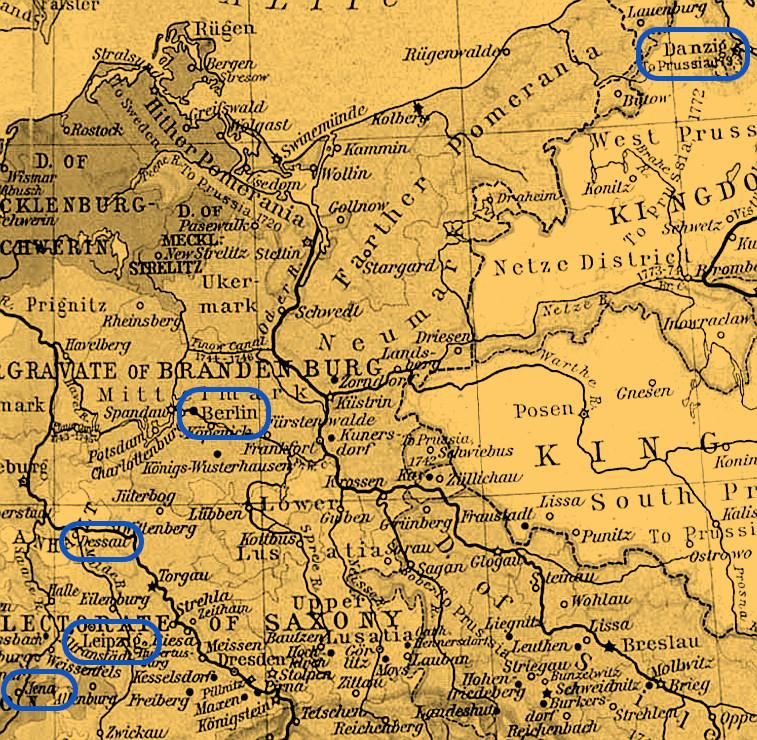
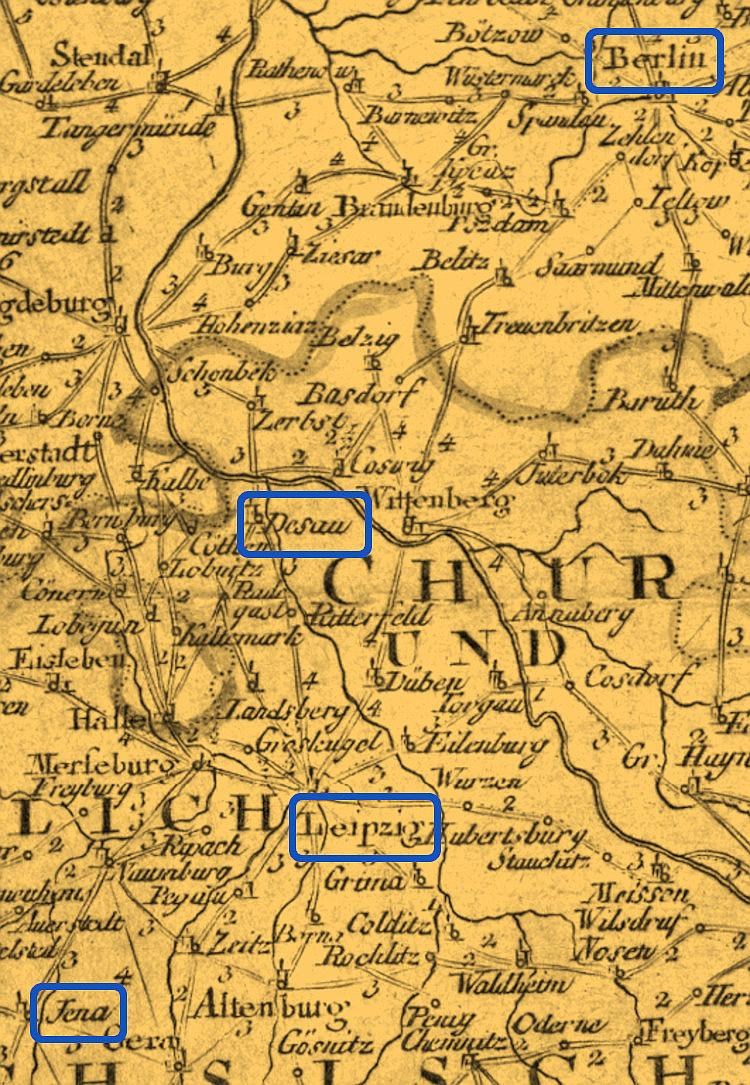
[7] Gottlieb and Konradine Luise Hufeland had visited his hometown of Danzig and were scheduled to pass through Berlin and Dessau on their way back to Jena, arriving in Jena on 27 October 1799; because they journeyed by way of Leipzig rather than Dessau, Auguste did not return with them (W. R. Shepherd, Historical Map of Central Europe about 1786 [1926]; map of postal routes: Post Karte Durch ganz Deutschland, ed. J. Walch [Augsburg 1795]):
[8] Unknown allusion to a journey at Easter 1800. Back.
Translation © 2013 Doug Stott