
• 235. Caroline to Luise Gotter in Gotha: Jena, 24 April 1799 [*]
Jena, 24 April [17]99
|535| [Errand requests.] All of you have probably recovered from the wedding festivities by now and have sent the young woman on her way. [1] Although I would gladly come visit you in that regard, such cannot be arranged as conveniently as might appear. —
Someone told me that Vanderbek was in Weimar on Saturday. [2] Why did Minchen not come along as well? It would have been so nice had we all been able to meet there at the same time. It would be better that she not come here until things have completely leafed out and gotten warm. —
In Weimar we finally killed off Wallenstein — and are hoping he thereby acquires immortality. |536| The beauty and power of the individual parts is what one notices most. If I might offer an assessment after seeing it only once, I would say the whole forfeited considerably in effect for having been so long. It should have been but a single play, then the scenes, concentrated on a single focal point, would have followed slowly, one after the other, leaving the spectator time for calm reflection. As it is, the final act falls flat — one hardly even notices the demise of the hero, whose greatness has been established and enhanced through the 11 preceding acts so that his fall might generate a powerful convulsion in the spectator. [3]
And all the evidence of intention, of calculation that one cannot fail to see!
Simply put, it is a work of art alone, void of instinct. I cannot describe to you how, by comparison, the conclusions to the plays of Shakespeare, even his political ones, fill and stir the heart. But please write and tell me what Van der Bek’s assessment was.
The Piccolomini intimated so many more things, seemed to anticipate so many things that were simply resolved in an insignificant manner here. [4] Madam Iffland wrote me that the latter were quite coldly received in Berlin, [5] though that admittedly does not constitute proof against them as such. Iffland allegedly performed magnificently. [6] —
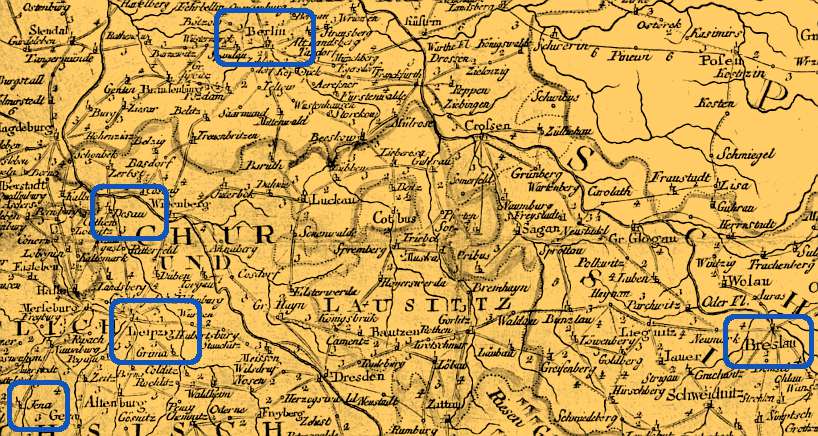
He is going to Dessau, Leipzig, and Breslau. Did you know that in Dessau, Baron Lichtenstein and his spouse performed along with the other actors in an opera that he himself wrote and scored? [7] All this took place on the 2nd day of Easter and was received quite ill by the nobility but quite well by the rest of the public.
It is only with great sorrow that I can write you about what you asked me — about Fichte’s situation. [8] Believe me, it is extremely bad for all who are friends of sincere, candid conduct. You probably have a fairly good idea of what one is to think about the initial accusation, which came from a bigoted prince and his in part Catholic |537| and in part Moravian advisors.
We, however, were hoping the whole thing would end with some insignificant formality. But then people agitated Fichte himself to such an extent with all sorts of reports from Weimar alleging that things were very serious indeed etc. that he wrote to Geheimerath Voigt saying he would resign if he were given a court reprimand and if his academic freedom were to be restricted. [9] —
The letter was, moreover, quite forceful — if the the duke, who is quite ill disposed toward Jena in any case, saw it, the outcome could hardly be any other. But Fichte had reason to consider Voigt his friend — if Voigt was such a friend, then he had to give the letter back to Fichte and tell him — “If you leave the use of this letter to me, the only use of it I will make is to pocket it, assuming you still do not want me to show it.”
It was shown to the duke and put on file. A rescript was issued with a reprimand that was for all practical purposes no reprimand at all and which because of the postscript could be formulated as gently as possible.
That postscript, however, did indeed make known that they were accepting Fichte’s demand for dismissal, since one could not, after all, get around issuing a reprimand — which admittedly was not of the sort Fichte wanted to avoid for the sake of saving his honor. [10] —
All the court attendants, all the professors whom Fichte had outshown — he had 400 people attending his lectures last winter — are now wailing about his brazenness and his impulsiveness. He is abandoned and shunned.
The students turned to Weimar in an attempt to keep him, though, of course, he would not have stayed in any case. The response was that Fichte’s private letter to Voigt was communicated to them, essentially turning them into judges themselves. —
The result of all this was that they gleefully seized on a pretext for getting rid of him because they fear the Saxon court and |538| because they often found Fichte’s imperturbable honesty embarrassing. [11]
The duke has allowed himself some rather excessive measures against Jena. You have probably heard about the Schützes’ amateur theater nonsense [12] — even though it was probably a good idea to thwart this rather grand entreprise, he went so far as to issue a second police regulation prohibiting any performance in any room even before just a few friends.
And this pathetic quarrel was then followed by the considerably more serious one involving Fichte, one that has — you would be astonished at how quickly — completely reversed the public spirit here and made it subservient to rather shrewd restrictions. [13] —
Stay well, and kiss your dear children for me.
Notes
[*] Chronological note: Caroline’s review of Orlando furioso appeared on 29 April 1799 in the Allgemeine Literatur-Zeitung (1799) 136 (Monday, 29 April 1799) 257–62. Back.
[1] Unknown allusion. Back.
[2] As Caroline goes on to suggest, Johann Karl van der Becke was apparently in Weimar on Saturday, 20 April 1799, for the premiere of Wallensteins Tod, the final part of Schiller’s Wallenstein; Caroline is writing here on the following Wednesday (Post Karte Durch ganz Deutschland, ed. J. Walch [Augsburg 1795]):

Concerning the three parts, see the summary of the trilogy. — Die Piccolomini was performed on 17 April 1799, then Wallenstein (otherwise known as Wallensteins Tod) on 20 and 22 April 1799 (Das Repertoire des Weimarischen Theaters, 32). Back.
[3] Here the initial scenes in acts 1–5 of Wallenstein’s Death (in order: Schiller’s Works, ed. J. G. Fischer, vol. 2 [Philadelphia 1883], 185, 197, 208, 228, 241):
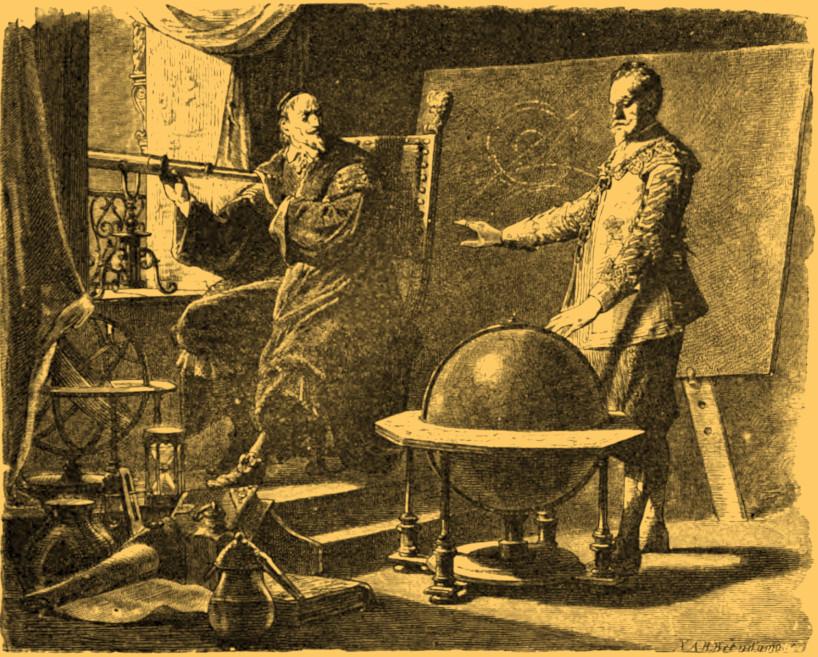
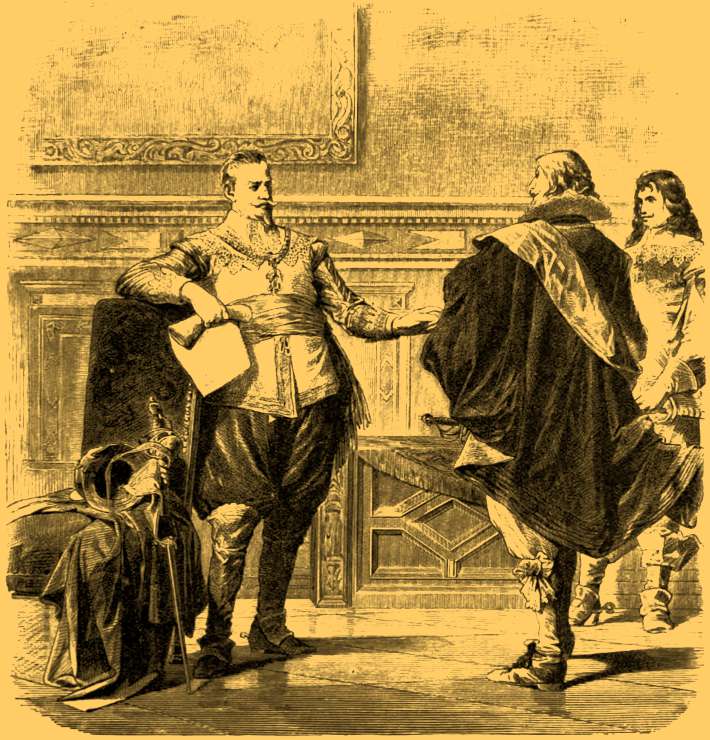
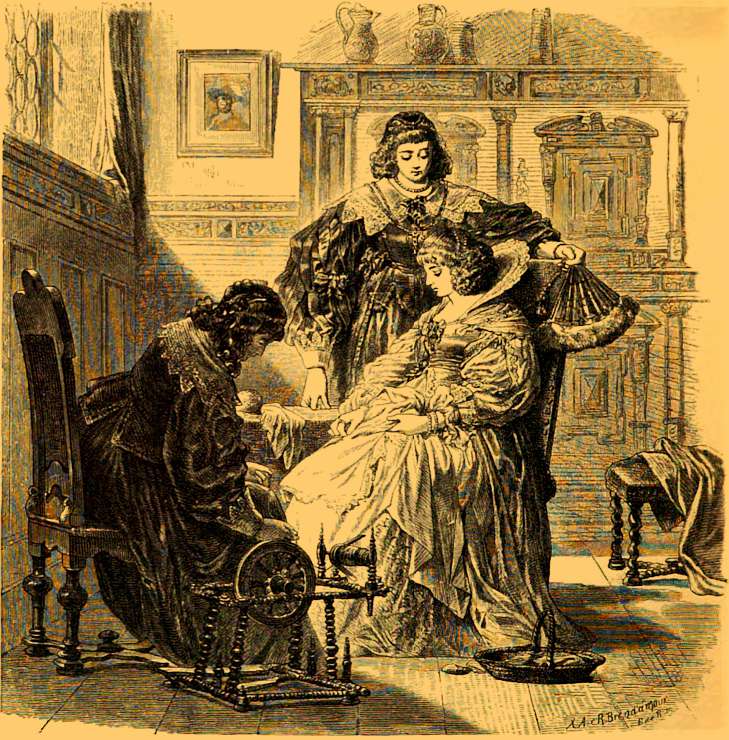
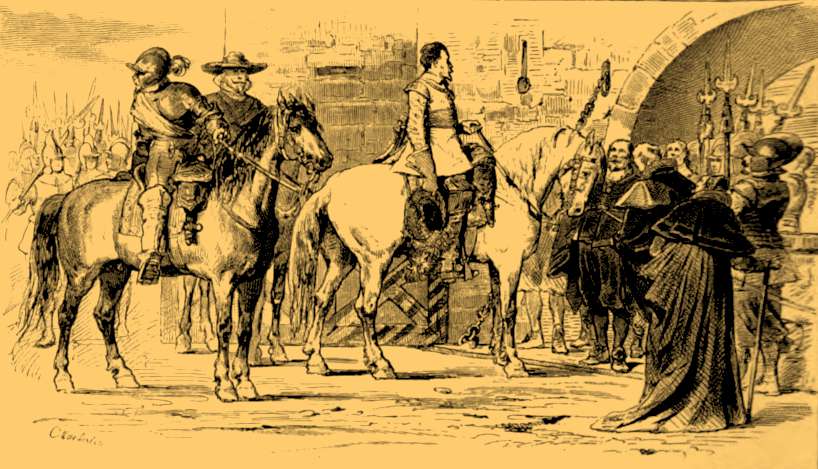
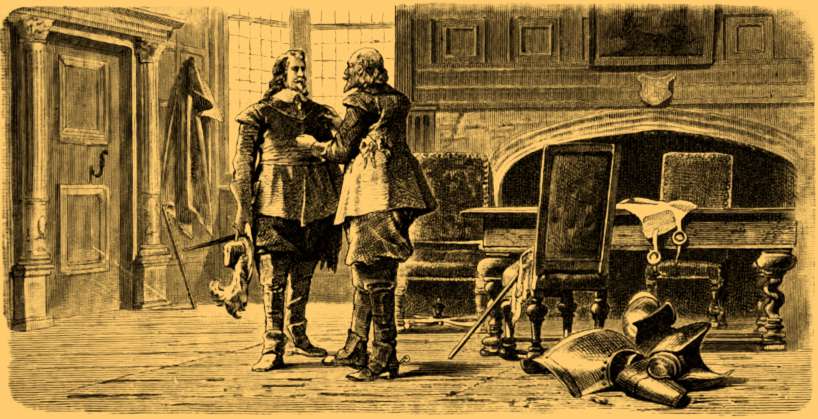
[4] Die Piccolomini had premiered in Weimar on 30 January 1799. See esp. Auguste’s letter to Cäcilie Gotter on 18 February 1799 (letter 220). Back.
[5] Die Piccolomini premiered in Berlin on 18 February 1799, Wallensteins Tod on 17 May 1799 (C. Schäffer and C. Hartmann, Die Königlichen Theater in Berlin: Statistischer Rückblick auf die künstlerische Thätigkeit und die Personal-Verhältnisse während des Zeitraums vom 5. December 1786 bis 31. December 1885 [Berlin 1886], 68, 91). Back.
[6] Iffland had performed the role of Octavio Piccolomini. Here the characters of Octavio Piccolomini and Wallenstein (Schiller-galerie: Charaktere aus Schiller’s Werken, no pagination):
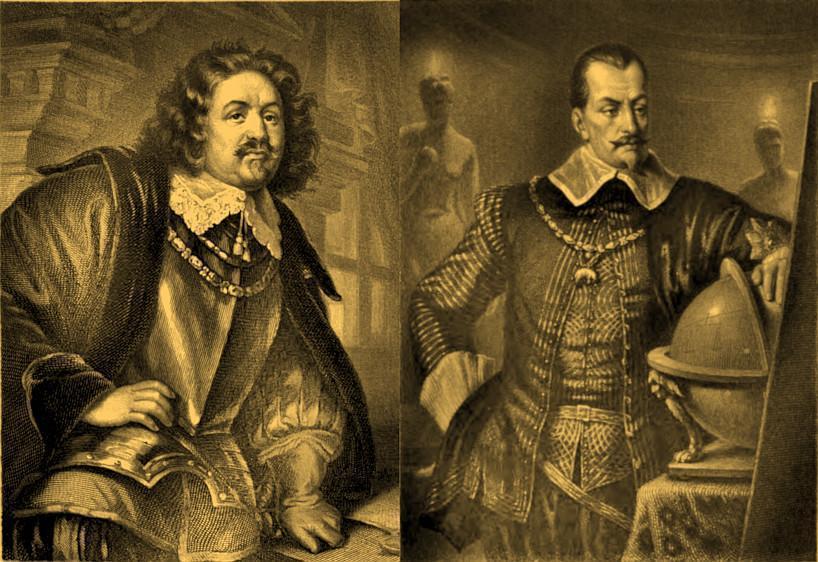
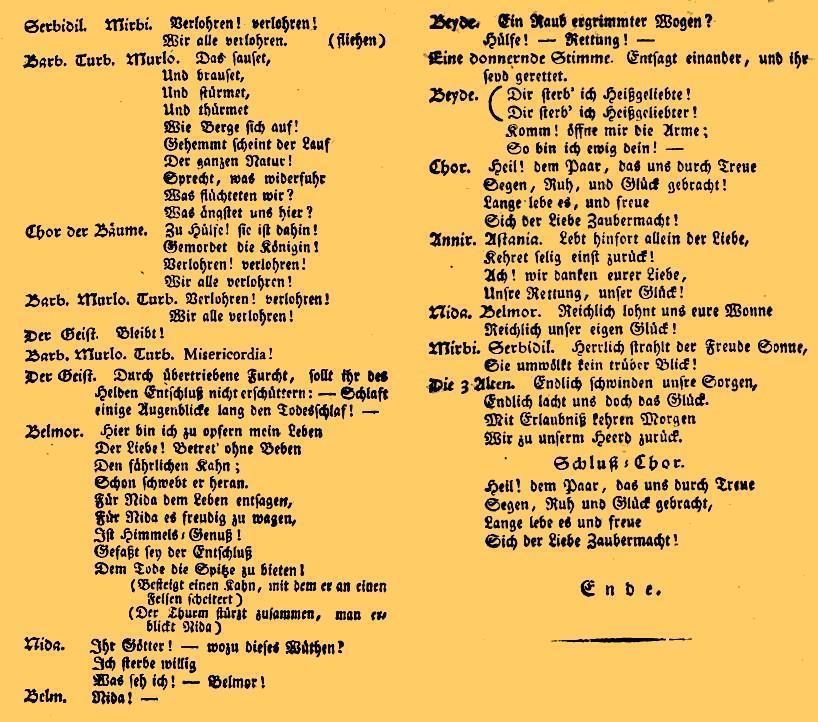
[7] Iffland did indeed had an extensive performing journey planned (Post Karte Durch ganz Deutschland, ed. J. Walch [Augsburg 1795]):
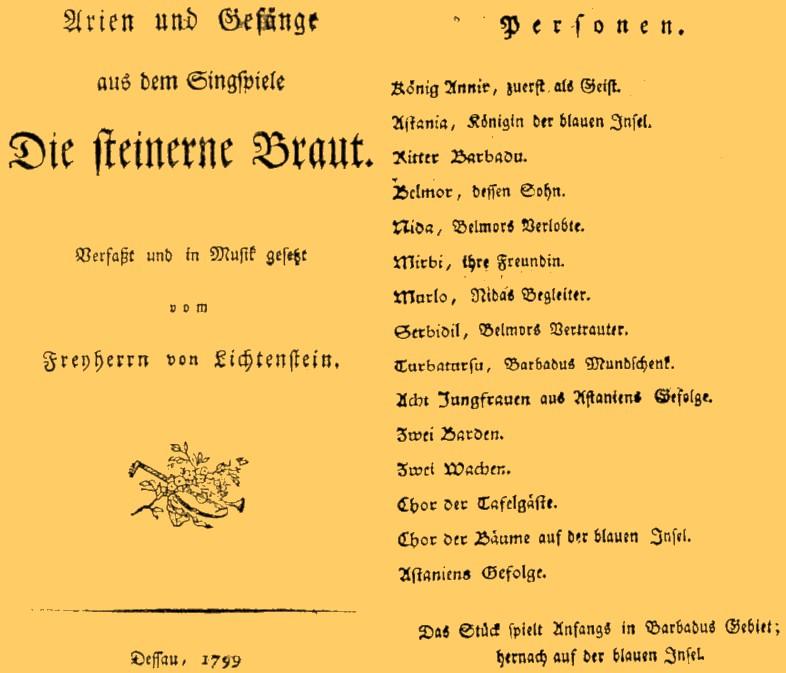
The piece in Dessau was almost certainly Die steinerne Braut (Dessau 1799), in which on 25 April 1799 Lichtenstein and his wife performed the two main roles with extraordinary success according to the Allgemeine musikalische Zeitung (1799) 33 (15 May 1799), 511–14 (ed. note: pp. 511–12 inadvertently also appear in the previous issue, no. 32); the enthusiastic reviewer (Karl Spazier) remarks:
This incomparably grander, more thoroughly structured opera [than Lichtenstein’s previous Bathmendi] was recently given several performances here, creating an extraordinary sensation among the theater public not only because of its uniquely interesting content from the realm of magic and fairies, but also because of the strange circumstance that the composer himself, also functioning as the poet, not only invented and wrote the material itself for the opera, but also, together with his charming and talented spouse, performed the main roles of Belmor and Astania to universal acclaim. . . .
I know of very few theater composers indeed who unite within themselves so much true genius, artistic savvy, and taste, who work with so much fieriness and yet such prudent reflection, who write with such genuine dramatic style, who are able to move with such lightness and sound method despite their wealth of ideas and with a consciousness of acquired artistic wealth, — than the composer of Die steinerne Braut, the latter of which offers such a wealth of material for the expression of emotion, for grandeur and seriousness, as well as for the more pleasing genre of the light play of emotion and ideas, for comical tableau and in general for genuinely dramatic situations.
Chronological questions arise insofar as Caroline is writing on 24 April 1799, whereas the play was allegedly performed (premiered?) on 25 April 1799 (according to Christian August Vulpius. Eine Korrespondenz zur Kulturgeschichte der Goethezeit, vol. 2, Kommentar, ed. Andreas Meier, Quellen und Forschungen zur Literatur- und Kulturgeschichte 28 [Berlin 2003], 116). The second day of Easter 1799 (Easter Monday) to which Caroline next alludes, was 25 March 1799, Easter falling on 24 March that year.
That said, Spazier does point out in his review on 15 May that the piece had already been performed “repeatedly,” allowing for several performances during this period. Here the title page and dramatis personæ and the final two pages of the final act:
[8] Concerning Fichte’s atheism dispute, see the overview in supplementary appendix 215a.1, which also provides a source for English translations of the texts mentioned here and in the rest of the dispute, including the story behind the student petitions. Back.
[9] On 22 March 1799, and at the suggestion of Rector Paulus, Fichte wrote to Christian Gottlob Voigt, who had played a major role in Fichte’s original appointment at the university; in it, Fichte asserted that he would respond to any censure in the senate by resigning. Voigt in his own turn filed this imprudent letter away, not least because it shifted responsibility to him. Ultimately a censure was indeed issued; see below. Back.
[10] Karl August proposed reprimanding both Fichte and Friedrich Immanuel Niethammer essentially merely for “thoughtlessness” or “imprudence,” the academic senate in Jena also being charged with admonishing them to “pay better attention” to their public utterances. It was, however, still a reprimand. The postscript then read in part:
We provide for your perusal the written enclosure [Fichte’s letter] demonstrating how Professor Fichte, of your own locale, in a missive directed to a member of our privy council [Voigt], declares to answer any reprimand directed to him in the case of alleged atheism by submitting his resignation.
Insofar as this reprimand had to be addressed to him in our main decree, we have made the decision to accept immediately this declared submission of his resignation. Back.
[11] Concerning the background to other courts having a voice in Fichte’s situation, see section on the Ernestine trustees in the supplementary appendix on Germany in the late-eighteenth century. Back.
[12] See Caroline’s letter to Luise Gotter on 25 February 1799 (letter 222a). Back.
[13] Although no faculty members resigned in support after Fichte’s dismissal as he had anticipated and even maintained would happen, the period following his departure from Jena did mark the beginning of a gradual decline in the previous efferverscent academic atmosphere at the university.
This decline culminated by 1803 with the resignation and departure of, among others, Schelling, H. E. G. Paulus, and Gottlieb Hufeland, all of whom went to Würzburg, and Christian Gottfried Schütz, who went to Halle, taking the Allgemeine Literatur-Zeitung with him (Goethe and Heinrich Karl Abraham Eichstädt set about founding a new version of the journal [from January 1804], the Jenaische Allgemeine Literatur-Zeitung, in which Caroline herself would later publish literary reviews); Fichte’s codefendant in the atheism controversy, Friedrich Immanuel Niethammer, also left for Würzburg in 1804.
See in this context esp. the remarks by H. E. G. Paulus in 1803 in supplementary appendix 377c.1. Back.
Translation © 2013 Doug Stott