
230c. Henriette Mendelssohn to Dorothea Veit in Berlin: Leipzig, 16 April 1799 [*]
Leipzig, [Tuesday] 16 April [1799]
So, this is what has become of all our grand plans, namely, that I am still sitting here while all of you there imagine me to be enjoying myself amid all sorts of splendor and joy. I told you I had found a travelling companion for the trip to Jena. I was supposed to depart with him yesterday.
In the meantime, I was informed that I needed to prepare myself for the journey to Vienna on the 18th; hence I would hardly have had time even to open my eyes properly there. [1] Through Frommann [2] I yet received a few words from Caroline; they are expecting me at midday today, but will only be receiving my letter tomorrow. I sent Lucinde along with it; I myself am counting on receiving a finished copy in Vienna as promised. I wrote Caroline about how their later coming was making all of you so impatient, and may God forgive them for what they are doing for Iffland. [3]
I cannot go to Dresden [4] because I cannot even find anyone here to accompany me even as far as the town gates. Everyone here is so busy, running and scurrying about all over such as to make my head spin. I do not have the courage to travel alone, and so I will be bored here for a few more days in preparation for the grand ennui [5] of the journey to Vienna, which I will be making with two men who are utter strangers to me. I will make every effort to stay at least one full day in Dresden. —
Yesterday I attended a souper at the home of the banker Ludwig, with all sorts of people, illustres and elegance. Bertuch from Weimar was there among others, who suddenly represented the entirety of Berlin to me — he is like Nikolai and Rosenstiel together. [6] He sat next to me at dinner without knowing who I was, and spoke with a Leipzig physician about Fichte and all the more recent philosophers. They quite ridiculed Fichte’s behavior. God knows how Schelling will be reacting to Fichte’s more recent dispute, [7] but enough: now it was his turn as well, though Bertuch defended him a bit on the basis of his own thorough familiarity with him.
The physician related how he had treated Schelling here in Leipzig for some illness or other, and how peculiarly Schelling had acted, whereupon Bertuch remarked, “Ah, yes, yes, the wise of the world are rarely wise in the ways of the world!” And he was so pleased with himself that he repeated it three times. I would so like to have asked about the Schlegels, but I lacked the courage.
Once Bertuch even addressed me directly, talking about how the more recent philosophers “are so busy constructing frameworks without thinking about houses, which are, after all, the real purpose of frameworks.” Because I did not quite know how to respond to such a statement, and in part just to have a bit of fun, I wanted to ask him quite valiantly what he thought of the two Schlegels — and at that very moment the host came and asked him in a whisper whether he realized he was sitting next to a daughter of Mendelssohn. Bertuch thanked him profusely for this information, as if having thereby just escaped some very great danger! You can imagine how ridiculous I found it all, especially since he then suddenly broke into a grand panegyric to — Mendelssohn! —
But what does any of that help? I am quite peevish and irked at being here, especially when I think how I could have been living in Jena — — —
I bought you a tea setting. If it but makes it to you sauf et saint, [8] you will doubtless be very pleased with it.
Am I to receive no letter from you at all? If you have not already written, no letter will arrive while I am still here, which would quite vex me.
Tell me how and what you are doing. My kisses and regards to Philipp. Tell me something about him.
Please be so kind, my dear Madam Veit, and have Guste give you my silver fruit knife, which I forgot; keep it yourself or send it to me on occasion; I have it from Abraham and I do not want it ending up in a stranger’s hands.
Give the Tiecks my regards when you have the chance.
If you want the tea setting to be truly black, you must rub it a bit with butter.
Notes
[*] Source: Dreihundert Briefe 1:2:172–75; KFSA 24:270–72.
Background: Plans for Henriette to visit the Schlegels in Jena on her way to Vienna to accept a position as a governess extend back to October 1798; see esp. her letter to Wilhelm Schlegel on 18 December 1798 (letter 212c), note 2.
The journey and logistics for staying in Jena are extensively discussed in the correspondence here dating to the late winter of 1798–99 and early spring 1799. See, e.g., Caroline’s letter to Friedrich 14–15 October 1798 (letter 204) with note 30, Friedrich’s letter to Caroline in mid-December 1798 (letter 211); also letters 202f, 207b, 207c, 211, 212 (with cross references) (Dilligence [19th century]; Bibliothèque municipale de Bordeaux, Album d’illustrations diverses] [278]):

Henriette’s lament is that after all this planning, the visit itself now seems in jeopardy (see also “so I will be bored here for a few more days in preparation for the grand ennui of the journey to Vienna”). Although it is clear from Auguste’s letter to Friedrich Schlegel and Ludwig Tieck after mid-April (letter 232), and Friedrich’s undated letter to Auguste presumably after mid-April (letter 230f), that she did visit Jena, however briefly, it is unclear exactly when she did.
KFSA 24:455, in the single annotation to Henriette’s letter to Dorothea on 19 April 1799 (here letter 230e), notes that:
In none of her three letters to Dorothea does Henriette mention her extremely short stay with AWS and Caroline on 16 April. That it did indeed take place, however, we know only from FS’s [Friedrich Schlegel’s] question to Auguste [here letter 230f], “How does my little Henriette please you?,” from Auguste’s words in her Knittel-verse letter [here letter 232], “I, too, have reason for ire on this day / For that evil old man whisked my sister away,” and from Henriette’s comparison of AWS’s facial features with those of Charlotte Ernst. Prior to this trip, FS was the only one of the Schlegel siblings with whom she was acquainted.
Such was, however, not quite the case. In a letter to Wilhelm on 16 August 1798 (letter 202f), however, Henriette remarks concerning a letter she has just received from Wilhelm that
it was the first real amusement I have had since you left us. But that I must now extend my thanks to you in writing rather than anticipating a cordial morning visit during which I might express it to you in person — quite annoys and makes me anxious, just as during your first visit . . .
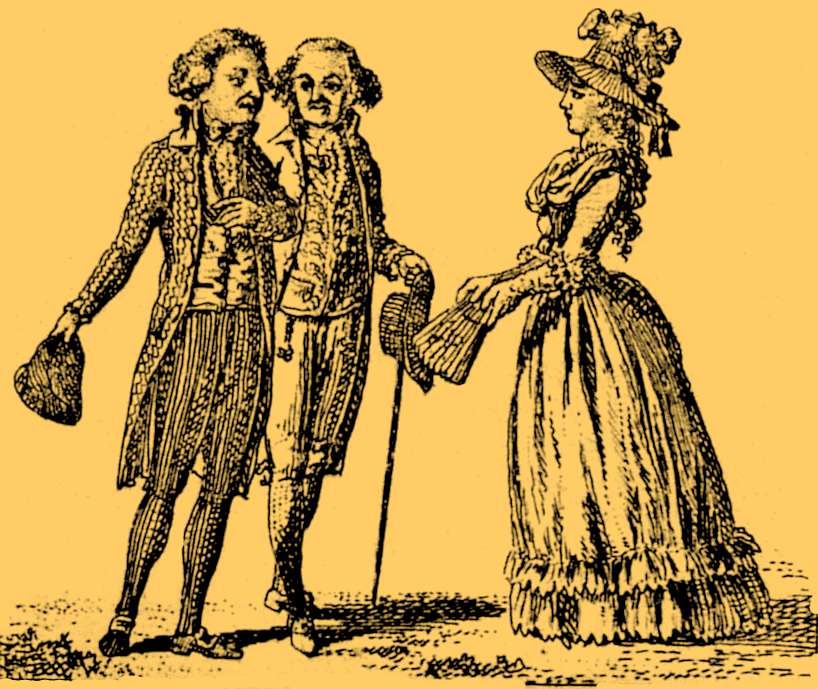
It may be recalled that prior to going to Dresden in mid-June 1798 (arriving on 30 June) to meet Caroline and Auguste, who had travelled there ahead of him with Johann Diederich Gries (see Caroline’s letter to Dorothea Marie Campe on 6 May 1798 [letter 200b], with note 1), Wilhelm had indeed been in Berlin with Friedrich, who had known Dorothea Veit since August 1797. Hence Henriette’s comparison between the Schlegel siblings after having met Charlotte Ernst in Dresden (in letter 230e on 19 April; possibly with Friedrich von Hardenberg in letter 230d on 18 April) cannot be adduced as evidence of her visit to the Schlegels in Jena on either 16 April or any other day, since she was already acquainted with both Friedrich and Wilhelm (Goettinger Taschen Kalender vom Jahr 1790; Inhaltsverzeichnis deutscher Almanache, Theodor Springmann Stiftung):
In this present letter, moreover, written on 16 April, she mentions only that she is expected in Jena that afternoon (or midday; in any event a 75 km trip and not on the way to Dresden), but that they would only get her (unknown) letter the next day, presumably explaining her absence on 16 April. Were she going to Jena on 16 April, it also seems unlikely she would have sent the advance copy of Lucinde on ahead with that letter, as she mentions in this letter.
Finally, in his undated letter to Auguste in mid-April 1799 (letter 230f), Friedrich asks Auguste how she likes Henriette and knows already that she has departed. On the other hand, in her letter to Caroline on 20 April 1799 (letter 234), Dorothea did not know whether Henriette was in Jena or Leipzig (Henriette had left Dresden for Vienna the previous day), whereas Friedrich, in his undated letter to Auguste (letter 234a; dictated to Dorothea), presupposes Auguste’s verse-letter (letter 232) but does not independently attest Henriette’s visit.
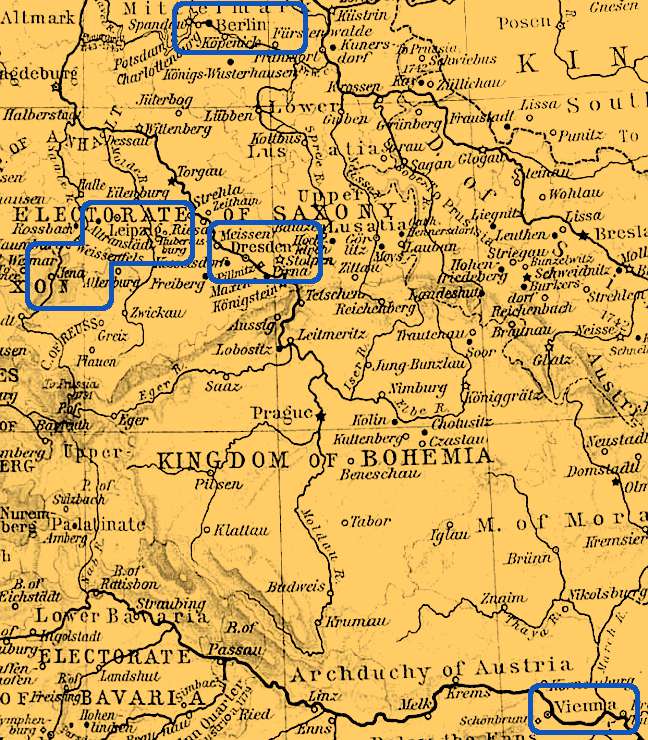
In any event, the only evidence for Henriette’s visit with the Schlegels in Jena is possibly Friedrich’s undated letter to Auguste in mid-April 1799 (letter 230f), and — unequivocally — Auguste’s verse-letter to Friedrich and Ludwig Tieck (letter 232), similarly undated (at its initial publication, Karl von Holtei, Briefe an Ludwig Tieck, 4 vols. [Breslau 1864], here 1:27–29, was unsure of the identity of the letter’s author). Neither letter provides an unequivocal date for the visit, though given this chronology and the considerations in Henriette’s letter to Dorothea on 19 April (letter 230e), note 1, the possibility exists that Henriette was in Jena on 17 April, then journeyed on to Dresden the same day (W. R. Shepherd, Historical Map of Central Europe about 1786 [1926]):
Oddly, in a letter to Brinckmann from Berlin on 4 May 1799 (Franz Deibel, Dorothea Schlegel als Schrifstellerin im Zusammenhang mit der romantischen Schule. Palaestra XL [Berlin 1905], 165; KFSA 24:279), Dorothea does not even mention Jena as having been part of Henriette’s itinerary:
She departed here [Berlin] on 7 April, spent several weeks [viz., days] in Leipzig being bored, but then wrote with genuine delight from Dresden, where she stayed for several days and from which she also wrote me. The gallery, the surrounding area, and the acquaintance of several quite interesting people. — You can imagine what impression all that together, along with her completely carefree existence, made on her! She has not yet related to me a specific address in Vienna. Back.
[1] This statement seems to confirm that Henriette had decided not to travel on to Jena on this day, 16 April. Back.
[2] Who was in Leipzig for the book fair, which in 1799 would begin on 14 April (see Dorothea Veit to Wilhelm and Caroline on 9 March 1799 [letter 224e], note 10). Back.
[3] Henriette does not seem to know yet that the Schlegels’ trip to Berlin for the premiere of Hamlet (as discussed in previous letters) had already essentially been canceled; the premiere would not take place until 15 October 1799, but the Schlegels would not be in attendance. See Ella Horn’s essay the background to the premiere of Hamlet in Berlin. Back.
[4] Where, to the contrary, she was soon to meet Friedrich and Wilhelm’s sister, Charlotte, and her husband, though also Friedrich von Hardenberg. Back.
[5] Fr., “boredom.” Back.
[6] Possibly Friedrich Philipp Rosenstiel, director of porcelain manufacturing in Berlin and a privy senior financial and mining administrator. Henriette’s point seems to be that Bertuch evoked for her the overall personality of (late) Enlightenment Berlin (Daniel Nikolaus Chodowiecki, “Die Abendgesellschaft bei Pastor Bocquet,” Von Berlin nach Danzig: Eine Künstlerfahrt im Jahre 1773, von Daniel Chodowiecki. 108 Lichtdrucke nach den originalen in der Staatl. akademie der künste in Berlin, mit erläuterndem text und einer einführung von Wolfgang von Oettingen [Leipzig 1923], plate 47):

[7] Concerning Fichte’s atheism dispute, see supplementary appendix 215a.1; as a result of having lost his position in Jena, Fichte would be moving to Berlin in early July. Back.
[8] Fr., “safe and sound.” Back.
Translation © 2013 Doug Stott