
212b. Friedrich Schlegel to Friedrich von Hardenberg in Freiberg: Berlin, 17 December 1798 [*]
Berlin, 17 December 1798
Your magnificent, warm letter was so refreshing for us; [1] for apart from the air we construct for ourselves, everything round about us here reeks of suffocating dullness. We are able to enjoy your friendship calmly and without disruption, since at least for the moment we do not so urgently need your help. —
When I first wrote, everything was still in flux and uncertain, and I myself with neither money nor means, and with a thousand chance circumstances on which everything would have depended. —
But the world is already becoming clearer; today I will be seeing my lady friend for the first time in her own apartment, and in a short time she will also be divorced. [2] Everything was negotiated amicably, and even the point concerning finances acceptably resolved. More on which later.
We will yet be staying here this winter; we are not afraid of the stir it may cause, and in any event such is always best laid to rest quickly. I will not really be marrying her, since that is the condition under which they are willing and able to give her custody of her youngest son. I also much prefer that no ceremonies are necessary. I may not have mentioned to you that in this respect I find myself closer to Leibnizian philosophy. To wit, through an imaginative bit of chance my lady friend is the daughter of the elderly Mendelssohn, and precisely that is the stumbling block to that ceremony, since her baptism would be an unacceptable insult to her family. [3]
We will not be staying here this coming summer; I think we will be in Dresden. We really would like to see you! — Should we perhaps first come visit you in Freyberg before we go there, or will it work out fine in Dresden? [4] —
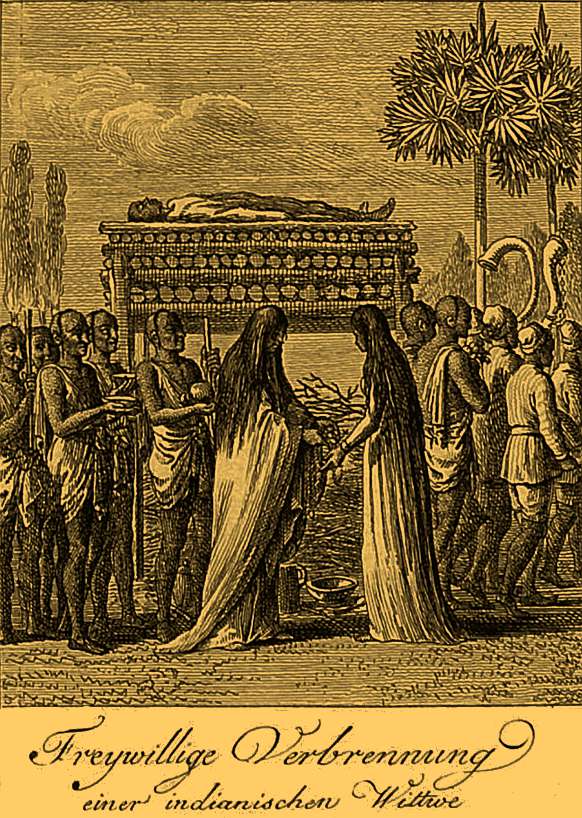
You would be pleased with her, a woman who has kept herself upright with such dignity during such long misery, and without any support except the energy of her own despair, and who now emerges from it all with this quiet strength. In external cultivation and comeliness she lags far behind my sister-in-law. [5] She is merely a sketch, but wholly in a grand style. Her entire essence is religion, even though she knows nothing about that. [6] If she were to lose me, she would, in the Indian custom, follow after me out of genuine religion, and without suspecting that it might be something extraordinary or even that it might be right. [7]
I tell you this because I cannot conceal from you any longer that I have related your mysteries to her. [8] All these ideas and notions touch so closely on her own feelings that it seemed unnatural to me not to initiate her into them. —
The religiosity of her feelings is all the more resolute because her understanding is still as if deadened by unhappiness, and she has no real concepts. Let us know soon how we can and should best arrange to see each other again, and write me a response soon as well to the biblical letter. [9]
Now a bit more detail about financial matters. Your letter seems to suggest that you cannot do anything merely for now, but perhaps more toward Easter or so, and more easily then.
Her own money is being held in deposit, and she receives only the interest, which along with what has been stipulated for her youngest son comes to 400 Thaler a year. Although she also freely disposes over approximately 1100 Thaler, at least 500 Thaler of that sum must remain untouched in view of the quite possible case that she become gravely ill, which has already happened on several occasions. She has debts of 200 Thaler on her own and we together have 200 Thaler. This money must also cover initial domestic arrangements.
Since I am now entering into a communal arrangement with her as regards property, and will thenceforth be living with her inseparably, it is, of course, quite necessary that I marshal my own resources as well; moreover, two remnants of my old debts, at 90 Thaler each, are now so old that I really cannot postpone paying them much longer. The worst part is that it would be much too obvious to her family were she to make excessive use of her rights just now by having more from her own capital paid out to her than, as people will know, she really needs to cover her own needs or debts. This is unacceptable for a variety of reasons.
Hence if between now and Easter, or whenever it may be convenient for you, you might be able to fulfill my request, let me confirm and reiterate that request here.
You can, by the way, be assured that I will be more attentive to the mercantile spirit now that I must support more than merely myself alone, and since my life is now no longer merely chaos, having instead found both a center and form and firm footing beneath it. [10] And, after all, all earning and commerce, indeed even property itself must begin thus: with one’s family.
Friedrich
Let me ask that you observe complete silence toward Caroline and Charlotte with respect to these financial matters. [11] They know or are allowed to know everything else.
Will you be satisfied now, or should I not have told her anything about you? — We have often thought about you amid both tears and joy. Though pain predominates in her soul.
Notes
[*] Sources: Briefe von und an Friedrich und Dorothea Schlegel, ed. Josef Körner (Berlin 1926), 19–21; KFSA 24:214–16; Novalis Schriften 4:511–12. — This letter addresses, among other things, the issue of Friedrich’s relationship with Dorothea Veit and also Friedrich’s chronic financial difficulties, references to which recur as a refrain in subsequent correspondence. Back.
[1] Hardenberg’s letter of 10 December 1798 (KFSA 24:208–10; Novalis Schriften 4:267–70). By “us” Friedrich is referring to himself and Dorothea. Back.
[2] Dorothea’s divorce from Simon Veit was effected on 11 January 1799. — Concerning Dorothea’s circumstances and divorce (including the terms), see supplementary appendix 210.1.
Her new apartment, in the “Barez” house, was on Ziegelstrasse in north Berlin near the Oranienburg Gate (Schleiermacher to Henriette Herz on 12 April 1799 [KGA V/3:84), presumably in the buildings belonging to the lead-acetate and starch factory of the Barez brothers at Ziegelstraße 4 (a university clinic was later established in buildings rented at nos. 5 and 6, and no. 4 similarly seems to have been used in connection with the clinic, D. Friedrich Ludwig Augustin, Die Königlich Preussische Medicinalverfassung, vol. 2 [Potsdam 1818], 74).
Concerning its location in Berlin, see Grundriss der Königl. Residenzstädte Berlin Im Jahr 1786 von neuen zusammengetragen und gestochen durch D. F. Sotzman (Berlin, Stettin 1786) (note the Charité hospital complex to the west, where Friedrich lived with Schleiermacher):

Here Dorothea’s apartment location at no. 4 in an excerpt from G. D. Reymann, Neuester Grundriss von Berlin (1810):

Concerning the street itself, see the description of Friedrich Nicolai (keyed to the map above) in Beschreibung der königlichen Residenzstädte Berlin und Potsdam, aller daselbst befindlicher Merkwürdigkeiten, und der umliegenden Gegend, 3rd ed., vol. 1 (Berlin 1786), 44:
78. The Kalkscheunen [limestone respositories] or Ziegelstrasse [brick/tile street] proceeds from Wasserstrasse toward Damm- or Friedrichstrasse. On this street one finds:
A royal limestone furnace to the left on the Spree River [south] side;
The auxiliary building of the barracks of the second artillery regiment;
Also several gardens, including that of Schuler, Horch, and van Asten. Back.
[3] See Dorothea to Schleiermacher on 11 April 1800, cited in excerpt in supplementary appendix 210.1. Back.
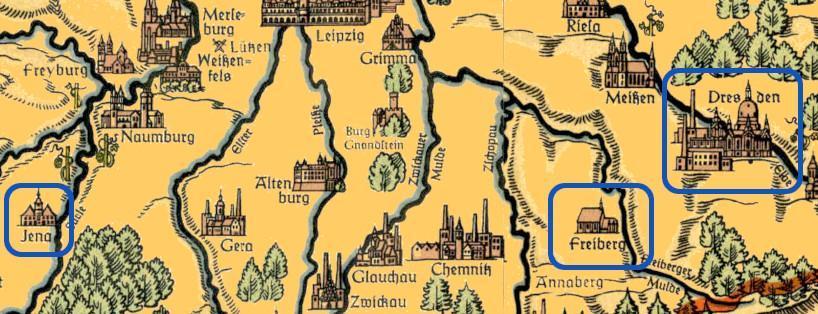
[4] In December 1798, Hardenberg became engaged to Julie von Charpentier, daughter of a mining official and professor at the mining academy in Freiberg, ca. 30 km from Dresden ([1] Post Karte Durch ganz Deutschland, ed. J. Walch [Augsburg 1795]; [2] Rudolf Koch and Fritz Kredel, Deutschland und angrenzende Gebiete [Leipzig 1937]):

[5] Anonymous pastel reproduced in Briefe von und an Friedrich und Dorothea Schlegel, ed. Josef Körner (Berlin 1926), plate following p. 26:
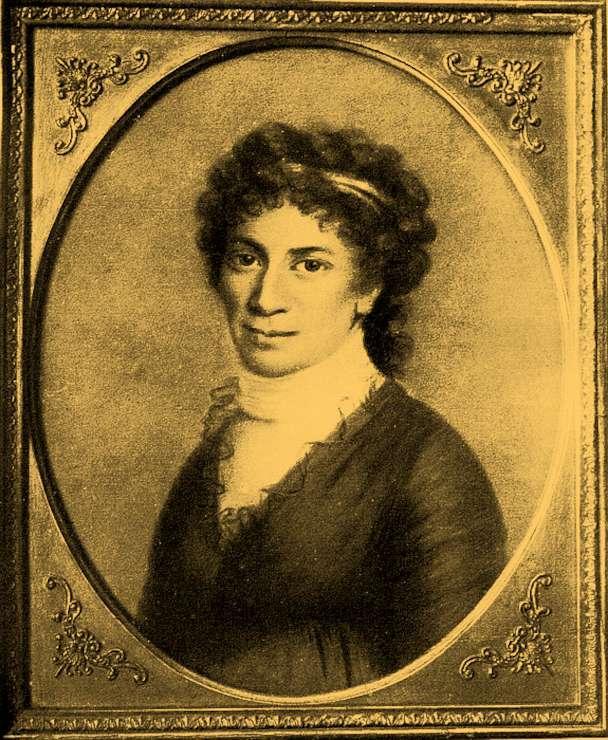
Concerning Dorothea’s external appearance, see Caroline to Auguste on 6 October 1799 (letter 247) and Henriette Herz. Ihr Leben und ihre Erinnerungen, ed. J. Fürst, 2nd ed. (Berlin 1858), 116 (excerpt in supplementary appendix 210.1). Back.
[6] See Friedrich’s essay “Ueber die Philosophie. An Dorothea,” Athenaeum (1799) 1–38 (trans. here Lisa Roetzel, in Theory as Practice: A Critical Anthology of Early German Romantic Writings, ed. and trans. Jochen Schulte-Sasse et al [Minneapolis 1997], 419, 420, 431):
You did not listen without religion to what I told you about Spinoza. . . . I remember quite vividly my bold assertion that philosophy is indispensable to women because there is no other virtue for them than religion, to which they can gain access only through philosophy. . . . For the rest, however, I stand firmly by my statement: religion is the true source of virtue and happiness for women, and philosophy the most exquisite source of eternal youth for them, as is poesy for men. Back.
[7] See Lucinde, “A Dithyrambic Fantasy on the Loveliest Situation in the World” (Friedrich Schlegel’s Lucinde and the Fragments, trans. Peter Firchow [Minneapolis 1971], 48):
I know that you wouldn’t want to outlive me either. You too would follow your rash husband into the grave, and willingly and lovingly descend into the flaming abyss into which an insane law forces Indian women and, by its rude intention and command, desecrates and destroys freedom’s most delicate shrines.
(Daniel Nikolaus Chodowiecki, “Freiwillige Verbrennung einer indianischen Witwe,” part of the series Ostindische Gebräuche [1786]; Historisch-Genealogischer Calender oder Jahrbuch der merkwürdigsten neuen Welt-Begebenheiten für 1786; also Herzog Anton Ulrich-Museum; Museums./Signatur DChodowiecki AB 3.677):
[8] Novalis Schriften, 4:969, suggests this passage may mean that Friedrich spoke to Dorothea about Hardenberg’s longing for death in connection with the latter’s reflections on his late bride, Sophie von Kühn, whose death had plunged Hardenberg himself into a crisis; Hardenberg mentions “early death” being “his grand slogan” now (on 10 December 1798; ibid., 4:268). Back.
[9] See Friedrich’s letter to Caroline on 27 November 1798 (letter 210), note 15. Back.
[10] See in general Friedrich’s letter to Caroline of 15 December 1798 (letter 212), and Lucinde (Friedrich Schlegel’s Lucinde and the Fragments, 108): “Up to now whatever I’ve used, I’ve used thoughtlessly and without any feeling of ownership. I lived on this earth, but I was not at home on it. Now the sanctity of marriage has given me citizenship in the state of nature.” Back.
[11] Hardenberg visited Friedrich’s sister Charlotte in Dresden in early January 1799, writing him then on 20 January from Freiberg about the visit (KFSA 24:219): “You and your new circumstances were the main topic of our conversation. We have one remaining wish, namely, that these circumstances also receive civil sanction if at all possible.” Back..
Translation © 2013 Doug Stott