
• 187. Caroline to Wilhelm Schlegel: Jena, 1797? [*]
[Beginning, two pages, missing.]
|428| . . . write a story will similarly be quiet beneficial for him.
Yesterday Madam Hufeland sang almost the entire role of Juliet from Gotter’s opera; my feeling is that the music is quite noble. [1] Nothing of the spirit of the original has been transferred to the opera itself. The lovers in it always seem to me like Julie and St. Preux [2] — whose love — though Madame de Staël might put it differently — is based a bit on principle. Sh[akespeare’s] Juliet is so young, so sincerely ardent. There we have moral, here romantic passion. Romeo resembles St. Preux in that he is unable to conceal and unable to master his pain. [3]
But who would require this of the youth? What becomes the man the monk well knows, but also that he is talking to the air, and shall only edify the nurse. Some minutes, however, thus passed away during which the despairing one could collect himself and then listen to the effective consolation that a Juliet is promised to him, which philosophy could not do. Romeo’s gentle steadfastness shews itself on other occasions. His bravery seeks no quarrel, and even without love he seems to be beyond hate — this enables him to get over his insult. |429| Only the death of his noble friend draws forth his sword.
In the initial outbreak of the pair’s despair, we undeniably find — regardless of how gently we tell ourselves, my dear friend — several elements of Sh[akespear]ean harshness and unattractiveness — but in contrast it is also heavenly the way the joys of love have broken the wild grief in the farewell scene — with what melancholy, hope, and presentiment of disaster it simultaneously also speaks out of them.
You cannot neglect to note that in this scene poetic beauty is most excellently fused with the simplest expression of a torn disposition. The first dialogue in the garden exhibits an element of romantic energy and momentum, yet also contains expressions of the most intimate tenderness of the sort that emerges spontaneously from the heart and from an imagination filled with love. [4] Romeo is no more cast down — hope — blooming, youthful hope — has taken possession of him — he awaits tidings almost joyfully. He himself afterward calls this the last lightning before death.
Such elements are wholly part of Shakesp[eare]. I know of no one who might resemble him in that regard — it is with such elements that he turns the souls of human beings around. — What Romeo now hears transforms his heart also like lightning — but two words — and he is resolved to die, resolved to descend into the earth, over which he but now hovered so lightly.
I think the next scene is quite good, moreover, not, for example, interruptive of the whole. Here one can sense a trace of the tone of Hamlet — he could have ended thus had it been necessary for him to buy poison.
Let Romeo’s final scene speak for itself — [5] merely note how different is the funeral celebration for the faithful bridegroom from that of the beloved lover, how calmly he strews his flowers. |430| And then also that Romeo’s nobility of mind breaks through here as well, like a ray of light from gloomy clouds as he speaks the final benediction over him who was his brother in misfortune.
That is why I also cannot ask whether it really was necessary that this good soul was sacrificed and whether Romeo kills yet another person. Paris is an absolutely necessary character in the play — and one of those who does well in both living and dying. [5a] —
Sha[kespeare] admittedly knew nothing of the kind of economy exhibited by several (excellent) more recent pieces — Lessing’s plays are structured in this way — where everything that appears superfluous is spared, and often even certain characters are merely mentioned rather than actually portrayed, where every element is so precisely weighed that not a single word might be eliminated without disrupting the whole. He [Shakespeare] was as generous as nature herself, whom one might also occasionally accuse of coming up with superfluous roles and unnecessary events. — It counts for much that he does not allow Rosalind to appear, since he is not at all really concerned with one character more or less. —
Perhaps Rosalind might even be eliminated entirely without doing damage to the piece. And yet the deeper one penetrates into the flow of a Shak[espearean] piece, the more harmony and necessity does one tend to discover, such that ultimately nothing can be eliminated (Cymbeline will probably not grant us this pleasure; there is little connection within it, and only the execution of individual elements generates a beautiful fusion).
One often hears that the story, the tale, is not his own. The spirit, however, always is. The raw plan, on the one hand, and the spirit, on the other, as I always prefer to call the more refined plan, are quite different. Just as Hamlet is now, it is Sh[akespeare’s] most characteristic and personal creation (as we have long known). I imagine it is probably more advantageous for a genius not always to invent and execute at the same time. [6]
May not even the strangeness of the raw material |431| furnish occasion for beauties through a process in which it is only the mode of the treatment itself that first imposes true unity on the less cohesive material the writer finds before him? And this unity, where it is found together with apparent contradictions, is the very source of that wonderful spirit, from which we are ever eliciting new secrets, and which we never grow weary in attempting to fathom. (If only you two are of one understanding, I comprehend it quite well.)
I do not recall the legend of Hamlet, but presumably the end was as in the play, namely, that chance has more to do with vengeance than does Hamlet. And to whom do we then owe Hamlet himself? — In Romeo, Sh[akespeare] found considerably more material already at hand, and followed it faithfully; and yet how he made it his own! The characters themselves assist the story and introduce the most vivid element of probability into it. —
Although the father’s vehemence and the base elements in behavior of both sets of parents is quite offensive, it does save Juliet from having to struggle between passion and childlike love, and also saves her from reproach. The former would have been completely out of place here (as, to be sure, it was in the moral love affair in Nouvelle Heloise). The latter is simply left to Johnson’s severity (think of the note). [7]
And I must say, none of the father’s words of reproach are as repugnant to me as the mother’s remark: “I would the fool were married to her grave.” I would so like to just translate such statements right out of the piece. If it is merely an uncouth, thoughtless expression — why should one not be permitted to do so? Rarely will such an occasion for unfaithfulness be found. I would not suppress any imprecation in the mouth of Margaret (King Richard III), and Lady Macbeth, too, may certainly say: “How tender ‘tis to love the babe that milks me etc.,” instead of — “I have no children etc.” But such dissonances, where everything else is so harmonious, are painful.
You alone can keep Mercutio and the nurse, who similarly can be left to her own gossiping tongue.
And you two together can decide whether Romeo and Juliet is a tragedy.
Tuesday, the 19th
Today I must hear something from you. My good friend, that particular hope enables me to bear the day’s burdens so easily.
Yesterday I was again together with 40 or 50 people without enjoying it. But now the . . . has . . .
[Conclusion is missing.]
Notes
[*] See the editorial note to letter 186 for an introduction to this letter. Dating considerations the same as in note 1 to that letter. — A translation of short excerpts from this letter by Lisa C. Roetzel appeared in Theory as Practice: A Critical Anthology of Early German Romantic Writings, ed. Jochen Schulte-Sasse et al. (Minneapolis 1997), 443–44. — See also Hermann Conrad on Caroline and the translation of Shakespeare. Back.
[1] The reference is to an amateur theater performance in Jena, not to the theater in nearby Weimar. Konradine Luise Hufeland was the Schlegels’ neighbor rather than a professional actress and singer.
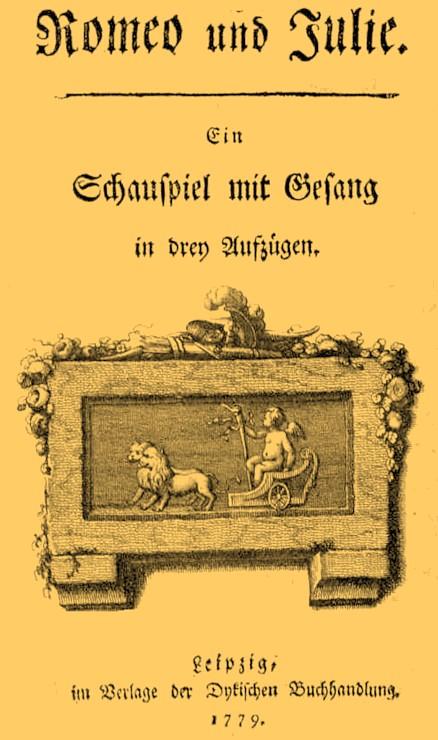
The theater piece was Friedrich Wilhelm Gotter and Georg Benda, Romeo und Julie. Ein Schauspiel mit Gesang in drey Aufzügen, written 1776 (Leipzig 1778, 1779), adapted from Christian Felix Weisse’s play with its so-called happy ending, Romeo und Julie. Ein buergerliches Trauerspiel (Berlin 1768). Here the title page to Gotter’s edition:
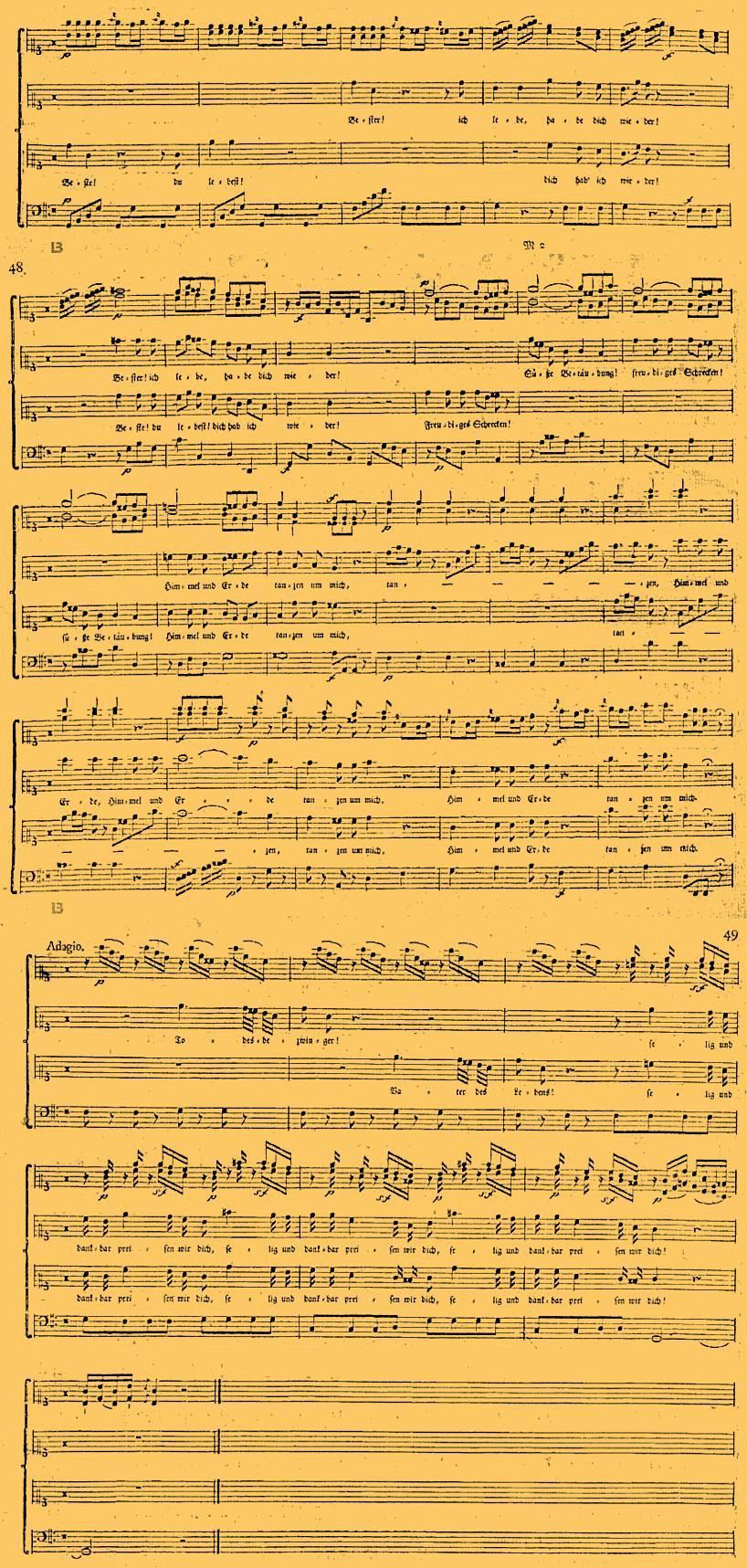
Here the final duet of Romeo and Juliet in the “happy ending,” music by Georg Benda, that Madam Hufeland would have sung (Georg Benda, Klavierauszug von Romeo und Julie einer Oper in drey Akten. In Musik gesetzt, 2nd ed. [Leipzig 1784]):
[2] Caroline is referring to Julie d’Étanges and Saint-Preux in Rousseau’s novel La nouvelle Héloïse (Paris 1761) (summary here adapted from Oxford Companion to French Literature [London 1959] 517; illustrations from La nouvelle Héloise, 3rd, ed., vol. 2 [Amersterdam 1772], part 3, plates 6, 8:):
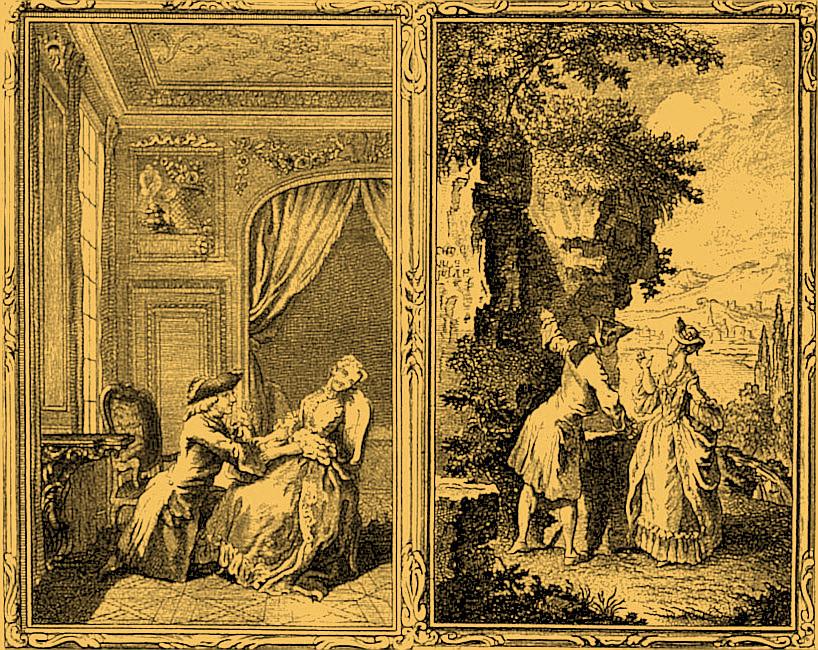
Julie and Saint-Preux, a tutor in her father’s house, fall in love but are prevented from entertaining any thoughts of a future together because of her father. Although they consummate their love, they are soon remorseful and are separated, he going to sea for a year, she marrying an older but benevolent man. When Saint-Preux returns, her husband invites them to his estate. Although he already knows (including through Julie’s own confession) about their previous love, he countenances having the two remain despite their mutual attraction by counting on their loyalty to himself. The arrangement works out, though Julie and Saint-Preux must struggle against a renewal of their love. Back.
[3] The passage beginning with “But who would require” corresponds to the passage beginning with the same words (save “But”) on page 25 in “A. W. Schlegel on Shakspeare’s Romeo and Juliet” (similarly [1913], 1:428, par. Sämmtliche Werke 1:81). Back.
[4] The passage beginning with “Romeo is no more cast down” corresponds to the passage beginning with “Henceforward Romeo, though in banishment” on page 27 in “A. W. Schlegel on Shakspeare’s Romeo and Juliet” (similarly [1913], 1:429, par. Sämmtliche Werke 1:82). Back.
[5] The passage beginning with “merely note how different is the funeral celebration ” corresponds to the passage beginning with “And yet how different is his funeral celebration” on page 26 in “A. W. Schlegel on Shakspeare’s Romeo and Juliet” (similarly [1913], 1:429 bottom, par. Sämmtliche Werke 1:83). Back.
[5a] In act 5, scene 3, Romeo slays Count Paris. Illustration from The Dramatic Works of William Shakspeare, ed. Samuel Weller Singer, and (in the same volume) “The Life of the Poet” by Charles Symmons, vol. 10 (Chiswick 1826). Singer cites Julius Charles Hare’s translation of Wilhelm and Caroline’s essay on Romeo and Juliet several times — and a scant six years after its publication — in his notes to the play:

[6] The passage beginning with “May not even the strangeness of the raw material” corresponds to the passage beginning with the same words on page 19 in “A. W. Schlegel on Shakspeare’s Romeo and Juliet” (similarly [1913], 1:430–31 [“Sollte nicht eben die Fremdheit”], par. Sämmtliche Werke 1:76). Back.
[7] Samuel Johnson’s edition of Shakespeare, The plays of William Shakespeare in eight volumes, with the corrections and illustrations of various commentators; to which are added notes by Sam Johnson (London 1765–66); Romeo and Juliet is found in vol. 10 (1766). Back.
Translation © 2012 Doug Stott