
• 178. Wilhelm and Caroline Schlegel to Georg Joachim Göschen in Leipzig: Jena, 3 February 1797 [*]
Jena, 3 February 1797
[Wilhelm:] Although I have too long remained indebted to you, you would forgive my neglect in letter writing if you but knew how things invariably transition seamlessly from one piece of work to the other for me. My lot is to write for everyone in the world — the public — except my friends. . . .
People have told us all sorts of comical things about Ramdohr’s wedding. Will Urania be appearing at Easter? [1] And Klopstock’s odes? [2]
Wieland let loose against Goethe and Schiller in the 2nd issue of his Merkur. [3] And even in the larger sense, the Xenien have rendered our literature so bellicose that it has become rather difficult for a pacifically inclined person such as myself to find his way through all this boisterous tumult.
I have taken great pains not to burn your letter, as you demanded out of fear it might be published someday again. The letter is valuable to me because of its description of your domestic Christmas joy. [4] We unfortunately did not perceive anything of the toasts and salutes. The letter did not arrive until both were long over. Even lacking such toasts, however, we do often think of you and your dear spouse. — My wife is just now trying to pull the quill away from me to add a few lines of her own. I embrace you and send a thousand warm regards to your family.
|414| [Caroline:] As a matter of fact I would indeed greatly like to hear how your “dear spouse” is doing and whether it still looks as if she will be giving birth in the spring. [5] The wife of the Prince Elector of Saxony, one hears, has had a change of mind, though she admittedly is by far not as inclined to have children as is your dear spouse. [6] I am speaking out of envy — can you not tell?
Please write and tell us exactly when and where the event will take place, my good friend. I greatly fear that things will converge such that I will not be able to see you after all en famille — the country estate, the confinement, the book fair, the date of our trip, and the circumstances of our hosts in Dresden. [7] So, when is the birth, when the book fair, and at which time can you yet or again see us? We are thinking about going to Dresden just before Easter, [8] and it would probably be nicest if we could visit you on our return trip 3–4 weeks later if that be possible and if we may do so. Best and warmest regards to everyone.
|415| If you know anything else about Ramdohr, please do not keep it from us, for everything concerning him really is simply too comical. One can still laugh about it, whereas this whole Xenien business does not perform this service for me at all. [9] Please stay well and remain favorably disposed toward us.
Notes
[*] Source: Wilhelm’s portion of the letter in Körner (1930), 1:52–53.
Chronological note: A few days after this letter was written, Caroline’s review of Michel Paul Guy de Chabanon appeared in the Allgemeine Literatur-Zeitung on 7 February 1797. Back.
[1] Wilhelm had already written to Göschen on 22 December 1796 (Körner [1930], 1:45–46):
Have you heard the latest, namely, that your Herr von Ramdohr is getting married, to wit: to a widow from the older nobility who is in fact already a grandmother, the daughter of a certain Oberkammerherr von dem Busche? Her parents are so incensed by this mesalliance that they send back unopened all his written communications to their daughter, and though they answered Ramdohr politely enough, they also forbade any further correspondence. Is it simply celestial love that prompts him to such sacrifices? And will he be concluding his book with these demonstrations of heroism?
“Celestial love” alludes to Ramdohr’s book Venus Urania. Über die Natur der Liebe. Über ihre Veredlung und Verschönerung, 3 vols. (Leipzig 1798). The piece would be mocked yet again in Athenaeum (1799) 333; see Ramdohr’s biogram for text and particulars. Here the frontispieces to all three volumes:
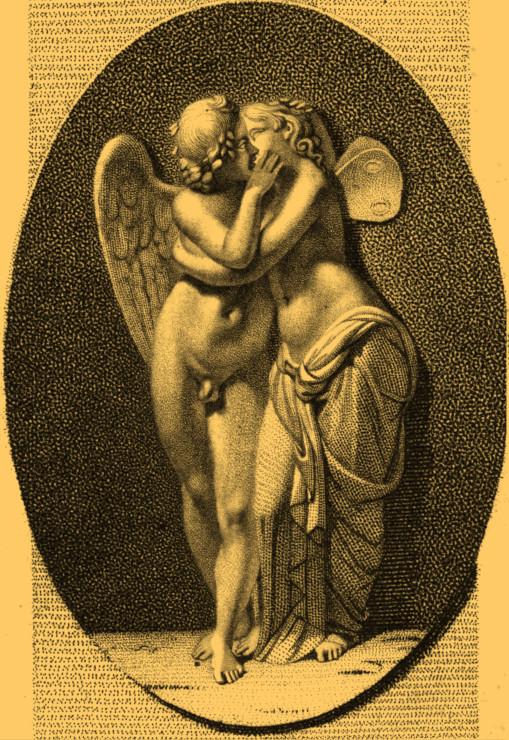
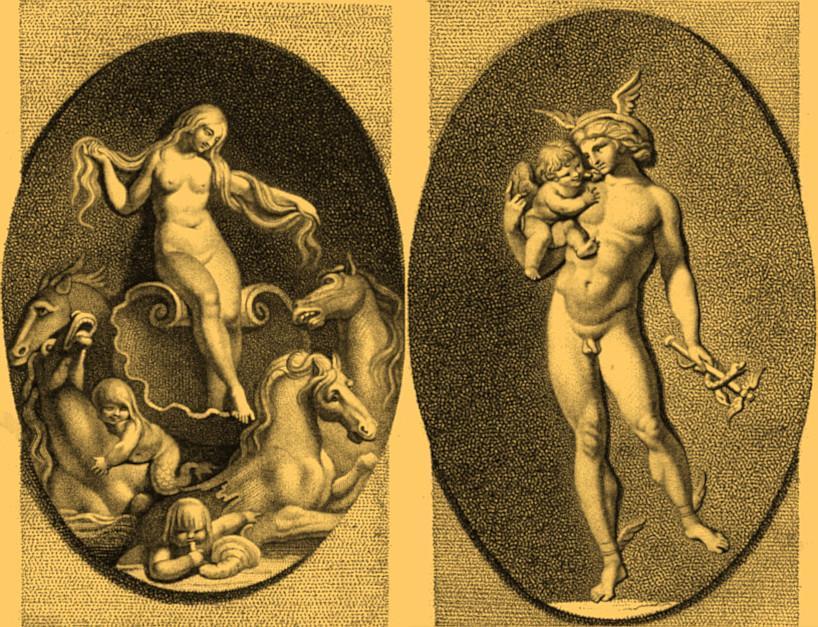
[2] In 1798 Göschen would begin two editions of Klopstock’s works: one (in quarto) in seven volumes containing only the poetry, and a complete edition (in octavo) in twelve volumes. The Oden were published in the first two volumes (Oden [Leipzig 1798]), though the remainder of the overall edition was affected by the Second Wars of Coalition (1799–1802) and the resulting economic problems in Europe. In any event, Caroline and Wilhelm will later be receiving volumes of this edition from Göschen. Back.
[3] See Caroline’s letter to Karl August Böttiger on 5 January 1797 (letter 176). Back.
[4] The letter has apparently not been preserved (Körner [1930], 2:22). Back.
[5] It is unclear to which child Caroline is referring. Viscount George Goschen, The Life and Times of Georg Joachim Goschen, Publisher and Printer of Leipzig 1752–1828, 2 vols. (New York, London 1903), 2:436, writes: “The fifth son, August Robert, born in 1794 [oddly, the German edition, Das Leben Georg Joachim Göschens von seinem Enkel Vicount Goschen, trans. T. A. Fischer, 2 vols. [Leipzig 1905], 1:323, gives the year of birth as 1795], died in infancy, as did two children who followed him.” Caroline may be referring to one of those two children. Back.
[6] Although Maria Amalie Auguste von Zweibrücken-Birkenfeld-Bischweiler, as the wife of the Prince Elector Friedrich August III of Saxony, gave birth to four children, three (1771, 1775, 1797 [the one to which Caroline is here referring]) were stillborn. Only her daughter Maria Augusta (1782–1863) grew to adulthood, albeit without ever marrying. Caroline, interestingly, seems not to know about the stillbirths but apparently is aware the princess was expecting a child in 1797. Back.
[7] Regarding Göschen’s country estate: In September 1796, Göschen had bought a house on the market square in Grimma, ca. 30 km southeast of Leipzig, and would move his Leipzig printing company there in July 1797, i.e., several months after this present letter, while leaving his sales center in Leipzig (concerning these and the following purchases, see Viscount George Goschen. The Life and Times of Georg Joachim Goschen, Publisher and Printer of Leipzig 1752–1828, 2 vols. [New York, London 1903], 1:460–65; also Christian Gottlob Lorenz, Zur Erinnerung an Georg Joachim Göschen, Jahresbericht über d. Königl. Sächs. Landesschule zu Grimma [Grimma 1861], 7–8; map: Karte des deutschen Reichs, ed. C. Vogel [Gotha 1907], no. 19):
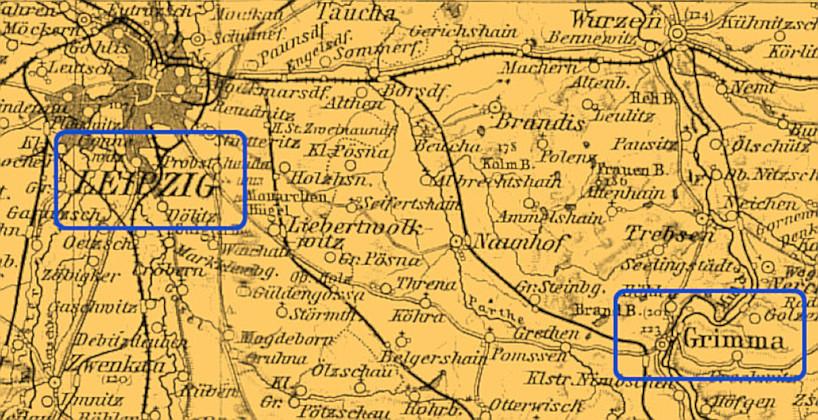
He chose Grimma because on 12 December 1795 he had purchased a summer estate for his family in Hohenstädt (Hohnstädt), “a group of houses on a hill, distant about half an hour’s walk from Grimma, a quaint little country town, overlooking the valley of the Mulde, a tributary of the Elbe, a stream of varying depth, running through prettily wooded hills in a winding course” (The Life and Times of Georg Joachim Goschen, 460–61). The previous owner moved out at Easter 1796, and Göschen and his family spent their first summer there in 1797. Beginning in 1812, he and his family lived there year round.
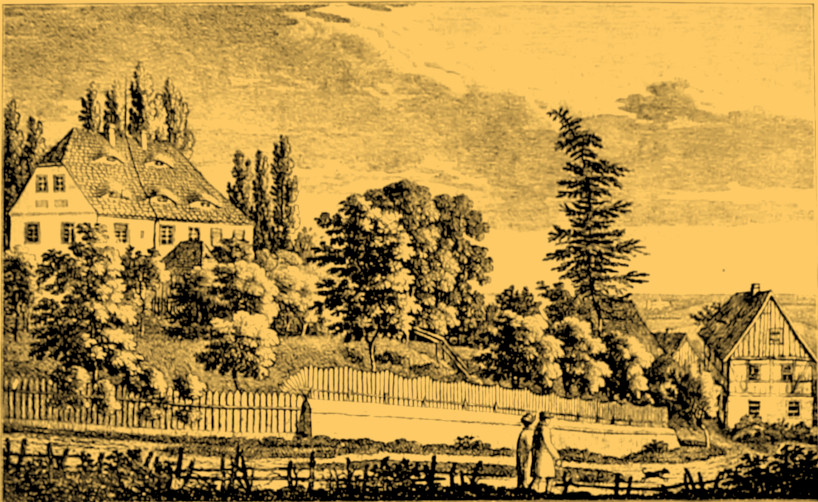
In any event, Caroline was quite right in assuming that the coming spring and summer would doubtless be quite busy for the Göschen family with the plans for the first summer at the country estate, the Leipzig trade fair (which would commence on 7 May 1797), and Madam Göschen’s confinement. Here the illustration of his estate house from The Life and Times of Georg Joachim Goschen, illustration facing 1:462; the house is still extant:
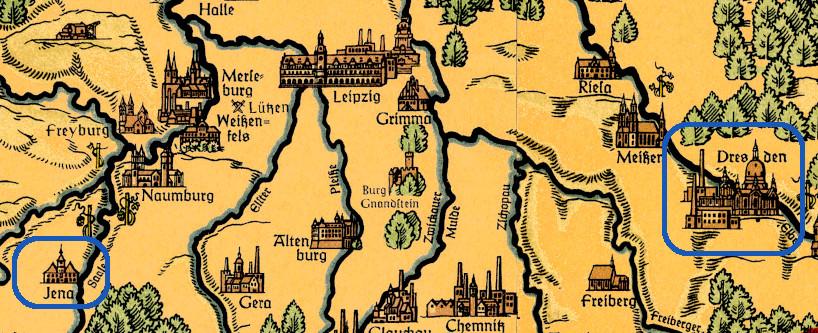
[8] Caroline, Wilhelm, and Auguste would be in Dresden from 10 April till 20 May 1797 (Easter fell on 16 April in 1797) (Post Karte Durch ganz Deutschland, ed. J. Walch [Augsburg 1795]; Rudolf Koch and Fritz Kredel, Deutschland und angrenzende Gebiete [Leipzig 1937]; street scene in Dresden ca. 1750 by Bernardo Belotto):


[9] Concerning the Xenien controversy, see Caroline’s letters to Luise Gotter on 4 September, 3 October, 15–16 October, and 22 October 1796 (letters 169, 170, 171, 172). Back.
Translation © 2012 Doug Stott