
• 157. Friedrich Schlegel to Caroline in Braunschweig: Dresden, 2 October 1795 [*]
Dresden, 2 October [1795]
|372| Although my manuscript has not yet been sent off, [1] I must nonetheless break my vow because your letter makes it impossible for me to keep it. And I can do so with a good conscience, since I am quite far at the moment, and today the manuscript is with Körner in any event, [2] who is again behaving rather awkwardly because I did not sufficiently praise Schiller. —
I was already fretting and worrying about your silence. I feared I was too coarse for you and that you had decided one Schlegel was quite enough. Yesterday morning I also became angry at the negligence of you both, since quite by chance I received a printed copy of my “Gränzen.” [3] I imagined it would be quite irksome for me and that I would have to expose myself if you two had it printed yet again. Then your letter arrived and doubly surprised me. —
I am quite charmed by your goodness, but do also tell me now just why you |373| are so inclined to have so much goodwill toward me. I myself truthfully know not. Perhaps an explanation would emerge on its own were I with you two. The Grand Schoolmaster of the Universe could then take me in as his apprentice and teach me the art of writing properly and loving perfectly. I am referring to his sweet contacts [4] —
But before I start nattering on, let me turn first to some boring but useful matters.
Let me thank both of you for being willing to find me a publisher. I cannot yet possibly have seen a brochure that only just left the press in Paris.
The Journal de Paris nro 341, contains an extensive review of the Essai sur la vie de Barthelemy par Mancini. 69 p. 8° chez Debûre l’ainée rûe Serpente nro. 6. [5]
I have already written about what I want to accomplish. I am requesting
1. The French copy gratis. Shipment must be prompted as soon as possible.
2. 1 louis d'or honorarium per sheet.
3. 8 complementary copies.
You can modify the last two points as you see fit.
If he agrees, then either reserve the option of not giving a final, decisive answer from me until you have written me, or, if the offer seems that good to you, accept it immediately and immediately write and tell Göschen that you have done so, since he has inquired with someone else on my behalf. Since it is not he himself, I am for the latter if the man is good and is ready. The brochure does not necessarily need to appear right away, that is, at the next book fair. If I have the French copy in mid-November, the completed manuscript can be in the hands of the publisher by the end of December.
|374| I am dwelling in the bosom of Abraham, that is, with my sister. I have every reason to be grateful to her, and if no unanticipated misfortune occurs, I can work this winter more peacefully and cheerfully than ever.
My hand is almost lame from working on manuscripts yesterday, and I still must work just as much today. In all seriousness, my hand genuinely hurts after I have spent the entire day writing. That will probably continue for a while yet. The first increment will be sent the day after tomorrow, then the continuation each week. In three weeks it will reliably comprise far more than an alphabet. So please pardon me in advance if for now I do not answer your interesting letters more than I am currently able.
I can say absolutely nothing yet about my financial situation. Everything depends on Michaelis.
Something else regarding the bookseller. If he is satisfied with it, he will immediately put an announcement in the [Allgemeine] Literatur-Zeitung under my name.
The prospect of seeing the charming schoolmaster is delightful. [6] Charlotte, too, is quite looking forward to it. He need not be concerned about his arrangements here. If he was hoping to live with me, he will have even more reason to do so with the Ernsts, where he need only be careful not to demand too much space, though he will certainly have enough for his needs as far as Charlotte and I have been able to determine. He will also have his own table for his sweet contacts, by which I mean for letter writing. We would like to know the details soon, indeed quite soon. He will not be going by way of Leipzig, will he? That would be quite to my dislike. [7]
Please also send me some news concerning your American project. [8] Are you envisioning owning real estate, or holding public office, or using private connections? — |375| I hope it was only a fleeting fantasy that, to escape the two mothers, [9] you were intending to cast yourselves into the maw of the revolutionary giant. [10] The possibilities for returning are at the very least quite limited for those who have ventured beyond the Rhine. Moreover, the giant might also easily enough get cramps again, or, to use Huber’s expression: flow together, and you two could well get caught in the squeeze. Please write and tell me briefly what you think of the deux tiers, whether ministerially or oppositionally. [11]
Please also write and tell me how your mother is behaving. Both of you need to give her a hard time should she deserve such.
What now follows is for your god, independent Diotima. [12] I do not have time to offer him anything better. It is more a warning against false conceptualization and suspicions. I have neither the time nor the books for extensive research. In any event, that which is here now I already found while traveling down my own path.
A few words about Greek improvisers . . . [13]
Stay well, O Independent One, and please embrace the Divine Schoolmaster for me.
Fr. Schl.
Please excuse the typographical errors; I cannot read the letter over again.
Notes
[*] Also published in KFSA 23:252–54. Back.
[1] Part of Friedrich’s Griechen und Römer, which did not appear until 1797 (Neustrelitz 1797); the publisher, Salomo Michaelis, was awaiting the manuscript for the first volume (the only volume to appear). Back.
[2] Christian Gottfried Körner was reviewing and critiquing the main part of the manuscript of the essay “Ueber das Studium der Griechischen Poesie,” which appeared in the aforementioned Griechen und Römer, 1–250, along with the essays “Über die Darstellung der Weiblichkeit in den griechischen Dichtern,” 327–58, which initially appeared as “Ueber die weiblichen Charaktere in den griechischen Dichtern,” in the Leipziger Monatsschrift für Damen 4 (1794) October, no. 1, 3–25; November, no. 2, 103–21, and “Über die Diotima,” 251–326, which initially appeared in the Berliner Monatsschrift 26 (1795) July, no. 3, 30–64; August, no. 4, 154–86 (all three reprinted in Jugendschriften 1:28–45, 46–74, 75–180). Back.
[3] “Über die Grenzen des Schönen” (“On the limits of the beautiful”), in Der Neue Teutsche Merkur (1795) 5 (May) no. 5, 79–92 (Jugendschriften 1:21-27); the article had, however, appeared without Friedrich’s knowledge, whence his surprise. Christian Gottfried Körner had written Schiller quite glowingly about Friedrich from Dresden on 21 June 1795 (Schillers Briefwechsel mit Körner. Von 1784 bis zum Tode Schillers, ed. Karl Goedeke, 2nd ed., 2 vols. [Leipzig 1878], 2:159; here Correspondence of Schiller with Körner, trans. Leonard Simpson, 3 vols. [London 1849], 3:4):
The letter to Schlegel has been forwarded. His brother is much flattered by your attention to him. I may confidently say that his writings will be of good service to you. He has plenty of materials on hand, and his style improves daily. He cheerfully attends to any hints; and where I think any alteration advisable, I shall tell him so frankly, as he requested me to do so. Young men of this cast will always be valuable contributors. Authors who have already attained a certain reputation have mostly fixed occupations of their own, and cannot be counted upon for regular contributions.
Schiller, however, came down hard on 4 July 1795 (Schillers Briefwechsel mit Körner. Von 1784 bis zum Tode Schillers, 159–60; trans. Correspondence of Schiller with Körner, 5 [translation altered]):
I read some time back an article in Der Teutsche Merkur by your Schlegel, on the “Limits of the Beautiful” [“Ueber die Grenzen des Schönen”]. What a confusion of ideas and harshness of expression! You must not allow such a thing to pass unnoticed if you have promised to tell him the truth. He is well-informed, and thinks over his subject. But he does not arrive at clearness, and his diction consequently does not flow freely. I almost fear he is not fit to be an author.
As a result, Schiller’s periodical Die Horen remained unfairly closed off to Friedrich. Back.
[4] See Friedrich’s letter to Wilhelm on 16 June 1795 (letter 150c) with the final paragraph. Back.
[5] Louis-Jules-Barbon Mancini Nivernois, Essai sur la vie de J. J. Barthélemy (Paris 1795); during his own study of classical antiquity, Friedrich had become intimately familiar with Jean-Jacques Barthélemy’s book, Voyage du jeune Anacharsis en Grèce, vers le milieu du quatrième siècle avant l’ère vulgaire, 4 vols. (Paris 1788), which “relates the imaginary visit of a young Scythian to Greece in the time of Philip of Macedon (4th century B.C.), and is a popular reconstruction of the Greek civilization of that period, somewhat superficial in character” (The Oxford Companion to French Literature, ed. Sir Paul Harvey and J. F. Heseltine [Oxford 1969], 50).
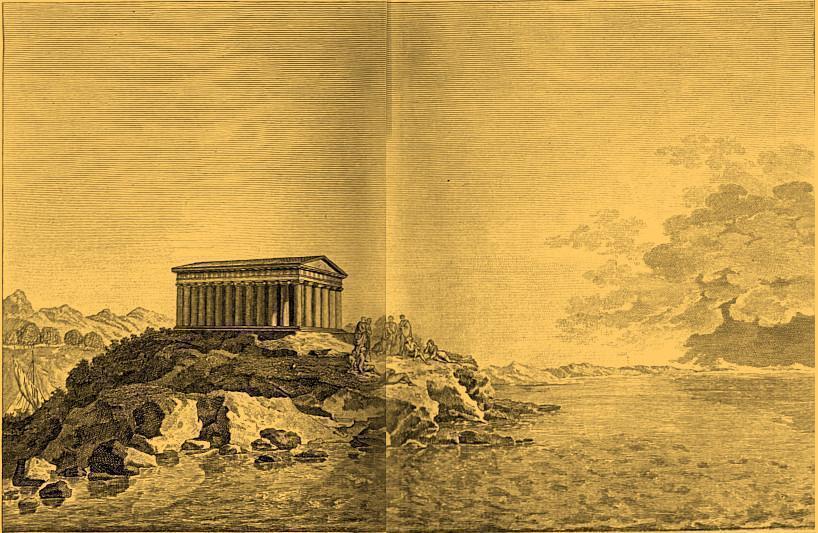
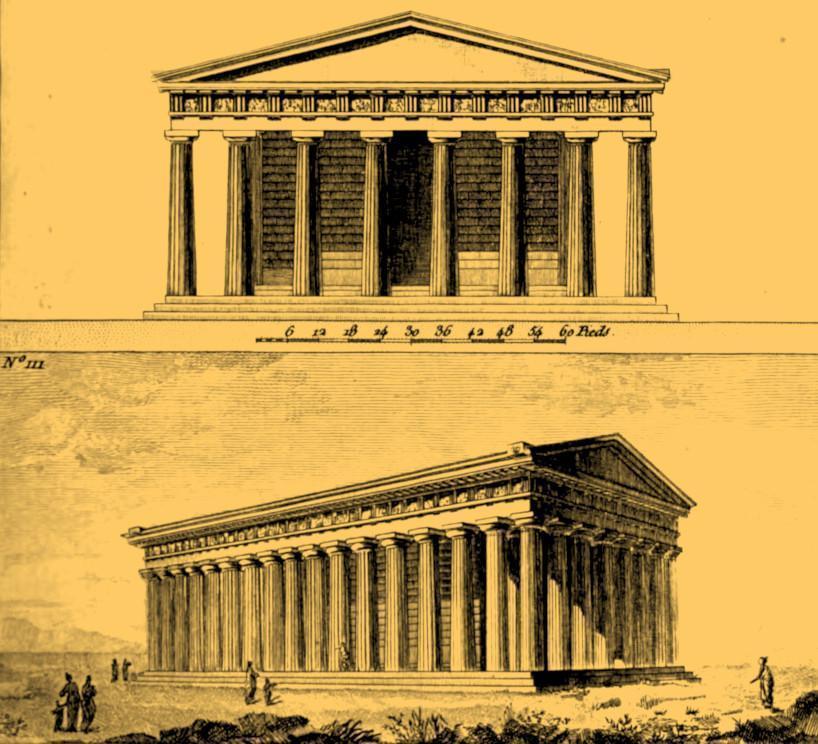
The following two-page illustration, for example, from the accompanying volume of maps and illustrations (Recueil de cartes géographiques Plans, vues et médailles de l’ancienne grèce, relatifs au voyage du jeune anacharsis précédé d’une analyse critiques des cartes, 3rd ed. [Paris 1790], plate 24) depicts Plato with his disciples walking about in the vicinity of the temple on Cape Sunion, the latter considerably out of proportion to its topographical reality. Second illustration (plate 9): “Plan et élévation des propylées”; third illustration (plate 22): “Elévation de la Façade du Parthénon”; fourth illustration (plate 20): “Vue du Parthénon”:

[6] Wilhelm Schlegel was apparently already planning a trip to Dresden; see Caroline’s remark in her letter to Luise Gotter in the autumn of 1795 (letter 156) that she would indeed be dispatching him to Saxony the following spring. Back.
[7] Friedrich still had considerable debts in Leipzig. Back.
[8] The subject of Wilhelm and Caroline emigrating to America had been an unresolved issue in Friedrich’s letters; see Friedrich to Wilhelm on 20 May and 16 June 1795 (letters 150a, 150c), and Karl Schlegel to Wilhelm on 23 August 1795 (letter 154a). Back.
[9] Wilhelm and Friedrich’s own mother in Hannover, and Caroline’s mother in Braunschweig, the former of whom was uneasy with Wilhelm’s relationship with Caroline (though she would later think differently), the latter for creating otherwise unspecified trouble (see Friedrich’s reference to her as a “despotic old fool” in his letter to Wilhelm on 16 June 1795 [letter 150c]). Back.
[10] Apparently a plan to move to France. Back.
[11] See The New Illustrated Encyclopedia of World History, ed. William L. Langer, 2 vols. (New York 1975), 1:614: On 22 August 1795 in France, the third constitution of the revolution was enacted,
the executive power vested in a directory of five; legislature of two chambers (Council of Elders, or Ancients, 250; Council of Five Hundred); for the first term, two-thirds [deux tiers] of the members of both houses were to be taken from the rolls of the convention. This self-protective proviso led to opposition in Paris and the provinces. The Paris royalists instigated an outbreak of the sections [the “Day of the Sections,” 5 October 1795]. On the motion of [Paul-Jean-François-Nicolas, Vicomte de] Barras [1755–1829], the convention placed Gen. Bonaparte in charge of its troops.
The convention itself was dissolved on 26 October 1795 after voting “that relatives of émigrés should not be permitted to hold office” (ibid.). Back.
[12] Allusion to the ideal woman Friedrich describes in his essay “Über die Diotima,” Griechen und Römer, 251–326, which initially appeared in the Berliner Monatsschrift 26 (1795) July, no. 3, 30–64; August, no. 4, 154–86. See also in this regard The German Classics of the Nineteenth and Twentieth Centuries: Masterpieces of German Literature Translated into English, vol. 4, ed. Kuno Francke (New York 1913), 121:
The earliest writings of Friedrich Schlegel — he was born in 1772 — relate to Greek literature, a field which he cultivated with enthusiasm and with ample learning. In particular he was interested in what his Greek poets and philosophers had to say of the position of women in society; of the hetairai as the equal and inspiring companions of men; of a more or less refined sexual love, untrammeled by law and convention, as the basis of a free, harmonious and beautiful existence.
Among other things, he seems to have been much impressed by Plato’s notion that the genus homo was one before it broke up into male and female, and that sexual attraction is a desire to restore the lost unity. In a very learned essay On Diotima, published in 1797 — Diotima is the woman of whose relation to Socrates we get a glimpse in Plato’s Symposium — there is much that foreshadows Lucinda. Let two or three sentences suffice. “What is uglier than the overloaded femininity, what is more loathesome than the exaggerated masculinity, that rules in our customs, our opinions, and even in our better art?” “Precisely the tyrannical vehemence of the man, the flabby self-surrender of the woman, is in itself an ugly exaggeration.” “Only the womanhood that is independent, only the manhood that is gentle, is good and beautiful.” Back.
[13] Here Friedrich’s letter turns to Wilhelm (continued in Walzel, 237-41; KFSA 23:254–57). Back.
Translation © 2011 Doug Stott