
• 156. Caroline to Luise Gotter in Gotha: Braunschweig, autumn 1795
[Braunschweig, autumn 1795]
[Beginning of letter is missing.]
|371|. . . Give my regards to Minchen, however, and tell her I am, to the contrary, much more fortunate than she — for my friend is not in Breslau, but rather, at least for the winter, quite nearby. [1] And that he came here in part because he simply wanted to be around me, and in part because he did not want to stay in cursed Hannover.
In the spring I will be dispatching him to Saxony, and then he will be coming through Gotha. [2] (At the end of this letter, you will learn why I am using such vehement expressions.) Tell my Minchen further that I intend to write her as soon as I conclude this letter and again take up my quill, and that I will remain fond of her to the very end of my days. And that I have never been as certain as now that certain things genuinely are exactly as I believed.
We recently arranged a very nice day indeed for ourselves. One gentle autumn morning, we drove over to Salzdal once again, this time accompanied by Schlegel — lingering in the gallery until midday, where the inspector told us a great deal about Ramdohr. [3] |372| Afterward we went to Wolfenbüttel to visit the Trapps, [3a] where we ate and then returned here toward evening to dine with the Campes. [4] Vieweg was here, the bridegroom — a nice, respected man — the Niemeyers from Halle — the wife is (to use Goethe’s expression) extraordinarily dainty [5] — Köpke from Magdeburg, etc.
A stranger was supposed to attend as well, and it was for that reason I myself was invited, but the bookseller Hofmann arrived from Hamburg without bringing him along. That evening we were nonetheless quite entertained. Schlegel flirted with Madam Niemeyer, [6] and I was not at all as jealous as Minchen was of Madam Schüz. [7]
[Conclusion seems to be missing.]
Notes
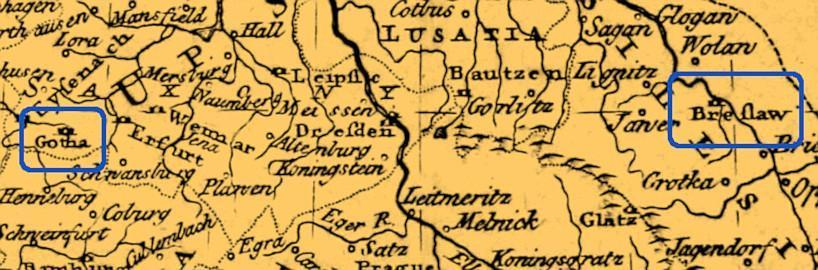
[1] Wilhelmine Bertuch’s love interest in Breslau — almost 450 km east of Gotha — was Johann Kaspar Friedrich Manso, who had been a Gymnasium director in Gotha from 1783 to 1793 before moving to Breslau (“Breslaw” below, today in Poland; Tho. Kitchin, Germany [n.p., n.d.]):
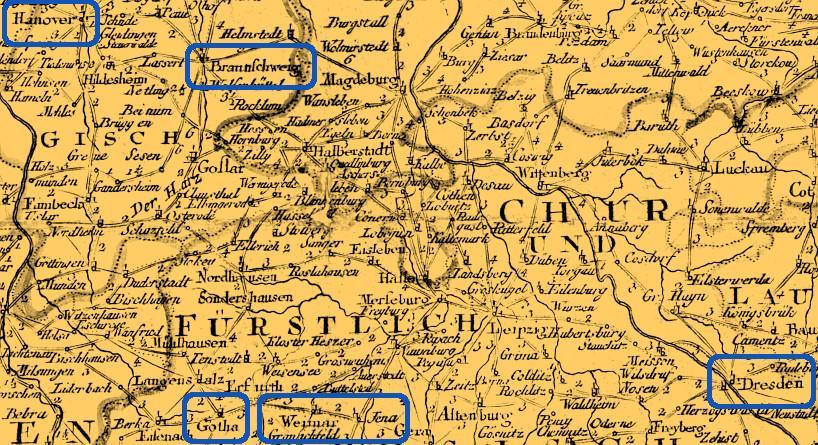
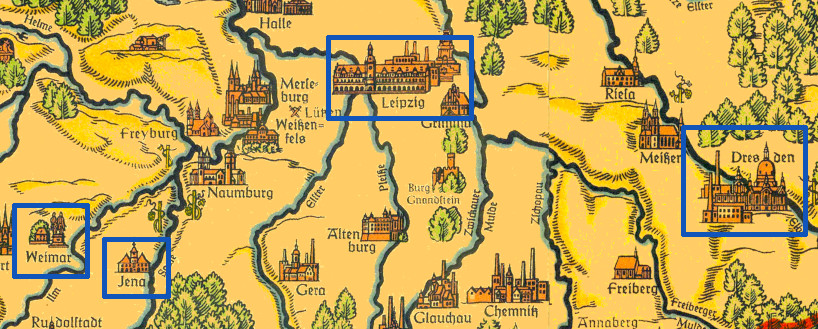
[2] Wilhelm would indeed be in Dresden from late March till 7 May 1796 and would subsequently pass through Leipzig, Jena (where he would remain until 28 June 1796), and Weimar to prepare for his and Caroline’s move to Jena. Wilhelm explains part of his itinerary in a letter from Dresden to Georg Joachim Göschen on 28 April 1796 (Körner [1930] 1:29–30; 2:13; also KFSA 23:499n152.2) (Post Karte Durch ganz Deutschland, ed. J. Walch [Augsburg 1795]; illustrated map: Rudolf Koch and Fritz Kredel, Deutschland und angrenzende Gebiete [Leipzig 1937]):
[3] The Salzdahlum Castle was the summer residence Duke Anton Ulrich von Braunschweig-Wolfenbüttel (1633–1713) built between 1688 and 1694 between Braunschweig and Wolfenbüttel, the village of Salzdahlum being located halfway between the two towns, Wolfenbüttel being the actual residence of the duke.
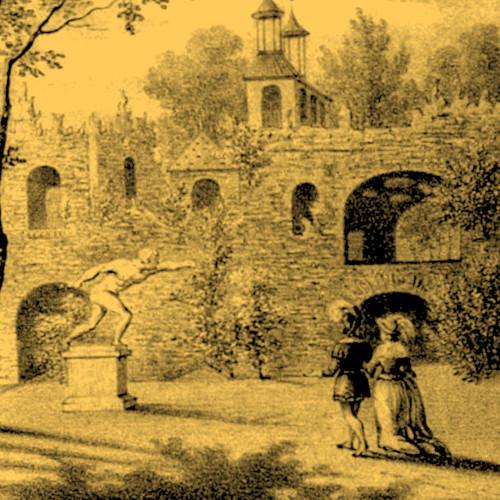
This was Caroline’s second visit; she had already visited the castle, its grounds, and its gallery back in June 1795 with Auguste, and Philipp Michaelis (map, with English spelling “Saltzdalen”: R. Sayer and J. Bennett, The German Dominions of the King of Great Britain Comprised Under the Name of Electorate of Brunswick Luneburg [London 1778]; illustrations: Pieter Schenk, [Schloss Salzdahlum]: Vue et perspective de Salzthalen avec ses environs du cote de jardin. [n.d.]; Herzog August Bibliothek; Museums./Signatur Top 15a:2.2; Wilhelm Görges, Vaterländische Geschichten und Denkwürdigkeiten der Vorzeit . . . der Lande Braunschweig und Hannover, vol. 1, 2nd ed., ed. Ferdinand Spehr [Braunschweig 1881], 199):

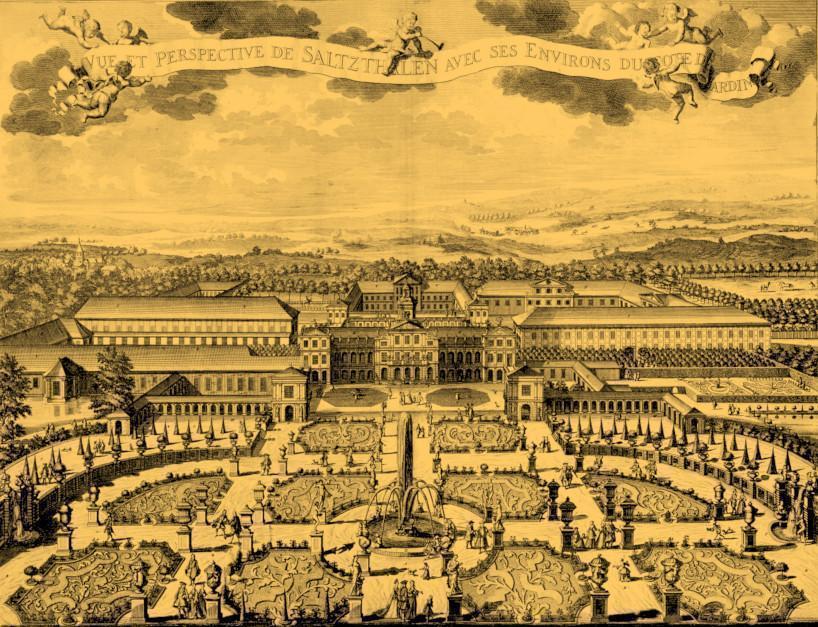
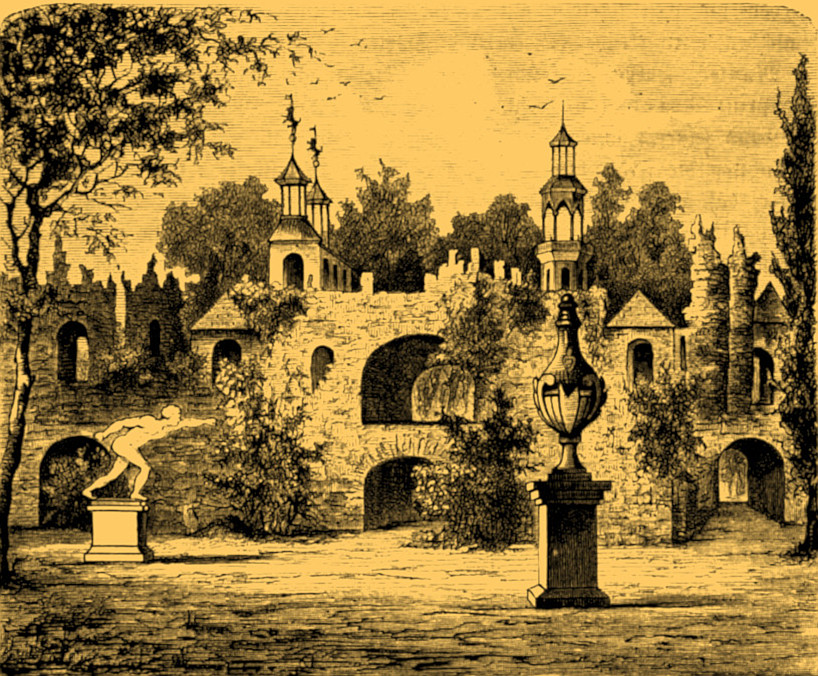
The complex was additionally intended to house the ducal art collections, especially the art gallery. For financial reasons, however, the castle was built almost exclusively of wood with surface treatment giving the impression of sandstone. Unfortunately, the edifice was built on a damp foundation, which caused the wood to rot. Under Duke Karl Wilhelm Ferdinand von Braunschweig-Wolfenbüttel, under whose reign Caroline would have visited the gallery, the royal coffers were already unable to keep up with repairs. On 24 November 1810 the entire inventory of the collections, including some eight hundred paintings, was auctioned. Napoleon had in any case earlier seized ca. 250 paintings and deposited them in the Louvre; some were eventually returned and are now housed in the Duke Anton Ulrich Museum in Braunschweig. Auctions were held between 1811 and 1813, the physical buildings demolished, and hardly a trace remains today of these extensive buildings and grounds.
Erich Schmidt (1913), 1:709, remarks that according to one of Auguste’s letters (Schmidt unfortunately identifies neither the date nor the location of the letter), she and Caroline had already visited the art gallery in Salzdahlum in June 1795 (something also implied by Caroline’s remark “we drove over to Salzdal once again”) accompanied by Philipp Michaelis, who had agreed to having the wedding between Wilhelm and Caroline postponed.
For historical illustrations of the castle complex, its grounds and gardens, and some of the artwork essentially as Caroline would have experienced it, click on the image below:
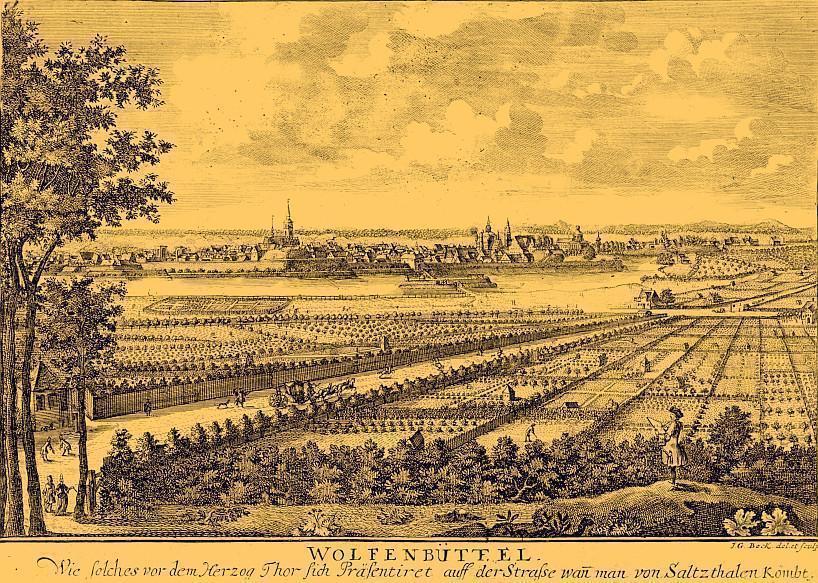
[3a] Wolfenbüttel is situated not quite 5½ km southwest of Salzdahlum (see map above); here the road Caroline and Wilhelm would have taken leading from Salzdahlum to Wolfenbüttel, which can be seen in the distance (Johann Georg Beck, Wolfenbüttel, Gesamtansicht, von Salzdahlum gesehen [ca. 1696–1722]; Herzog Anton Ulrich-Museum; Museums./Signatur JGBeck AB 3.19):
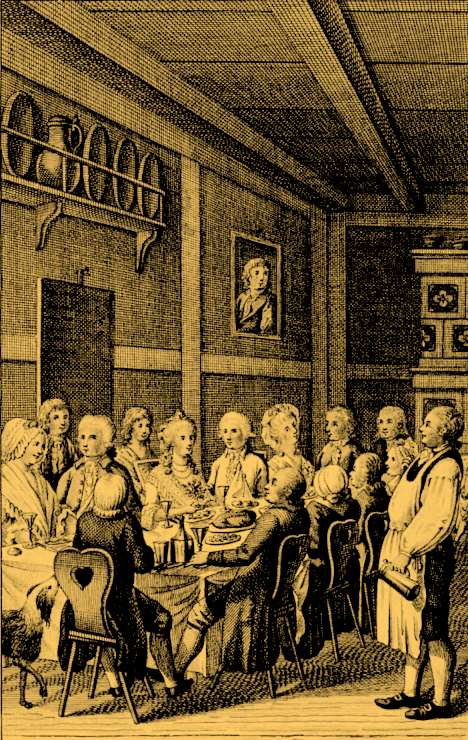
[4] Frontispiece to Johannes Ludwig, Fragmente aus dem häuslichen Leben des Bürgers Klugmann und des Landmanns Fröhlich. Oder: über die Glückseligkeit des Bürgers und Landmanns: Ein unterhaltendes Lesebuch in den Winter-Abenden (Nürnberg 1799):
[5] Germ. ungemein zierlich, the term ungemein here as an adverb in the sense of “extraordinarily, uncommonly”; see Wilhelm Kühlewein and P. Theodor Bohner, Beiträge zu einem Goethe-Wörterbuch, Zeitschrift für deutsche Wortforschung Beiheft zum sechsten Band (Strasbourg 1904), 83, who point out that Goethe uses the adverb in a positive sense to describe something as being extraordinarily or uncommonly pleasant, compassionate, clear, gay, praiseworthy, gentle, a vista as being extraordinarily or uncommonly beautiful, or an expression as extraordinarily or uncommonly gentle or tender. He thus describes the footwear of Niobe’s son in a Florentine statue as “extraordinarily dainty, among the most elegant in all of antiquity” (“Niobe mit ihren Kindern,” Propyläen 2/1 [1799], 48–91, here 70). Back.
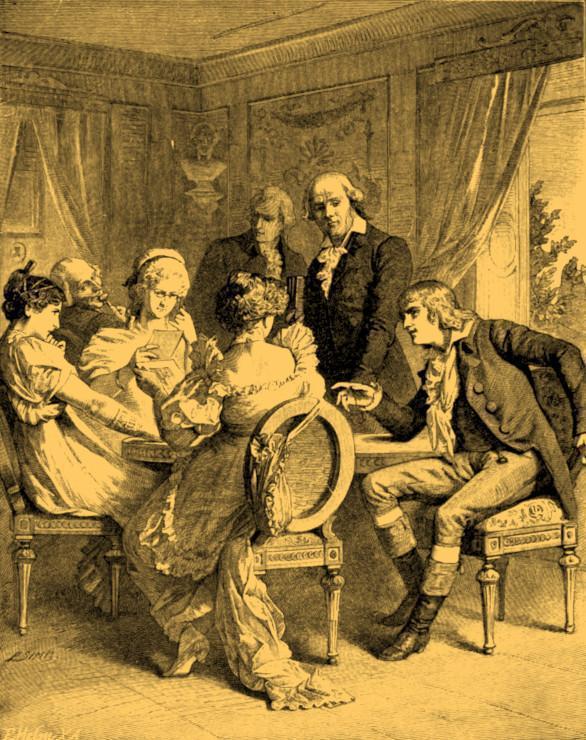
[6] Illustration to Goethe’s novelle The Good Women (Die guten Weiber [1801]), Goethe’s Works, trans. George Barrie (Philadelphia, New York, Boston 1885), vol. 3, 242:
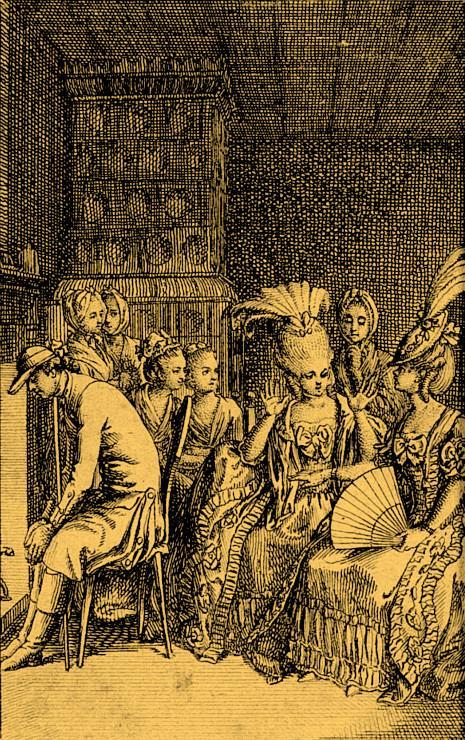
Wilhelm Schlegel was apparently not the only man whom Madam Niemeyer charmed. According to Wilhelm Süss, Karl Morgenstern (1770–1852) (Dorpat 1929), 31, Karl Morgenstern, who lived with the Niemeyers in Halle, developed an “ardent inclination” for Madam Niemeyer, who was known as “a thoroughly charming hostess who knew how to animate her guests’ conversation with both tact and skill” (Daniel Nikolaus Chodowiecki, La veille de Noel; Herzog August Bibliothek; Museums./Signatur Chodowiecki Sammlung [2-65]):
[7] Concerning Anna Henriette Schütz in social contexts, see also Caroline’s letter to Luise Gotter in October/November 1796 (letter 173). Back.
Translation © 2011 Doug Stott