
• 127. Caroline to Friedrich Wilhelm Gotter in Gotha: Königstein, 16 May 1793
[Königstein] 16 May [1793]
|288| The day before yesterday your letter arrived with the enclosure from Humbold[t] [1] — who simply cannot refrain from falling into his courtier-voice — |289| perhaps because he believed his letter would be read by someone else before it got to me. In any event, you can see that he offers no great consolation — and my situation is getting more unbearable by the day. [2]
It seems none of you comprehends the real nature of things here. The only things one hears about here are arbitrary procedures and false rumors. The reason I am allegedly being held as a hostage is that certain citizens of Mainz were taken to Strasbourg as hostages — they are trying to liberate them before Mainz changes hands lest, for example, criminals among them escape. Their intention is to frighten those women suspected of having specific, if not acknowledged, connections with French citizens. Forster is supposed to ransom me. [3] — But Forster cannot, nor will I ever ask him to do so — for that is not the nature of our relationship.
Afterward they will return to chicanerie — which costs a great deal of time — and in the meantime I am languishing here utterly dependent on pathetic people from whom every favor must be purchased with money. — We lost our fine commandant and immediately felt the effects. [4]
I am nonetheless hoping now for a favorable turn and for imminent release. If I am hoping for too much — then that is alright as well.
It goes without saying that I have not introduced — nor will I — any extraneous matters into the interrogations. Believe me, we are conducting ourselves in a more manly fashion than is usually the case with unfortunate women. My own ideas about this entire matter are fairly clear. — Could I but squelch one particular, more tender feeling inside me and get past the desecration of my name! Had I indeed played the role being attributed to me, I would presumably have the requisite resolve.
I have a great desire to read Meyer’s writings [5] — could Ettinger not forward them unfranked to Frankfurt, that is, |290| send your copy to Varrentrap[p] and We[n]ner [6] — I will certainly bring it back to you! I know not how I can get it from Frankfurt, since I do not know the title and have been unable to find it in the book-fair catalog. After this adventure, Meyer will surely detest me — and he would have every right to do so had I indeed incurred it all myself. —
I have received letters from Schiller’s friend and written to him myself. [7]
Adieu, dear Gotter and Louise.
(Postscript): My dear Gotter — you say that they would be willing to release me under certain conditions, presumably bail; what a pretty sort of freedom would await me then — currently bound by iron chains, I would then be bound by golden ones. I still do not know anything official.
Please expedite the letters. They must know about my fate in Frankfurt by now — the Moniteur has already reported “qu’on a mené à la forteresse de K[önigstein] la veuve Böh[mer], amie du Citoyen Forster.” [8] — How comforting; I am his friend, but not in the French sense of the word. [9]
Notes
[1] Concerning Wilhelm von Humboldt’s role, see Caroline’s letters to Friedrich Wilhelm Gotter on 27 April 1793 and 28, 29 April 1793 (letters 123, 124), and Humboldt’s own letter to Wilhelm Schlegel on 16 November 1793 (letter 136.3). Back.
[2] Caroline is likely also (or especially) thinking of her pregnancy; insofar as she was described as having a petite or diminutive build, the pregnancy may already have or was about to become particularly noticeable. Back.
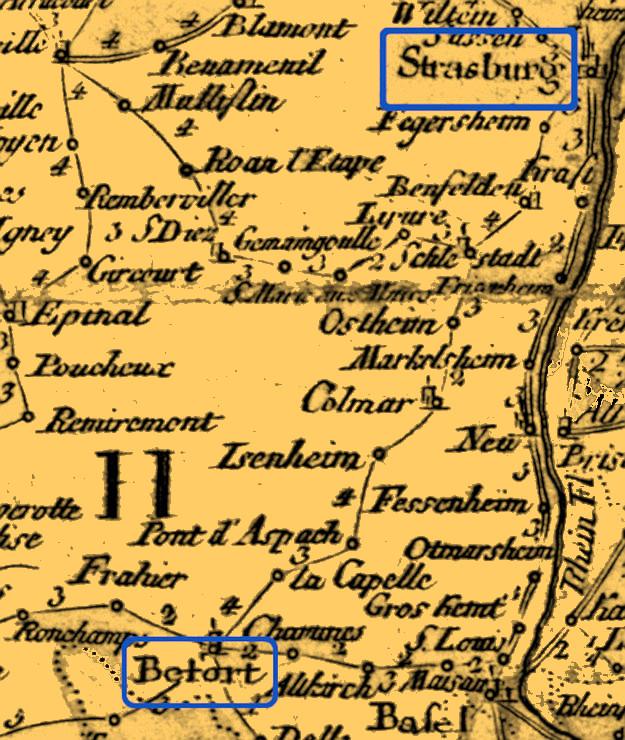
[3] Georg Forster had left Mainz for Paris on 25 March 1793, arriving on 29 March. As the threat of a siege by the Prussians became imminent in March 1793, sixteen prominent Mainz citizens were gathered up during the night by a military commando led by Clubbists and on 29 March 1793 sent to Strasbourg by way of Landau and afterward to “Bedford” (presumably Béfort; Franz Werner, Der Dom zu Mainz und seine Denkmäler, nebst Darstellung der Schicksale der Stadt und der Geschichte ihrer Erzbischöfe, vol. 3 [Mainz 1836], 385; Post Karte Durch ganz Deutschland, ed. J. Walch [Augsburg 1795]):
[4] See note 6 to Caroline’s letter to Friedrich Wilhelm Gotter on 12 May 1793 (letter 126). Back.
[5] In 1793, Friedrich Ludwig Wilhelm Meyer published Beyträge, der vaterländischen Bühne gewidmet (Berlin 1793) and Spiele des Witzes und der Phantasie (Berlin 1793), along with a play, Der seltne Freyer: Lustspiel in 3 Aufzügen (Augsburg 1793). Because Caroline refers to “writings” (Schriften), she may be referring to the “contributions” (Beyträge), which included four plays: Der Schutzgeist: Lustspiel in drey Aufzügen; Wie gewonnen so zerronnen: Posse in zwey Aufzügen (after the French of Dumaniant); Der Schriftsteller: Lustspiel in zwey Aufzügen (after the English of Foote); Die Prüfung: Lustpiel in einem Aufzuge (after Marivaux). Back.
[6] Johann Friedrich Varrentrapp und his brother-in-law, Franz Wenner, booksellers in Frankfurt am Main who founded their own firm ca. 1776, Varrentrapp Sohn & Wenner. Back.
[7] It seems Caroline either is unaware Schiller had essentially fallen out with Ludwig Ferdinand Huber after the latter abandoned Dora Stock in what was essentially a relationship of betrothal, or is intentionally dissembling. Back.
[8] Fr., “that the widow Böhmer, the lady friend [amie] of Citizen Forster, has been taken to the fortress Königstein.” The original wording in the Moniteur reads: “On a conduit à la même forteresse la veuve du docteur Boëhmer, l’amie du citoyen Forster,” and the complete passage reads as follows (Gazette Nationale ou Le Moniteur Universel [1793] 118 [Sunday, 28 April 1793], 519, i.e., less than three weeks earlier than Caroline is here writing):

Word has it from Frankfurt that the imprisoned German patriots were subjected to everything of which aristocratic rage was capable in the way of insults. Poor Blau and several others, in the very midst of the guards who were taking them to Königstein, were reviled and stoned by an enraged populace demanding the death of these honorable victims. The widow of Dr. Böhmer, the lady friend [amie] of Citizen Forster, along with Madame Forkel, Wedekind’s sister, and his mother were all taken to the same fortress. Back.
[9] Goettinger Taschen Calender Für das Jahr 1794:

Schmidt (1913), 1:701–2, maintains that there can be no doubt concerning the veracity of Caroline’s concluding asseveration here (see also her letter to Friedrich Ludwig Wilhelm Meyer on 15 June 1793 [letter 129]), and that Therese Huber should never have allowed herself to lose control of her own emotions to the point of telling her and Georg Forster’s own, still very young daughter Therese, after a later encounter with Caroline in the summer of 1803, that Forster and Caroline had had an affair (see Therese Huber to Therese Forster on 17–25 July 1803 [letter 380b]).
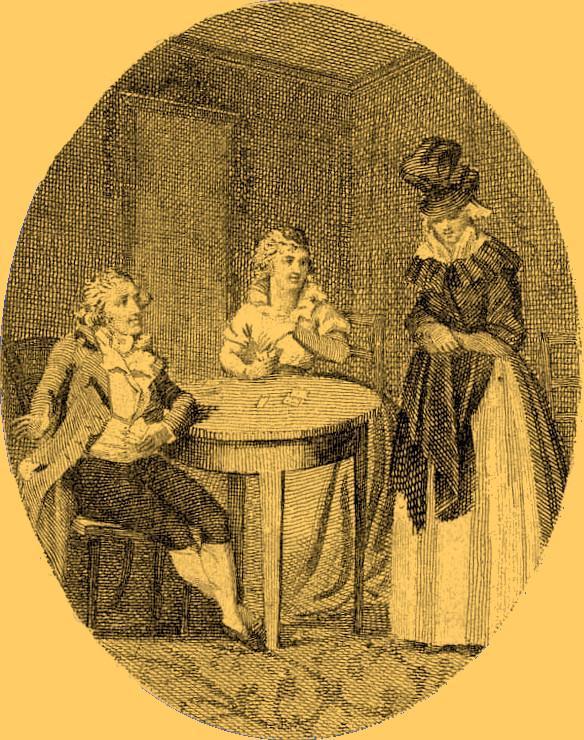
Caroline had in any case been a daily visitor at the Forsters’ residence in Mainz between approximately June 1792 and Therese Forster’s departure in December 1792, and thereafter presumably equally or even more frequently; the emergence of such a rumor — true or not — was understandable (Almanach und Taschenbuch für Haeusliche und Gesellschaftliche Freuden 1796; Inhaltsverzeichnis deutscher Almanache, Theodor Springmann Stiftung):
Translation © 2011 Doug Stott